Thailand Textiles Fibre Market Size, Share & Growth Rate
The Thailand Textiles Fibre Market was estimated at USD 136 Million in 2025 and is projected to reach USD 156 Million by 2032, growing at a CAGR of 2.0% from 2026 to 2032. This steady growth trajectory is fueled by the increasing demand for high-quality textile fibers driven by the country's robust garment industry and evolving fashion trends. Moreover, the rising consumer preference for sustainable and eco-friendly fibers is compelling manufacturers to innovate and adapt their product offerings.
Thailand Textiles Fibre Market Year-wise Growth Rate and Key Drivers
This graph highlights how the Thailand Textiles Fibre Market has steadily grown over the years, supported by major growth factors.
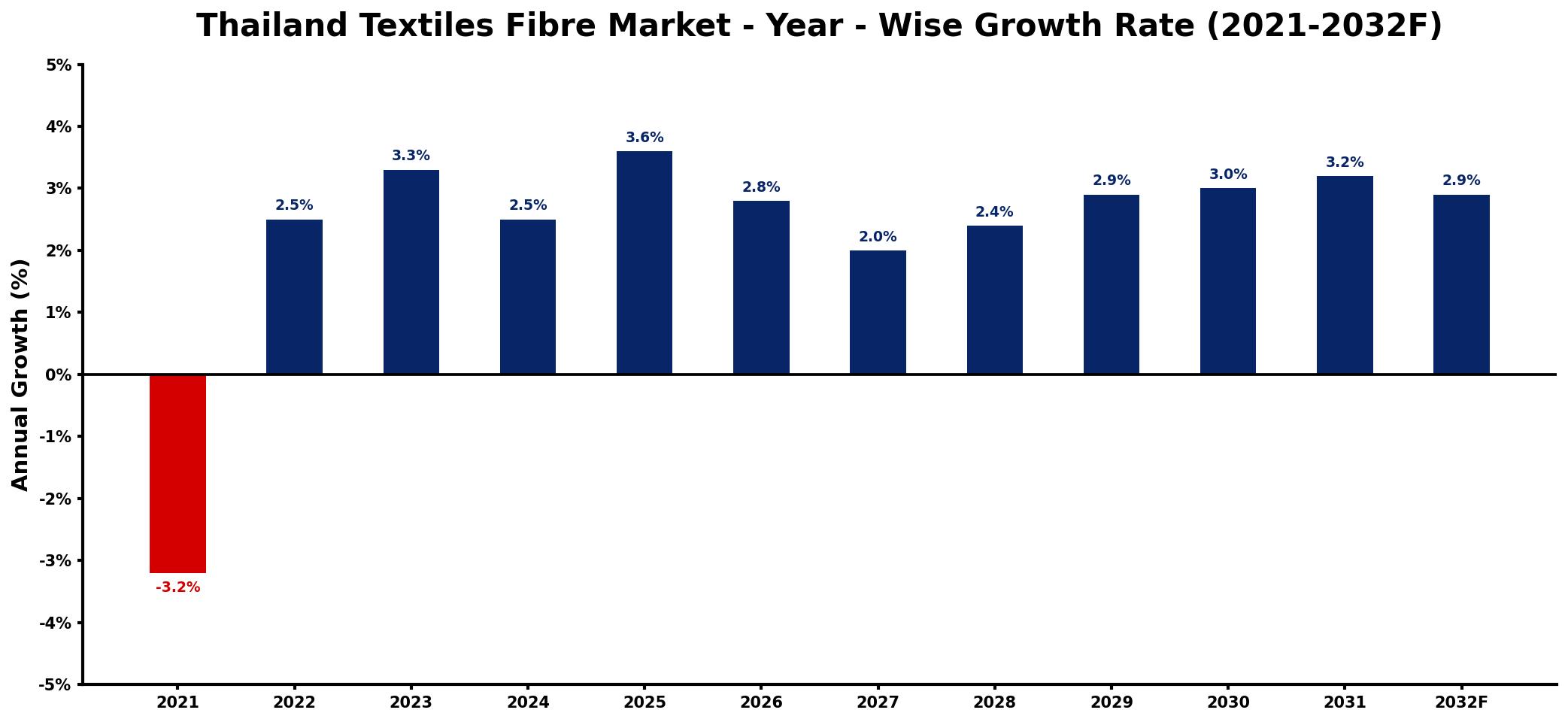
The table below presents the year‑wise growth rates along with the key drivers influencing the market
| Year | Growth Rate | Major Drivers |
| 2021 | -3.2% | decrease in consumer spending habits |
| 2022 | 2.5% | rise in fashion industry demand |
| 2023 | 3.3% | expansion of e-commerce platforms |
| 2024 | 2.5% | growth in sustainable materials adoption |
| 2025 | 3.6% | increased investment in technology |
| 2026 | 2.8% | surge in export markets expansion |
| 2027 | 2.0% | development of innovative manufacturing processes |
| 2028 | 2.4% | enhanced domestic production capabilities |
| 2029 | 2.9% | rising export shipment volumes |
| 2030 | 3.0% | increase in global trade agreements |
| 2031 | 3.2% | increased production capacity utilization |
| 2032 | 2.9% | growing regional consumption patterns |
Note: Market size estimations and growth projections presented in this report are based on 6Wresearch's proprietary forecasting methodology, utilizing the latest available industry data, government publications, and primary research inputs.
Thailand Textiles Fibre Market Synopsis
The most significant force currently shaping the Thailand Textiles Fibre Market is the growing emphasis on sustainability. As consumers become more environmentally conscious, the demand for fibers made from organic and recycled materials is on the rise, prompting local producers to rethink their manufacturing processes. This shift towards eco-friendly practices is not only beneficial for the planet but is also becoming a critical competitive differentiator in the marketplace.
Additionally, the integration of advanced fibers in various sectors, including automotive and technical textiles, has opened up new avenues for growth. Specialized fibers with unique attributes, such as durability and flame resistance, are gaining traction. This diversification of applications is broadening the market's appeal and enhancing its resilience against global economic fluctuations.
Thailand Textiles Fibre Market Key Takeaways
- Growing demand for sustainable and eco-friendly fibers is reshaping production strategies.
- Expanding applications in automotive and technical textiles are creating new market segments.
- The market remains sensitive to global fashion trends, necessitating continuous innovation.
- Competitive pricing pressures from low-cost manufacturing countries pose challenges.
- Investment in technology is crucial for meeting evolving consumer preferences and sustainability goals.
Evaluation of Restraints in Thailand Textiles Fibre Market
While the Thailand Textiles Fibre Market shows promising growth prospects, it is not without its constraints. The competitive landscape remains challenging due to pressures from lower-cost producers in neighboring countries. This has resulted in decreased profit margins for local manufacturers, forcing them to optimize operations without compromising quality. Furthermore, the industry faces significant environmental scrutiny regarding water and chemical usage, necessitating urgent attention to sustainable practices. Adapting to these external pressures requires both financial and strategic investments, potentially diverting resources from innovation initiatives.
Thailand Textiles Fibre Market Trends
Several current and emerging trends are influencing the Thailand Textiles Fibre Market. One of the most notable is the rise of digital textile printing, which is revolutionizing the customization of fabrics and reducing waste. Additionally, the implementation of circular economy principles is gaining traction, where recycled fibers are reintegrated into the supply chain. Moreover, advancements in smart textiles, which incorporate technology for added functionality, are becoming more prevalent, attracting interest from diverse sectors beyond fashion.
Thailand Textiles Fibre Market Opportunities
Opportunities for growth in the Thailand Textiles Fibre Market lie in the increasing demand for specialty fibers tailored for niche applications. The automotive sector, in particular, is seeking high-performance materials to enhance vehicle safety and comfort. Additionally, investment in sustainable fiber production methods presents a unique opportunity to capture the growing segment of eco-conscious consumers. Collaborations with technology firms to develop innovative textile solutions could also pave the way for market expansion.
Government Initiatives in the Thailand Textiles Fibre Market
The Thai government has recognized the importance of the textile industry and is promoting initiatives aimed at enhancing sustainability within the sector. Various programs and policies are being implemented to encourage the use of eco-friendly materials and technologies. Additionally, public spending on infrastructure improvements and incentives for research and development in textile innovation are designed to bolster the country's competitive edge in the global market.
Future Insights of the Thailand Textiles Fibre Market
Looking ahead to 2026-2032, the Thailand Textiles Fibre Market is poised for dynamic evolution. The increasing integration of sustainability into the core business model of textile production will be paramount. As technology continues to advance, the focus will shift toward enhancing fiber performance and functionality while reducing environmental impact. The ability to adapt to changing consumer preferences and market demands will dictate the long-term success of the industry.
Thailand Textiles Fibre Market Latest Developments (2025 - 2026)
Recent developments in the Thailand Textiles Fibre Market highlight a trend towards increased investment in sustainable practices. Numerous producers are incorporating recycled materials into their offerings, responding to rising consumer demand for eco-friendly products. Additionally, innovations in fiber technology are enabling manufacturers to create fabrics with enhanced durability and performance characteristics. These trends reflect the ongoing transformation of the market as it navigates challenges and embraces new opportunities.
Thailand Textiles Fibre Market - Key Attractiveness of the Report
- 10 Years of Market Numbers
- Historical Data Starting from 2022 to 2025
- Base Year: 2025
- Forecast Data until 2032
- Key Performance Indicators Impacting the Market
- Major Upcoming Developments and Projects
Key Highlights of the Report:
- Thailand Textiles Fibre Market Outlook
- Market Size of Thailand Textiles Fibre Market, 2025
- Forecast of Thailand Textiles Fibre Market, 2032
- Historical Data and Forecast of Thailand Textiles Fibre Revenues & Volume for the Period 2022-2032F
- Thailand Textiles Fibre Market Trend Evolution
- Thailand Textiles Fibre Market Drivers and Challenges
- Thailand Textiles Fibre Price Trends
- Thailand Textiles Fibre Porter's Five Forces
- Thailand Textiles Fibre Industry Life Cycle
- Historical Data and Forecast of Thailand Textiles Fibre Market Revenues & Volume By Type for the Period 2022-2032F
- Historical Data and Forecast of Thailand Textiles Fibre Market Revenues & Volume By Natural Fiber for the Period 2022-2032F
- Historical Data and Forecast of Thailand Textiles Fibre Market Revenues & Volume By Synthetic Fiber for the Period 2022-2032F
- Historical Data and Forecast of Thailand Textiles Fibre Market Revenues & Volume By Application for the Period 2022-2032F
- Historical Data and Forecast of Thailand Textiles Fibre Market Revenues & Volume By Industrial for the Period 2022-2032F
- Historical Data and Forecast of Thailand Textiles Fibre Market Revenues & Volume By Filters for the Period 2022-2032F
- Historical Data and Forecast of Thailand Textiles Fibre Market Revenues & Volume By Tire Cords for the Period 2022-2032F
- Historical Data and Forecast of Thailand Textiles Fibre Market Revenues & Volume By Feminine & Baby Care Products for the Period 2022-2032F
- Historical Data and Forecast of Thailand Textiles Fibre Market Revenues & Volume By Surgical Gloves for the Period 2022-2032F
- Historical Data and Forecast of Thailand Textiles Fibre Market Revenues & Volume By Apparels for the Period 2022-2032F
- Historical Data and Forecast of Thailand Textiles Fibre Market Revenues & Volume By Bedding & Blankets for the Period 2022-2032F
- Historical Data and Forecast of Thailand Textiles Fibre Market Revenues & Volume By Others for the Period 2022-2032F
- Historical Data and Forecast of Thailand Textiles Fibre Market Revenues & Volume By End-Use Industry for the Period 2022-2032F
- Historical Data and Forecast of Thailand Textiles Fibre Market Revenues & Volume By Automotive for the Period 2022-2032F
- Historical Data and Forecast of Thailand Textiles Fibre Market Revenues & Volume By Building & Construction for the Period 2022-2032F
- Historical Data and Forecast of Thailand Textiles Fibre Market Revenues & Volume By Healthcare for the Period 2022-2032F
- Historical Data and Forecast of Thailand Textiles Fibre Market Revenues & Volume By Aerospace and Defense for the Period 2022-2032F
- Historical Data and Forecast of Thailand Textiles Fibre Market Revenues & Volume By Textile for the Period 2022-2032F
- Historical Data and Forecast of Thailand Textiles Fibre Market Revenues & Volume By Oil & Gas for the Period 2022-2032F
- Historical Data and Forecast of Thailand Textiles Fibre Market Revenues & Volume By Energy and Power for the Period 2022-2032F
- Historical Data and Forecast of Thailand Textiles Fibre Market Revenues & Volume By Others for the Period 2022-2032F
- Thailand Textiles Fibre Import Export Trade Statistics
- Market Opportunity Assessment By Type
- Market Opportunity Assessment By Application
- Market Opportunity Assessment By End-Use Industry
- Thailand Textiles Fibre Top Companies Market Share
- Thailand Textiles Fibre Competitive Benchmarking By Technical and Operational Parameters
- Thailand Textiles Fibre Company Profiles
- Thailand Textiles Fibre Key Strategic Recommendations






































