Thailand Thermostats Market Summary
The thailand thermostats market was estimated at USD 198 Million in 2025 and is projected to reach USD 227 Million by 2032, growing at a CAGR of 2.8% from 2026 to 2032.
Thailand Thermostats Market Year-wise Growth Rate and Key Drivers
This graph highlights how the Thailand Thermostats Market has steadily grown over the past five years, supported by major growth factors.
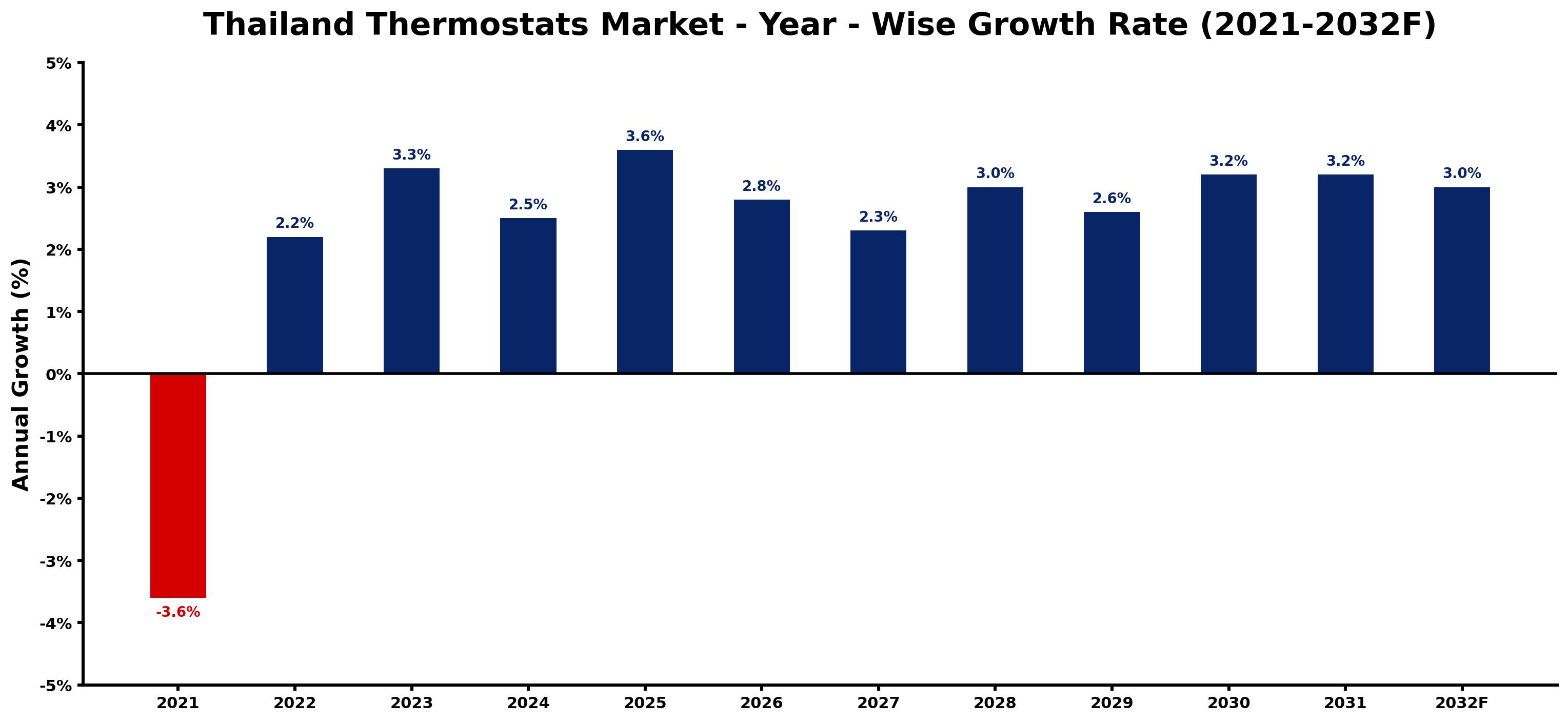
The table below presents the year wise growth rates along with the key drivers influencing the market
| Year | Growth Rate | Major Drivers |
| 2021 | -3.6% | Supply chain disruptions stemming from the pandemic hindered product availability, leading to decreased sales in the thermostat sector. |
| 2022 | 2.2% | Homeowners began prioritizing energy efficiency amid fluctuating energy prices nationwide. |
| 2023 | 3.3% | Technological advancements in IoT prompted manufacturers to innovate their thermostat offerings. |
| 2024 | 2.5% | Increasing urbanization fueled demand for integrated climate control solutions in metropolitan areas. |
| 2025 | 3.6% | Consumer awareness of environmental impacts shifted preferences towards eco-friendly thermostat options. |
| 2026 | 2.8% | The hospitality sector's modernization efforts spurred investments in advanced temperature regulation systems. |
| 2027 | 2.3% | Home automation trends grew as millennials sought smarter living environments and convenience. |
| 2028 | 3.0% | Climate change concerns led to more proactive residential adaptation strategies in Thailand. |
| 2029 | 2.6% | Collaboration among tech firms and construction companies enhanced product availability and awareness. |
| 2030 | 3.2% | Rural electrification projects supported increased thermostat installations in previously underserved areas. |
| 2031 | 3.2% | Population growth in urban centers created a sustained demand for efficient home climate control. |
| 2032 | 3.0% | Enhanced public awareness around health impacts of temperature control influenced consumer choices. |
Note - Market size estimations and growth projections presented in this report are based on 6Wresearch's advanced forecasting approach, validated with industry datasets as of June 2026.
Thailand Thermostats Market Synopsis
The Thailand Thermostats Market is projected to reach 2.8% and witness significant growth during the forecast period (2026-2032). This anticipated expansion is driven by a combination of rising demand for energy-efficient products and government initiatives aimed at promoting green buildings and smart homes. As stakeholders focus on sustainable solutions, increased investments in product development and consumer awareness will further catalyze market growth in Thailand.
Thailand Thermostats Market Growth Drivers
The primary drivers of the Thailand thermostats market include:
- Increasing environmental awareness among consumers has resulted in a heightened demand for energy-efficient thermostats. Programmable and Wi-Fi-enabled models are particularly popular as they allow users to optimize energy consumption and reduce their carbon footprint.
- Government initiatives aimed at promoting sustainable living are a significant factor in the market's growth. Fiscal incentives and tax benefits encourage the installation of advanced HVAC systems, further driving the adoption of modern thermostatic controls.
- Technological advancements in thermostat design and functionality allow for better energy management and user control, thereby appealing to tech-savvy consumers looking for integrated smart home solutions.
- As more commercial establishments adopt automated temperature controls, the demand for advanced thermostat solutions in the commercial sector is expected to rise significantly.
- Reliability and ease of use are major selling points for consumers. As manufacturers improve product designs that offer enhanced functionalities without complicated installations, user adoption rates are likely to increase.
Thailand Thermostats Market Challenges and Restraints
Despite positive growth prospects, the Thailand thermostats market faces several challenges that could hinder its expansion:
- The higher upfront costs associated with modern thermostatic solutions compared to traditional models may deter cost-conscious consumers, particularly in residential applications.
- The installation of advanced thermostats often necessitates professional expertise due to the complexity of the systems involved, limiting DIY adoption among consumers who lack technical knowledge.
- A shortage of skilled technicians for installation and maintenance can impede market growth, particularly in regions where professional HVAC services are not easily accessible.
- Market volatility related to raw material supply chains has been a concern, particularly in light of disruptions caused by global events such as the COVID-19 pandemic.
- Consumer resistance to adopting new technologies remains a barrier, as some individuals remain comfortable with conventional thermostatic controls and may be hesitant to transition to newer products.
Thailand Thermostats Market Government Investment and Initiatives
The Thai government plays an influential role in fostering a conducive environment for the thermostats market through various investment initiatives. Key aspects of government support include:
- The implementation of policies aimed at promoting energy efficiency in buildings, which includes encouraging the use of advanced thermostat technologies within new construction and renovation projects.
- Public spending on infrastructure development has created opportunities for energy-efficient systems, thus indirectly boosting the demand for modern thermostats in commercial and residential applications.
- Incentives for businesses to adopt sustainable practices have led to increased installations of HVAC systems equipped with innovative thermostats that optimize energy use and improve overall building efficiency.
- The government's dedication to environmental sustainability aligns with the market's growth strategy, working together to push for more energy-efficient solutions in line with global climate goals.
- Ongoing educational programs and campaigns raising awareness about energy conservation and the benefits of using advanced thermostatic controls are helping to cultivate a more informed consumer base.
Thailand Thermostats Market Latest Developments (May 2025 - June 2026)
Recent developments in the Thailand thermostats market from May 2025 to June 2026 indicate a trend towards increasing automation and connectivity in temperature control solutions. Industry stakeholders are focusing on integrating advanced digital technologies into thermostat systems, which enhance user experience and energy monitoring capabilities.
Furthermore, there is a noticeable uptick in collaborations among technology providers and HVAC manufacturers aimed at developing smarter, more adaptable solutions to meet evolving consumer needs. Research and development initiatives are also being emphasized, reflecting a broader commitment to innovation in product design.
Consumer trends indicate a preference for thermostats that seamlessly integrate with existing smart home systems, pointing toward a future where connectivity and AI-driven functionalities become crucial components of thermostatic offerings.
Thailand Thermostats Market - Key Attractiveness of the Report
- 10 Years of Market Numbers
- Historical Data Starting from 2022 to 2025
- Base Year: 2025
- Forecast Data until 2032
- Key Performance Indicators Impacting the Market
- Major Upcoming Developments and Projects
Key Highlights of the Report:
- Thailand Thermostats Market Outlook
- Market Size of Thailand Thermostats Market, 2025
- Forecast of Thailand Thermostats Market, 2032
- Historical Data and Forecast of Thailand Thermostats Revenues & Volume for the Period 2022-2032F
- Thailand Thermostats Market Trend Evolution
- Thailand Thermostats Market Drivers and Challenges
- Thailand Thermostats Price Trends
- Thailand Thermostats Porter's Five Forces
- Thailand Thermostats Industry Life Cycle
- Historical Data and Forecast of Thailand Thermostats Market Revenues & Volume By Products for the Period 2022-2032F
- Historical Data and Forecast of Thailand Thermostats Market Revenues & Volume By Smart Thermostat for the Period 2022-2032F
- Historical Data and Forecast of Thailand Thermostats Market Revenues & Volume By Mechanical Thermostat for the Period 2022-2032F
- Historical Data and Forecast of Thailand Thermostats Market Revenues & Volume By Programmable Thermostat for the Period 2022-2032F
- Historical Data and Forecast of Thailand Thermostats Market Revenues & Volume By Distribution Channel for the Period 2022-2032F
- Historical Data and Forecast of Thailand Thermostats Market Revenues & Volume By Utility for the Period 2022-2032F
- Historical Data and Forecast of Thailand Thermostats Market Revenues & Volume By Retail for the Period 2022-2032F
- Historical Data and Forecast of Thailand Thermostats Market Revenues & Volume By Security for the Period 2022-2032F
- Historical Data and Forecast of Thailand Thermostats Market Revenues & Volume By HVAC for the Period 2022-2032F
- Historical Data and Forecast of Thailand Thermostats Market Revenues & Volume By Mode of Operations for the Period 2022-2032F
- Historical Data and Forecast of Thailand Thermostats Market Revenues & Volume By Line Voltage for the Period 2022-2032F
- Historical Data and Forecast of Thailand Thermostats Market Revenues & Volume By Low Voltage for the Period 2022-2032F
- Historical Data and Forecast of Thailand Thermostats Market Revenues & Volume By Millivolt for the Period 2022-2032F
- Historical Data and Forecast of Thailand Thermostats Market Revenues & Volume By Applications for the Period 2022-2032F
- Historical Data and Forecast of Thailand Thermostats Market Revenues & Volume By Residential for the Period 2022-2032F
- Historical Data and Forecast of Thailand Thermostats Market Revenues & Volume By Commercial for the Period 2022-2032F
- Thailand Thermostats Import Export Trade Statistics
- Market Opportunity Assessment By Products
- Market Opportunity Assessment By Distribution Channel
- Market Opportunity Assessment By Mode of Operations
- Market Opportunity Assessment By Applications
- Thailand Thermostats Top Companies Market Share
- Thailand Thermostats Competitive Benchmarking By Technical and Operational Parameters
- Thailand Thermostats Company Profiles
- Thailand Thermostats Key Strategic Recommendations






































