Thailand Toggle Clamps Market Size, Share & Growth Rate
The Thailand Toggle Clamps Market was estimated at USD 190 Million in 2025 and is projected to reach USD 217 Million by 2032, growing at a CAGR of 1.9% from 2026 to 2032. This growth trajectory is driven by a robust manufacturing sector that increasingly embraces automation and precision in operations. The demand for reliable workholding solutions in various industries, including woodworking and electronics, serves as a catalyst for market expansion.
Thailand Toggle Clamps Market Year-wise Growth Rate and Key Drivers
This graph highlights how the Thailand Toggle Clamps Market has steadily grown over the years, supported by major growth factors.
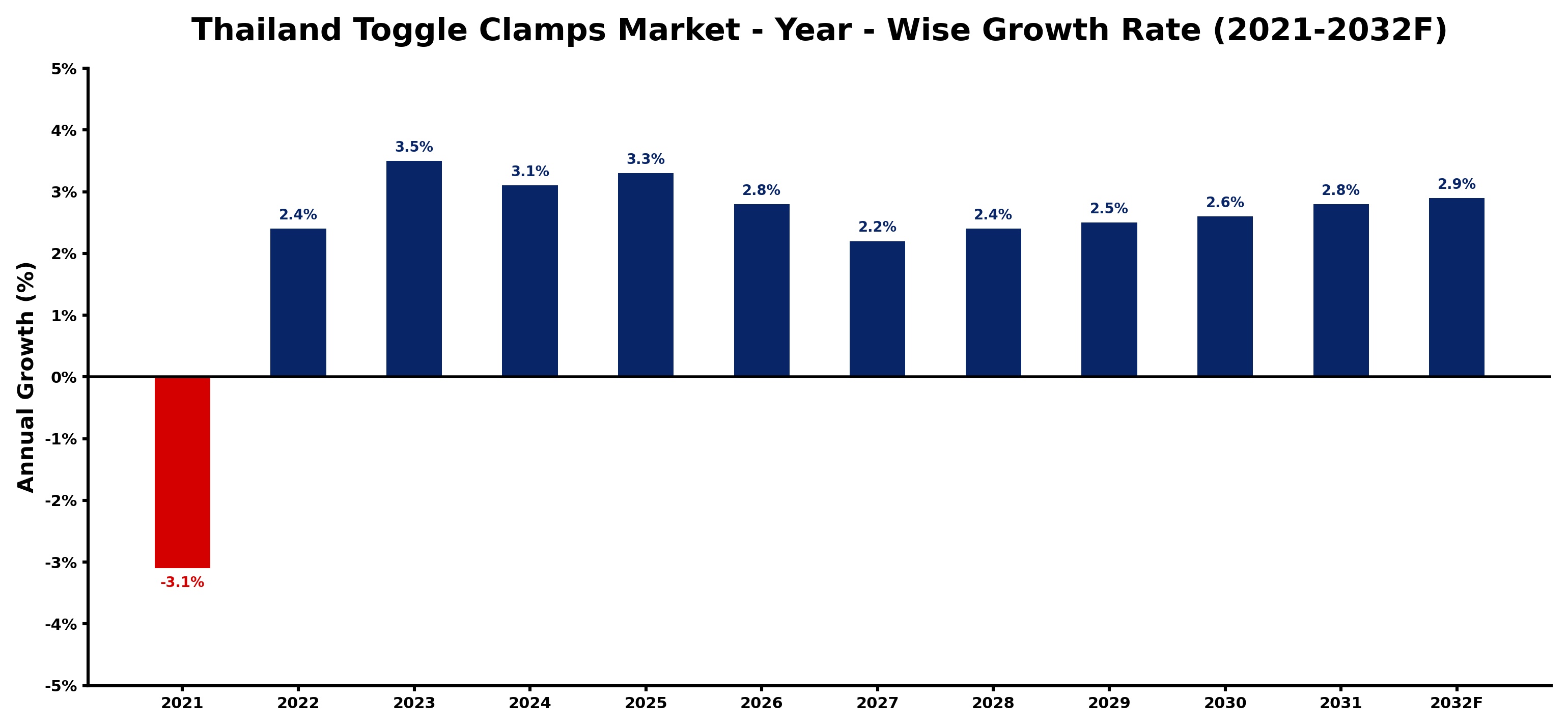
The table below presents the year‑wise growth rates along with the key drivers influencing the market
| Year | Growth Rate | Major Drivers |
| 2021 | -3.1% | Expansion of manufacturing activities |
| 2022 | 2.4% | Increasing adoption of advanced technologies |
| 2023 | 3.5% | Increasing smart city development projects |
| 2024 | 3.1% | Increasing industrial infrastructure investments |
| 2025 | 3.3% | Increasing industrial infrastructure investments |
| 2026 | 2.8% | Growing urbanization and commercial development |
| 2027 | 2.2% | Expansion of manufacturing activities |
| 2028 | 2.4% | Expansion of commercial construction activities |
| 2029 | 2.5% | Increasing industrial automation investments |
| 2030 | 2.6% | Growing renewable energy integration projects |
| 2031 | 2.8% | Government infrastructure modernization initiatives |
| 2032 | 2.9% | Growing renewable energy integration projects |
Note - Market size estimations and growth projections presented in this report are based on 6Wresearch’s advanced forecasting approach, validated with industry datasets as of June 2026.
Thailand Toggle Clamps Market Synopsis
The foremost force shaping the Thailand Toggle Clamps Market is the growing automation within the manufacturing sector. As industries strive for higher efficiency and productivity, the demand for high-performance toggle clamps is surging, particularly in machining and assembly processes.
Moreover, advancements in technology are paving the way for innovative clamping solutions, allowing for enhanced precision and durability. The government's commitment to bolstering manufacturing activities, particularly among small and medium enterprises, further supports the optimistic outlook for the toggle clamps market.
Thailand Toggle Clamps Market Key Takeaways
- The market is poised for steady growth due to rising automation in manufacturing.
- Technological innovation in clamping solutions is enhancing product offerings.
- Government support for SMEs is expected to stimulate demand for toggle clamps.
- Key industries driving market growth include woodworking, metalworking, and electronics.
- Adoption of automated machines featuring toggle clamps is on the rise.
Evaluation of Restraints in Thailand Toggle Clamps Market
Despite the favorable growth prospects, the Thailand Toggle Clamps Market faces certain restraints. One significant factor is the increasing competition from advanced clamping solutions that could overshadow traditional toggle clamps. As manufacturers demand more sophisticated equipment, the market must adapt by innovating and enhancing product designs. Additionally, fluctuations in raw material costs can impact pricing strategies, challenging vendors to maintain profitability while delivering high-quality products.
Thailand Toggle Clamps Market Trends
Current trends in the Thailand Toggle Clamps Market include a notable shift towards automation, with manufacturers integrating toggle clamps into robotic and automated systems. This trend reflects a growing preference for seamless and efficient production lines. Furthermore, sustainability is becoming increasingly important, prompting manufacturers to explore eco-friendly materials and processes in their toggle clamp production, thus appealing to environmentally-conscious buyers.
Thailand Toggle Clamps Market Opportunities
There are significant growth opportunities within the Thailand Toggle Clamps Market, particularly in niche applications and sectors. The rising demand for customized clamping solutions tailored to specific manufacturing processes can serve as a lucrative avenue for innovation. Additionally, expanding export markets for Thai manufacturers can lead to increased sales opportunities, as international markets seek reliable and high-quality workholding solutions.
Government Initiatives in the Thailand Toggle Clamps Market
The Thai government has implemented various initiatives aimed at enhancing the manufacturing landscape, thereby positively impacting the toggle clamps market. Programs focused on promoting industrial modernization, such as financial incentives for adopting advanced technologies, are fostering growth. Furthermore, there are initiatives supporting SMEs to strengthen their operational capabilities, increasing the potential customer base for toggle clamp suppliers.
Future Insights of the Thailand Toggle Clamps Market
Looking ahead to 2026-2032, the Thailand Toggle Clamps Market is expected to evolve significantly, driven by ongoing automation and technological advancements. The need for precision workholding solutions will likely grow, with industries adopting more sophisticated toggle clamps that integrate seamlessly with automated systems. Continued government support for the manufacturing sector and a focus on sustainability will further shape the market landscape, presenting a balanced mix of challenges and opportunities for stakeholders.
Thailand Toggle Clamps Market Latest Developments (May 2025 - June 2026)
In the most recent developments within the Thailand Toggle Clamps Market, various manufacturers have begun investing in innovative technologies to enhance product performance and durability. Industry players are exploring collaborations to develop automated solutions featuring toggle clamps, which is expected to streamline production processes. Furthermore, as the market navigates post-pandemic recovery, there is a noticeable increase in demand for toggle clamps among SMEs, which are ramping up their manufacturing capacities.
Thailand Toggle Clamps Market - Key Attractiveness of the Report
- 10 Years of Market Numbers
- Historical Data Starting from 2022 to 2025
- Base Year: 2025
- Forecast Data until 2032
- Key Performance Indicators Impacting the Market
- Major Upcoming Developments and Projects
Key Highlights of the Report:
- Thailand Toggle Clamps Market Outlook
- Market Size of Thailand Toggle Clamps Market, 2025
- Forecast of Thailand Toggle Clamps Market, 2032
- Historical Data and Forecast of Thailand Toggle Clamps Revenues & Volume for the Period 2022-2032F
- Thailand Toggle Clamps Market Trend Evolution
- Thailand Toggle Clamps Market Drivers and Challenges
- Thailand Toggle Clamps Price Trends
- Thailand Toggle Clamps Porter's Five Forces
- Thailand Toggle Clamps Industry Life Cycle
- Historical Data and Forecast of Thailand Toggle Clamps Market Revenues & Volume By Product Type for the Period 2022-2032F
- Historical Data and Forecast of Thailand Toggle Clamps Market Revenues & Volume By Horizontal Toggle Clamps for the Period 2022-2032F
- Historical Data and Forecast of Thailand Toggle Clamps Market Revenues & Volume By Vertical Toggle Clamps for the Period 2022-2032F
- Historical Data and Forecast of Thailand Toggle Clamps Market Revenues & Volume By Application for the Period 2022-2032F
- Historical Data and Forecast of Thailand Toggle Clamps Market Revenues & Volume By Assembly Technology for the Period 2022-2032F
- Historical Data and Forecast of Thailand Toggle Clamps Market Revenues & Volume By Clamping Technology for the Period 2022-2032F
- Historical Data and Forecast of Thailand Toggle Clamps Market Revenues & Volume By Tool Construction for the Period 2022-2032F
- Historical Data and Forecast of Thailand Toggle Clamps Market Revenues & Volume By Fixture Construction for the Period 2022-2032F
- Thailand Toggle Clamps Import Export Trade Statistics
- Market Opportunity Assessment By Product Type
- Market Opportunity Assessment By Application
- Thailand Toggle Clamps Top Companies Market Share
- Thailand Toggle Clamps Competitive Benchmarking By Technical and Operational Parameters
- Thailand Toggle Clamps Company Profiles
- Thailand Toggle Clamps Key Strategic Recommendations






































