Thailand Two Wheeler Market Summary
The thailand two wheeler market was estimated at USD 139 Million in 2025 and is projected to reach USD 159 Million by 2032, growing at a CAGR of 3.2% from 2026 to 2032.
Thailand Two Wheeler Market Year-wise Growth Rate and Key Drivers
This graph highlights how the Thailand Two Wheeler Market has steadily grown over the past five years, supported by major growth factors.
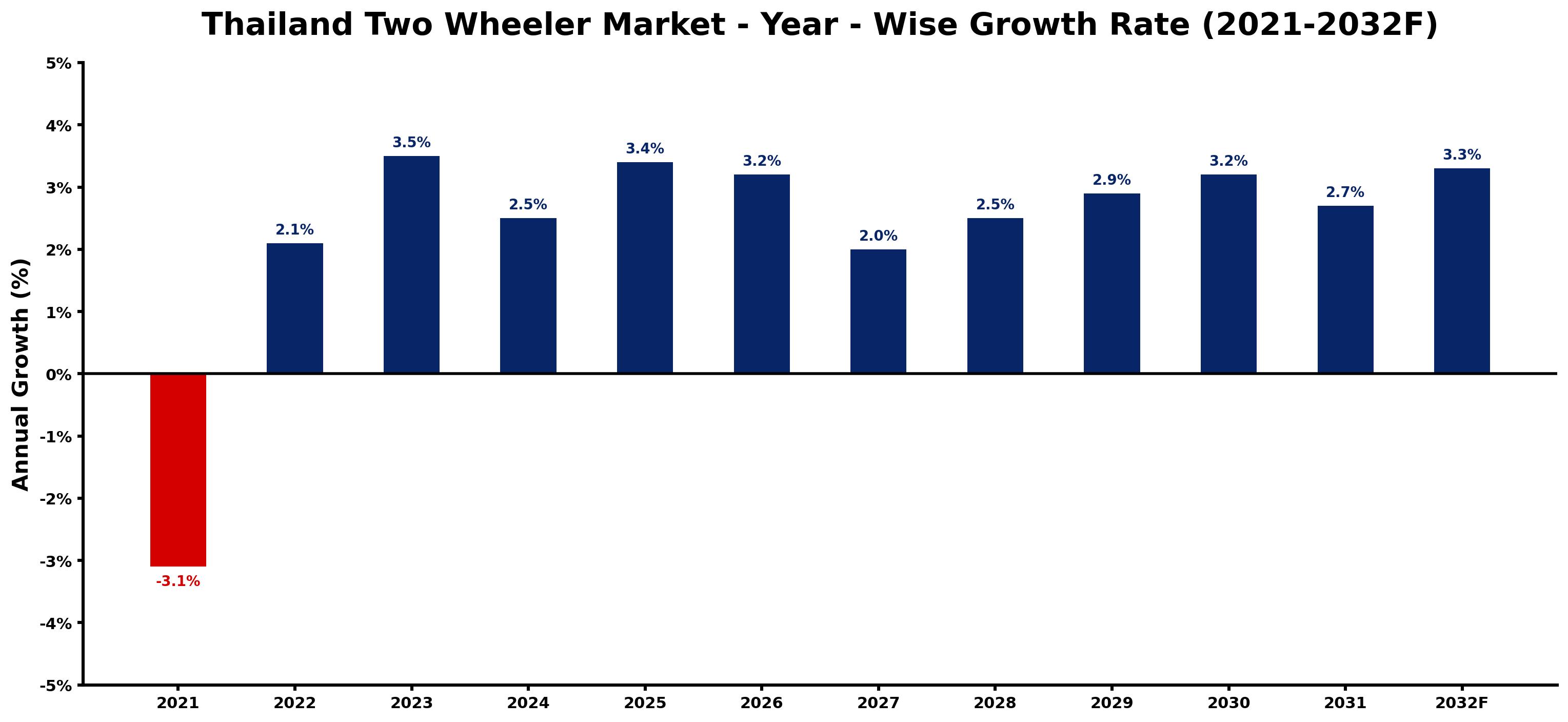
The table below presents the year wise growth rates along with the key drivers influencing the market
| Year | Growth Rate | Major Drivers |
| 2021 | -3.1% | Severe supply chain disruptions caused by the pandemic hampered vehicle availability, leading to decreased sales in the twowheeler market. |
| 2022 | 2.1% | The pandemic accelerated interest in personal mobility solutions across urban centers. |
| 2023 | 3.5% | Rising fuel prices prompt consumers to consider two-wheelers as economical alternatives. |
| 2024 | 2.5% | Innovations in electric two-wheelers appeal to environmentally conscious consumers. |
| 2025 | 3.4% | Infrastructure improvements enhance the viability of commuting via two-wheelers. |
| 2026 | 3.2% | Urban traffic congestion drives demand for agile and smaller vehicle options. |
| 2027 | 2.0% | Increased disposable income allows more consumers to invest in personal vehicles. |
| 2028 | 2.5% | Diverse financing options make purchasing two-wheelers more accessible to the masses. |
| 2029 | 2.9% | Growing awareness of health benefits encourages biking culture among urban dwellers. |
| 2030 | 3.2% | Technology integration, such as smart features, enhances user experience and appeal. |
| 2031 | 2.7% | Localized manufacturing lowers costs and increases the availability of two-wheeler models. |
| 2032 | 3.3% | Sustainability trends push manufacturers to innovate in electric and hybrid two-wheelers. |
Note - Market size estimations and growth projections presented in this report are based on 6Wresearch's advanced forecasting approach, validated with industry datasets as of June 2026.
Thailand Two Wheeler Market Synopsis
The Thailand Two Wheeler Market is projected to reach 3.2% and witness significant growth during the forecast period (2026-2032). This growth can be largely attributed to the rising demand for efficient urban and rural transportation options. As disposable incomes in Thailand continue to increase and economic conditions improve, the preference for two-wheelers is expected to rise. Moreover, evolving lifestyles among the population contribute to a heightened interest in more convenient and cost-effective modes of transport.
Thailand Two Wheeler Market Growth Drivers
Several key drivers are expected to propel the Thailand Two Wheeler Market in the coming years. One primary factor is the increase in disposable income among consumers, which enables more individuals to invest in personal transportation. This trend is particularly evident in urban areas, where the need for efficient commuting is critical.
- The growth of urban centers in Thailand is fostering a demand for two-wheelers, facilitating easier navigation through congested streets.
- Government support through initiatives such as tax exemptions for electric scooters is likely to boost the adoption of two-wheelers, aligning with the nation's sustainability goals.
- Technological advancements, particularly in safety features like anti-lock braking systems (ABS) and fuel injection technologies, are enhancing consumer confidence in the safety of two-wheelers, further stimulating market growth.
- The changing lifestyle preferences among younger populations, who increasingly seek mobility solutions that are both affordable and environmentally friendly, are influencing the market landscape.
- The rise of online retail platforms is making it easier for consumers to access a variety of models, enhancing market outreach and sales opportunities across different demographics.
Thailand Two Wheeler Market Government Investment and Initiatives
The Thai government has been proactive in implementing policies aimed at fostering the growth of the two-wheeler market. Initiatives include financial incentives, such as tax exemptions on electric scooters, which are designed to encourage environmentally sustainable transportation choices. The government's commitment to supporting public transportation improvements also indirectly benefits the two-wheeler segment, as enhanced infrastructure makes biking a more appealing option for commuters.
Furthermore, investments in electric vehicle (EV) technology and infrastructure are gaining traction, promoting a broader adoption of electric two-wheelers. This aligns with global trends aimed at reducing carbon emissions and addressing climate change. The government is also exploring partnerships with private sector stakeholders to bolster the development of charging stations and maintenance facilities, thereby supporting the market's growth potential.
Thailand Two Wheeler Market Latest Developments (May 2025 - June 2026)
Recent developments within the Thailand Two Wheeler Market indicate a marked shift towards electrification and technological enhancements. During this period, there has been a notable increase in both public awareness and consumer acceptance of electric two-wheelers, driven by ongoing government initiatives promoting green transportation.
Additionally, dealers and distributors are enhancing their service offerings, with many introducing flexible financing options to accommodate a wider range of customers. The emphasis on safety features has also gained momentum, with manufacturers increasingly integrating advanced technology like smart braking systems and enhanced navigation aids into their models.
This strategic focus on safety and technology, coupled with government support, suggests a bright outlook for the Thailand Two Wheeler Market, as both consumers and businesses align with the evolving demands for mobility and environmental responsibility.
Thailand Two Wheeler Market - Key Attractiveness of the Report
- 10 Years of Market Numbers
- Historical Data Starting from 2022 to 2025
- Base Year: 2025
- Forecast Data until 2032
- Key Performance Indicators Impacting the Market
- Major Upcoming Developments and Projects
Key Highlights of the Report:
- Thailand Two Wheeler Market Outlook
- Market Size of Thailand Two Wheeler Market, 2025
- Forecast of Thailand Two Wheeler Market, 2032F
- Historical Data and Forecast of Thailand Two Wheeler Revenues & Volume for the Period 2022-2032F
- Thailand Two Wheeler Market Trend Evolution
- Thailand Two Wheeler Market Drivers and Challenges
- Thailand Two Wheeler Price Trends
- Thailand Two Wheeler Porter's Five Forces
- Thailand Two Wheeler Industry Life Cycle
- Historical Data and Forecast of Thailand Two Wheeler Market Revenues & Volume By Vehicle Type for the Period 2022-2032F
- Historical Data and Forecast of Thailand Two Wheeler Market Revenues & Volume By Motorcycle for the Period 2022-2032F
- Historical Data and Forecast of Thailand Two Wheeler Market Revenues & Volume By Scooter/Moped for the Period 2022-2032F
- Historical Data and Forecast of Thailand Two Wheeler Market Revenues & Volume By Engine Capacity for the Period 2022-2032F
- Historical Data and Forecast of Thailand Two Wheeler Market Revenues & Volume By Up to 125cc for the Period 2022-2032F
- Historical Data and Forecast of Thailand Two Wheeler Market Revenues & Volume By 126-250cc for the Period 2022-2032F
- Historical Data and Forecast of Thailand Two Wheeler Market Revenues & Volume By 251-500cc for the Period 2022-2032F
- Historical Data and Forecast of Thailand Two Wheeler Market Revenues & Volume By Above 500cc for the Period 2022-2032F
- Thailand Two Wheeler Import Export Trade Statistics
- Market Opportunity Assessment By Vehicle Type
- Market Opportunity Assessment By Engine Capacity
- Thailand Two Wheeler Top Companies Market Share
- Thailand Two Wheeler Competitive Benchmarking By Technical and Operational Parameters
- Thailand Two Wheeler Company Profiles
- Thailand Two Wheeler Key Strategic Recommendations






































