Thailand Vetiver Oil Market Size, Share & Growth Rate
The Thailand Vetiver Oil Market was estimated at USD 229 Million in 2025 and is projected to reach USD 263 Million by 2032, growing at a CAGR of 2.0% from 2026 to 2032. This growth trajectory is largely fueled by the surging demand for natural and organic products in the global fragrance and cosmetics sectors. The strong emphasis on sustainable sourcing and the unique, high-quality characteristics of Thai vetiver oil further support this upward trend.
Thailand Vetiver Oil Market Year-wise Growth Rate and Key Drivers
This graph highlights how the Thailand Vetiver Oil Market has steadily grown over the years, supported by major growth factors.
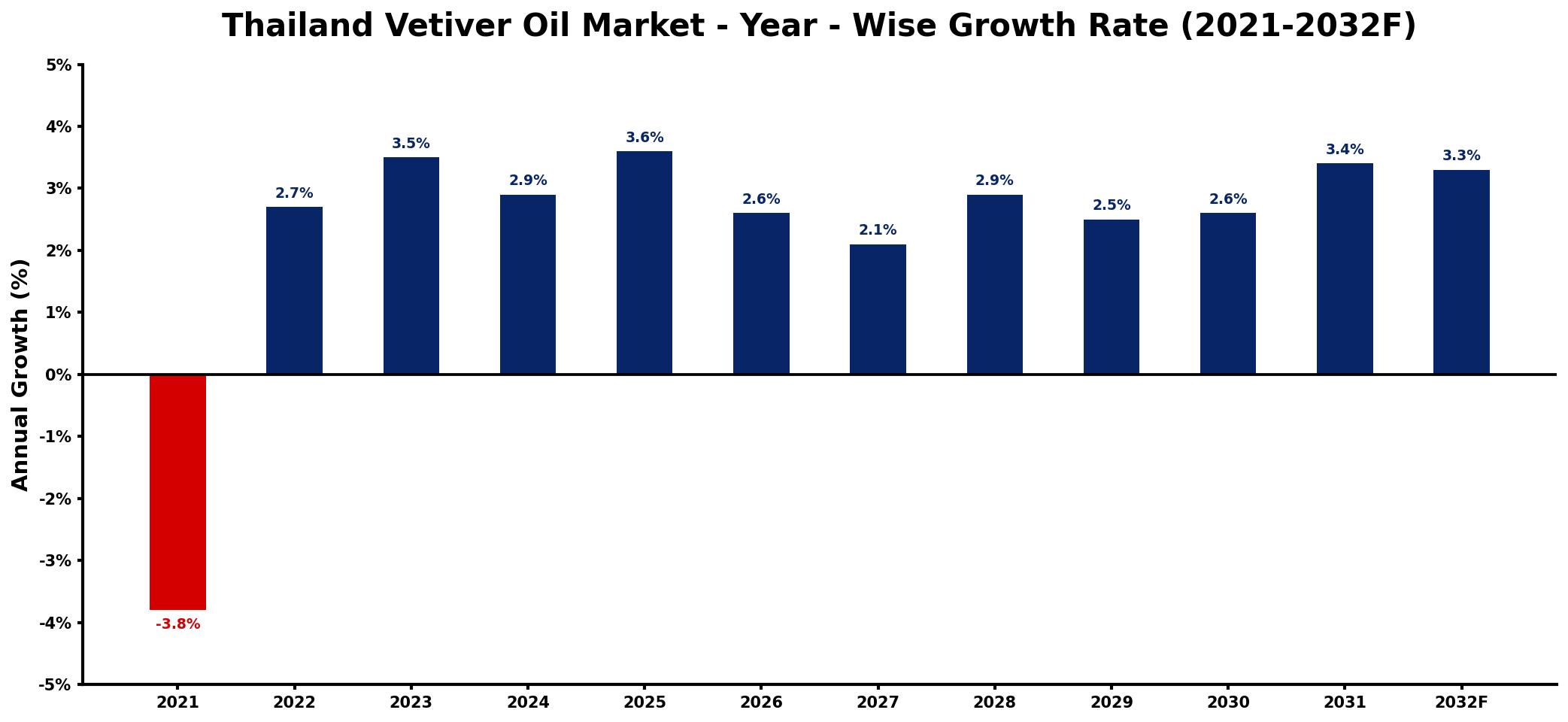
The table below presents the year‑wise growth rates along with the key drivers influencing the market
| Year | Growth Rate | Major Drivers |
| 2021 | -3.8% | decrease in consumer interest |
| 2022 | 2.7% | rising demand in cosmetics sector |
| 2023 | 3.5% | expansion of fragrance market |
| 2024 | 2.9% | growth in natural product segment |
| 2025 | 3.6% | increased investment in agriculture |
| 2026 | 2.6% | surge in wellness trends |
| 2027 | 2.1% | growing popularity of aromatherapy |
| 2028 | 2.9% | enhanced awareness of sustainability |
| 2029 | 2.5% | emergence of new applications |
| 2030 | 2.6% | growing downstream application demand |
| 2031 | 3.4% | rising infrastructure development spending |
| 2032 | 3.3% | growing automotive sector requirements |
Note: Market size estimations and growth projections presented in this report are based on 6Wresearch's proprietary forecasting methodology, utilizing the latest available industry data, government publications, and primary research inputs.
Thailand Vetiver Oil Market Synopsis
The primary force shaping the Thailand vetiver oil market today is the growing consumer preference for natural ingredients in beauty and wellness products. This trend is accelerating the adoption of vetiver oil as a sought-after ingredient in perfumes, skincare formulations, and aromatherapy applications.
Additionally, the commitment to sustainable cultivation practices is strengthening the market position of Thai vetiver oil. Initiatives aimed at promoting responsible harvesting not only protect the environment but also enhance the oil's reputation as a premium product on the international stage.
Thailand Vetiver Oil Market Key Takeaways
- The market is experiencing steady growth driven by the demand for natural and organic cosmetics.
- Sustainable farming practices are becoming increasingly important to preserve vetiver cultivation.
- Key applications of vetiver oil include fragrance, skincare, and traditional medicine.
- Thailand's positioning as a leader in high-quality vetiver oil production is gaining global recognition.
- Trade dynamics are influenced by international demand fluctuations and supply chain factors.
Evaluation of Restraints in Thailand Vetiver Oil Market
Despite the promising outlook, the Thailand vetiver oil market grapples with several restraints that could hinder its progress. The cultivation of vetiver grass often occurs in ecologically sensitive areas, where improper agricultural practices can lead to soil degradation and erosion. Ensuring sustainable farming methods is essential not only for environmental conservation but also for maintaining a reliable supply chain. Furthermore, variations in international demand for vetiver oil may create access challenges, necessitating a strategic approach to market engagement and export dynamics.
Thailand Vetiver Oil Market Trends
The trend towards clean beauty is significantly impacting the demand for vetiver oil, as consumers increasingly seek products that are both natural and sustainably sourced. Emerging applications, particularly in the wellness sector, are also on the rise, with vetiver oil being embraced for its calming and therapeutic properties. Moreover, technology in extraction methods is advancing, allowing for improved efficiency and higher quality oil, which is pivotal for sustaining competitive advantage.
Thailand Vetiver Oil Market Opportunities
There are substantial growth opportunities within the Thailand vetiver oil market, particularly in expanding the product base to include wellness applications. Companies can capitalize on the increasing global consumer interest in aromatherapy and natural skincare. Additionally, forging partnerships with international fragrance houses can enhance market penetration, enabling Thai vetiver oil to assert its presence in premium segments.
Government Initiatives in the Thailand Vetiver Oil Market
The Thai government is actively supporting the vetiver oil industry through various initiatives aimed at promoting sustainable agricultural practices. Public programs are being implemented to educate farmers about responsible cultivation techniques, thereby enhancing product quality and environmental stewardship. Moreover, government-backed efforts to establish trade agreements can further facilitate market access, opening new avenues for export and international collaboration.
Future Insights of the Thailand Vetiver Oil Market
Looking ahead to 2026-2032, the Thailand vetiver oil market is poised for steady growth. The emphasis on eco-friendly and sustainable practices will likely strengthen the position of Thai vetiver oil as a premium product globally. As consumer demand for natural ingredients continues to rise, innovative uses for vetiver oil in emerging sectors, such as wellness and personal care, will contribute to a diverse and robust market landscape.
Thailand Vetiver Oil Market Latest Developments (2025 - 2026)
Recent industry developments indicate a push towards enhanced sustainability practices in vetiver oil production. New partnerships are being formed between local farmers and international cosmetic brands aimed at ensuring fair trade and improving the supply chain. Additionally, advancements in extraction technologies are starting to gain traction, promoting higher-quality oil extraction methods while minimizing environmental impacts.
Thailand Vetiver Oil Market - Key Attractiveness of the Report
- 10 Years of Market Numbers
- Historical Data Starting from 2022 to 2025
- Base Year: 2025
- Forecast Data until 2032
- Key Performance Indicators Impacting the Market
- Major Upcoming Developments and Projects
Key Highlights of the Report:
- Thailand Vetiver Oil Market Outlook
- Market Size of Thailand Vetiver Oil Market, 2025
- Forecast of Thailand Vetiver Oil Market, 2032
- Historical Data and Forecast of Thailand Vetiver Oil Revenues & Volume for the Period 2022-2032F
- Thailand Vetiver Oil Market Trend Evolution
- Thailand Vetiver Oil Market Drivers and Challenges
- Thailand Vetiver Oil Price Trends
- Thailand Vetiver Oil Porter's Five Forces
- Thailand Vetiver Oil Industry Life Cycle
- Historical Data and Forecast of Thailand Vetiver Oil Market Revenues & Volume By Application for the Period 2022-2032F
- Historical Data and Forecast of Thailand Vetiver Oil Market Revenues & Volume By Medical for the Period 2022-2032F
- Historical Data and Forecast of Thailand Vetiver Oil Market Revenues & Volume By Food & Beverage for the Period 2022-2032F
- Historical Data and Forecast of Thailand Vetiver Oil Market Revenues & Volume By Spa & Relaxation for the Period 2022-2032F
- Thailand Vetiver Oil Import Export Trade Statistics
- Market Opportunity Assessment By Application
- Thailand Vetiver Oil Top Companies Market Share
- Thailand Vetiver Oil Competitive Benchmarking By Technical and Operational Parameters
- Thailand Vetiver Oil Company Profiles
- Thailand Vetiver Oil Key Strategic Recommendations






































