Thailand Wire Drawing Machinery Market Size, Share & Growth Rate
The Thailand Wire Drawing Machinery Market was estimated at USD 139 Million in 2025 and is projected to reach USD 158 Million by 2032, growing at a CAGR of 1.8% from 2026 to 2032. This growth trajectory is largely fueled by a robust demand for electrical wires and cables, primarily driven by the construction and infrastructure sectors. Moreover, the rising presence of automotive and electronics manufacturing in Thailand further propels the market, as these industries require high-quality wire drawing machinery to produce various components efficiently.
Thailand Wire Drawing Machinery Market Year-wise Growth Rate and Key Drivers
This graph highlights how the Thailand Wire Drawing Machinery Market has steadily grown over the years, supported by major growth factors.
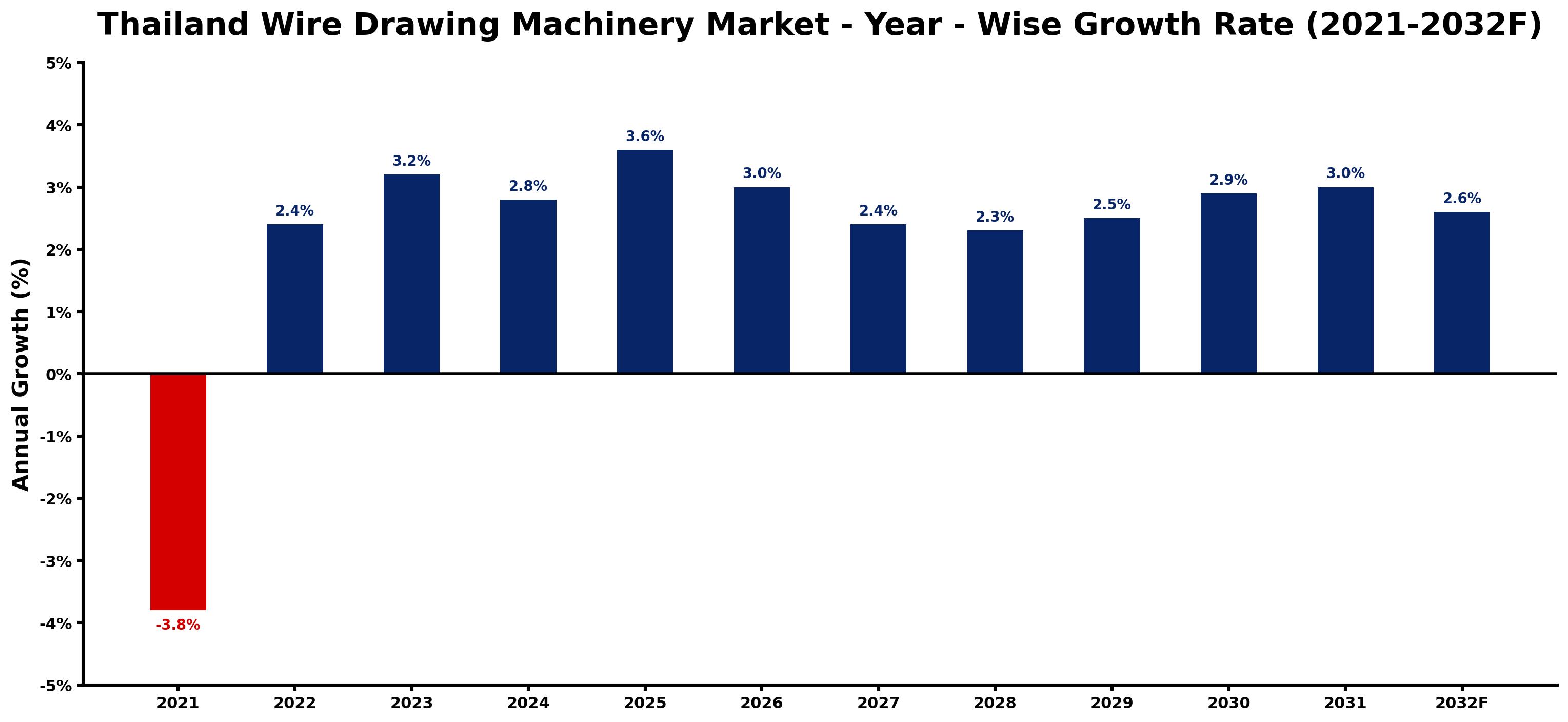
The table below presents the year‑wise growth rates along with the key drivers influencing the market
| Year | Growth Rate | Major Drivers |
| 2021 | -3.8% | Government infrastructure modernization initiatives |
| 2022 | 2.4% | Expansion of commercial construction activities |
| 2023 | 3.2% | Growing urbanization and commercial development |
| 2024 | 2.8% | Expansion of commercial construction activities |
| 2025 | 3.6% | Increasing smart city development projects |
| 2026 | 3.0% | Government infrastructure modernization initiatives |
| 2027 | 2.4% | Growing urbanization and commercial development |
| 2028 | 2.3% | Growing renewable energy integration projects |
| 2029 | 2.5% | Increasing industrial infrastructure investments |
| 2030 | 2.9% | Expansion of transportation and logistics networks |
| 2031 | 3.0% | Growing urbanization and commercial development |
| 2032 | 2.6% | Expansion of commercial construction activities |
Note - Market size estimations and growth projections presented in this report are based on 6Wresearch’s advanced forecasting approach, validated with industry datasets as of June 2026.
Thailand Wire Drawing Machinery Market Synopsis
The Thailand wire drawing machinery market is poised for a remarkable transformation, transitioning from a period of moderate performance during the pandemic to a phase of renewed growth. As economic activities regain momentum, industry players are focusing on modernizing their production capabilities to align with the increasing demand for efficient wire manufacturing solutions.
This revitalization is further supported by ongoing advancements in wire drawing technology, which emphasize energy efficiency and material optimization. The competitive landscape is becoming increasingly dynamic as manufacturers adapt to evolving market requirements, ensuring that the Thailand wire drawing machinery market is not only resilient but also innovative.
Thailand Wire Drawing Machinery Market Key Takeaways
- Robust growth forecast as demand for wires and cables rises across key industries.
- Technological advancements driving the modernization of wire drawing machinery.
- The automotive and electronics sectors are critical growth drivers in Thailand.
- Emphasis on energy efficiency is shaping machinery investments and upgrades.
- Post-pandemic recovery is set to boost production rates and market activity.
Evaluation of Restraints in Thailand Wire Drawing Machinery Market
Despite the promising outlook, the Thailand wire drawing machinery market is confronted with notable restraints. Technological advancements can outpace existing machinery, compelling manufacturers to continually invest in upgrades to maintain competitive advantage. Furthermore, the skill gap in operating and maintaining advanced machinery poses challenges; a shortage of trained personnel may hinder optimal performance and reduce efficiency in production processes. These factors collectively could stall growth if not adequately addressed by industry stakeholders.
Thailand Wire Drawing Machinery Market Trends
Several current and emerging trends are shaping the Thailand wire drawing machinery market. A significant shift toward automation and the integration of Industry 4.0 principles are becoming increasingly prominent, as manufacturers seek to enhance productivity and reduce operational costs. Additionally, the focus on sustainability is pushing companies to adopt machinery that minimizes waste and energy consumption. These trends not only address immediate market needs but also align with global standards for eco-friendly manufacturing processes, further solidifying the market's forward momentum.
Thailand Wire Drawing Machinery Market Opportunities
The market presents substantial growth and investment opportunities, particularly in sectors like renewable energy and smart technologies. As Thailand advances its infrastructure projects, the demand for high-quality wire and cable products will intensify, thereby creating a ripe environment for innovative machinery solutions. Furthermore, as manufacturers increasingly look to incorporate advanced automation technologies, suppliers of state-of-the-art wire drawing machinery stand to benefit from partnerships and collaborations that leverage cutting-edge capabilities.
Government Initiatives in the Thailand Wire Drawing Machinery Market
The Thai government has implemented several initiatives aimed at bolstering the manufacturing sector, including the wire drawing machinery market. Policies focused on enhancing infrastructure and providing incentives for energy-efficient technologies are significant. Public spending on construction and green energy projects is expected to create a robust demand for wires and cables, further stimulating the market. Moreover, support for workforce development initiatives is essential for addressing the skills gap, ensuring that operators are equipped to manage advanced machinery effectively.
Future Insights of the Thailand Wire Drawing Machinery Market
Looking ahead to 2026-2032, the Thailand wire drawing machinery market is set for a transformative phase characterized by innovation and adaptation. As demand for advanced manufacturing processes continues to rise, the integration of smart technologies and data analytics will likely become a standard practice. Manufacturers will need to invest in machinery that not only meets current demands but also anticipates future requirements, thus positioning themselves to capitalize on emerging trends in various sectors.
Thailand Wire Drawing Machinery Market Latest Developments (May 2025 - June 2026)
Recent developments in the Thailand wire drawing machinery market indicate a strong focus on technological upgrades and enhanced production methodologies. Companies are increasingly adopting automation and digital monitoring systems to optimize efficiency and reduce operational costs. Additionally, collaborations between machinery manufacturers and technology providers are becoming more common, aiming to innovate solutions that meet the evolving demands of the market.
Thailand Wire Drawing Machinery Market - Key Attractiveness of the Report
- 10 Years of Market Numbers
- Historical Data Starting from 2022 to 2025
- Base Year: 2025
- Forecast Data until 2032
- Key Performance Indicators Impacting the Market
- Major Upcoming Developments and Projects
Key Highlights of the Report:
- Thailand Wire Drawing Machinery Market Outlook
- Market Size of Thailand Wire Drawing Machinery Market, 2025
- Forecast of Thailand Wire Drawing Machinery Market, 2032F
- Historical Data and Forecast of Thailand Wire Drawing Machinery Revenues & Volume for the Period 2022-2032F
- Thailand Wire Drawing Machinery Market Trend Evolution
- Thailand Wire Drawing Machinery Market Drivers and Challenges
- Thailand Wire Drawing Machinery Price Trends
- Thailand Wire Drawing Machinery Porter's Five Forces
- Thailand Wire Drawing Machinery Industry Life Cycle
- Historical Data and Forecast of Thailand Wire Drawing Machinery Market Revenues & Volume By Product Type for the Period 2022-2032F
- Historical Data and Forecast of Thailand Wire Drawing Machinery Market Revenues & Volume By Big Jar Of Wire Drawing Machine for the Period 2022-2032F
- Historical Data and Forecast of Thailand Wire Drawing Machinery Market Revenues & Volume By Large Water Tank Wire Drawing Machine for the Period 2022-2032F
- Historical Data and Forecast of Thailand Wire Drawing Machinery Market Revenues & Volume By Small Water Tank Wire Drawing Machine for the Period 2022-2032F
- Historical Data and Forecast of Thailand Wire Drawing Machinery Market Revenues & Volume By Application for the Period 2022-2032F
- Historical Data and Forecast of Thailand Wire Drawing Machinery Market Revenues & Volume By Machinery Manufacturing for the Period 2022-2032F
- Historical Data and Forecast of Thailand Wire Drawing Machinery Market Revenues & Volume By Petroleum Chemical Industry for the Period 2022-2032F
- Historical Data and Forecast of Thailand Wire Drawing Machinery Market Revenues & Volume By Plastics Industry for the Period 2022-2032F
- Historical Data and Forecast of Thailand Wire Drawing Machinery Market Revenues & Volume By Other for the Period 2022-2032F
- Thailand Wire Drawing Machinery Import Export Trade Statistics
- Market Opportunity Assessment By Product Type
- Market Opportunity Assessment By Application
- Thailand Wire Drawing Machinery Top Companies Market Share
- Thailand Wire Drawing Machinery Competitive Benchmarking By Technical and Operational Parameters
- Thailand Wire Drawing Machinery Company Profiles
- Thailand Wire Drawing Machinery Key Strategic Recommendations






































