Thailand Woodworking Tools Market Summary
The thailand woodworking tools market was estimated at USD 242 Million in 2025 and is projected to reach USD 278 Million by 2032, growing at a CAGR of 2.9% from 2026 to 2032.
Thailand Woodworking Tools Market Year-wise Growth Rate and Key Drivers
This graph highlights how the Thailand Woodworking Tools Market has steadily grown over the past five years, supported by major growth factors.
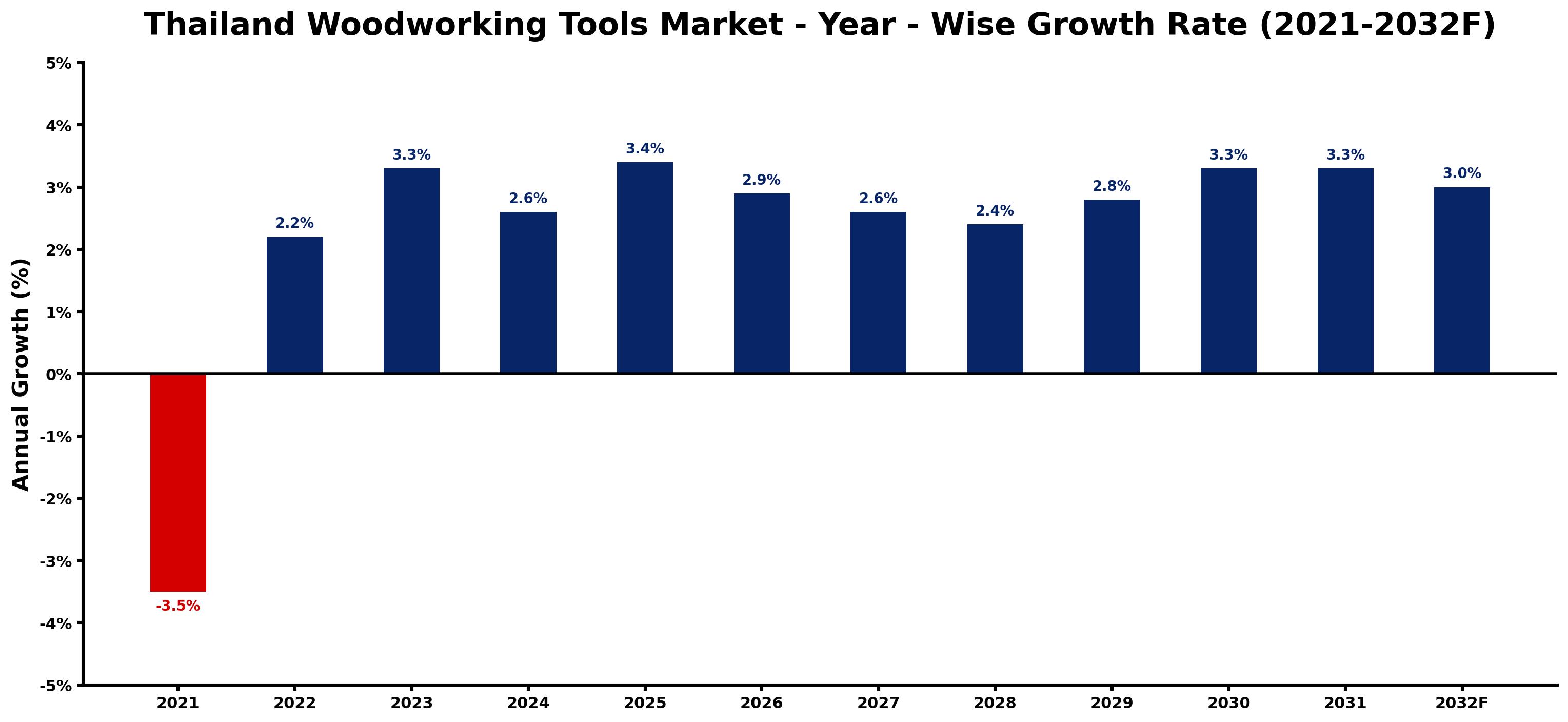
The table below presents the year wise growth rates along with the key drivers influencing the market
| Year | Growth Rate | Major Drivers |
| 2021 | -3.5% | Supply chain disruptions caused by the pandemic hampered tool availability, leading to reduced market demand. |
| 2022 | 2.2% | Expanding e-commerce platforms facilitate access to woodworking tools for consumers. |
| 2023 | 3.3% | Local craftsmanship movements encourage traditional woodworking practices and tool demand. |
| 2024 | 2.6% | Sustainable materials grow popular, influencing new tool designs and features. |
| 2025 | 3.4% | Emerging local startups innovate in woodworking tools, increasing market competition. |
| 2026 | 2.9% | Collaborative workshops and maker spaces boost community engagement in woodworking. |
| 2027 | 2.6% | Urbanization trends lead to smaller living spaces, increasing demand for compact tools. |
| 2028 | 2.4% | Educational programs in woodworking promote skills and tool usage among youth. |
| 2029 | 2.8% | Cross-border trade agreements enhance access to international woodworking brands. |
| 2030 | 3.3% | Technological integration in tools, like smart features, attracts new consumer segments. |
| 2031 | 3.3% | Rural electrification projects expand, offering new markets for basic woodworking tools. |
| 2032 | 3.0% | Sustainability certifications influence purchasing preferences towards eco-friendly tools. |
Note - Market size estimations and growth projections presented in this report are based on 6Wresearch's advanced forecasting approach, validated with industry datasets as of June 2026.
Thailand Woodworking Tools Market Synopsis
The Thailand Woodworking Tools Market is projected to reach 2.9% and witness significant growth during the forecast period (2026-2032). The market is poised to expand at a CAGR of 5.3%, driven by several pivotal factors. These include a rising demand for furniture from both residential and commercial sectors, an increasing requirement for automated woodworking tools in the furniture industry, and proactive government initiatives aimed at environmental conservation and the reduction of deforestation.
Thailand Woodworking Tools Market Growth Drivers
The growth of the Thailand woodworking tools market can be attributed to various underlying factors:
- The burgeoning population in Thailand has escalated the demand for housing and office spaces. Consequently, this surge in construction activity has amplified the requirement for furniture, thereby benefitting the woodworking tools sector.
- As businesses evolve, there is a notable shift towards automation within small-scale woodworking workshops. This transition not only enhances operational efficiency but also significantly reduces labor costs associated with traditional methods.
- The integration of automated tools facilitates better quality control, minimizing errors typically introduced through manual handling. This capability is becoming increasingly attractive for manufacturers, prompting a wider adoption of such technologies.
- Environmental awareness has prompted a preference for sustainable practices within the industry. The adoption of automated tools aligns with governmental policies aimed at minimizing ecological impact while promoting efficient resource utilization.
- The ongoing urbanization in Thailand continues to foster a favorable climate for local woodworking enterprises, which are equipped with modern tools to meet the escalating demand for high-quality furniture.
Thailand Woodworking Tools Market Challenges and Restraints
Despite the promising growth trajectory, the Thailand woodworking tools market faces significant challenges:
- High initial capital investment remains a considerable barrier to entry for many small-scale operators. The cost of automated woodworking machinery can be prohibitive for businesses with limited financial resources.
- Manufacturers may find themselves at a competitive disadvantage if they are unable to invest in modern tools, leading to stagnation in technological advancement and reliance on outdated methods.
- The COVID-19 pandemic has undeniably impacted the global supply chain, causing delays in equipment delivery and disruptions in production. This uncertainty can deter investment in new tools and technologies.
- Additionally, the concentration of woodworking tools production in certain regions can create vulnerabilities in supply chains, particularly during crises when reliance on specific suppliers becomes untenable.
- Small operations that do not adapt to new technologies may experience reduced market share and profitability, capturing less of the expanding demand in the woodworking sector.
Thailand Woodworking Tools Market Government Investment and Initiatives
The government of Thailand is actively promoting initiatives aimed at bolstering the woodworking tools market. Investments are being channeled towards sustainable forestry practices and technological upgrades in manufacturing processes. These initiatives are designed to:
- Support small and medium enterprises (SMEs) in accessing funding for modern equipment, effectively lowering financial barriers to technological adoption.
- Encourage environmentally friendly practices that align with national goals of sustainable development, ensuring that the woodworking sector contributes positively to ecological preservation.
- Facilitate training programs aimed at equipping the workforce with skills necessary to operate advanced woodworking machinery, addressing the talent gap in this evolving industry.
- Promote research and development through grants and partnerships with educational institutions, focusing on innovation in woodworking technologies and materials.
- Develop infrastructure that supports the woodworking industry, including improved logistics and distribution networks, to enhance market efficiency and accessibility.
Thailand Woodworking Tools Market Latest Developments (May 2025 - June 2026)
In recent months leading up to June 2026, the Thailand woodworking tools market has observed a noteworthy shift towards digitalization. Companies are increasingly adopting online platforms for marketing and sales, thereby expanding their customer reach. Additionally, many businesses have introduced new product lines tailored to the evolving demands of the market, particularly in response to consumer preferences for customizable furniture solutions. Furthermore, vendors are focusing on enhancing their after-sales services as a strategy to maintain customer loyalty amidst rising competition.
Thailand Woodworking Tools Market - Key Attractiveness of the Report
- 10 Years of Market Numbers
- Historical Data Starting from 2022 to 2025
- Base Year: 2025
- Forecast Data until 2032
- Key Performance Indicators Impacting the Market
- Major Upcoming Developments and Projects
Key Highlights of the Report:
- Thailand Woodworking Tools Market Outlook
- Market Size of Thailand Woodworking Tools Market, 2025
- Forecast of Thailand Woodworking Tools Market, 2032
- Historical Data and Forecast of Thailand Woodworking Tools Revenues & Volume for the Period 2022-2032F
- Thailand Woodworking Tools Market Trend Evolution
- Thailand Woodworking Tools Market Drivers and Challenges
- Thailand Woodworking Tools Price Trends
- Thailand Woodworking Tools Porter's Five Forces
- Thailand Woodworking Tools Industry Life Cycle
- Historical Data and Forecast of Thailand Woodworking Tools Market Revenues & Volume By Operations for the Period 2022-2032F
- Historical Data and Forecast of Thailand Woodworking Tools Market Revenues & Volume By Handheld for the Period 2022-2032F
- Historical Data and Forecast of Thailand Woodworking Tools Market Revenues & Volume By Power Tools for the Period 2022-2032F
- Historical Data and Forecast of Thailand Woodworking Tools Market Revenues & Volume By Electric for the Period 2022-2032F
- Historical Data and Forecast of Thailand Woodworking Tools Market Revenues & Volume By Pneumatic for the Period 2022-2032F
- Historical Data and Forecast of Thailand Woodworking Tools Market Revenues & Volume By Product Type for the Period 2022-2032F
- Historical Data and Forecast of Thailand Woodworking Tools Market Revenues & Volume By Bandsaw for the Period 2022-2032F
- Historical Data and Forecast of Thailand Woodworking Tools Market Revenues & Volume By Chisels for the Period 2022-2032F
- Historical Data and Forecast of Thailand Woodworking Tools Market Revenues & Volume By Hammers for the Period 2022-2032F
- Historical Data and Forecast of Thailand Woodworking Tools Market Revenues & Volume By Planes for the Period 2022-2032F
- Historical Data and Forecast of Thailand Woodworking Tools Market Revenues & Volume By Workbench for the Period 2022-2032F
- Historical Data and Forecast of Thailand Woodworking Tools Market Revenues & Volume By Sanders for the Period 2022-2032F
- Historical Data and Forecast of Thailand Woodworking Tools Market Revenues & Volume By Routers for the Period 2022-2032F
- Historical Data and Forecast of Thailand Woodworking Tools Market Revenues & Volume By Others for the Period 2022-2032F
- Historical Data and Forecast of Thailand Woodworking Tools Market Revenues & Volume By End-Users for the Period 2022-2032F
- Historical Data and Forecast of Thailand Woodworking Tools Market Revenues & Volume By Manufacturing/Industrial for the Period 2022-2032F
- Historical Data and Forecast of Thailand Woodworking Tools Market Revenues & Volume By Professional for the Period 2022-2032F
- Historical Data and Forecast of Thailand Woodworking Tools Market Revenues & Volume By DIY for the Period 2022-2032F
- Historical Data and Forecast of Thailand Woodworking Tools Market Revenues & Volume By Residential for the Period 2022-2032F
- Historical Data and Forecast of Thailand Woodworking Tools Market Revenues & Volume By Sales Channel for the Period 2022-2032F
- Historical Data and Forecast of Thailand Woodworking Tools Market Revenues & Volume By Offline for the Period 2022-2032F
- Historical Data and Forecast of Thailand Woodworking Tools Market Revenues & Volume By Authorized Distributor/Dealer for the Period 2022-2032F
- Historical Data and Forecast of Thailand Woodworking Tools Market Revenues & Volume By Mom and Pop Stores for the Period 2022-2032F
- Historical Data and Forecast of Thailand Woodworking Tools Market Revenues & Volume By Supermarkets/Hypermarkets for the Period 2022-2032F
- Historical Data and Forecast of Thailand Woodworking Tools Market Revenues & Volume By Online for the Period 2022-2032F
- Thailand Woodworking Tools Import Export Trade Statistics
- Market Opportunity Assessment By Operations
- Market Opportunity Assessment By Product Type
- Market Opportunity Assessment By End-Users
- Market Opportunity Assessment By Sales Channel
- Thailand Woodworking Tools Top Companies Market Share
- Thailand Woodworking Tools Competitive Benchmarking By Technical and Operational Parameters
- Thailand Woodworking Tools Company Profiles
- Thailand Woodworking Tools Key Strategic Recommendations






































