Thailand Wool Market Size, Share & Growth Rate
The Thailand Wool Market was estimated at USD 188 Million in 2025 and is projected to reach USD 216 Million by 2032, growing at a CAGR of 2.0% from 2026 to 2032. This growth trajectory is primarily driven by the increasing demand for high-quality woolen garments, especially in urban centers where winter wear is becoming increasingly popular. Additionally, fashion trends are leaning towards sustainable materials, which wool can meet effectively.
Thailand Wool Market Year-wise Growth Rate and Key Drivers
This graph highlights how the Thailand Wool Market has steadily grown over the years, supported by major growth factors.
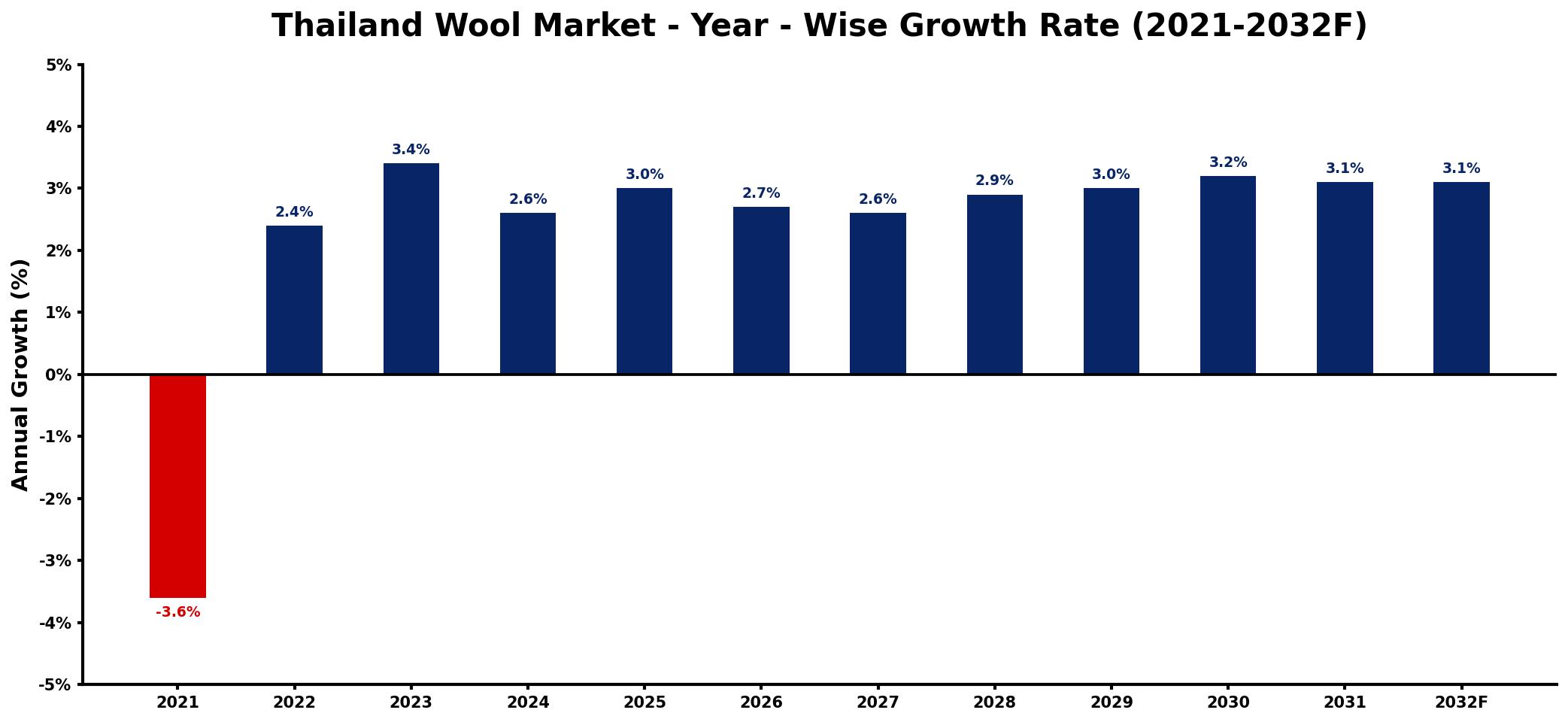
The table below presents the year‑wise growth rates along with the key drivers influencing the market
| Year | Growth Rate | Major Drivers |
| 2021 | -3.6% | global demand for textiles declines |
| 2022 | 2.4% | increased interest in sustainable materials |
| 2023 | 3.4% | rising exports to international markets |
| 2024 | 2.6% | expansion of local manufacturing capabilities |
| 2025 | 3.0% | growing popularity of eco-friendly fabrics |
| 2026 | 2.7% | increased investment in production technology |
| 2027 | 2.6% | enhanced marketing strategies for textiles |
| 2028 | 2.9% | growth in domestic consumption rates |
| 2029 | 3.0% | rising demand from fashion industry |
| 2030 | 3.2% | strengthening trade agreements with partners |
| 2031 | 3.1% | emergence of innovative textile applications |
| 2032 | 3.1% | increased collaboration with research institutions |
Note: Market size estimations and growth projections presented in this report are based on 6Wresearch's proprietary forecasting methodology, utilizing the latest available industry data, government publications, and primary research inputs.
Thailand Wool Market Synopsis
The Thailand wool market is characterized by its reliance on imported wool, as domestic production is limited due to the country's hot and humid climate. This necessity creates a dynamic trade landscape where international prices and supply can significantly influence local market conditions.
Despite these challenges, wool remains a sought-after material in Thailand's textile industry, valued for its versatility and durability. The ongoing interest in eco-friendly fashion and materials is fostering a renewed appreciation for wool, which is perceived as a sustainable alternative to synthetic fibers.
Thailand Wool Market Key Takeaways
- The market is expected to grow steadily at a CAGR of 2.0% from 2026 to 2032.
- Wool's natural insulation properties cater to rising demand for winter garments.
- Competitive pressures from synthetic alternatives necessitate a focus on sustainability.
- Fashion trends increasingly embrace the aesthetic and functional qualities of wool.
- Domestic production constraints compel reliance on international wool supply.
Evaluation of Restraints in Thailand Wool Market
The primary constraints in the Thailand wool market stem from both climatic conditions and competitive pressures. With a predominantly tropical climate, Thailand's ability to produce wool locally is severely limited. This results in a heavy dependence on imports, making the market vulnerable to global price fluctuations and supply chain uncertainties. Moreover, synthetic fibers are appealing to cost-sensitive consumers, further complicating market dynamics. To address these challenges, stakeholders must adopt innovative strategies that highlight the unique benefits of wool and emphasize sustainable sourcing practices.
Thailand Wool Market Trends
Emerging trends in the Thailand wool market include a noticeable shift towards sustainable fashion practices, encouraging designers and brands to utilize natural fibers such as wool. This trend is fueled by consumer demand for environmentally friendly products, prompting companies to highlight the sustainable aspects of wool. Additionally, the increased integration of technology in textile manufacturing, including digital printing and advanced fabric treatments, is enhancing the appeal and performance of wool products in the market.
Thailand Wool Market Opportunities
Growth opportunities lie in developing specialized wool products, such as performance-oriented fabrics that cater to outdoor and athletic wear markets. Moreover, an increased focus on e-commerce platforms for woolen products presents avenues for brands to reach broader audiences. Collaborations with fashion designers to create limited-edition wool collections could also tap into niche markets, driving demand for high-quality wool goods.
Government Initiatives in the Thailand Wool Market
The Thai government has shown interest in promoting the textile industry, including initiatives focused on sustainable practices and supporting local producers. Programs aimed at enhancing the competitiveness of local textile firms, along with incentives for adopting eco-friendly production processes, are being explored. While specific figures and schemes are not delineated, these initiatives seek to bolster the overall growth of the wool market in alignment with global sustainability trends.
Future Insights of the Thailand Wool Market
From 2026 to 2032, the Thailand wool market is poised for gradual expansion. As the demand for sustainable textiles continues to rise, manufacturers are likely to innovate in the types of wool products offered. This period may also see an increased integration of digital technologies in textile production, enhancing efficiency and product customization. Furthermore, evolving fashion trends and a heightened focus on quality over quantity among consumers are expected to sustain the market's growth momentum.
Thailand Wool Market Latest Developments (2025 - 2026)
Recent developments within the Thailand wool market have indicated a shift towards embracing sustainability. Various local textile firms are exploring partnerships with international wool suppliers to secure high-quality materials while maintaining eco-friendly practices. Additionally, online retail channels are gaining traction, providing brands with opportunities to reach consumers directly and adapt to their shifting shopping preferences.
Thailand Wool Market - Key Attractiveness of the Report
- 10 Years of Market Numbers
- Historical Data Starting from 2022 to 2025
- Base Year: 2025
- Forecast Data until 2032
- Key Performance Indicators Impacting the Market
- Major Upcoming Developments and Projects
Key Highlights of the Report:
- Thailand Wool Market Outlook
- Market Size of Thailand Wool Market, 2025
- Forecast of Thailand Wool Market, 2032
- Historical Data and Forecast of Thailand Wool Revenues & Volume for the Period 2022-2032F
- Thailand Wool Market Trend Evolution
- Thailand Wool Market Drivers and Challenges
- Thailand Wool Price Trends
- Thailand Wool Porter's Five Forces
- Thailand Wool Industry Life Cycle
- Historical Data and Forecast of Thailand Wool Market Revenues & Volume By Source for the Period 2022-2032F
- Historical Data and Forecast of Thailand Wool Market Revenues & Volume By Merino Wool for the Period 2022-2032F
- Historical Data and Forecast of Thailand Wool Market Revenues & Volume By Peruvian Highland Wool for the Period 2022-2032F
- Historical Data and Forecast of Thailand Wool Market Revenues & Volume By Teeswater Wool for the Period 2022-2032F
- Historical Data and Forecast of Thailand Wool Market Revenues & Volume By Shetland Wool for the Period 2022-2032F
- Historical Data and Forecast of Thailand Wool Market Revenues & Volume By Cashmere Wool for the Period 2022-2032F
- Historical Data and Forecast of Thailand Wool Market Revenues & Volume By others for the Period 2022-2032F
- Historical Data and Forecast of Thailand Wool Market Revenues & Volume By Type for the Period 2022-2032F
- Historical Data and Forecast of Thailand Wool Market Revenues & Volume By Fine wool (? 25 ) for the Period 2022-2032F
- Historical Data and Forecast of Thailand Wool Market Revenues & Volume By Medium wool (25 to 35 ) for the Period 2022-2032F
- Historical Data and Forecast of Thailand Wool Market Revenues & Volume By Coarse wool (? 35 ) for the Period 2022-2032F
- Historical Data and Forecast of Thailand Wool Market Revenues & Volume By Application for the Period 2022-2032F
- Historical Data and Forecast of Thailand Wool Market Revenues & Volume By Apparels for the Period 2022-2032F
- Historical Data and Forecast of Thailand Wool Market Revenues & Volume By Interior Textiles for the Period 2022-2032F
- Thailand Wool Import Export Trade Statistics
- Market Opportunity Assessment By Source
- Market Opportunity Assessment By Type
- Market Opportunity Assessment By Application
- Thailand Wool Top Companies Market Share
- Thailand Wool Competitive Benchmarking By Technical and Operational Parameters
- Thailand Wool Company Profiles
- Thailand Wool Key Strategic Recommendations






































