Thailand Worldwide Rolling Stock Wheel Market Size, Share & Growth Rate
The Thailand Worldwide Rolling Stock Wheel Market was estimated at USD 145 Million in 2025 and is projected to reach USD 166 Million by 2032, growing at a CAGR of 2.0% from 2026 to 2032. This growth is primarily fueled by Thailand's strategic investments in railway infrastructure and an expanding fleet of trains, which directly translates to heightened demand for high-quality rolling stock wheels. Additionally, as Thailand positions itself as a regional transportation hub, the emphasis on safe and efficient rail operations plays a crucial role in supporting this upward trajectory.
Thailand Worldwide Rolling Stock Wheel Market Year-wise Growth Rate and Key Drivers
This graph highlights how the Thailand Worldwide Rolling Stock Wheel Market has steadily grown over the years, supported by major growth factors.
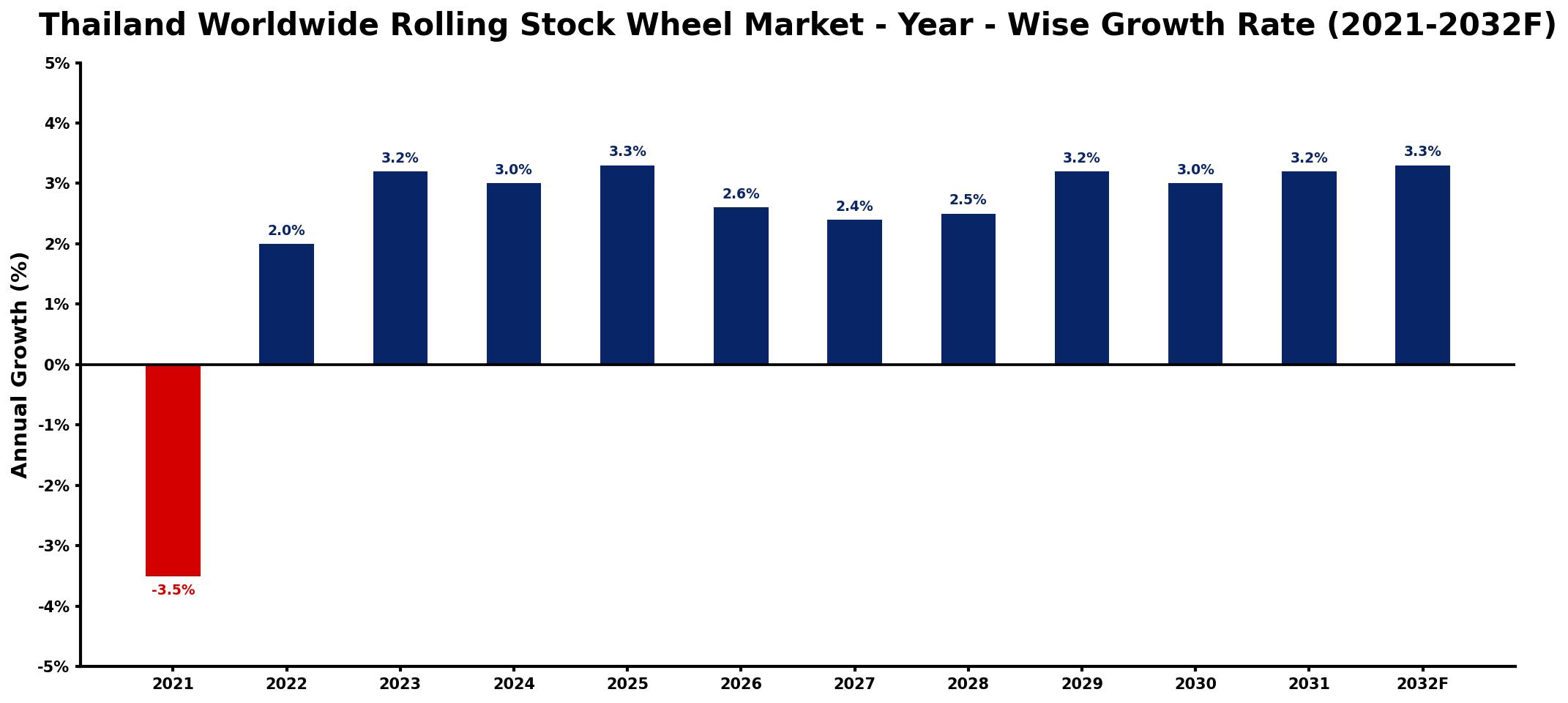
The table below presents the year‑wise growth rates along with the key drivers influencing the market
| Year | Growth Rate | Major Drivers |
| 2021 | -3.5% | decrease in infrastructure investments |
| 2022 | 2.0% | increased government transportation funding |
| 2023 | 3.2% | growing urban rail projects |
| 2024 | 3.0% | expansion of freight networks |
| 2025 | 3.3% | rise in passenger transport demand |
| 2026 | 2.6% | boost in renewable energy initiatives |
| 2027 | 2.4% | enhancement of logistics capabilities |
| 2028 | 2.5% | development of smart transportation |
| 2029 | 3.2% | surge in international trade agreements |
| 2030 | 3.0% | investment in modern transit systems |
| 2031 | 3.2% | focus on sustainable transport solutions |
| 2032 | 3.3% | advancements in manufacturing technologies |
Note: Market size estimations and growth projections presented in this report are based on 6Wresearch's proprietary forecasting methodology, utilizing the latest available industry data, government publications, and primary research inputs.
Thailand Worldwide Rolling Stock Wheel Market Synopsis
The primary force currently shaping the Thailand Worldwide Rolling Stock Wheel Market is the governments significant investment in railway infrastructure. This initiative not only supports domestic rail networks but also enhances Thailand's role in cross-border rail logistics, a crucial factor for economic connectivity in the region. Furthermore, the increasing focus on safety and quality standards is creating a pressing need for reliable wheel manufacturing, essential for sustaining operational efficiency across the railway sector.
As the railway infrastructure continues to evolve, manufacturers are also tapping into technological advancements that optimize wheel design and materials. These innovations lead to the production of lightweight, durable wheels that further enhance the safety and efficiency of rail operations. In tandem, the focus on sustainability is paving the way for environmentally-friendly manufacturing processes, contributing to the overall market appeal.
Thailand Worldwide Rolling Stock Wheel Market Key Takeaways
- The market is driven by substantial government investments in railway infrastructure.
- Technological advancements are promoting the development of lightweight and durable wheels.
- Thailands strategic geographic location enhances its role in regional rail logistics.
- Growing emphasis on safety and quality standards is critical for operational success.
- The market is poised for recovery following disruptions caused by the COVID-19 pandemic.
Evaluation of Restraints in Thailand Worldwide Rolling Stock Wheel Market
While the market demonstrates strong growth potential, it faces real constraints that could impede progress. The rolling stock wheel manufacturing process requires significant investments in specialized machinery and advanced technology, which can be a barrier for smaller manufacturers. Moreover, the cyclical nature of the rail industry, influenced by broader economic conditions, can create fluctuations in demand. Compounded by intense competition from international manufacturers, local companies must maintain high-quality standards while managing costs effectively. Finally, the adherence to strict safety regulations is non-negotiable, as any lapses could jeopardize both operational integrity and passenger safety.
Thailand Worldwide Rolling Stock Wheel Market Trends
Several current and emerging trends are significantly influencing the Thailand Worldwide Rolling Stock Wheel Market. The push for sustainability is compelling manufacturers to adopt environmentally friendly practices, from sourcing raw materials to the production process itself. Additionally, there is a growing adoption of advanced technologies, such as 3D printing and composite materials, which are revolutionizing traditional wheel manufacturing. Furthermore, the digitalization of rail operations through smart technologies is enhancing maintenance practices, ultimately influencing the demand for high-performance rolling stock wheels.
Thailand Worldwide Rolling Stock Wheel Market Opportunities
Opportunities within the Thailand Worldwide Rolling Stock Wheel Market are abundant as the nation enhances its rail infrastructure and services. The integration of new technologies, including AI-driven analytics for predictive maintenance, presents avenues for growth. Additionally, as regional trade expands, there is potential for increased exports of rolling stock wheels to neighboring countries. Lastly, investments in research and development to innovate wheel designs could result in significant competitive advantages for local manufacturers, allowing them to cater to the evolving needs of the rail industry.
Government Initiatives in the Thailand Worldwide Rolling Stock Wheel Market
The Thai government is actively promoting the expansion and modernization of its railway infrastructure through various initiatives, such as public-private partnerships and funding for new rail projects. These initiatives emphasize the necessity of enhancing rail transport efficiency, safety, and sustainability. In addition, policies aimed at developing the logistics sector are further incentivizing investments in rolling stock components, including wheels, to ensure that the railway system can support increasing transportation demands.
Future Insights of the Thailand Worldwide Rolling Stock Wheel Market
Looking forward to the period from 2026 to 2032, the Thailand Worldwide Rolling Stock Wheel Market is expected to experience steady growth, primarily driven by ongoing investments in infrastructure and advancements in wheel technology. The growing regional demand for efficient rail logistics will further bolster market expansion. As manufacturers embrace innovation, the quality and durability of rolling stock wheels will improve, attracting domestic and international clientele. Overall, the market is anticipated to solidify its role as a critical player in the regional transportation sector.
Thailand Worldwide Rolling Stock Wheel Market Latest Developments (2025 - 2026)
Recent developments in the Thailand Worldwide Rolling Stock Wheel Market reveal a growing focus on technological innovation and sustainability. Manufacturers are increasingly adopting advanced materials and production techniques to enhance wheel performance. Additionally, initiatives aimed at upgrading existing rail systems are underway, with various projects aimed at improving passenger and freight rail services. This period is also marked by a stronger push for compliance with international safety standards, ensuring that locally produced wheels meet global expectations.
Thailand Worldwide Rolling Stock Wheel Market - Key Attractiveness of the Report
- 10 Years of Market Numbers
- Historical Data Starting from 2022 to 2025
- Base Year: 2025
- Forecast Data until 2032
- Key Performance Indicators Impacting the Market
- Major Upcoming Developments and Projects
Key Highlights of the Report:
- Thailand Worldwide Rolling Stock Wheel Market Outlook
- Market Size of Thailand Worldwide Rolling Stock Wheel Market, 2025
- Forecast of Thailand Worldwide Rolling Stock Wheel Market, 2032
- Historical Data and Forecast of Thailand Worldwide Rolling Stock Wheel Revenues & Volume for the Period 2022-2032F
- Thailand Worldwide Rolling Stock Wheel Market Trend Evolution
- Thailand Worldwide Rolling Stock Wheel Market Drivers and Challenges
- Thailand Worldwide Rolling Stock Wheel Price Trends
- Thailand Worldwide Rolling Stock Wheel Porter's Five Forces
- Thailand Worldwide Rolling Stock Wheel Industry Life Cycle
- Historical Data and Forecast of Thailand Worldwide Rolling Stock Wheel Market Revenues & Volume By Product Type for the Period 2022-2032F
- Historical Data and Forecast of Thailand Worldwide Rolling Stock Wheel Market Revenues & Volume By Casting for the Period 2022-2032F
- Historical Data and Forecast of Thailand Worldwide Rolling Stock Wheel Market Revenues & Volume By Forged for the Period 2022-2032F
- Historical Data and Forecast of Thailand Worldwide Rolling Stock Wheel Market Revenues & Volume By Applications for the Period 2022-2032F
- Historical Data and Forecast of Thailand Worldwide Rolling Stock Wheel Market Revenues & Volume By High Speed for the Period 2022-2032F
- Historical Data and Forecast of Thailand Worldwide Rolling Stock Wheel Market Revenues & Volume By Freight Wagons for the Period 2022-2032F
- Historical Data and Forecast of Thailand Worldwide Rolling Stock Wheel Market Revenues & Volume By Passenger Wagons for the Period 2022-2032F
- Historical Data and Forecast of Thailand Worldwide Rolling Stock Wheel Market Revenues & Volume By Locos for the Period 2022-2032F
- Thailand Worldwide Rolling Stock Wheel Import Export Trade Statistics
- Market Opportunity Assessment By Product Type
- Market Opportunity Assessment By Applications
- Thailand Worldwide Rolling Stock Wheel Top Companies Market Share
- Thailand Worldwide Rolling Stock Wheel Competitive Benchmarking By Technical and Operational Parameters
- Thailand Worldwide Rolling Stock Wheel Company Profiles
- Thailand Worldwide Rolling Stock Wheel Key Strategic Recommendations






































