Thailand Zinc Sulphate Market Size, Share & Growth Rate
The Thailand Zinc Sulphate Market was estimated at USD 210 Million in 2025 and is projected to reach USD 241 Million by 2032, growing at a CAGR of 2.0% from 2026 to 2032. This growth trajectory is primarily fueled by the increasing demand for zinc sulphate in agricultural fertilizers, a sector increasingly recognized for enhancing crop yields. Additionally, urbanization and population growth are creating expanded opportunities in various industries including paints, coatings, and pharmaceuticals, all of which require zinc sulphate in their formulations.
Thailand Zinc Sulphate Market Year-wise Growth Rate and Key Drivers
This graph highlights how the Thailand Zinc Sulphate Market has steadily grown over the years, supported by major growth factors.
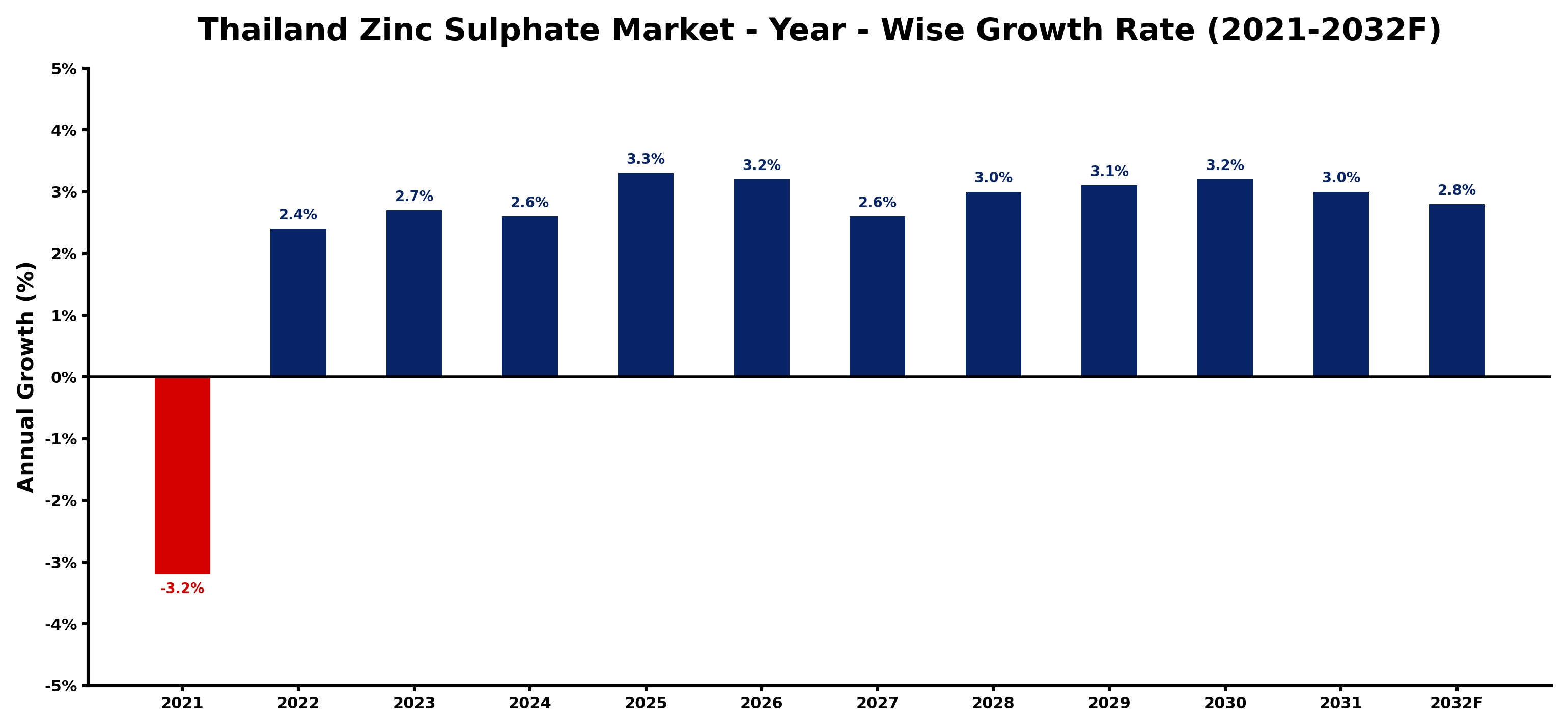
The table below presents the year‑wise growth rates along with the key drivers influencing the market
| Year | Growth Rate | Major Drivers |
| 2021 | -3.2% | Supply chain disruptions limited availability |
| 2022 | 2.4% | Agricultural sector recovery stimulated demand |
| 2023 | 2.7% | Increased fertilizer usage drove consumption |
| 2024 | 2.6% | Industrial activity supported growth |
| 2025 | 3.3% | Sustainable farming practices gained popularity |
| 2026 | 3.2% | Export opportunities enhanced market growth |
| 2027 | 2.6% | Technological advancements improved production efficiency |
| 2028 | 3.0% | Organic farming trends increased usage |
| 2029 | 3.1% | Government initiatives supported agricultural growth |
| 2030 | 3.2% | Rising population boosted agricultural needs |
| 2031 | 3.0% | Consumer health trends drove demand |
| 2032 | 2.8% | Innovative product formulations attracted interest |
Note - Market size estimations and growth projections presented in this report are based on 6Wresearch’s advanced forecasting approach, validated with industry datasets as of June 2026.
Thailand Zinc Sulphate Market Synopsis
The most significant force currently shaping the Thailand Zinc Sulphate Market is its expanding use as a fertilizer in the agricultural sector. As farmers seek to improve soil health and boost agricultural productivity, the demand for high-quality zinc sulphate continues to grow.
Furthermore, industrial applications such as water treatment and pharmaceuticals are augmenting the market's growth. As a critical component in animal feed supplements, the rise in livestock farming in Thailand also contributes to a robust demand for zinc sulphate.
Thailand Zinc Sulphate Market Key Takeaways
- The market is anticipated to grow steadily, driven by agricultural and industrial needs.
- Urbanization and population growth play a pivotal role in demand expansion.
- Innovations in agricultural practices highlight the importance of micronutrients like zinc.
- Regulatory pressures for sustainable practices could reshape production methodologies.
- The market landscape is influenced by fluctuations in raw material supply.
Evaluation of Restraints in Thailand Zinc Sulphate Market
While the Thailand Zinc Sulphate Market holds considerable potential, it is not without its challenges. Environmental regulations are becoming increasingly stringent, impacting production and operational costs. Manufacturers must navigate a landscape that demands cleaner technologies and responsible sourcing of raw materials. These requirements not only impose financial burdens but also complicate supply chains, making it essential for companies to invest in sustainable practices while striving to maintain competitiveness.
Thailand Zinc Sulphate Market Trends
Current trends indicate a robust shift towards sustainable agriculture, where the use of micronutrients, including zinc, is gaining traction. Advances in zinc sulphate formulations are also emerging, enabling greater efficacy and user-friendliness. Moreover, with the rise of organic farming practices, the demand for high-quality, environmentally-friendly zinc sulphate products is expected to escalate, aligning with the global trend towards sustainability.
Thailand Zinc Sulphate Market Opportunities
Opportunities for growth within the Thailand Zinc Sulphate Market are abundant. The burgeoning agricultural sector is a primary avenue, as farmers increasingly recognize the importance of micronutrient supplementation for enhancing crop yields. Additionally, sectors such as water treatment and pharmaceuticals are anticipated to create new avenues for zinc sulphate applications. Investments in research and development of innovative products that cater to specific industrial requirements present lucrative prospects for market players.
Government Initiatives in the Thailand Zinc Sulphate Market
The Thai government has been proactive in promoting sustainable agricultural practices and enhancing the quality of local produce. Policies that encourage the use of micronutrients in fertilizers are likely to stimulate growth in the zinc sulphate market. Public initiatives focused on agricultural productivity enhancement reflect a commitment to improving food security, which directly impacts demand for zinc supplements. Moreover, government spending on agricultural infrastructure is expected to facilitate greater access to quality inputs, including zinc sulphate.
Future Insights of the Thailand Zinc Sulphate Market
Looking ahead to the 2026-2032 timeframe, the Thailand Zinc Sulphate Market is positioned for steady growth. The combined forces of urbanization and agricultural modernization will likely bolster demand. As industries pivot toward sustainable practices, market participants who innovate in product development and adhere to environmental regulations will be best positioned to capitalize on growth opportunities. The ongoing rise of the agricultural sector, coupled with advancements in industrial applications, heralds a promising future for zinc sulphate in Thailand.
Thailand Zinc Sulphate Market Latest Developments (May 2025 - June 2026)
In recent months, there has been a notable shift in production strategies within the Thailand Zinc Sulphate Market, with several manufacturers enhancing their focus on sustainable sourcing practices. Additionally, collaborative efforts between agricultural stakeholders have emerged to promote the efficient use of zinc in crop production. Innovations aimed at improving the effectiveness of zinc sulphate in various applications are also on the rise, highlighting the industry's commitment to advancing product quality and sustainability.
Thailand Zinc Sulphate Market - Key Attractiveness of the Report
- 10 Years of Market Numbers
- Historical Data Starting from 2022 to 2025
- Base Year: 2025
- Forecast Data until 2032
- Key Performance Indicators Impacting the Market
- Major Upcoming Developments and Projects
Key Highlights of the Report:
- Thailand Zinc Sulphate Market Outlook
- Market Size of Thailand Zinc Sulphate Market, 2025
- Forecast of Thailand Zinc Sulphate Market, 2032
- Historical Data and Forecast of Thailand Zinc Sulphate Revenues & Volume for the Period 2022-2032F
- Thailand Zinc Sulphate Market Trend Evolution
- Thailand Zinc Sulphate Market Drivers and Challenges
- Thailand Zinc Sulphate Price Trends
- Thailand Zinc Sulphate Porter's Five Forces
- Thailand Zinc Sulphate Industry Life Cycle
- Historical Data and Forecast of Thailand Zinc Sulphate Market Revenues & Volume By Type for the Period 2022-2032F
- Historical Data and Forecast of Thailand Zinc Sulphate Market Revenues & Volume By Zinc Sulphate Anhydrous for the Period 2022-2032F
- Historical Data and Forecast of Thailand Zinc Sulphate Market Revenues & Volume By Zinc Sulphate Hexahydrate for the Period 2022-2032F
- Historical Data and Forecast of Thailand Zinc Sulphate Market Revenues & Volume By Zinc Sulphate Heptahydrate for the Period 2022-2032F
- Historical Data and Forecast of Thailand Zinc Sulphate Market Revenues & Volume By Zinc Sulphate Monohydrate for the Period 2022-2032F
- Historical Data and Forecast of Thailand Zinc Sulphate Market Revenues & Volume By Application for the Period 2022-2032F
- Historical Data and Forecast of Thailand Zinc Sulphate Market Revenues & Volume By Agrochemicals for the Period 2022-2032F
- Historical Data and Forecast of Thailand Zinc Sulphate Market Revenues & Volume By Chemicals for the Period 2022-2032F
- Historical Data and Forecast of Thailand Zinc Sulphate Market Revenues & Volume By Pharmaceuticals for the Period 2022-2032F
- Historical Data and Forecast of Thailand Zinc Sulphate Market Revenues & Volume By Synthetic Fibers for the Period 2022-2032F
- Historical Data and Forecast of Thailand Zinc Sulphate Market Revenues & Volume By Water Treatment for the Period 2022-2032F
- Historical Data and Forecast of Thailand Zinc Sulphate Market Revenues & Volume By Others for the Period 2022-2032F
- Thailand Zinc Sulphate Import Export Trade Statistics
- Market Opportunity Assessment By Type
- Market Opportunity Assessment By Application
- Thailand Zinc Sulphate Top Companies Market Share
- Thailand Zinc Sulphate Competitive Benchmarking By Technical and Operational Parameters
- Thailand Zinc Sulphate Company Profiles
- Thailand Zinc Sulphate Key Strategic Recommendations






































