Tunisia 5G Core Market Size, Share & Growth Rate
The Tunisia 5G Core Market was estimated at USD 359 Million in 2025 and is projected to reach USD 485 Million by 2032, growing at a CAGR of 4.4% from 2026 to 2032. This trajectory is primarily driven by the increasing demand for high-speed connectivity and the rapid digital transformation across various sectors in Tunisia. As mobile operators enhance their core networks to cater to emerging technologies and consumer needs, investments are surging, paving the way for a robust 5G infrastructure.
Tunisia 5G Core Market Year-wise Growth Rate and Key Drivers
This graph highlights how the Tunisia 5G Core Market has steadily grown over the years, supported by major growth factors.
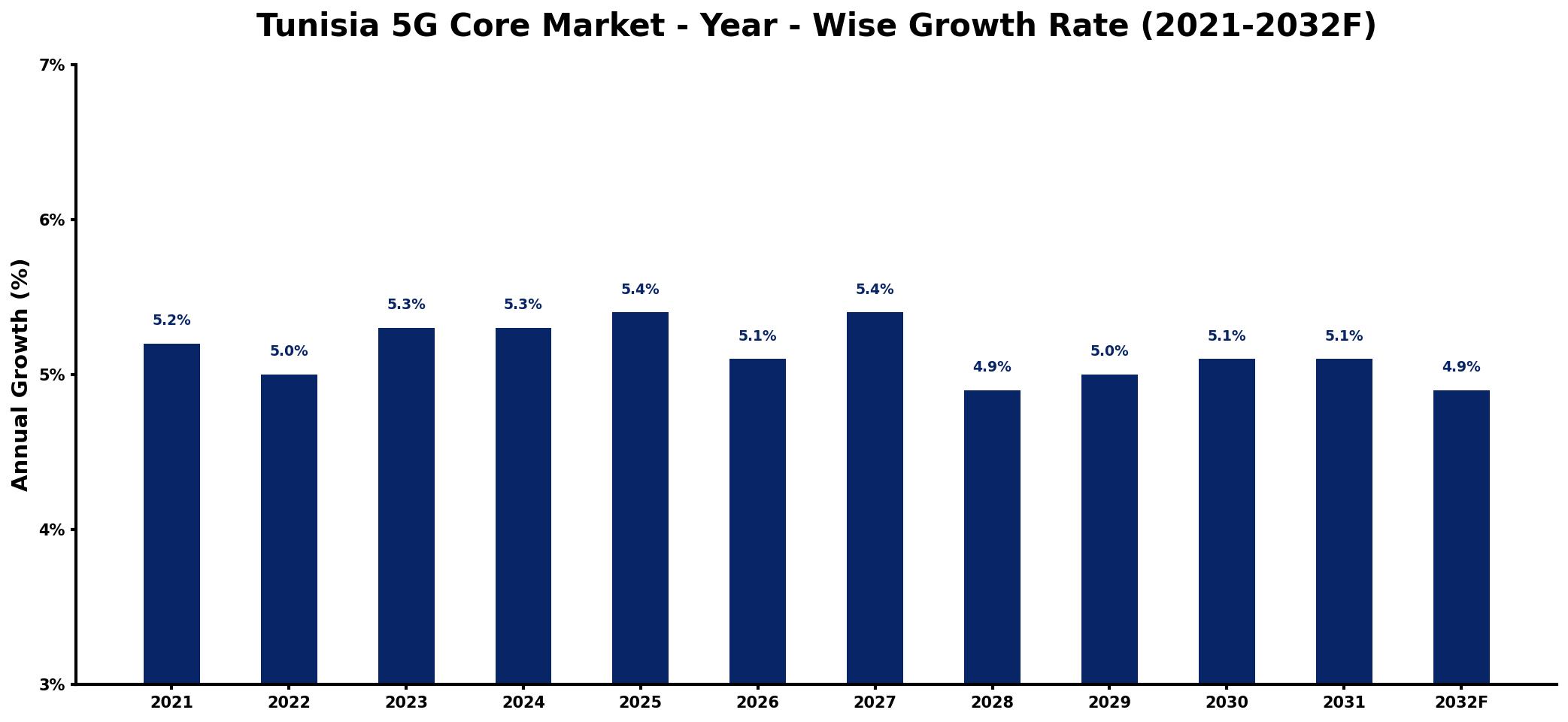
The table below presents the year‑wise growth rates along with the key drivers influencing the market
| Year | Growth Rate | Major Drivers |
| 2021 | 5.2% | Rising demand for connectivity solutions |
| 2022 | 5.0% | Increased investment in infrastructure development |
| 2023 | 5.3% | Expansion of mobile data services |
| 2024 | 5.3% | Growth in IoT applications adoption |
| 2025 | 5.4% | Surge in digital transformation initiatives |
| 2026 | 5.1% | Enhancement of urban smart technologies |
| 2027 | 5.4% | Development of new telecom partnerships |
| 2028 | 4.9% | Emergence of new service providers |
| 2029 | 5.0% | Advancements in network technology innovations |
| 2030 | 5.1% | rising procurement volume requirements |
| 2031 | 5.1% | expanding industrial usage applications |
| 2032 | 4.9% | Investment in cybersecurity solutions |
Note: Market size estimations and growth projections presented in this report are based on 6Wresearch's proprietary forecasting methodology, utilizing the latest available industry data, government publications, and primary research inputs.
Tunisia 5G Core Market Synopsis
Recent momentum in the Tunisia 5G Core Market reflects a robust shift towards the deployment of advanced mobile networks. With mobile operators now focused on developing sophisticated 5G core solutions, the landscape is set for substantial growth. The market is poised to evolve, creating opportunities for service diversification and enhanced connectivity, especially as industries such as healthcare and manufacturing begin to leverage these advancements.
Looking ahead, the ongoing investments in infrastructure coupled with government support signal a future where 5G technology significantly alters the operational paradigm. As the core market continues to mature, it is expected to facilitate groundbreaking applications in smart cities, IoT, and beyond, establishing Tunisia as a competitive player in the digital economy.
Tunisia 5G Core Market Key Takeaways
- The market is characterized by a strong commitment to infrastructure investment by mobile operators.
- Key trends include the deployment of standalone networks and an emphasis on network slicing for tailored services.
- Cloud-native architecture is gaining traction, enhancing flexibility and scalability within network operations.
- Government initiatives are crucial in facilitating the rollout and adoption of 5G technology.
- Investment opportunities are broad, spanning network equipment to software development focused on 5G applications.
Evaluation of Restraints in Tunisia 5G Core Market
Despite its promising outlook, the Tunisia 5G Core Market faces notable restraints that may limit its growth potential. Chief among these is the substantial capital investment required to upgrade existing infrastructure and deploy new technologies. Additionally, the scarcity of available spectrum presents a significant hurdle, potentially delaying the rollout of reliable 5G networks. Furthermore, navigating regulatory frameworks to ensure compliance with security and privacy standards poses an ongoing challenge. Collaborative efforts among telecommunications providers, government bodies, and industry stakeholders will be essential to address these impediments and foster a conducive environment for 5G adoption.
Tunisia 5G Core Market Trends
The Tunisia 5G Core Market is currently witnessing pivotal trends that are reshaping its landscape. One notable trend is the increasing focus on the deployment of standalone 5G networks, which offer greater efficiency and customization capabilities. Additionally, the practice of network slicing is gaining popularity, allowing for specialized service offerings tailored to diverse customer segments. The transition to cloud-native architectures is enhancing the scalability and adaptability of core networks, thereby supporting a wider range of applications and services. Furthermore, a shift towards automation and virtualization is simplifying network operations, ultimately leading to cost savings and improved service delivery.
Tunisia 5G Core Market Opportunities
Investment opportunities within the Tunisia 5G Core Market are abundant and varied. As the demand for 5G networks accelerates, there is a pressing need for innovative technology solutions and infrastructure development. Investors can tap into opportunities presented by network equipment providers and telecom firms that are focusing on next-generation 5G core technologies. Moreover, substantial growth potential exists in sectors such as data centers and fiber optics infrastructure, essential for supporting the burgeoning demand for high-speed connectivity. With the promise of enhanced services and increased network capacity, the market offers promising prospects for those looking to engage in Tunisia's digital evolution.
Government Initiatives in the Tunisia 5G Core Market
The Tunisian government is actively fostering the growth of 5G technology, evidenced by its strategic initiatives aimed at promoting digital transformation. The auction of 5G spectrum licenses to telecom operators in 2020 exemplifies the government's commitment to expediting network deployment. Additionally, regulatory frameworks are being established to enhance the security and privacy of 5G networks, addressing essential concerns around data protection and cybersecurity. Collaborative engagements with industry stakeholders reflect the government's proactive approach to facilitating investment in 5G infrastructure, thereby positioning Tunisia to reap the benefits of this transformative technology.
Future Insights of the Tunisia 5G Core Market
The future of the Tunisia 5G Core Market looks exceedingly bright as adoption of 5G technology is set to increase steadily. With telecom operators committed to upgrading their network infrastructures, there will be a marked surge in the demand for enhanced mobile broadband services and low-latency connectivity. The anticipated expansion into sectors such as smart cities and healthcare will further drive the adoption of 5G core solutions. Government policies aimed at nurturing innovation and investment are expected to catalyze growth, ensuring that Tunisia remains at the forefront of the digital transformation journey through 2032 and beyond.
Tunisia 5G Core Market Latest Developments (2025 - 2026)
Recent developments in the Tunisia 5G Core Market indicate a strong focus on advancing network infrastructure. The trend towards virtualization and cloud-based services has gained traction, enabling more agile and efficient network operations. Operators are beginning to pilot innovative applications that leverage 5G capabilities, particularly in areas like healthcare and smart cities. Furthermore, ongoing government engagements with telecom stakeholders aim to streamline regulatory processes, paving the way for a smoother rollout of new services. These developments underscore the vibrancy and dynamic nature of the market as it evolves to meet consumer and enterprise demands.
Tunisia 5G Core Market - Key Attractiveness of the Report
- 10 Years of Market Numbers
- Historical Data Starting from 2022 to 2025
- Base Year: 2025
- Forecast Data until 2032
- Key Performance Indicators Impacting the Market
- Major Upcoming Developments and Projects
Key Highlights of the Report:
- Tunisia 5G Core Market Outlook
- Market Size of Tunisia 5G Core Market, 2025
- Forecast of Tunisia 5G Core Market, 2032
- Historical Data and Forecast of Tunisia 5G Core Revenues & Volume for the Period 2022-2032F
- Tunisia 5G Core Market Trend Evolution
- Tunisia 5G Core Market Drivers and Challenges
- Tunisia 5G Core Price Trends
- Tunisia 5G Core Porter's Five Forces
- Tunisia 5G Core Industry Life Cycle
- Historical Data and Forecast of Tunisia 5G Core Market Revenues & Volume By Component for the Period 2022-2032F
- Historical Data and Forecast of Tunisia 5G Core Market Revenues & Volume By Solutions for the Period 2022-2032F
- Historical Data and Forecast of Tunisia 5G Core Market Revenues & Volume By Services for the Period 2022-2032F
- Historical Data and Forecast of Tunisia 5G Core Market Revenues & Volume By Network Function for the Period 2022-2032F
- Historical Data and Forecast of Tunisia 5G Core Market Revenues & Volume By Access for the Period 2022-2032F
- Historical Data and Forecast of Tunisia 5G Core Market Revenues & Volume By Mobility Management Function for the Period 2022-2032F
- Historical Data and Forecast of Tunisia 5G Core Market Revenues & Volume By Policy Control Function for the Period 2022-2032F
- Historical Data and Forecast of Tunisia 5G Core Market Revenues & Volume By Unified Data Management for the Period 2022-2032F
- Historical Data and Forecast of Tunisia 5G Core Market Revenues & Volume By Deployment Model for the Period 2022-2032F
- Historical Data and Forecast of Tunisia 5G Core Market Revenues & Volume By Cloud for the Period 2022-2032F
- Historical Data and Forecast of Tunisia 5G Core Market Revenues & Volume By On-premises for the Period 2022-2032F
- Historical Data and Forecast of Tunisia 5G Core Market Revenues & Volume By End User for the Period 2022-2032F
- Historical Data and Forecast of Tunisia 5G Core Market Revenues & Volume By Telecom Operators for the Period 2022-2032F
- Historical Data and Forecast of Tunisia 5G Core Market Revenues & Volume By Enterprises for the Period 2022-2032F
- Tunisia 5G Core Import Export Trade Statistics
- Market Opportunity Assessment By Component
- Market Opportunity Assessment By Network Function
- Market Opportunity Assessment By Deployment Model
- Market Opportunity Assessment By End User
- Tunisia 5G Core Top Companies Market Share
- Tunisia 5G Core Competitive Benchmarking By Technical and Operational Parameters
- Tunisia 5G Core Company Profiles
- Tunisia 5G Core Key Strategic Recommendations






































