Tunisia Advertising Market Size, Share & Growth Rate
The Tunisia Advertising Market was estimated at USD 288 Million in 2025 and is projected to reach USD 392 Million by 2032, growing at a CAGR of 4.5% from 2026 to 2032. This growth trajectory is primarily driven by the rapid shift towards digital platforms as internet connectivity and smartphone usage rise among the Tunisian population. Furthermore, localized advertising strategies are increasingly resonating with consumers, enhancing engagement and effectiveness in reaching diverse target demographics.
Tunisia Advertising Market Year-wise Growth Rate and Key Drivers
This graph highlights how the Tunisia Advertising Market has steadily grown over the years, supported by major growth factors.
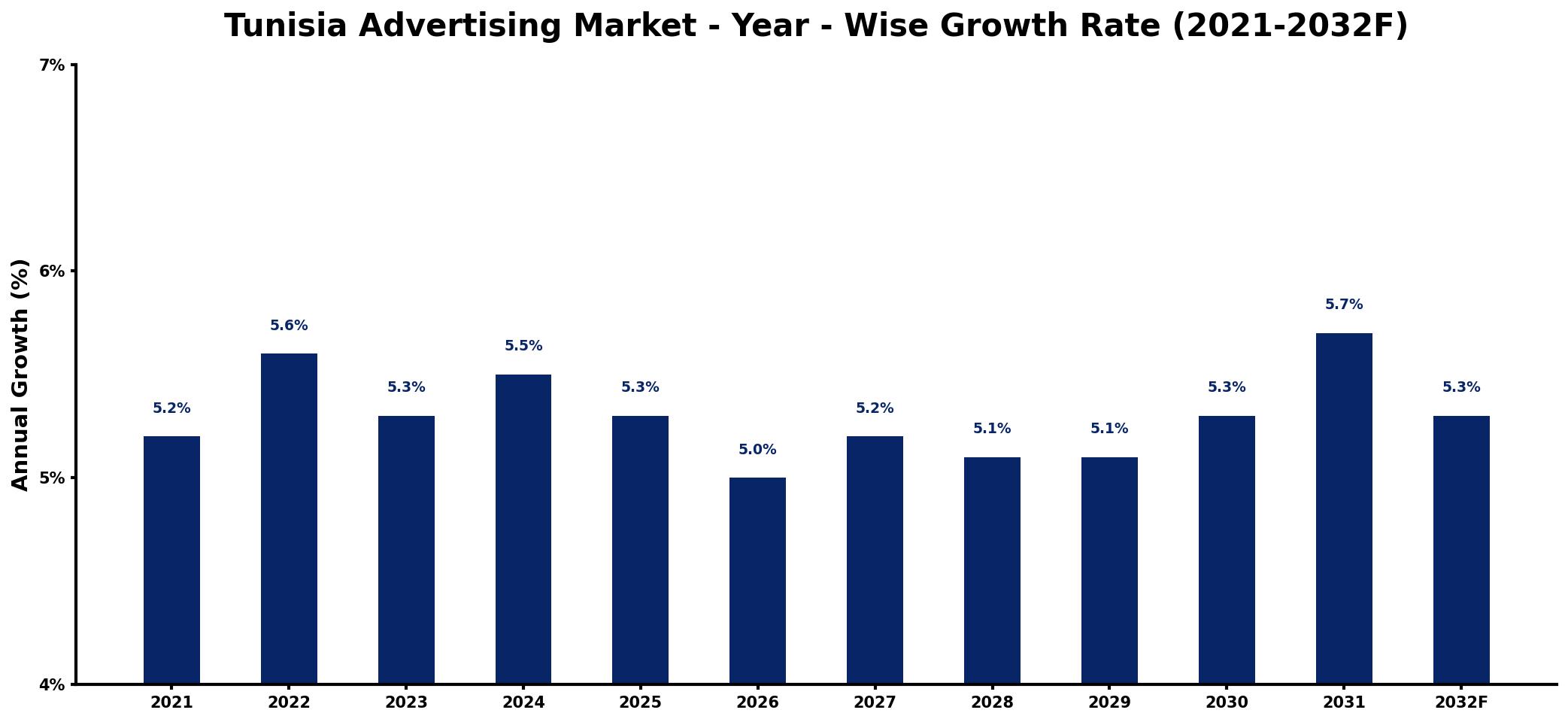
The table below presents the year‑wise growth rates along with the key drivers influencing the market
| Year | Growth Rate | Major Drivers |
| 2021 | 5.2% | Rising digital media consumption |
| 2022 | 5.6% | Increased marketing technology adoption |
| 2023 | 5.3% | Growing e-commerce platforms usage |
| 2024 | 5.5% | Expansion of mobile internet access |
| 2025 | 5.3% | Higher social media engagement rates |
| 2026 | 5.0% | Investment in local content production |
| 2027 | 5.2% | Emergence of influencer partnerships |
| 2028 | 5.1% | Diversification of marketing strategies |
| 2029 | 5.1% | Strengthening brand loyalty programs |
| 2030 | 5.3% | Enhancement of customer experience initiatives |
| 2031 | 5.7% | Boost in small business marketing |
| 2032 | 5.3% | Rise of data-driven insights |
Note: Market size estimations and growth projections presented in this report are based on 6Wresearch's proprietary forecasting methodology, utilizing the latest available industry data, government publications, and primary research inputs.
Tunisia Advertising Market Synopsis
Digital advertising is the strongest force shaping the Tunisia Advertising Market today. As more Tunisians gain access to the internet and mobile technology, brands are pivoting their marketing strategies to harness these new digital channels. This evolution presents both challenges and opportunities, urging advertisers to adapt to the shifting landscape.
Traditional media still play a significant role in the market, particularly television and print, yet they are increasingly complemented by digital channels. The interplay between various media types allows advertisers to craft more comprehensive campaigns that leverage the strengths of each platform while catering to the unique preferences of Tunisian consumers.
Tunisia Advertising Market Key Takeaways
- Strong growth in the digital advertising sector, fueled by rising smartphone and internet penetration.
- Localized marketing strategies are essential for effective audience engagement.
- Investment opportunities are abundant in digital platforms and experiential marketing.
- Regulatory oversight by the Advertising Regulatory Authority ensures compliance and ethical practices.
- Competition is intensifying as new entrants and established players adapt their advertising budgets to capture market share.
Evaluation of Restraints in Tunisia Advertising Market
Despite its growth potential, the Tunisia Advertising Market faces certain limitations that may hinder progress. A significant concern is the lack of reliable data for measuring advertising effectiveness, which complicates campaign evaluations for advertisers. This gap in data can lead to less informed decision-making and inefficient allocation of marketing resources. Additionally, the continuously evolving competitive landscape heightens the challenge of maintaining visibility and resonance in the market. Economic fluctuations and occasional political instability further exacerbate uncertainty, making strategic planning increasingly complex for advertisers in Tunisia.
Tunisia Advertising Market Trends
The advertising landscape in Tunisia is witnessing transformative trends. Digital channels, particularly social media, are becoming preferred platforms for brands seeking to engage with consumers. Influencer marketing is on the rise as brands leverage the reach and credibility of social media personalities to promote their offerings. The use of data-driven strategies is also gaining traction, enabling advertisers to optimize campaigns and enhance their targeting capabilities. Meanwhile, traditional media like television continue to play a crucial role, but their growth rate is slower compared to the booming digital sector.
Tunisia Advertising Market Opportunities
Investment opportunities in the Tunisia Advertising Market are diverse and promising. Digital advertising solutions tailored to the local context stand out as particularly lucrative due to the high number of digitally-savvy consumers. Additionally, out-of-home advertising avenues, such as billboards and transit ads, present viable options for visibility. Event sponsorships and experiential marketing activations offer unique opportunities to create memorable brand experiences. As brands increasingly recognize Tunisias strategic position as a gateway to North Africa and Europe, there is a greater incentive to invest in innovative strategies that resonate culturally and drive consumer engagement.
Government Initiatives in the Tunisia Advertising Market
The advertising market in Tunisia is regulated by the Advertising Law enacted in 1992, which ensures that advertising practices adhere to ethical standards. The Advertising Regulatory Authority (ARP) plays a crucial role in monitoring compliance with these regulations. It evaluates advertising content and practices across various media channels, aiming to foster a trustworthy advertising environment. The government's commitment to upholding these standards aims to protect consumer interests while supporting the overall growth of the advertising sector.
Future Insights of the Tunisia Advertising Market
Looking ahead to 2026-2032, the Tunisia Advertising Market is poised for steady growth, primarily driven by advancements in digital advertising and the expanding middle class with greater purchasing power. Digital formats, particularly through social media and online video, are expected to dominate, although traditional channels will continue to hold relevance. Moreover, proactive government initiatives to attract foreign investment will likely stimulate advertising spending, further enriching the market's dynamics. Advertisers will need to continuously adapt to evolving consumer preferences and technological advancements to effectively capture the attention of their target audience.
Tunisia Advertising Market Latest Developments (2025 - 2026)
Recent developments in the Tunisia advertising sector indicate a continued shift towards digital platforms, with brands increasingly prioritizing online engagement strategies. Social media campaigns are being designed with greater focus on interactivity and community involvement. Moreover, various brands are exploring partnerships with local influencers to enhance their outreach. The regulatory landscape remains dynamic, as the Advertising Regulatory Authority actively engages with stakeholders to refine compliance standards and practices, ensuring the market's integrity.
Tunisia Advertising Market - Key Attractiveness of the Report
- 10 Years of Market Numbers
- Historical Data Starting from 2022 to 2025
- Base Year: 2025
- Forecast Data until 2032
- Key Performance Indicators Impacting the Market
- Major Upcoming Developments and Projects
Key Highlights of the Report:
- Tunisia Advertising Market Outlook
- Market Size of Tunisia Advertising Market, 2025
- Forecast of Tunisia Advertising Market, 2032
- Historical Data and Forecast of Tunisia Advertising Revenues & Volume for the Period 2022-2032F
- Tunisia Advertising Market Trend Evolution
- Tunisia Advertising Market Drivers and Challenges
- Tunisia Advertising Price Trends
- Tunisia Advertising Porter's Five Forces
- Tunisia Advertising Industry Life Cycle
- Historical Data and Forecast of Tunisia Advertising Market Revenues & Volume By Type for the Period 2022-2032F
- Historical Data and Forecast of Tunisia Advertising Market Revenues & Volume By Television for the Period 2022-2032F
- Historical Data and Forecast of Tunisia Advertising Market Revenues & Volume By Print (Newspaper and Magazine) for the Period 2022-2032F
- Historical Data and Forecast of Tunisia Advertising Market Revenues & Volume By Radio for the Period 2022-2032F
- Historical Data and Forecast of Tunisia Advertising Market Revenues & Volume By Outdoor for the Period 2022-2032F
- Historical Data and Forecast of Tunisia Advertising Market Revenues & Volume By Internet (Search, Display, Classified, Video) for the Period 2022-2032F
- Historical Data and Forecast of Tunisia Advertising Market Revenues & Volume By Mobile for the Period 2022-2032F
- Historical Data and Forecast of Tunisia Advertising Market Revenues & Volume By Cinema for the Period 2022-2032F
- Tunisia Advertising Import Export Trade Statistics
- Market Opportunity Assessment By Type
- Tunisia Advertising Top Companies Market Share
- Tunisia Advertising Competitive Benchmarking By Technical and Operational Parameters
- Tunisia Advertising Company Profiles
- Tunisia Advertising Key Strategic Recommendations






































