Tunisia Auto Parts And Accessories Market Size, Share & Growth Rate
The Tunisia Auto Parts And Accessories Market was estimated at USD 406 Million in 2025 and is projected to reach USD 537 Million by 2032, growing at a CAGR of 4.1% from 2026 to 2032. This growth trajectory is primarily fueled by increasing vehicle ownership, spurred by rising disposable incomes among consumers. Additionally, a burgeoning automotive industry, backed by supportive government policies aimed at local manufacturing, is further enhancing market dynamics.
Tunisia Auto Parts And Accessories Market Year-wise Growth Rate and Key Drivers
This graph highlights how the Tunisia Auto Parts And Accessories Market has steadily grown over the years, supported by major growth factors.
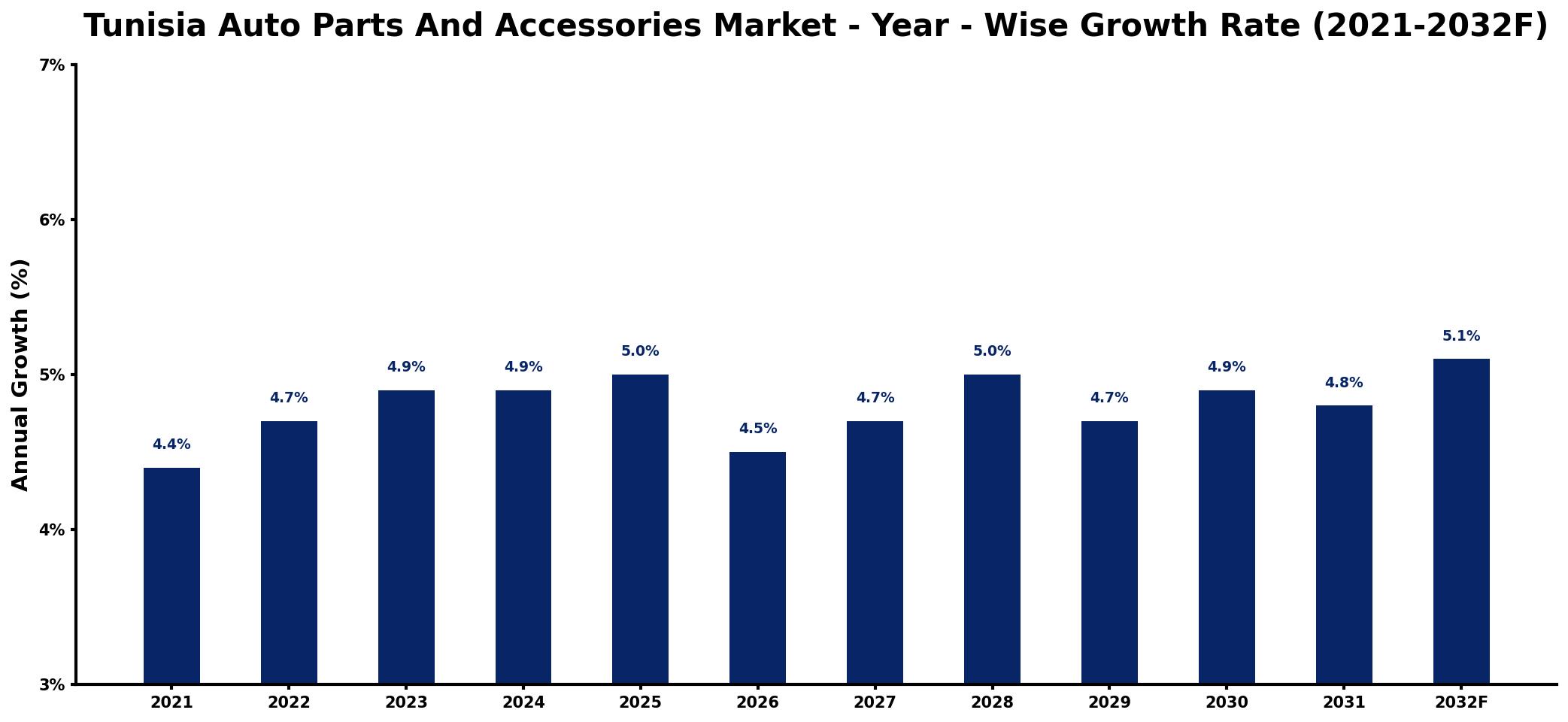
The table below presents the year‑wise growth rates along with the key drivers influencing the market
| Year | Growth Rate | Major Drivers |
| 2021 | 4.4% | Rising consumer vehicle ownership |
| 2022 | 4.7% | Increased domestic manufacturing capacity |
| 2023 | 4.9% | Growth in e-commerce platforms |
| 2024 | 4.9% | Expansion of distribution networks |
| 2025 | 5.0% | Investment in renewable energy vehicles |
| 2026 | 4.5% | Boost in repair service demand |
| 2027 | 4.7% | Technological advancements in vehicles |
| 2028 | 5.0% | Surge in vehicle export opportunities |
| 2029 | 4.7% | Growing interest in electric vehicles |
| 2030 | 4.9% | Enhancements in logistics efficiency |
| 2031 | 4.8% | Rising urbanization and infrastructure |
| 2032 | 5.1% | Increased focus on sustainability initiatives |
Note: Market size estimations and growth projections presented in this report are based on 6Wresearch's proprietary forecasting methodology, utilizing the latest available industry data, government publications, and primary research inputs.
Tunisia Auto Parts And Accessories Market Synopsis
The most significant force currently shaping the Tunisia Auto Parts and Accessories Market is the robust expansion of the automotive sector. As vehicle sales surge, the demand for a diverse array of auto parts—ranging from engine components to eco-friendly accessories—has intensified, creating a vibrant marketplace.
Complementing this growth is a clear shift towards sustainability and innovation. Consumers are increasingly favoring electric vehicle parts and advanced technology solutions, driven by both environmental considerations and government incentives that bolster electric mobility initiatives.
Tunisia Auto Parts And Accessories Market Key Takeaways
- The market is benefiting from a rising trend towards local manufacturing, supported by government initiatives.
- Increased consumer awareness of environmental issues is spurring demand for electric vehicle components.
- Online sales channels are gaining traction as consumers seek convenience and variety in purchasing auto parts.
- Technological advancements, including 3D printing, are paving the way for rapid prototyping and customization of auto parts.
- Investment in research and development is crucial for introducing innovative products tailored to evolving consumer needs.
Evaluation of Restraints in Tunisia Auto Parts And Accessories Market
Despite its promising outlook, the Tunisia Auto Parts and Accessories Market faces several restraints that could hinder its potential. The competition from both local and international suppliers is intense, often compressing margins and pressuring prices. Additionally, the market is grappling with issues surrounding counterfeit products, which undermine customer trust and brand integrity. Access to financing remains a significant hurdle for many local manufacturers, limiting their capacity for growth and innovation. Lastly, fluctuations in currency exchange rates and stringent import regulations present ongoing challenges for businesses reliant on imported auto parts.
Tunisia Auto Parts And Accessories Market Trends
Several key trends are shaping the Tunisia Auto Parts and Accessories Market. The increasing demand for eco-friendly components reflects a broader global push towards sustainability. Meanwhile, consumers are gravitating towards online shopping platforms, favoring the convenience and extensive selection these channels offer. Furthermore, advancements in manufacturing technologies, such as additive manufacturing, are revolutionizing how auto parts are produced, allowing for quicker and more efficient design iterations. This trend aligns with the growing consumer preference for customized and specialized vehicle accessories.
Tunisia Auto Parts And Accessories Market Opportunities
The Tunisia Auto Parts and Accessories Market presents numerous investment opportunities for local and international stakeholders. The steady growth in vehicle ownership indicates a sustained demand for high-quality auto parts, which makes establishing manufacturing facilities and distribution networks a lucrative venture. Additionally, collaborating with local manufacturers can create competitive advantages, particularly as the market pivots toward innovative and specialized products. Investment in research and development will be vital for companies seeking to address the rapidly evolving demands of the consumer base.
Government Initiatives in the Tunisia Auto Parts And Accessories Market
The Tunisian government is actively promoting the auto parts and accessories market through various initiatives aimed at bolstering local production and reducing reliance on imports. Policies include financial incentives, such as tax breaks for domestic manufacturers, aimed at encouraging local assembly and production of auto parts. Additionally, regulatory measures are in place to uphold quality and safety standards for auto components sold in the market. Import tariffs are strategically implemented to protect and nurture domestic producers, creating a more competitive landscape for local businesses.
Future Insights of the Tunisia Auto Parts And Accessories Market
Looking forward to the period between 2026 and 2032, the Tunisia Auto Parts and Accessories Market is anticipated to experience steady growth. Factors such as rising disposable income, improved road infrastructure, and increasing vehicle customization trends are expected to drive demand for auto parts and accessories. Moreover, government efforts to promote the automotive industry are likely to enhance the local manufacturing landscape, enabling businesses to thrive. However, companies must remain vigilant and adaptable to potential market fluctuations and consumer shifts to maintain competitive advantages.
Tunisia Auto Parts And Accessories Market Latest Developments (2025 - 2026)
Recent developments in the Tunisia Auto Parts and Accessories Market indicate a growing emphasis on sustainable practices and innovative solutions. Businesses are increasingly exploring partnerships aimed at enhancing supply chain efficiency and product quality. Furthermore, advancements in online retailing are reshaping how consumers access auto parts, prompting companies to invest in digital marketing strategies. Regulatory changes aimed at enhancing quality standards are also coming into effect, reflecting the government's commitment to elevating the market's overall standards.
Tunisia Auto Parts And Accessories Market - Key Attractiveness of the Report
- 10 Years of Market Numbers
- Historical Data Starting from 2022 to 2025
- Base Year: 2025
- Forecast Data until 2032
- Key Performance Indicators Impacting the Market
- Major Upcoming Developments and Projects
Key Highlights of the Report:
- Tunisia Auto Parts And Accessories Market Outlook
- Market Size of Tunisia Auto Parts And Accessories Market, 2025
- Forecast of Tunisia Auto Parts And Accessories Market, 2032
- Historical Data and Forecast of Tunisia Auto Parts And Accessories Revenues & Volume for the Period 2022-2032F
- Tunisia Auto Parts And Accessories Market Trend Evolution
- Tunisia Auto Parts And Accessories Market Drivers and Challenges
- Tunisia Auto Parts And Accessories Price Trends
- Tunisia Auto Parts And Accessories Porter's Five Forces
- Tunisia Auto Parts And Accessories Industry Life Cycle
- Historical Data and Forecast of Tunisia Auto Parts And Accessories Market Revenues & Volume By Product for the Period 2022-2032F
- Historical Data and Forecast of Tunisia Auto Parts And Accessories Market Revenues & Volume By Driveline & Powertrain for the Period 2022-2032F
- Historical Data and Forecast of Tunisia Auto Parts And Accessories Market Revenues & Volume By Interiors & Exteriors for the Period 2022-2032F
- Historical Data and Forecast of Tunisia Auto Parts And Accessories Market Revenues & Volume By Electronics for the Period 2022-2032F
- Historical Data and Forecast of Tunisia Auto Parts And Accessories Market Revenues & Volume By Bodies & Chassis for the Period 2022-2032F
- Historical Data and Forecast of Tunisia Auto Parts And Accessories Market Revenues & Volume By Wheel & Tires for the Period 2022-2032F
- Historical Data and Forecast of Tunisia Auto Parts And Accessories Market Revenues & Volume By Others for the Period 2022-2032F
- Historical Data and Forecast of Tunisia Auto Parts And Accessories Market Revenues & Volume By Application for the Period 2022-2032F
- Historical Data and Forecast of Tunisia Auto Parts And Accessories Market Revenues & Volume By OEMs for the Period 2022-2032F
- Historical Data and Forecast of Tunisia Auto Parts And Accessories Market Revenues & Volume By Aftermarket for the Period 2022-2032F
- Tunisia Auto Parts And Accessories Import Export Trade Statistics
- Market Opportunity Assessment By Product
- Market Opportunity Assessment By Application
- Tunisia Auto Parts And Accessories Top Companies Market Share
- Tunisia Auto Parts And Accessories Competitive Benchmarking By Technical and Operational Parameters
- Tunisia Auto Parts And Accessories Company Profiles
- Tunisia Auto Parts And Accessories Key Strategic Recommendations






































