Tunisia Automotive Drive Shaft Market Size, Share & Growth Rate
The Tunisia Automotive Drive Shaft Market was estimated at USD 425 Million in 2025 and is projected to reach USD 581 Million by 2032, growing at a CAGR of 4.6% from 2026 to 2032. This growth trajectory is primarily fueled by the burgeoning automotive production in Tunisia, spurred by a rise in both local vehicle assembly and increased consumer demand for personal and commercial transport options. As manufacturers adapt to the evolving market, the focus on producing lightweight and fuel-efficient drive shafts further amplifies this upward trend.
Tunisia Automotive Drive Shaft Market Year-wise Growth Rate and Key Drivers
This graph highlights how the Tunisia Automotive Drive Shaft Market has steadily grown over the years, supported by major growth factors.
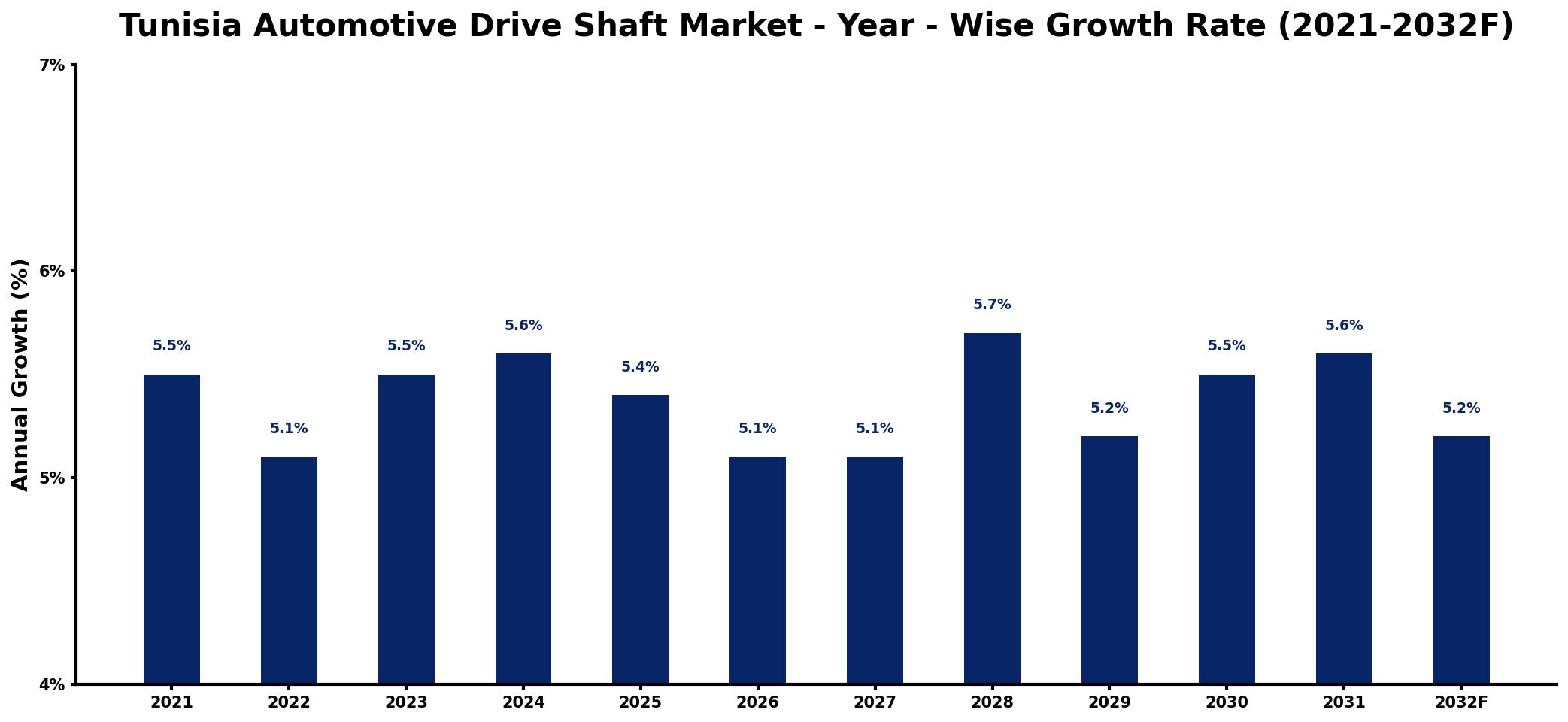
The table below presents the year‑wise growth rates along with the key drivers influencing the market
| Year | Growth Rate | Major Drivers |
| 2021 | 5.5% | Rising vehicle production volume |
| 2022 | 5.1% | Increased consumer purchasing power |
| 2023 | 5.5% | Expansion of transportation infrastructure |
| 2024 | 5.6% | Growth in aftermarket services |
| 2025 | 5.4% | Technological advancements in manufacturing |
| 2026 | 5.1% | Surge in electric vehicle adoption |
| 2027 | 5.1% | Strengthened local supply chains |
| 2028 | 5.7% | Investment in renewable technologies |
| 2029 | 5.2% | expanding manufacturing base activity |
| 2030 | 5.5% | Improved trade agreements benefits |
| 2031 | 5.6% | Development of urban mobility solutions |
| 2032 | 5.2% | Rise in export opportunities |
Note: Market size estimations and growth projections presented in this report are based on 6Wresearch's proprietary forecasting methodology, utilizing the latest available industry data, government publications, and primary research inputs.
Tunisia Automotive Drive Shaft Market Synopsis
In Tunisia, the automotive industry is expanding rapidly, creating a substantial demand for drive shafts. This growth is underscored by the local production of vehicles, which increasingly emphasizes fuel efficiency and performance—key attributes that drive the need for advanced drive shaft technologies.
The market landscape features a dominance of domestic manufacturers complemented by a few international players. With evolving consumer preferences favoring electric and hybrid vehicles, there is a notable shift in the drive shaft designs to accommodate these new powertrains, thereby enhancing the market's potential for innovation and expansion.
Tunisia Automotive Drive Shaft Market Key Takeaways
- Market is poised for growth with rising vehicle production and sales in Tunisia.
- Domestic manufacturers are adapting to increasing consumer preferences for lightweight, fuel-efficient drive shafts.
- Technological advancements are paving the way for advanced materials in drive shaft production.
- Government initiatives are enhancing local production and attracting foreign investments.
- The rise of electric and hybrid vehicles creates demand for specialized drive shaft solutions.
Evaluation of Restraints in Tunisia Automotive Drive Shaft Market
Despite its promising outlook, the Tunisia Automotive Drive Shaft Market faces several constraints that may hinder growth. High costs associated with raw materials and manufacturing processes pose significant challenges, leading to potential pricing pressures. Local manufacturers also contend with competition from imported drive shafts, which can capitalize on economies of scale. Additionally, maintaining quality control and adhering to international standards are critical for local firms aiming to compete globally. Fluctuating exchange rates and the broader economic climate further complicate consumer demand, impacting overall market stability.
Tunisia Automotive Drive Shaft Market Trends
Several trends are shaping the Tunisia Automotive Drive Shaft Market. A strong emphasis on lightweight and high-strength drive shafts has emerged, aimed at enhancing vehicle fuel efficiency. Manufacturers are increasingly investing in advanced materials, such as carbon fiber and aluminum, to achieve this goal without compromising durability. Moreover, the integration of smart technologies, including sensors for predictive maintenance, is gaining traction as it enhances overall vehicle performance and lowers long-term maintenance costs. The shift towards electric and hybrid vehicles is also influencing drive shaft design, necessitating the development of specialized components tailored to new powertrains.
Tunisia Automotive Drive Shaft Market Opportunities
The Tunisia Automotive Drive Shaft Market presents numerous opportunities for investment and growth. The escalating demand for vehicles indicates a favorable environment for manufacturers of high-quality drive shafts, particularly those targeting both local assembly plants and export markets. Moreover, the aftermarket for drive shafts is expanding, offering lucrative possibilities for suppliers catering to maintenance and replacement needs. Strategic collaborations with local automotive manufacturers and distribution partnerships can facilitate market entry, allowing businesses to tap into the promising developments within Tunisia's automotive landscape.
Government Initiatives in the Tunisia Automotive Drive Shaft Market
The Tunisian government has undertaken several initiatives to bolster the automotive sector, positively influencing the automotive drive shaft market. Policies aimed at attracting foreign investments and promoting local production capabilities are in place, with incentives such as tax breaks and streamlined regulations encouraging automotive manufacturers to establish operations in Tunisia. Additionally, the government has prioritized workforce development through vocational training programs, ensuring that the local workforce is equipped with the necessary skills to support the automotive industry's growth.
Future Insights of the Tunisia Automotive Drive Shaft Market
Looking ahead to 2026-2032, the Tunisia Automotive Drive Shaft Market is set to evolve in response to growing vehicle demand, technological innovations in manufacturing, and supportive government policies. As the production of passenger cars, commercial vehicles, and off-highway vehicles rises, the market is expected to align with the increasing emphasis on fuel efficiency and advanced vehicle performance. However, factors such as fluctuating raw material costs and heightened competition will require agile strategies from market players to maintain a competitive edge and sustain growth.
Tunisia Automotive Drive Shaft Market Latest Developments (2025 - 2026)
The automotive drive shaft market in Tunisia is witnessing significant developments, driven by advancements in manufacturing technologies and materials. New partnerships among local manufacturers are forming to innovate drive shaft solutions that meet the specific demands of modern vehicles, including electric models. Additionally, increased public and private investments in the automotive sector are supporting the expansion of manufacturing facilities and enhancing local production capabilities, setting the stage for robust market growth in the coming years.
Tunisia Automotive Drive Shaft Market - Key Attractiveness of the Report
- 10 Years of Market Numbers
- Historical Data Starting from 2022 to 2025
- Base Year: 2025
- Forecast Data until 2032
- Key Performance Indicators Impacting the Market
- Major Upcoming Developments and Projects
Key Highlights of the Report:
- Tunisia Automotive Drive Shaft Market Outlook
- Market Size of Tunisia Automotive Drive Shaft Market, 2025
- Forecast of Tunisia Automotive Drive Shaft Market, 2032
- Historical Data and Forecast of Tunisia Automotive Drive Shaft Revenues & Volume for the Period 2022-2032F
- Tunisia Automotive Drive Shaft Market Trend Evolution
- Tunisia Automotive Drive Shaft Market Drivers and Challenges
- Tunisia Automotive Drive Shaft Price Trends
- Tunisia Automotive Drive Shaft Porter's Five Forces
- Tunisia Automotive Drive Shaft Industry Life Cycle
- Historical Data and Forecast of Tunisia Automotive Drive Shaft Market Revenues & Volume By Design Type for the Period 2022-2032F
- Historical Data and Forecast of Tunisia Automotive Drive Shaft Market Revenues & Volume By Hollow Shaft for the Period 2022-2032F
- Historical Data and Forecast of Tunisia Automotive Drive Shaft Market Revenues & Volume By Solid Shaft for the Period 2022-2032F
- Historical Data and Forecast of Tunisia Automotive Drive Shaft Market Revenues & Volume By Position Type for the Period 2022-2032F
- Historical Data and Forecast of Tunisia Automotive Drive Shaft Market Revenues & Volume By Rear Axle for the Period 2022-2032F
- Historical Data and Forecast of Tunisia Automotive Drive Shaft Market Revenues & Volume By Front Axle for the Period 2022-2032F
- Historical Data and Forecast of Tunisia Automotive Drive Shaft Market Revenues & Volume By Vehicle Type for the Period 2022-2032F
- Historical Data and Forecast of Tunisia Automotive Drive Shaft Market Revenues & Volume By Passenger Cars for the Period 2022-2032F
- Historical Data and Forecast of Tunisia Automotive Drive Shaft Market Revenues & Volume By Commercial Vehicles for the Period 2022-2032F
- Tunisia Automotive Drive Shaft Import Export Trade Statistics
- Market Opportunity Assessment By Design Type
- Market Opportunity Assessment By Position Type
- Market Opportunity Assessment By Vehicle Type
- Tunisia Automotive Drive Shaft Top Companies Market Share
- Tunisia Automotive Drive Shaft Competitive Benchmarking By Technical and Operational Parameters
- Tunisia Automotive Drive Shaft Company Profiles
- Tunisia Automotive Drive Shaft Key Strategic Recommendations






































