Tunisia Barrier Systems Market Size, Share & Growth Rate
The Tunisia Barrier Systems Market was estimated at USD 325 Million in 2025 and is projected to reach USD 442 Million by 2032, growing at a CAGR of 4.5% from 2026 to 2032. This growth trajectory is predominantly fueled by the government's increased focus on enhancing road safety through infrastructural projects and the rising adoption of innovative barrier technologies. As urbanization accelerates, the demand for robust traffic management solutions will further propel market expansion.
Tunisia Barrier Systems Market Year-wise Growth Rate and Key Drivers
This graph highlights how the Tunisia Barrier Systems Market has steadily grown over the years, supported by major growth factors.
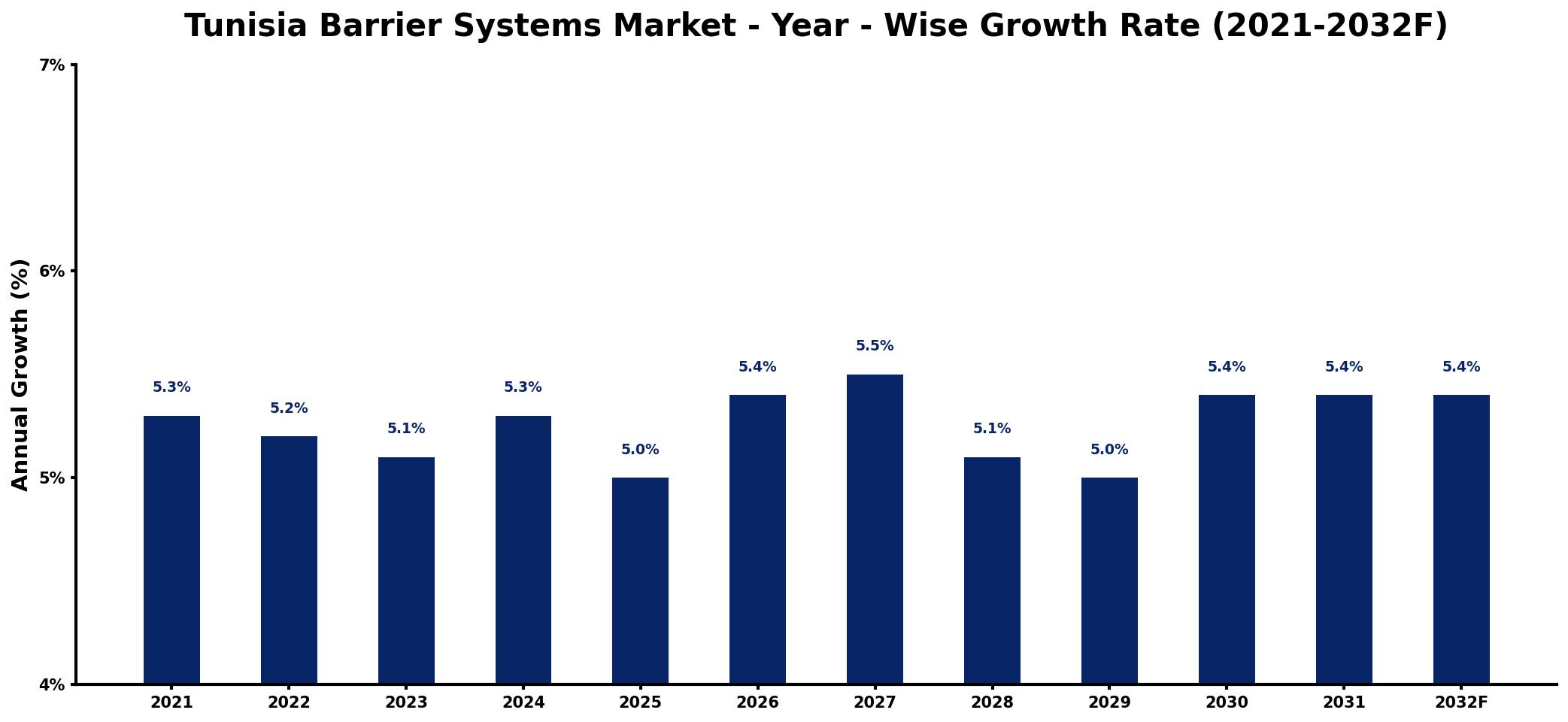
The table below presents the year‑wise growth rates along with the key drivers influencing the market
| Year | Growth Rate | Major Drivers |
| 2021 | 5.3% | Increased infrastructure development projects |
| 2022 | 5.2% | Growing demand for safety solutions |
| 2023 | 5.1% | Rising investments in urban planning |
| 2024 | 5.3% | Expansion of construction industry initiatives |
| 2025 | 5.0% | Increased public sector funding allocations |
| 2026 | 5.4% | Surge in private sector investments |
| 2027 | 5.5% | Growing awareness of safety regulations |
| 2028 | 5.1% | Development of smart city initiatives |
| 2029 | 5.0% | Rising urban population density concerns |
| 2030 | 5.4% | Increased focus on environmental sustainability |
| 2031 | 5.4% | Growing international trade agreements |
| 2032 | 5.4% | rising demand from electronics |
Note: Market size estimations and growth projections presented in this report are based on 6Wresearch's proprietary forecasting methodology, utilizing the latest available industry data, government publications, and primary research inputs.
Tunisia Barrier Systems Market Synopsis
In recent years, the Tunisia Barrier Systems Market has demonstrated consistent growth, attributed to significant investments in infrastructure and public safety initiatives. As the market evolves, it is transitioning toward more sophisticated, multi-functional barrier solutions that address complex security challenges and enhance public safety measures.
Looking ahead, the focus on intelligent barrier technologies, coupled with a commitment to sustainable practices, signifies a pivotal shift in the industry. The combination of increasing accident rates and stringent safety compliance requirements underscores the pressing need for advanced barrier systems across various sectors.
Tunisia Barrier Systems Market Key Takeaways
- The market is driven by infrastructural developments and government initiatives aimed at improving road safety.
- There is a growing demand for innovative, intelligent barrier solutions equipped with advanced features.
- Sustainable materials and eco-friendly designs are becoming increasingly prioritized in product offerings.
- Public safety concerns are driving the demand for crash-tested and high-performance barrier systems.
- Investment opportunities exist in manufacturing, distribution, and innovative installation practices.
Evaluation of Restraints in Tunisia Barrier Systems Market
The Tunisia Barrier Systems Market is confronted with several real restraints that could hinder its growth. Inconsistent government regulations pose a significant challenge, leading to uncertainty among stakeholders regarding compliance and standards. Additionally, limited awareness about advanced barrier technologies among end-users reduces the adoption of superior products. The market is also plagued by the presence of counterfeit or substandard products, which can undermine the reputation of quality manufacturers. Furthermore, political and economic instability may disrupt infrastructure projects, creating fluctuations in demand for barrier systems. Addressing these issues requires active engagement between industry players and regulatory bodies to establish clearer guidelines and promote the advantages of high-quality barrier solutions.
Tunisia Barrier Systems Market Trends
The market is witnessing a notable shift towards technologically advanced barrier systems that enhance safety and security across transportation and public infrastructure. Features such as automatic operation, remote monitoring, and integration with smart city initiatives are gaining traction. Furthermore, the emphasis on sustainability is steering manufacturers towards utilizing eco-friendly materials, including recycled plastic. The preference for crash-tested barriers is also increasing, driven by the need to comply with stringent safety standards, particularly in high-risk areas. This evolution reflects a broader trend toward multifunctional barriers that can effectively address diverse security challenges.
Tunisia Barrier Systems Market Opportunities
Investment opportunities in the Tunisia Barrier Systems Market are abundant, particularly in infrastructure development projects. The government's focus on enhancing transportation efficiency presents a unique opportunity for businesses engaged in the manufacturing and distribution of advanced barrier systems. Collaborations with international firms could facilitate the introduction of cutting-edge technologies to the local market. Moreover, as urbanization accelerates, there is a pressing need for high-quality barrier systems that enhance road safety standards, making this a lucrative avenue for investors and stakeholders.
Government Initiatives in the Tunisia Barrier Systems Market
The Tunisian government has introduced various policies aimed at improving road safety and promoting the use of high-quality barrier systems. These policies emphasize compliance with international safety standards and encourage the local manufacturing of barrier solutions to bolster domestic businesses. Additionally, public spending on infrastructure projects is focused on integrating durable and effective barrier systems to enhance overall road safety, showcasing the government's commitment to a safer transportation network.
Future Insights of the Tunisia Barrier Systems Market
Looking ahead to the period between 2026 and 2032, the Tunisia Barrier Systems Market is poised for steady growth. Key factors driving this upward trajectory include ongoing government initiatives aimed at improving safety standards and traffic management systems. As urban areas expand and accident rates rise, the demand for sophisticated barrier systems will continue to increase. Furthermore, the market is expected to evolve with the introduction of innovative technologies that not only enhance safety but also promote sustainability in barrier design, ultimately ensuring a positive outlook for the sector.
Tunisia Barrier Systems Market Latest Developments (2025 - 2026)
Recent developments in the Tunisia Barrier Systems Market indicate a growing interest in innovative solutions that prioritize safety and efficiency. Industry players are increasingly focused on integrating smart technologies within barrier systems to improve functionality and responsiveness. Moreover, partnerships with international companies are becoming more common, facilitating the introduction of advanced materials and designs into the local market. As the regulatory landscape continues to evolve, stakeholders are actively working to align their offerings with emerging safety standards.
Tunisia Barrier Systems Market - Key Attractiveness of the Report
- 10 Years of Market Numbers
- Historical Data Starting from 2022 to 2025
- Base Year: 2025
- Forecast Data until 2032
- Key Performance Indicators Impacting the Market
- Major Upcoming Developments and Projects
Key Highlights of the Report:
- Tunisia Barrier Systems Market Outlook
- Market Size of Tunisia Barrier Systems Market, 2025
- Forecast of Tunisia Barrier Systems Market, 2032
- Historical Data and Forecast of Tunisia Barrier Systems Revenues & Volume for the Period 2022-2032F
- Tunisia Barrier Systems Market Trend Evolution
- Tunisia Barrier Systems Market Drivers and Challenges
- Tunisia Barrier Systems Price Trends
- Tunisia Barrier Systems Porter's Five Forces
- Tunisia Barrier Systems Industry Life Cycle
- Historical Data and Forecast of Tunisia Barrier Systems Market Revenues & Volume By Device Type for the Period 2022-2032F
- Historical Data and Forecast of Tunisia Barrier Systems Market Revenues & Volume By Fences for the Period 2022-2032F
- Historical Data and Forecast of Tunisia Barrier Systems Market Revenues & Volume By Bollards for the Period 2022-2032F
- Historical Data and Forecast of Tunisia Barrier Systems Market Revenues & Volume By Gate for the Period 2022-2032F
- Historical Data and Forecast of Tunisia Barrier Systems Market Revenues & Volume By Crash Barrier Systems for the Period 2022-2032F
- Historical Data and Forecast of Tunisia Barrier Systems Market Revenues & Volume By Crash Cushions for the Period 2022-2032F
- Historical Data and Forecast of Tunisia Barrier Systems Market Revenues & Volume By End Treatments for the Period 2022-2032F
- Historical Data and Forecast of Tunisia Barrier Systems Market Revenues & Volume By Sand and Water Filled Barriers for the Period 2022-2032F
- Historical Data and Forecast of Tunisia Fences Barrier Systems Market Revenues & Volume By Guardrail Energy Absorbent Terminal for the Period 2022-2032F
- Historical Data and Forecast of Tunisia Barrier Systems Market Revenues & Volume By Technology for the Period 2022-2032F
- Historical Data and Forecast of Tunisia Barrier Systems Market Revenues & Volume By Rigid for the Period 2022-2032F
- Historical Data and Forecast of Tunisia Barrier Systems Market Revenues & Volume By Semirigid for the Period 2022-2032F
- Historical Data and Forecast of Tunisia Barrier Systems Market Revenues & Volume By Flexible for the Period 2022-2032F
- Historical Data and Forecast of Tunisia Barrier Systems Market Revenues & Volume By Material Type for the Period 2022-2032F
- Historical Data and Forecast of Tunisia Barrier Systems Market Revenues & Volume By Metal for the Period 2022-2032F
- Historical Data and Forecast of Tunisia Barrier Systems Market Revenues & Volume By Steel for the Period 2022-2032F
- Historical Data and Forecast of Tunisia Barrier Systems Market Revenues & Volume By Aluminum for the Period 2022-2032F
- Historical Data and Forecast of Tunisia Barrier Systems Market Revenues & Volume By Tungsten for the Period 2022-2032F
- Historical Data and Forecast of Tunisia Barrier Systems Market Revenues & Volume By Non-Metal for the Period 2022-2032F
- Historical Data and Forecast of Tunisia Barrier Systems Market Revenues & Volume By Plastics for the Period 2022-2032F
- Historical Data and Forecast of Tunisia Barrier Systems Market Revenues & Volume By Wood for the Period 2022-2032F
- Historical Data and Forecast of Tunisia Barrier Systems Market Revenues & Volume By Concrete for the Period 2022-2032F
- Historical Data and Forecast of Tunisia Barrier Systems Market Revenues & Volume By Application for the Period 2022-2032F
- Historical Data and Forecast of Tunisia Barrier Systems Market Revenues & Volume By Roadways for the Period 2022-2032F
- Historical Data and Forecast of Tunisia Barrier Systems Market Revenues & Volume By Airports for the Period 2022-2032F
- Historical Data and Forecast of Tunisia Barrier Systems Market Revenues & Volume By Railways for the Period 2022-2032F
- Historical Data and Forecast of Tunisia Barrier Systems Market Revenues & Volume By Others for the Period 2022-2032F
- Tunisia Barrier Systems Import Export Trade Statistics
- Market Opportunity Assessment By Device Type
- Market Opportunity Assessment By Technology
- Market Opportunity Assessment By Material Type
- Market Opportunity Assessment By Application
- Tunisia Barrier Systems Top Companies Market Share
- Tunisia Barrier Systems Competitive Benchmarking By Technical and Operational Parameters
- Tunisia Barrier Systems Company Profiles
- Tunisia Barrier Systems Key Strategic Recommendations






































