Tunisia Billiards and Snooker Equipment Market Size, Share & Growth Rate
The Tunisia Billiards and Snooker Equipment Market was estimated at USD 1058 Million in 2025 and is projected to reach USD 1533 Million by 2032, growing at a CAGR of 5.4% from 2026 to 2032. This upward trajectory is being fueled by the increasing number of billiards and snooker clubs throughout Tunisia, as well as the growing popularity of cue sports among younger demographics. The local market is also benefiting from innovations in equipment quality and aesthetics, catering to the evolving tastes of both recreational and professional players.
Tunisia Billiards and Snooker Equipment Market Year-wise Growth Rate and Key Drivers
This graph highlights how the Tunisia Billiards and Snooker Equipment Market has steadily grown over the years, supported by major growth factors.
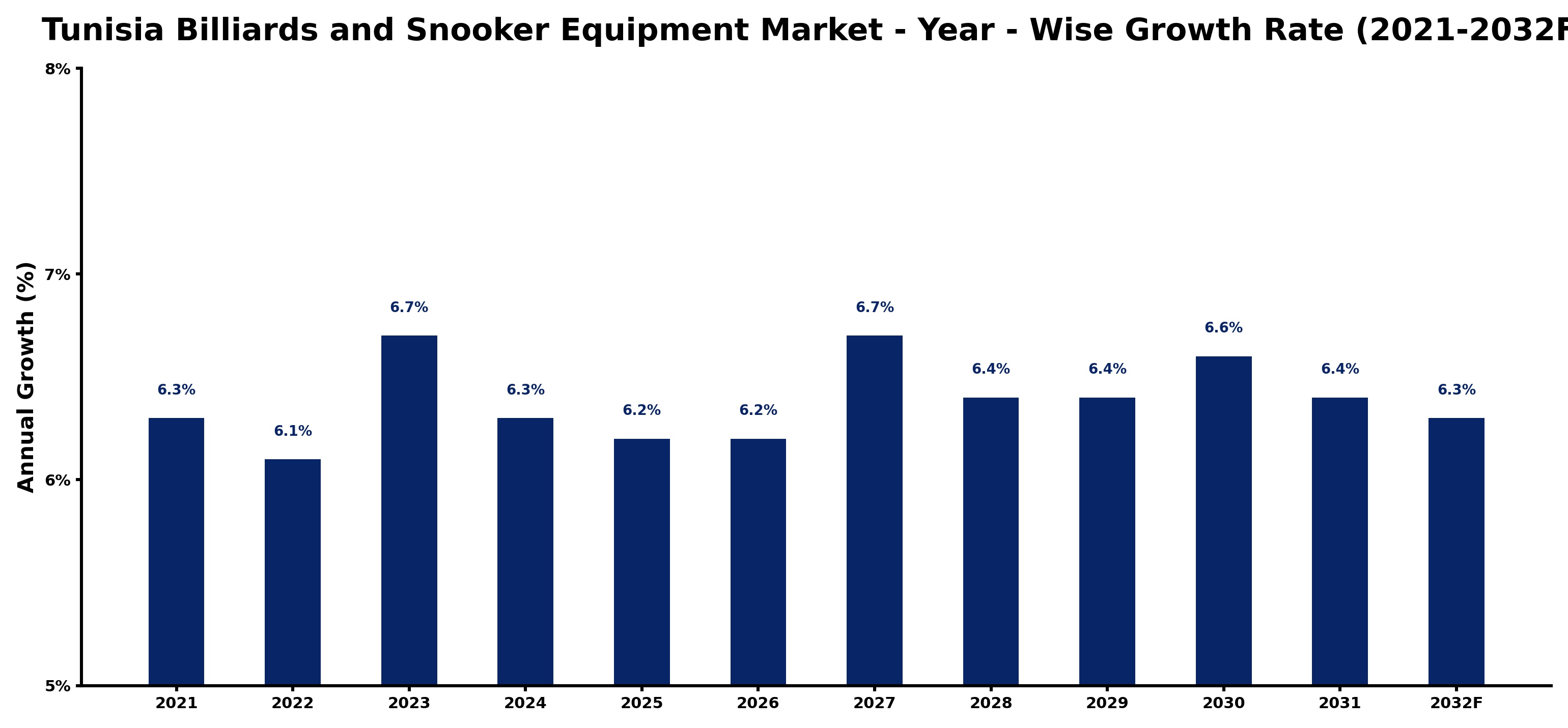
The table below presents the year‑wise growth rates along with the key drivers influencing the market
| Year | Growth Rate | Major Drivers |
| 2021 | 6.3% | Increasing industrial infrastructure investments |
| 2022 | 6.1% | Expansion of manufacturing activities |
| 2023 | 6.7% | Expansion of commercial construction activities |
| 2024 | 6.3% | Expansion of manufacturing activities |
| 2025 | 6.2% | Expansion of commercial construction activities |
| 2026 | 6.2% | Increasing adoption of advanced technologies |
| 2027 | 6.7% | Growing renewable energy integration projects |
| 2028 | 6.4% | Growing renewable energy integration projects |
| 2029 | 6.4% | Increasing industrial infrastructure investments |
| 2030 | 6.6% | Expansion of transportation and logistics networks |
| 2031 | 6.4% | Increasing industrial infrastructure investments |
| 2032 | 6.3% | Expansion of manufacturing activities |
Note - Market size estimations and growth projections presented in this report are based on 6Wresearch’s advanced forecasting approach, validated with industry datasets as of June 2026.
Tunisia Billiards and Snooker Equipment Market Synopsis
Recently, the Tunisia Billiards and Snooker Equipment Market has gained momentum, driven largely by a burgeoning interest in cue sports as both a social activity and a competitive pursuit. However, despite this positive trend, the market still faces limitations in overall awareness and accessibility, particularly in less urban areas.
Looking ahead, the market is poised for growth as disposable incomes rise and more establishments begin to incorporate billiards and snooker facilities. With increased investment in local clubs and a growing culture around cue sports, the future appears optimistic for both manufacturers and consumers alike.
Tunisia Billiards and Snooker Equipment Market Key Takeaways
- The market is forecasted to expand significantly, indicating strong consumer interest and participation in cue sports.
- High-quality, customizable equipment is becoming increasingly sought after by both recreational and professional players.
- Online sales channels are emerging as key platforms for purchasing billiards and snooker equipment.
- Environmental sustainability is influencing manufacturing trends, with a shift towards eco-friendly materials.
- Government initiatives aim to support and regulate market growth, fostering fair competition.
Evaluation of Restraints in Tunisia Billiards and Snooker Equipment Market
Despite its growth potential, the Tunisia Billiards and Snooker Equipment Market is constrained by several factors. One significant limitation is the low awareness of billiards and snooker among the general population, which restricts the target market. High-quality equipment often comes with a steep price tag, making it less accessible for many potential players. Additionally, the scarcity of dedicated facilities hinders opportunities for enthusiasts to practice and engage in these sports. The presence of counterfeit products in the market also poses a risk to authentic brands, challenging their market share and reputation.
Tunisia Billiards and Snooker Equipment Market Trends
Emerging trends within the Tunisia Billiards and Snooker Equipment Market include a growing demand for premium, durable tables and accessories that cater to serious players. There is also an increasing interest in customized products that reflect individual aesthetics, enhancing the overall user experience. Moreover, the market is witnessing a shift towards sustainable manufacturing practices, with more companies opting for eco-friendly materials. The rise of online shopping has transformed how consumers purchase equipment, providing them with more choices and convenience.
Tunisia Billiards and Snooker Equipment Market Opportunities
Investment opportunities abound in the Tunisia Billiards and Snooker Equipment Market as interest in billiards and snooker continues to grow. Manufacturers and distributors can benefit from increasing demand for tables, cues, and accessories, particularly as new clubs and sports bars emerge. Additionally, there is significant potential for the establishment of training centers and the organization of tournaments, capitalizing on the youthful demographic interested in cue sports. The development of online platforms for equipment sales and virtual coaching services also presents innovative avenues for growth.
Government Initiatives in the Tunisia Billiards and Snooker Equipment Market
The Tunisian government has introduced various policies to bolster the billiards and snooker equipment market. Import regulations ensure that all equipment meets quality and safety standards, fostering a reliable market environment. Furthermore, there are initiatives aimed at providing support, such as subsidies for local manufacturers, to promote fair competition and consumer protection. These measures aim to cultivate a thriving market, encouraging both local and international investment.
Future Insights of the Tunisia Billiards and Snooker Equipment Market
As we look toward 2026 and beyond, the Tunisia billiards and snooker equipment market is set for steady growth. Increasing disposable incomes and a broader acceptance of cue sports as a form of entertainment are anticipated to fuel demand. The growing trend of creating home entertainment spaces, coupled with young people's social engagement with these activities, will likely contribute to market vitality. Nonetheless, potential economic uncertainties and competition from alternative leisure activities may challenge sustained growth, requiring stakeholders to adapt and innovate continuously.
Tunisia Billiards and Snooker Equipment Market Latest Developments (May 2025 - June 2026)
In the past year, the Tunisia Billiards and Snooker Equipment Market has seen a noticeable shift toward online sales platforms, providing greater access for consumers. Additionally, the introduction of local tournaments has enhanced visibility for the sport and attracted a younger audience. Innovative product launches focusing on customization and eco-friendly materials have also made headlines, indicating a market that is actively responding to consumer trends and preferences.
Tunisia Billiards and Snooker Equipment Market - Key Attractiveness of the Report
- 10 Years of Market Numbers
- Historical Data Starting from 2022 to 2025
- Base Year: 2025
- Forecast Data until 2032
- Key Performance Indicators Impacting the Market
- Major Upcoming Developments and Projects
Key Highlights of the Report:
- Tunisia Billiards and Snooker Equipment Market Outlook
- Market Size of Tunisia Billiards and Snooker Equipment Market, 2025
- Forecast of Tunisia Billiards and Snooker Equipment Market, 2032
- Historical Data and Forecast of Tunisia Billiards and Snooker Equipment Revenues & Volume for the Period 2022-2032F
- Tunisia Billiards and Snooker Equipment Market Trend Evolution
- Tunisia Billiards and Snooker Equipment Market Drivers and Challenges
- Tunisia Billiards and Snooker Equipment Price Trends
- Tunisia Billiards and Snooker Equipment Porter's Five Forces
- Tunisia Billiards and Snooker Equipment Industry Life Cycle
- Historical Data and Forecast of Tunisia Billiards and Snooker Equipment Market Revenues & Volume By Type for the Period 2022-2032F
- Historical Data and Forecast of Tunisia Billiards and Snooker Equipment Market Revenues & Volume By Carom for the Period 2022-2032F
- Historical Data and Forecast of Tunisia Billiards and Snooker Equipment Market Revenues & Volume By Pool for the Period 2022-2032F
- Historical Data and Forecast of Tunisia Billiards and Snooker Equipment Market Revenues & Volume By Snooker for the Period 2022-2032F
- Historical Data and Forecast of Tunisia Billiards and Snooker Equipment Market Revenues & Volume By Equipment for the Period 2022-2032F
- Historical Data and Forecast of Tunisia Billiards and Snooker Equipment Market Revenues & Volume By Table for the Period 2022-2032F
- Historical Data and Forecast of Tunisia Billiards and Snooker Equipment Market Revenues & Volume By Ball for the Period 2022-2032F
- Historical Data and Forecast of Tunisia Billiards and Snooker Equipment Market Revenues & Volume By Cue for the Period 2022-2032F
- Historical Data and Forecast of Tunisia Billiards and Snooker Equipment Market Revenues & Volume By Other equipment for the Period 2022-2032F
- Historical Data and Forecast of Tunisia Billiards and Snooker Equipment Market Revenues & Volume By Distribution Channel for the Period 2022-2032F
- Historical Data and Forecast of Tunisia Billiards and Snooker Equipment Market Revenues & Volume By Offline channel for the Period 2022-2032F
- Historical Data and Forecast of Tunisia Billiards and Snooker Equipment Market Revenues & Volume By Online channel for the Period 2022-2032F
- Tunisia Billiards and Snooker Equipment Import Export Trade Statistics
- Market Opportunity Assessment By Type
- Market Opportunity Assessment By Equipment
- Market Opportunity Assessment By Distribution Channel
- Tunisia Billiards and Snooker Equipment Top Companies Market Share
- Tunisia Billiards and Snooker Equipment Competitive Benchmarking By Technical and Operational Parameters
- Tunisia Billiards and Snooker Equipment Company Profiles
- Tunisia Billiards and Snooker Equipment Key Strategic Recommendations






































