Tunisia Biosimilars Market Size, Share & Growth Rate
The Tunisia Biosimilars Market was estimated at USD 458 Million in 2025 and is projected to reach USD 616 Million by 2032, growing at a CAGR of 4.3% from 2026 to 2032. This growth trajectory is largely propelled by the increasing prevalence of chronic diseases among the Tunisian population, coupled with a rising demand for cost-effective biologic therapies. Additionally, an evolving regulatory framework is fostering an environment ripe for innovation and market entry, as both local and international manufacturers seek to capitalize on these opportunities.
Tunisia Biosimilars Market Year-wise Growth Rate and Key Drivers
This graph highlights how the Tunisia Biosimilars Market has steadily grown over the years, supported by major growth factors.
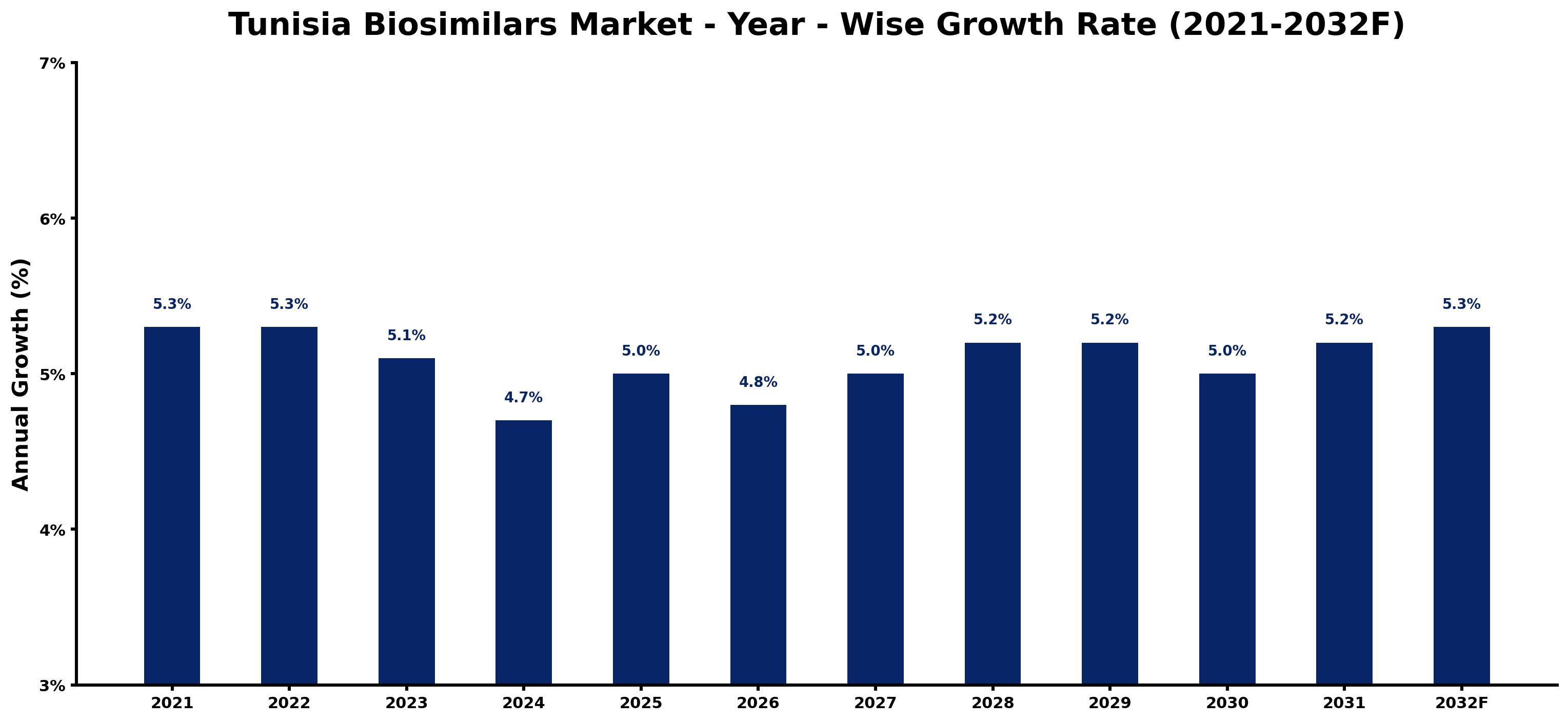
The table below presents the year‑wise growth rates along with the key drivers influencing the market
| Year | Growth Rate | Major Drivers |
| 2021 | 5.3% | Increasing smart city development projects |
| 2022 | 5.3% | Increasing industrial automation investments |
| 2023 | 5.1% | Expansion of transportation and logistics networks |
| 2024 | 4.7% | Increasing industrial infrastructure investments |
| 2025 | 5.0% | Rising electricity demand across industries |
| 2026 | 4.8% | Increasing adoption of advanced technologies |
| 2027 | 5.0% | Increasing industrial infrastructure investments |
| 2028 | 5.2% | Increasing adoption of advanced technologies |
| 2029 | 5.2% | Increasing industrial infrastructure investments |
| 2030 | 5.0% | Increasing smart city development projects |
| 2031 | 5.2% | Growing renewable energy integration projects |
| 2032 | 5.3% | Increasing adoption of advanced technologies |
Note - Market size estimations and growth projections presented in this report are based on 6Wresearch’s advanced forecasting approach, validated with industry datasets as of June 2026.
Tunisia Biosimilars Market Synopsis
The Tunisia biosimilars market is undergoing a transformation, with rising healthcare costs compelling stakeholders to explore more affordable treatment alternatives. As healthcare providers begin to recognize the efficacy of biosimilars, there is a marked shift towards their acceptance and utilization across various therapeutic areas.
With both local and international players entering the market, there is a visible drive towards enhancing product portfolios that focus on high-quality biosimilars. Government initiatives aimed at improving access to these biologics further underline the optimistic outlook for the market, suggesting a future replete with potential.
Tunisia Biosimilars Market Key Takeaways
- The market is experiencing steady growth fueled by chronic disease prevalence and rising treatment costs.
- An evolving regulatory framework is facilitating market entry and supporting local and international players.
- Awareness and acceptance of biosimilars among healthcare professionals and patients are on the rise.
- Government policies are actively promoting the affordability and accessibility of biosimilars.
- Investment opportunities abound for pharmaceutical companies aiming to expand within the North African region.
Evaluation of Restraints in Tunisia Biosimilars Market
Despite its potential, the Tunisia biosimilars market faces several constraints that could hinder its growth. Regulatory hurdles, particularly the lack of clear guidelines governing the approval process for biosimilars, pose significant challenges for manufacturers. These complexities can lead to delays in product launches, thereby affecting market penetration and competition. Furthermore, limited awareness among healthcare professionals regarding biosimilars can create hesitancy in prescribing these cost-effective alternatives, impacting overall market adoption.
Tunisia Biosimilars Market Trends
Several key trends are shaping the Tunisia biosimilars market landscape. The increasing demand for biologics, particularly in oncology, rheumatology, and diabetes management, is driving a heightened interest in biosimilars. Concurrently, collaborative efforts among healthcare providers, government entities, and pharmaceutical companies are fostering educational initiatives aimed at enhancing the understanding and acceptance of biosimilars. These dynamics indicate a burgeoning ecosystem primed for continued growth.
Tunisia Biosimilars Market Opportunities
The investment landscape for the Tunisia biosimilars market is promising. Given the rising incidence of chronic diseases, there is an urgent need for accessible treatment options, which biosimilars can adequately fulfill. Pharmaceutical companies have a unique opportunity to partner with local manufacturers or healthcare providers, positioning themselves strategically within this evolving market. Such alliances could provide insights into local needs while enhancing operational efficiencies, ultimately contributing to a stronger market presence.
Government Initiatives in the Tunisia Biosimilars Market
The Tunisian government has implemented crucial policies to regulate and promote the biosimilars market. The Ministry of Health has established robust guidelines for the registration and approval of these products, ensuring compliance with safety and efficacy standards. Additionally, the government's focus on affordability through pricing policies aims to enhance patient access to biosimilars. Such initiatives are instrumental in building a sustainable ecosystem for biosimilar development and utilization.
Future Insights of the Tunisia Biosimilars Market
Looking ahead to the period between 2026 and 2032, the Tunisia biosimilars market is set for substantial expansion. Driven by increasing healthcare costs and the demand for effective treatment alternatives, the market is anticipated to thrive under favorable regulatory conditions. Growing acceptance among healthcare providers, paired with ongoing government initiatives, will likely catalyze market growth, making it an attractive arena for both investment and innovation.
Tunisia Biosimilars Market Latest Developments (May 2025 - June 2026)
Recent developments in the Tunisia biosimilars market indicate a robust movement towards enhancing the regulatory framework, with ongoing discussions to streamline approval processes. Furthermore, there is a concerted effort to raise awareness among healthcare professionals through workshops and seminars, aimed at addressing misconceptions surrounding biosimilars. The introduction of new biosimilar products is anticipated, reflecting the growing commitment of manufacturers to diversify their offerings in response to market demands.
Tunisia Biosimilars Market - Key Attractiveness of the Report
- 10 Years of Market Numbers
- Historical Data Starting from 2022 to 2025
- Base Year: 2025
- Forecast Data until 2032
- Key Performance Indicators Impacting the Market
- Major Upcoming Developments and Projects
Key Highlights of the Report:
- Tunisia Biosimilars Market Outlook
- Market Size of Tunisia Biosimilars Market, 2025
- Forecast of Tunisia Biosimilars Market, 2032
- Historical Data and Forecast of Tunisia Biosimilars Revenues & Volume for the Period 2022-2032F
- Tunisia Biosimilars Market Trend Evolution
- Tunisia Biosimilars Market Drivers and Challenges
- Tunisia Biosimilars Price Trends
- Tunisia Biosimilars Porter's Five Forces
- Tunisia Biosimilars Industry Life Cycle
- Historical Data and Forecast of Tunisia Biosimilars Market Revenues & Volume By Product for the Period 2022-2032F
- Historical Data and Forecast of Tunisia Biosimilars Market Revenues & Volume By Insulin for the Period 2022-2032F
- Historical Data and Forecast of Tunisia Biosimilars Market Revenues & Volume By Follitropin for the Period 2022-2032F
- Historical Data and Forecast of Tunisia Biosimilars Market Revenues & Volume By Calcitonin for the Period 2022-2032F
- Historical Data and Forecast of Tunisia Biosimilars Market Revenues & Volume By Glucagon for the Period 2022-2032F
- Historical Data and Forecast of Tunisia Biosimilars Market Revenues & Volume By Teriparatide for the Period 2022-2032F
- Historical Data and Forecast of Tunisia Biosimilars Market Revenues & Volume By Others for the Period 2022-2032F
- Historical Data and Forecast of Tunisia Biosimilars Market Revenues & Volume By Indication for the Period 2022-2032F
- Historical Data and Forecast of Tunisia Biosimilars Market Revenues & Volume By Oncology for the Period 2022-2032F
- Historical Data and Forecast of Tunisia Biosimilars Market Revenues & Volume By Offsite Treatment for the Period 2022-2032F
- Historical Data and Forecast of Tunisia Biosimilars Market Revenues & Volume By Chronic Disorders for the Period 2022-2032F
- Historical Data and Forecast of Tunisia Biosimilars Market Revenues & Volume By Blood Disorders for the Period 2022-2032F
- Historical Data and Forecast of Tunisia Biosimilars Market Revenues & Volume By Infectious Diseases for the Period 2022-2032F
- Historical Data and Forecast of Tunisia Biosimilars Market Revenues & Volume By Others for the Period 2022-2032F
- Historical Data and Forecast of Tunisia Biosimilars Market Revenues & Volume By Manufacturing for the Period 2022-2032F
- Historical Data and Forecast of Tunisia Biosimilars Market Revenues & Volume By Outsourced for the Period 2022-2032F
- Historical Data and Forecast of Tunisia Biosimilars Market Revenues & Volume By In-house for the Period 2022-2032F
- Tunisia Biosimilars Import Export Trade Statistics
- Market Opportunity Assessment By Product
- Market Opportunity Assessment By Indication
- Market Opportunity Assessment By Manufacturing
- Tunisia Biosimilars Top Companies Market Share
- Tunisia Biosimilars Competitive Benchmarking By Technical and Operational Parameters
- Tunisia Biosimilars Company Profiles
- Tunisia Biosimilars Key Strategic Recommendations






































