Tunisia Canvas Market Size, Share & Growth Rate
The Tunisia Canvas Market was estimated at USD 498 Million in 2025 and is projected to reach USD 668 Million by 2032, growing at a CAGR of 4.3% from 2026 to 2032. This growth trajectory is underpinned by an increasing appreciation for sustainable textiles and the rising demand for personalized and durable outdoor products. The diverse applications of canvas in art, industrial textiles, and outdoor gear contribute significantly to the markets expansion.
Tunisia Canvas Market Year-wise Growth Rate and Key Drivers
This graph highlights how the Tunisia Canvas Market has steadily grown over the years, supported by major growth factors.
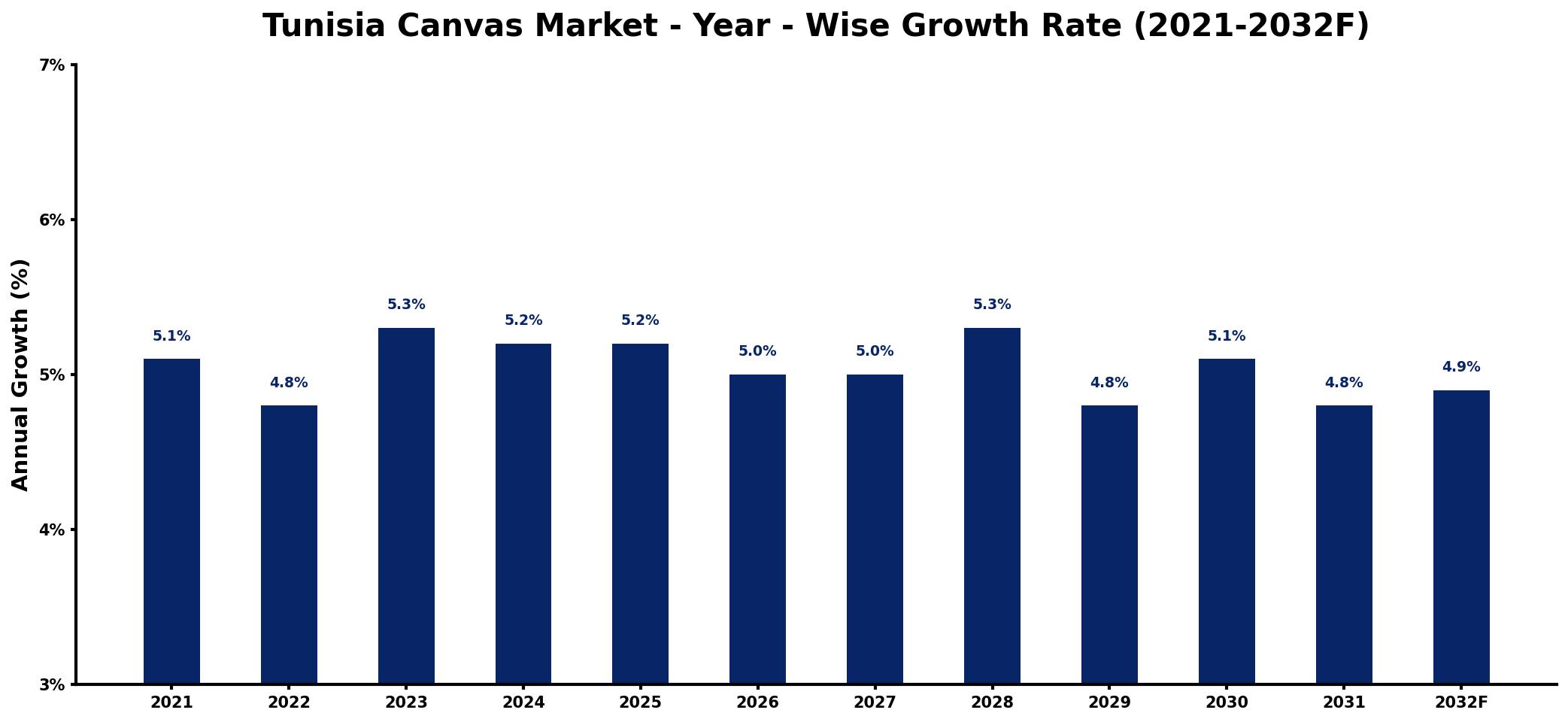
The table below presents the year‑wise growth rates along with the key drivers influencing the market
| Year | Growth Rate | Major Drivers |
| 2021 | 5.1% | Rising demand for outdoor activities |
| 2022 | 4.8% | Increased investment in art education |
| 2023 | 5.3% | Growth in eco-friendly materials |
| 2024 | 5.2% | Expansion of local artisan markets |
| 2025 | 5.2% | Surge in tourism and crafts |
| 2026 | 5.0% | Boost in home decor trends |
| 2027 | 5.0% | Growing popularity of DIY projects |
| 2028 | 5.3% | Increase in cultural festivals |
| 2029 | 4.8% | Rising interest in sustainable practices |
| 2030 | 5.1% | expanding industrial usage applications |
| 2031 | 4.8% | increased capital investment inflows |
| 2032 | 4.9% | rising infrastructure development spending |
Note: Market size estimations and growth projections presented in this report are based on 6Wresearch's proprietary forecasting methodology, utilizing the latest available industry data, government publications, and primary research inputs.
Tunisia Canvas Market Synopsis
In recent years, the Tunisia Canvas Market has seen a remarkable uptick in both consumer interest and production capacity, driven by advancements in manufacturing techniques and a growing outdoor lifestyle among the Tunisian populace. As we look forward, the market is expected to continue evolving, with innovations in eco-friendly materials and increased customization options setting the stage for a vibrant future.
While momentum has been strong, challenges from the availability of alternative synthetic materials and cost fluctuations of raw materials remain present. These factors will influence how manufacturers innovate and respond to market demands, ultimately defining the landscape over the next several years.
Tunisia Canvas Market Key Takeaways
- The market is projected to grow from USD 498 Million in 2025 to USD 668 Million by 2032.
- Increasing consumer preference for sustainable and personalized products is a key growth driver.
- Technological advancements in manufacturing processes enhance product performance and eco-friendliness.
- The expansion of e-commerce platforms is providing new avenues for sales and market reach.
- Government incentives are fostering innovation and foreign investment in the canvas sector.
Evaluation of Restraints in Tunisia Canvas Market
The Tunisia Canvas Market faces notable constraints, primarily stemming from intense competition with synthetic alternatives that often offer lower prices and greater durability. Additionally, fluctuations in raw material costs create unpredictability for manufacturers, complicating pricing strategies. The need for differentiation through product innovation is becoming increasingly vital, pushing manufacturers to focus on developing eco-friendly options and high-quality offerings that cater to specific consumer demands. Without addressing these challenges, companies may struggle to maintain their market position in a rapidly evolving landscape.
Tunisia Canvas Market Trends
Several current trends are shaping the Tunisia Canvas Market. The rise of DIY crafting among consumers is increasing demand for artistic canvas, while the outdoor lifestyle trend is boosting interest in durable canvas products for camping and recreational use. Furthermore, as environmental awareness grows, manufacturers are investing in sustainable production practices and eco-friendly dyeing techniques, positioning themselves to appeal to the environmentally-conscious consumer.
Tunisia Canvas Market Opportunities
Genuine growth opportunities lie in tapping into the increasing e-commerce sector, as online platforms continue to reshape retail landscapes. Furthermore, collaboration with artists and designers for custom products can carve out niche markets. Expanding export opportunities also present significant potential, particularly with products that meet international quality standards. The focus on sustainability offers a path to cater to global demands for environmentally responsible textiles, giving local manufacturers a competitive edge.
Government Initiatives in the Tunisia Canvas Market
The Tunisian government is actively supporting the canvas market through various initiatives aimed at boosting the textile and construction sectors. Key policies include tax incentives designed to stimulate manufacturing, along with subsidies for research and development focused on innovative and durable canvas products. Efforts to attract foreign investment are also part of a broader strategy to enhance the competitiveness of Tunisian canvas products in both domestic and international markets, ensuring that they meet rigorous quality and safety standards.
Future Insights of the Tunisia Canvas Market
Looking ahead to the 2026-2032 period, the Tunisia Canvas Market is poised for growth driven by technological advancements and shifts in consumer behavior. The increasing emphasis on sustainability is likely to encourage further innovation in eco-friendly materials and manufacturing processes. Additionally, as outdoor activities become more prevalent, the demand for durable and versatile canvas products will continue to rise, reinforcing the markets upward trajectory in a competitive global landscape.
Tunisia Canvas Market Latest Developments (2025 - 2026)
Recent developments in the Tunisia Canvas Market indicate a strong focus on enhancing production capabilities and exploring new sales channels. Manufacturers are increasingly adopting cutting-edge technologies to streamline operations and improve product quality. The interest in sustainable practices is manifesting in more companies experimenting with eco-friendly materials and recycling initiatives. Additionally, the trend towards e-commerce continues to evolve, with various brands enhancing their online presence to reach a broader audience.
Tunisia Canvas Market - Key Attractiveness of the Report
- 10 Years of Market Numbers
- Historical Data Starting from 2022 to 2025
- Base Year: 2025
- Forecast Data until 2032
- Key Performance Indicators Impacting the Market
- Major Upcoming Developments and Projects
Key Highlights of the Report:
- Tunisia Canvas Market Outlook
- Market Size of Tunisia Canvas Market, 2025
- Forecast of Tunisia Canvas Market, 2032
- Historical Data and Forecast of Tunisia Canvas Revenues & Volume for the Period 2022-2032F
- Tunisia Canvas Market Trend Evolution
- Tunisia Canvas Market Drivers and Challenges
- Tunisia Canvas Price Trends
- Tunisia Canvas Porter's Five Forces
- Tunisia Canvas Industry Life Cycle
- Historical Data and Forecast of Tunisia Canvas Market Revenues & Volume By Types for the Period 2022-2032F
- Historical Data and Forecast of Tunisia Canvas Market Revenues & Volume By Plane Canvas for the Period 2022-2032F
- Historical Data and Forecast of Tunisia Canvas Market Revenues & Volume By Duck Canvas for the Period 2022-2032F
- Historical Data and Forecast of Tunisia Canvas Market Revenues & Volume By Application for the Period 2022-2032F
- Historical Data and Forecast of Tunisia Canvas Market Revenues & Volume By Tent for the Period 2022-2032F
- Historical Data and Forecast of Tunisia Canvas Market Revenues & Volume By Luggage Fabric for the Period 2022-2032F
- Historical Data and Forecast of Tunisia Canvas Market Revenues & Volume By Automotive Fabric for the Period 2022-2032F
- Historical Data and Forecast of Tunisia Canvas Market Revenues & Volume By Apparel for the Period 2022-2032F
- Historical Data and Forecast of Tunisia Canvas Market Revenues & Volume By Others for the Period 2022-2032F
- Tunisia Canvas Import Export Trade Statistics
- Market Opportunity Assessment By Types
- Market Opportunity Assessment By Application
- Tunisia Canvas Top Companies Market Share
- Tunisia Canvas Competitive Benchmarking By Technical and Operational Parameters
- Tunisia Canvas Company Profiles
- Tunisia Canvas Key Strategic Recommendations






































