Tunisia Functional Apparel Market Size, Share & Growth Rate
The Tunisia Functional Apparel Market was estimated at USD 321 Million in 2025 and is projected to reach USD 438 Million by 2032, growing at a CAGR of 4.5% from 2026 to 2032. This growth trajectory is primarily driven by a surge in consumer interest towards high-performance clothing that caters to both leisure and professional activities. The expanding sports and outdoor sectors, alongside increasing workplace requirements for protective and comfortable apparel, are solidifying the demand for functional clothing in Tunisia.
Tunisia Functional Apparel Market Year-wise Growth Rate and Key Drivers
This graph highlights how the Tunisia Functional Apparel Market has steadily grown over the years, supported by major growth factors.
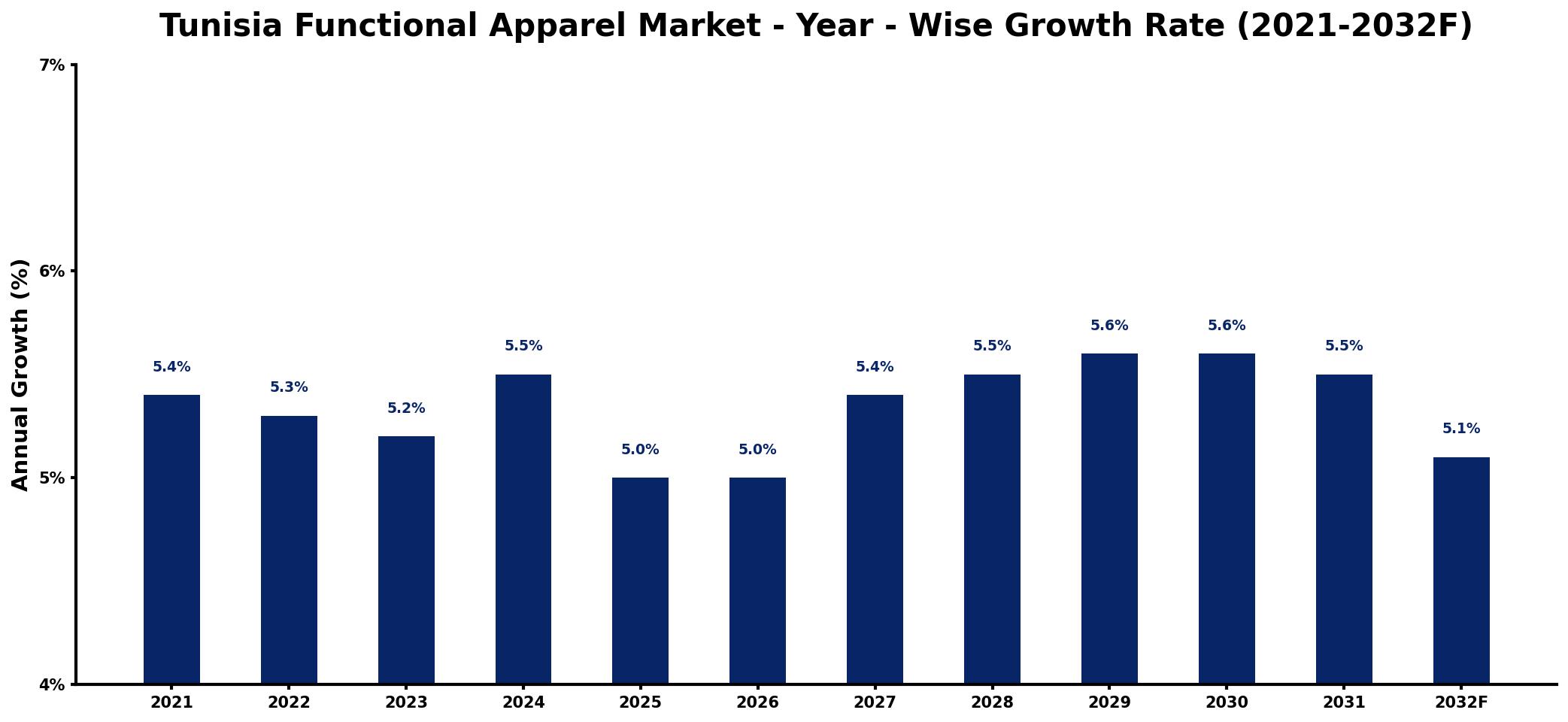
The table below presents the year‑wise growth rates along with the key drivers influencing the market
| Year | Growth Rate | Major Drivers |
| 2021 | 5.4% | increased consumer health awareness |
| 2022 | 5.3% | growth in online retail sales |
| 2023 | 5.2% | rising fitness trend adoption |
| 2024 | 5.5% | expansion of local manufacturers |
| 2025 | 5.0% | increased disposable income levels |
| 2026 | 5.0% | rising procurement volume requirements |
| 2027 | 5.4% | surge in eco-friendly materials |
| 2028 | 5.5% | growing emerging market penetration |
| 2029 | 5.6% | increased participation in sports |
| 2030 | 5.6% | expanding urban population demand |
| 2031 | 5.5% | rising popularity of athleisure |
| 2032 | 5.1% | increased focus on sustainability |
Note: Market size estimations and growth projections presented in this report are based on 6Wresearch's proprietary forecasting methodology, utilizing the latest available industry data, government publications, and primary research inputs.
Tunisia Functional Apparel Market Synopsis
Innovation stands as the most potent force shaping the Tunisia Functional Apparel Market. Advancements in textile technology, such as moisture-wicking and antimicrobial capabilities, have enhanced product offerings, meeting the evolving needs of consumers who prioritize both functionality and style.
Furthermore, the increasing focus on sustainability is compelling manufacturers to integrate eco-friendly materials into their products. As a result, brands are not only catering to performance requirements but also aligning with consumer expectations for environmentally responsible apparel.
Tunisia Functional Apparel Market Key Takeaways
- The market is experiencing steady growth, driven by diverse applications in sports, outdoor activities, and workwear.
- Technological advancements in fabrics are enhancing product functionality and aesthetic appeal.
- Consumer awareness regarding health and fitness is propelling the demand for high-performance activewear.
- Government initiatives are fostering local manufacturing and innovation within the functional apparel sector.
- Quality concerns related to counterfeit products pose challenges for establishing consumer trust.
Evaluation of Restraints in Tunisia Functional Apparel Market
Despite its growth potential, the Tunisia Functional Apparel Market faces several constraints that limit its development. One significant factor is the intense competition with imported apparel, which often benefits from established global brands and economies of scale. This scenario places pressure on local manufacturers to differentiate their products through innovation and quality. Additionally, the necessity for substantial investment in research and development to remain competitive can hinder smaller companies, limiting their ability to keep pace with rapid global trends. Addressing counterfeit products in the market is also critical; without consumer trust, it will be challenging for brands to establish a loyal customer base.
Tunisia Functional Apparel Market Trends
Several key trends are currently reshaping the Tunisia Functional Apparel Market. First, there's a noticeable shift towards athleisure, where consumers seek apparel that seamlessly transitions from active to casual wear. This trend is making functional apparel more versatile and appealing to a broader audience. Moreover, the emphasis on sustainability has prompted brands to explore organic and recycled materials, enhancing their eco-friendly profiles. Digital transformation within the retail sector, including e-commerce platforms, is also expanding access to functional apparel, creating new opportunities for brands to reach consumers directly.
Tunisia Functional Apparel Market Opportunities
Significant growth opportunities lie within the niche markets of outdoor and extreme sports apparel. As interest in activities such as hiking, camping, and water sports rises, brands can capitalize by offering specialized garments tailored to these pursuits. Furthermore, with the increasing integration of smart textiles and wearable technology, companies have the potential to innovate and differentiate their products. Engaging with younger consumers through targeted marketing and collaborations can also spur growth, tapping into a demographic that values functionality and style.
Government Initiatives in the Tunisia Functional Apparel Market
The Tunisian government actively supports the functional apparel sector through various initiatives aimed at fostering innovation and enhancing local manufacturing. These policies include financial incentives for research and development, which encourage businesses to innovate in fabric technology and design. Additionally, regulatory frameworks are in place to ensure compliance with quality standards, promoting confidence among consumers regarding the durability and safety of locally produced apparel. The governments commitment to boosting the textile and apparel industry significantly contributes to the market's long-term prospects.
Future Insights of the Tunisia Functional Apparel Market
Looking ahead to 2026-2032, the Tunisia Functional Apparel Market is poised for a promising trajectory. As consumer lifestyles continue to shift towards health and fitness, the demand for versatile and high-performance apparel will likely accelerate. The integration of innovative technologies, including smart textiles, is expected to reshape product offerings, making them more appealing to tech-savvy consumers. Moreover, as brands commit to sustainability, the market can anticipate a surge in environmentally-friendly products, further driving growth. Ultimately, the combination of consumer trends, government support, and technological advancements will define the future landscape of this dynamic market.
Tunisia Functional Apparel Market Latest Developments (2025 - 2026)
In recent months, the Tunisia Functional Apparel Market has seen a growing trend towards collaboration between local manufacturers and international brands, aiming to enhance product offerings and share technological advancements. Additionally, the rise of digital platforms has opened new channels for brands to connect with consumers, facilitating a more personalized shopping experience. Environmental sustainability has also gained traction, with several brands announcing initiatives aimed at reducing their carbon footprint and promoting ethical production practices.
Tunisia Functional Apparel Market - Key Attractiveness of the Report
- 10 Years of Market Numbers
- Historical Data Starting from 2022 to 2025
- Base Year: 2025
- Forecast Data until 2032
- Key Performance Indicators Impacting the Market
- Major Upcoming Developments and Projects
Key Highlights of the Report:
- Tunisia Functional Apparel Market Outlook
- Market Size of Tunisia Functional Apparel Market, 2025
- Forecast of Tunisia Functional Apparel Market, 2032
- Historical Data and Forecast of Tunisia Functional Apparel Revenues & Volume for the Period 2022-2032F
- Tunisia Functional Apparel Market Trend Evolution
- Tunisia Functional Apparel Market Drivers and Challenges
- Tunisia Functional Apparel Price Trends
- Tunisia Functional Apparel Porter's Five Forces
- Tunisia Functional Apparel Industry Life Cycle
- Historical Data and Forecast of Tunisia Functional Apparel Market Revenues & Volume By Product Type for the Period 2022-2032F
- Historical Data and Forecast of Tunisia Functional Apparel Market Revenues & Volume By Sportswear for the Period 2022-2032F
- Historical Data and Forecast of Tunisia Functional Apparel Market Revenues & Volume By Activewear for the Period 2022-2032F
- Historical Data and Forecast of Tunisia Functional Apparel Market Revenues & Volume By Protective Clothing for the Period 2022-2032F
- Historical Data and Forecast of Tunisia Functional Apparel Market Revenues & Volume By Others for the Period 2022-2032F
- Historical Data and Forecast of Tunisia Functional Apparel Market Revenues & Volume By Application for the Period 2022-2032F
- Historical Data and Forecast of Tunisia Functional Apparel Market Revenues & Volume By Sports Industry for the Period 2022-2032F
- Historical Data and Forecast of Tunisia Functional Apparel Market Revenues & Volume By Outdoor Clothing for the Period 2022-2032F
- Historical Data and Forecast of Tunisia Functional Apparel Market Revenues & Volume By Healthcare sector for the Period 2022-2032F
- Historical Data and Forecast of Tunisia Functional Apparel Market Revenues & Volume By Distribution Channel for the Period 2022-2032F
- Historical Data and Forecast of Tunisia Functional Apparel Market Revenues & Volume By Offline Store for the Period 2022-2032F
- Historical Data and Forecast of Tunisia Functional Apparel Market Revenues & Volume By Online Store for the Period 2022-2032F
- Tunisia Functional Apparel Import Export Trade Statistics
- Market Opportunity Assessment By Product Type
- Market Opportunity Assessment By Application
- Market Opportunity Assessment By Distribution Channel
- Tunisia Functional Apparel Top Companies Market Share
- Tunisia Functional Apparel Competitive Benchmarking By Technical and Operational Parameters
- Tunisia Functional Apparel Company Profiles
- Tunisia Functional Apparel Key Strategic Recommendations






































