Tunisia Gaming Market Size, Share & Growth Rate
The Tunisia Gaming Market was estimated at USD 388 Million in 2025 and is projected to reach USD 543 Million by 2032, growing at a CAGR of 4.9% from 2026 to 2032. This growth trajectory is fueled by the rapid increase in internet penetration and the rising popularity of mobile gaming, which are attracting a diverse group of gamers. The local appetite for esports and the emergence of home-grown game development further enhance the market's dynamic environment.
Tunisia Gaming Market Year-wise Growth Rate and Key Drivers
This graph highlights how the Tunisia Gaming Market has steadily grown over the years, supported by major growth factors.
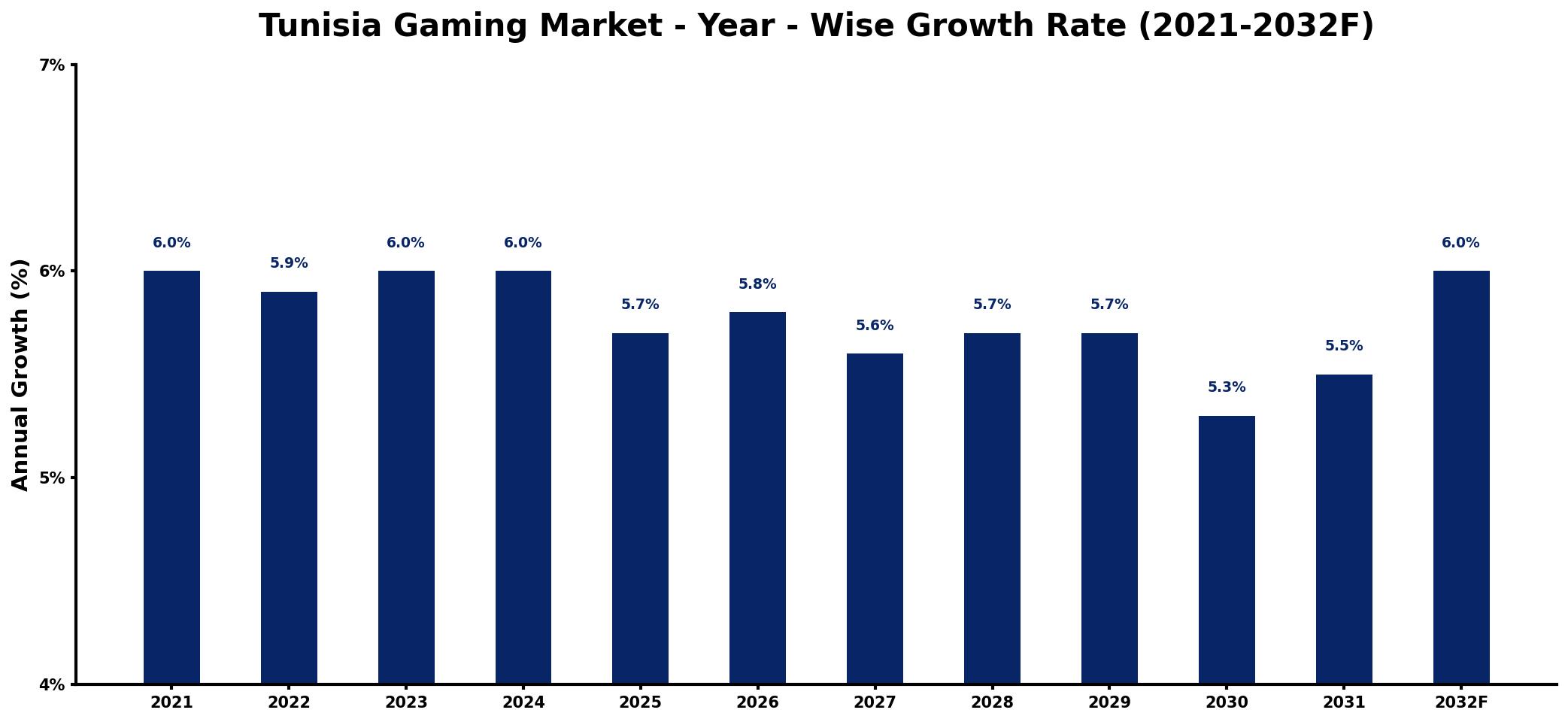
The table below presents the year‑wise growth rates along with the key drivers influencing the market
| Year | Growth Rate | Major Drivers |
| 2021 | 6.0% | Rise in digital entertainment consumption |
| 2022 | 5.9% | Increased mobile internet accessibility |
| 2023 | 6.0% | Growth in esports popularity worldwide |
| 2024 | 6.0% | Expansion of online social platforms |
| 2025 | 5.7% | Emergence of local development studios |
| 2026 | 5.8% | Investment in interactive technologies |
| 2027 | 5.6% | Adoption of augmented reality experiences |
| 2028 | 5.7% | Rising interest in virtual competitions |
| 2029 | 5.7% | Boost in cross-platform play options |
| 2030 | 5.3% | Enhancement of user engagement strategies |
| 2031 | 5.5% | Development of immersive storytelling techniques |
| 2032 | 6.0% | Surge in subscription-based services |
Note: Market size estimations and growth projections presented in this report are based on 6Wresearch's proprietary forecasting methodology, utilizing the latest available industry data, government publications, and primary research inputs.
Tunisia Gaming Market Synopsis
Recently, the Tunisia Gaming Market has witnessed significant momentum, driven primarily by the surge in mobile gaming and increased access to high-speed internet. As this momentum builds, the future looks promising, with innovations and investments projected to further enhance market growth.
The rise of local developers creating culturally relevant games signifies a shift toward a more robust gaming ecosystem. Meanwhile, esports events are flourishing, fostering community engagement and setting the stage for competitive gaming on both local and international fronts.
Tunisia Gaming Market Key Takeaways
- The market is dominated by mobile gaming, thanks to widespread smartphone adoption.
- Esports is gaining traction, leading to increased participation and event organization.
- Local game development is on the rise, reflecting the creative potential of Tunisian talent.
- Government support is vital, promoting industry growth through incentives and policy frameworks.
- Challenges such as internet access disparities and regulatory hurdles need addressing for sustained growth.
Evaluation of Restraints in Tunisia Gaming Market
Despite promising growth, the Tunisia Gaming Market faces several restraints that hinder its full potential. Limited access to high-speed internet in certain regions can severely impact online gaming experiences, leading to a fragmented user base. Additionally, piracy remains a significant concern, affecting revenue and stifling the ambitions of local developers. Regulatory challenges also present obstacles, with vague policies that can discourage new entrants and limit the introduction of innovative gaming products.
Tunisia Gaming Market Trends
The current landscape of the Tunisia Gaming Market is characterized by several notable trends. Firstly, mobile gaming continues to dominate, as affordable smartphones and improved internet connectivity make gaming more accessible. The rise of digital distribution platforms has facilitated wider access to both international and local games, supporting a vibrant gaming community. Additionally, esports competitions are rapidly gaining popularity, contributing to the growth of a spectator culture and community involvement.
Tunisia Gaming Market Opportunities
Investment opportunities within the Tunisia Gaming Market are expanding rapidly. The increasing interest in mobile and online gaming creates openings for game development studios, particularly those that leverage local themes and narratives. The thriving esports scene offers avenues for sponsorships and partnerships, while the youth demographic presents a fertile ground for innovative gaming products and services. Government initiatives further support this ecosystem, laying the groundwork for sustained growth and profitability.
Government Initiatives in the Tunisia Gaming Market
The Tunisian government plays an essential role in fostering a supportive environment for the gaming industry. Through the Ministry of Communication Technologies and the Digital Economy, regulatory measures have been introduced to encourage responsible gaming while promoting innovation. Furthermore, initiatives aimed at incentivizing local developers and organizing industry-related events highlight the government's commitment to nurturing the growth of this promising market.
Future Insights of the Tunisia Gaming Market
Looking ahead to 2026-2032, the Tunisia Gaming Market is set for continued expansion. Increasing internet accessibility, coupled with rising disposable incomes, is expected to drive further interest in gaming and esports among the younger population. The government's proactive stance in supporting the digital economy will likely result in additional investments in local game development, paving the way for innovative projects that cater to regional tastes. Emerging technologies like virtual reality and augmented reality may also find their way into the gaming experience, enhancing engagement and interactivity.
Tunisia Gaming Market Latest Developments (2025 - 2026)
In recent months, the Tunisia Gaming Market has seen notable developments aimed at enhancing community engagement and fostering local talent. Various gaming events have been organized to bring together enthusiasts and professional players, contributing to the growth of a competitive gaming culture. Additionally, partnerships between educational institutions and local game developers have emerged, creating pathways for talent development and innovation in game design.
Tunisia Gaming Market - Key Attractiveness of the Report
- 10 Years of Market Numbers
- Historical Data Starting from 2022 to 2025
- Base Year: 2025
- Forecast Data until 2032
- Key Performance Indicators Impacting the Market
- Major Upcoming Developments and Projects
Key Highlights of the Report:
- Tunisia Gaming Market Outlook
- Market Size of Tunisia Gaming Market, 2025
- Forecast of Tunisia Gaming Market, 2032
- Historical Data and Forecast of Tunisia Gaming Revenues & Volume for the Period 2022-2032F
- Tunisia Gaming Market Trend Evolution
- Tunisia Gaming Market Drivers and Challenges
- Tunisia Gaming Price Trends
- Tunisia Gaming Porter's Five Forces
- Tunisia Gaming Industry Life Cycle
- Historical Data and Forecast of Tunisia Gaming Market Revenues & Volume By Game Type for the Period 2022-2032F
- Historical Data and Forecast of Tunisia Gaming Market Revenues & Volume By Shooter for the Period 2022-2032F
- Historical Data and Forecast of Tunisia Gaming Market Revenues & Volume By Action for the Period 2022-2032F
- Historical Data and Forecast of Tunisia Gaming Market Revenues & Volume By Sports for the Period 2022-2032F
- Historical Data and Forecast of Tunisia Gaming Market Revenues & Volume By Role-Playing for the Period 2022-2032F
- Historical Data and Forecast of Tunisia Gaming Market Revenues & Volume By Others for the Period 2022-2032F
- Historical Data and Forecast of Tunisia Gaming Market Revenues & Volume By Device Type for the Period 2022-2032F
- Historical Data and Forecast of Tunisia Gaming Market Revenues & Volume By PC/MMO for the Period 2022-2032F
- Historical Data and Forecast of Tunisia Gaming Market Revenues & Volume By Tablet for the Period 2022-2032F
- Historical Data and Forecast of Tunisia Gaming Market Revenues & Volume By Mobile Phone for the Period 2022-2032F
- Historical Data and Forecast of Tunisia Gaming Market Revenues & Volume By TV/Console for the Period 2022-2032F
- Historical Data and Forecast of Tunisia Gaming Market Revenues & Volume By End-User for the Period 2022-2032F
- Historical Data and Forecast of Tunisia Gaming Market Revenues & Volume By Male for the Period 2022-2032F
- Historical Data and Forecast of Tunisia Gaming Market Revenues & Volume By Female for the Period 2022-2032F
- Tunisia Gaming Import Export Trade Statistics
- Market Opportunity Assessment By Game Type
- Market Opportunity Assessment By Device Type
- Market Opportunity Assessment By End-User
- Tunisia Gaming Top Companies Market Share
- Tunisia Gaming Competitive Benchmarking By Technical and Operational Parameters
- Tunisia Gaming Company Profiles
- Tunisia Gaming Key Strategic Recommendations






































