Tunisia Gifts Novelty and Souvenirs Market Size, Share & Growth Rate
The Tunisia Gifts Novelty and Souvenirs Market was estimated at USD 256 Million in 2025 and is projected to reach USD 340 Million by 2032, growing at a CAGR of 4.1% from 2026 to 2032. This growth trajectory is primarily driven by the rising influx of international tourists seeking authentic Tunisian experiences and the increasing appreciation for locally-made handicrafts. The blending of traditional and contemporary products is further stimulating consumer interest, bolstering sales across various distribution channels.
Tunisia Gifts Novelty and Souvenirs Market Year-wise Growth Rate and Key Drivers
This graph highlights how the Tunisia Gifts Novelty and Souvenirs Market has steadily grown over the years, supported by major growth factors.
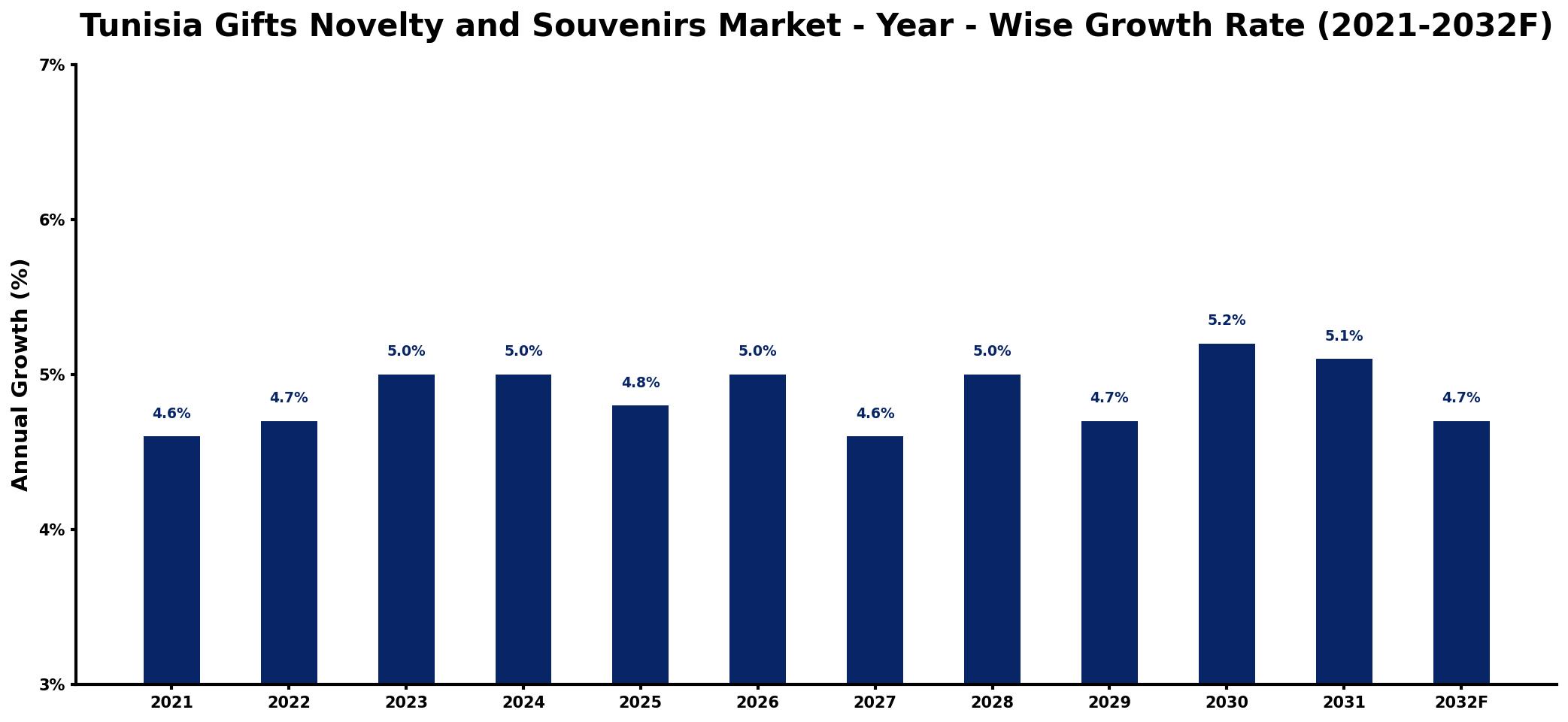
The table below presents the year‑wise growth rates along with the key drivers influencing the market
| Year | Growth Rate | Major Drivers |
| 2021 | 4.6% | Increased tourism boosting local economy |
| 2022 | 4.7% | Cultural festivals attracting more visitors |
| 2023 | 5.0% | Growing interest in local craftsmanship |
| 2024 | 5.0% | Expansion of e-commerce platforms |
| 2025 | 4.8% | Investment in artisan workshops rising |
| 2026 | 5.0% | Social media promoting regional artisans |
| 2027 | 4.6% | Collaborations with international brands increasing |
| 2028 | 5.0% | Sustainability trends enhancing product appeal |
| 2029 | 4.7% | Local markets gaining popularity abroad |
| 2030 | 5.2% | Emerging markets driving regional sales |
| 2031 | 5.1% | Innovative designs attracting younger consumers |
| 2032 | 4.7% | Strengthened community support for artisans |
Note: Market size estimations and growth projections presented in this report are based on 6Wresearch's proprietary forecasting methodology, utilizing the latest available industry data, government publications, and primary research inputs.
Tunisia Gifts Novelty and Souvenirs Market Synopsis
The most influential factor shaping the Tunisia Gifts Novelty and Souvenirs Market is the growing demand for authentic, locally-crafted products. Tourists and locals alike are drawn to traditional handicrafts that reflect Tunisias rich cultural heritage, with ceramics, textiles, and artisanal foods emerging as favorites. This trend signals a robust consumer preference for items that provide a deeper connection to Tunisian culture.
Additionally, the market is increasingly influenced by digital innovation, particularly through e-commerce platforms and social media. These tools are not only expanding market reach but also allowing for targeted marketing efforts that resonate with global audiences. As a result, the sector is witnessing a convergence of tradition and modernity, paving the way for exciting new product offerings.
Tunisia Gifts Novelty and Souvenirs Market Key Takeaways
- The market is anticipated to grow from USD 256 Million in 2025 to USD 340 Million by 2032.
- Strong demand for authentic and locally-made handicrafts continues to drive market growth.
- E-commerce and digital marketing are essential components for reaching a broader customer base.
- There is a growing preference for sustainable and eco-friendly products among consumers.
- Innovation in product design is vital for capturing the evolving tastes of the market.
Evaluation of Restraints in Tunisia Gifts Novelty and Souvenirs Market
Despite its vibrant growth prospects, the Tunisia Gifts Novelty and Souvenirs Market faces notable constraints. One major issue is the intense competition from other tourist destinations that offer similar products, which makes differentiation crucial. Furthermore, fluctuations in tourist arrivals, often influenced by security concerns, can adversely impact sales. The high import costs for unique materials, combined with the challenge of consistently innovating, can place additional strain on local artisans and businesses. Moreover, the seasonality of tourism necessitates careful inventory management to maintain cash flow throughout the year.
Tunisia Gifts Novelty and Souvenirs Market Trends
A marked trend in the Tunisia Gifts Novelty and Souvenirs Market is the increasing consumer preference for personalized and customizable gifts. Shoppers are now seeking more meaningful products that reflect individual experiences, driving artisans to offer bespoke items. Simultaneously, the rise of eco-conscious consumerism is prompting businesses to prioritize sustainable practices, including sourcing materials locally and minimizing environmental impact. Additionally, the blending of traditional craftsmanship with contemporary design elements is becoming prevalent, attracting a broader demographic of buyers.
Tunisia Gifts Novelty and Souvenirs Market Opportunities
Investment opportunities in the Tunisia Gifts, Novelty, and Souvenirs Market are abundant. The increasing number of tourists presents a prime chance for establishing souvenir shops in key tourist locations. Collaborations with local artisans can result in exclusive, high-quality products that cater to discerning consumers. Moreover, expanding e-commerce capabilities can unlock access to a global market, providing a vital lifeline for growth. Digital marketing strategies tailored to showcase the uniqueness of Tunisian products further enhance visibility and attract potential buyers.
Government Initiatives in the Tunisia Gifts Novelty and Souvenirs Market
The Tunisian government plays a pivotal role in supporting the Gifts, Novelty, and Souvenirs Market through various initiatives aimed at fostering local craftsmanship and cultural heritage preservation. Incentives are in place to assist artisans and small businesses in producing authentic handicrafts. Furthermore, regulations help ensure the quality and authenticity of products sold to tourists, enhancing trust and satisfaction. Collaborations between the government and stakeholders in the tourism sector aim to promote Tunisian gifts on both domestic and international stages, bolstering economic growth.
Future Insights of the Tunisia Gifts Novelty and Souvenirs Market
Looking ahead to 2026-2032, the Tunisia Gifts Novelty and Souvenirs Market is set for sustained growth, driven by an expanding tourism sector and an increasing appetite for unique cultural products. With international visitors appreciating authentic local craftsmanship, businesses can thrive by focusing on quality and innovation. The continued rise of digital platforms will also facilitate outreach, allowing smaller artisans to enter the market competitively. Overall, a forward-thinking approach combined with a commitment to heritage will be essential for long-term success.
Tunisia Gifts Novelty and Souvenirs Market Latest Developments (2025 - 2026)
In recent months, the Tunisia Gifts Novelty and Souvenirs Market has seen an uptick in digital marketing campaigns aimed at enhancing brand visibility among global tourists. Artisans are increasingly embracing e-commerce platforms to showcase their products, resulting in a more significant online presence. Concurrently, local craft fairs are re-emerging as key venues for artisans to connect with consumers and promote their unique offerings. These developments reflect a dynamic shift in how Tunisian products are marketed and sold, aimed at enhancing overall market growth.
Tunisia Gifts Novelty and Souvenirs Market - Key Attractiveness of the Report
- 10 Years of Market Numbers
- Historical Data Starting from 2022 to 2025
- Base Year: 2025
- Forecast Data until 2032
- Key Performance Indicators Impacting the Market
- Major Upcoming Developments and Projects
Key Highlights of the Report:
- Tunisia Gifts Novelty and Souvenirs Market Outlook
- Market Size of Tunisia Gifts Novelty and Souvenirs Market, 2025
- Forecast of Tunisia Gifts Novelty and Souvenirs Market, 2032
- Historical Data and Forecast of Tunisia Gifts Novelty and Souvenirs Revenues & Volume for the Period 2022-2032F
- Tunisia Gifts Novelty and Souvenirs Market Trend Evolution
- Tunisia Gifts Novelty and Souvenirs Market Drivers and Challenges
- Tunisia Gifts Novelty and Souvenirs Price Trends
- Tunisia Gifts Novelty and Souvenirs Porter's Five Forces
- Tunisia Gifts Novelty and Souvenirs Industry Life Cycle
- Historical Data and Forecast of Tunisia Gifts Novelty and Souvenirs Market Revenues & Volume By Product for the Period 2022-2032F
- Historical Data and Forecast of Tunisia Gifts Novelty and Souvenirs Market Revenues & Volume By Souvenirs and Novelty Items for the Period 2022-2032F
- Historical Data and Forecast of Tunisia Gifts Novelty and Souvenirs Market Revenues & Volume By Seasonal Decorations for the Period 2022-2032F
- Historical Data and Forecast of Tunisia Gifts Novelty and Souvenirs Market Revenues & Volume By Greeting Cards for the Period 2022-2032F
- Historical Data and Forecast of Tunisia Gifts Novelty and Souvenirs Market Revenues & Volume By Other Gift Items for the Period 2022-2032F
- Historical Data and Forecast of Tunisia Gifts Novelty and Souvenirs Market Revenues & Volume By Distribution Channel for the Period 2022-2032F
- Historical Data and Forecast of Tunisia Gifts Novelty and Souvenirs Market Revenues & Volume By Offline for the Period 2022-2032F
- Historical Data and Forecast of Tunisia Gifts Novelty and Souvenirs Market Revenues & Volume By Online for the Period 2022-2032F
- Tunisia Gifts Novelty and Souvenirs Import Export Trade Statistics
- Market Opportunity Assessment By Product
- Market Opportunity Assessment By Distribution Channel
- Tunisia Gifts Novelty and Souvenirs Top Companies Market Share
- Tunisia Gifts Novelty and Souvenirs Competitive Benchmarking By Technical and Operational Parameters
- Tunisia Gifts Novelty and Souvenirs Company Profiles
- Tunisia Gifts Novelty and Souvenirs Key Strategic Recommendations






































