Tunisia Gold Bullion Market Size, Share & Growth Rate
The Tunisia Gold Bullion Market was estimated at USD 240 Million in 2025 and is projected to reach USD 331 Million by 2032, growing at a CAGR of 4.7% from 2026 to 2032. This growth trajectory is primarily fueled by increasing economic uncertainties and a growing interest in gold as a safe-haven asset among local investors. Additionally, the rise in online trading platforms is making gold bullion more accessible, further driving demand within the market.
Tunisia Gold Bullion Market Year-wise Growth Rate and Key Drivers
This graph highlights how the Tunisia Gold Bullion Market has steadily grown over the years, supported by major growth factors.
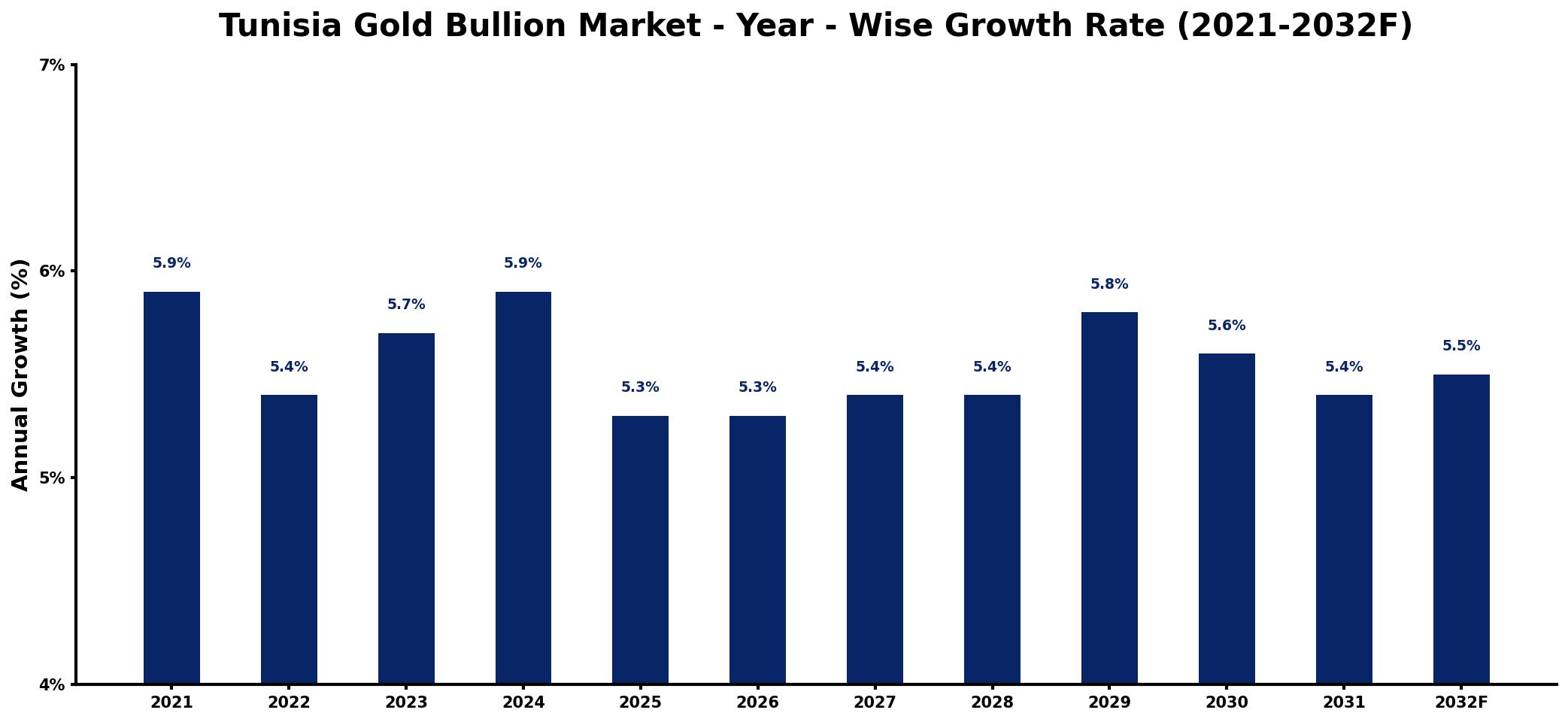
The table below presents the year‑wise growth rates along with the key drivers influencing the market
| Year | Growth Rate | Major Drivers |
| 2021 | 5.9% | Increased investor interest globally |
| 2022 | 5.4% | Rising demand for safe assets |
| 2023 | 5.7% | Growing popularity of alternative investments |
| 2024 | 5.9% | strengthening underlying market demand |
| 2025 | 5.3% | Expansion of retail investor base |
| 2026 | 5.3% | Strengthening of local mining sector |
| 2027 | 5.4% | Increase in luxury market demand |
| 2028 | 5.4% | Boost in tourism-related purchases |
| 2029 | 5.8% | Enhanced financial market stability |
| 2030 | 5.6% | Growing awareness of asset diversification |
| 2031 | 5.4% | Rise in cultural significance investments |
| 2032 | 5.5% | Strengthened regulatory framework benefits |
Note: Market size estimations and growth projections presented in this report are based on 6Wresearch's proprietary forecasting methodology, utilizing the latest available industry data, government publications, and primary research inputs.
Tunisia Gold Bullion Market Synopsis
In recent years, the Tunisia Gold Bullion Market has gained momentum, reflecting a notable shift in investor behavior toward precious metals. As the market evolves, it is transitioning into a more significant asset class amidst fluctuating economic conditions. This trend indicates a growing recognition of gold's stability as an investment, particularly during periods of financial distress.
Currently, gold bullion is traded predominantly in major cities like Tunis and Sousse, with both local and foreign investors participating. Despite its relatively small size compared to global markets, the demand for physical gold remains steady, highlighting the asset's unique allure. The market is poised for future growth, driven by both local aspirations and international influences.
Tunisia Gold Bullion Market Key Takeaways
- The market is projected to grow from USD 240 Million in 2025 to USD 331 Million by 2032.
- Increased economic uncertainty is driving local investors to seek gold as a safe-haven asset.
- The rise of online trading platforms is enhancing accessibility to gold bullion investments.
- Tourism is contributing to demand, with visitors purchasing gold as souvenirs or investments.
- Government regulations aim to enhance market integrity and consumer protection.
Evaluation of Restraints in Tunisia Gold Bullion Market
The Tunisia Gold Bullion Market faces significant restraints that hinder its potential growth. A key challenge is the lack of transparency and regulatory oversight, which can lead to price manipulation and the proliferation of counterfeit products. Additionally, the limited availability of reliable data impacts investors ability to make informed decisions. Political and economic instability further compounds these issues, introducing uncertainty into the gold market and deterring potential investors from fully engaging.
Tunisia Gold Bullion Market Trends
Several trends are shaping the current landscape of the Tunisia Gold Bullion Market. The demand for physical gold is escalating, driven by an increasing recognition of its value during times of economic volatility. Investors are increasingly diversifying their portfolios to include gold bullion, viewing it as a hedge against inflation and currency devaluation. Moreover, the emergence of online trading platforms allows for easier entry into the market, appealing to a younger, tech-savvy investor demographic.
Tunisia Gold Bullion Market Opportunities
The Tunisia Gold Bullion Market presents a variety of investment opportunities for discerning investors. Purchasing physical gold bars or coins from reputable dealers offers a tangible asset that retains intrinsic value. Additionally, investment in local gold mining companies provides exposure to the potential upside of gold production and exploration activities. Exchange-traded funds (ETFs) focused on gold bullion further enable investors to engage with the market conveniently, without the complications of physical storage.
Government Initiatives in the Tunisia Gold Bullion Market
The Tunisian government has taken significant steps to regulate the gold bullion market, establishing licensing requirements for dealers and guidelines for the import and export of gold. Anti-money laundering measures have been put in place to ensure compliance and protect against illicit trading practices. The Central Bank of Tunisia plays a crucial role in overseeing these regulations, aiming to promote transparency and stability within the market while generating revenue through taxes on gold sales.
Future Insights of the Tunisia Gold Bullion Market
The future outlook for the Tunisia Gold Bullion Market is optimistic, bolstered by rising geopolitical uncertainties and ongoing economic instability. As local investors increasingly seek reliable assets to safeguard their wealth, gold bullion is likely to remain a favored investment. Moreover, growing interest in sustainable investment options is expected to enhance the appeal of gold, contributing to market expansion. Nonetheless, potential fluctuations in gold prices and regulatory changes will need to be monitored closely.
Tunisia Gold Bullion Market Latest Developments (2025 - 2026)
Recent developments in the Tunisia Gold Bullion Market have underscored its evolving landscape. Initiatives aimed at enhancing transparency and regulatory compliance are being increasingly prioritized. There has been a notable increase in the number of authorized dealers, as the government pushes for a more structured market environment. Additionally, growing awareness and interest from local investors continue to shape market dynamics, demonstrating a positive shift in investment attitudes.
Tunisia Gold Bullion Market - Key Attractiveness of the Report
- 10 Years of Market Numbers
- Historical Data Starting from 2022 to 2025
- Base Year: 2025
- Forecast Data until 2032
- Key Performance Indicators Impacting the Market
- Major Upcoming Developments and Projects
Key Highlights of the Report:
- Tunisia Gold Bullion Market Outlook
- Market Size of Tunisia Gold Bullion Market, 2025
- Forecast of Tunisia Gold Bullion Market, 2032
- Historical Data and Forecast of Tunisia Gold Bullion Revenues & Volume for the Period 2022-2032F
- Tunisia Gold Bullion Market Trend Evolution
- Tunisia Gold Bullion Market Drivers and Challenges
- Tunisia Gold Bullion Price Trends
- Tunisia Gold Bullion Porter's Five Forces
- Tunisia Gold Bullion Industry Life Cycle
- Historical Data and Forecast of Tunisia Gold Bullion Market Revenues & Volume By Type for the Period 2022-2032F
- Historical Data and Forecast of Tunisia Gold Bullion Market Revenues & Volume By Gold Bar for the Period 2022-2032F
- Historical Data and Forecast of Tunisia Gold Bullion Market Revenues & Volume By Gold Coin for the Period 2022-2032F
- Historical Data and Forecast of Tunisia Gold Bullion Market Revenues & Volume By Distribution Channel for the Period 2022-2032F
- Historical Data and Forecast of Tunisia Gold Bullion Market Revenues & Volume By Online for the Period 2022-2032F
- Historical Data and Forecast of Tunisia Gold Bullion Market Revenues & Volume By Offline for the Period 2022-2032F
- Tunisia Gold Bullion Import Export Trade Statistics
- Market Opportunity Assessment By Type
- Market Opportunity Assessment By Distribution Channel
- Tunisia Gold Bullion Top Companies Market Share
- Tunisia Gold Bullion Competitive Benchmarking By Technical and Operational Parameters
- Tunisia Gold Bullion Company Profiles
- Tunisia Gold Bullion Key Strategic Recommendations






































