Tunisia High Strength Steel Market Size, Share & Growth Rate
The Tunisia High Strength Steel Market was estimated at USD 712 Million in 2025 and is projected to reach USD 1031 Million by 2032, growing at a CAGR of 5.4% from 2026 to 2032. This robust growth trajectory is largely fueled by the rising demand for lightweight and durable materials across key sectors such as automotive and construction. As industries increasingly prioritize energy efficiency and structural integrity, high strength steels are becoming indispensable for meeting these evolving performance requirements.
Tunisia High Strength Steel Market Year-wise Growth Rate and Key Drivers
This graph highlights how the Tunisia High Strength Steel Market has steadily grown over the years, supported by major growth factors.
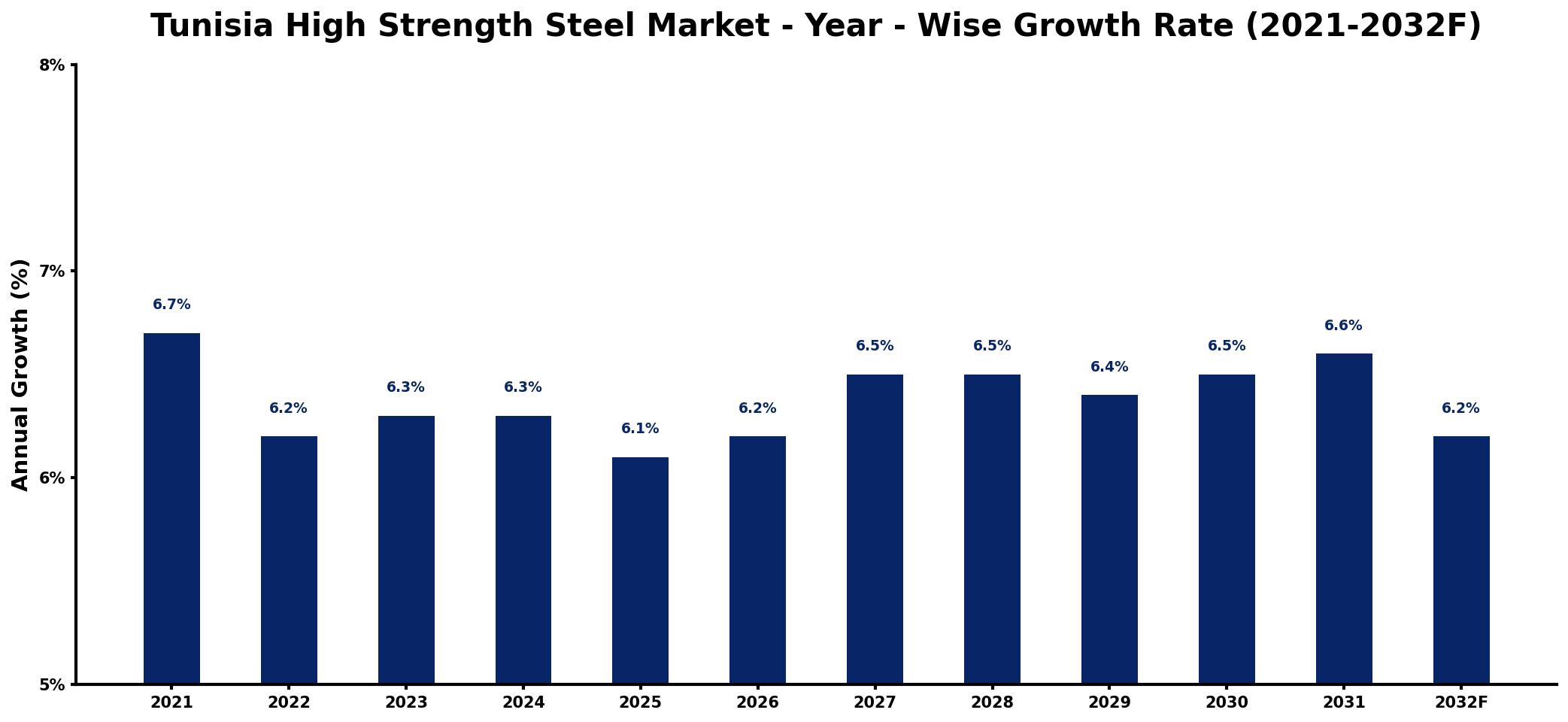
The table below presents the year‑wise growth rates along with the key drivers influencing the market
| Year | Growth Rate | Major Drivers |
| 2021 | 6.7% | Infrastructure investments drive demand |
| 2022 | 6.2% | Automotive industry expansion increases needs |
| 2023 | 6.3% | Construction sector shows robust growth |
| 2024 | 6.3% | Renewable energy projects boost usage |
| 2025 | 6.1% | Technology advancements enhance applications |
| 2026 | 6.2% | Manufacturing sector experiences revitalization |
| 2027 | 6.5% | Heavy machinery market expands significantly |
| 2028 | 6.5% | Government initiatives promote production efficiency |
| 2029 | 6.4% | growing emerging market penetration |
| 2030 | 6.5% | Urbanization trends fuel construction projects |
| 2031 | 6.6% | Defense sector increases procurement requirements |
| 2032 | 6.2% | Research and development investments rise |
Note: Market size estimations and growth projections presented in this report are based on 6Wresearch's proprietary forecasting methodology, utilizing the latest available industry data, government publications, and primary research inputs.
Tunisia High Strength Steel Market Synopsis
Currently, the strongest force driving the Tunisia High Strength Steel Market is the automotive sector's relentless quest for lightweight materials. The integration of advanced high-strength steels (AHSS) allows manufacturers to enhance vehicle efficiency while ensuring safety standards are met. This shift towards lightweighting is not just a trend; it has become a necessity in response to stringent environmental regulations and consumer expectations for fuel-efficient vehicles.
Additionally, the construction industry is significantly influencing market dynamics, leveraging high strength steel for superior structural performance in buildings and infrastructure projects. The ability of these materials to optimize resource use while maintaining resilience is integral to the ambitious urban development plans in Tunisia, which further propels demand for high strength steel solutions.
Tunisia High Strength Steel Market Key Takeaways
- High strength steels are pivotal in enhancing fuel efficiency and safety in the automotive sector.
- Demand for high-strength materials in construction is rising, particularly for large-scale infrastructure projects.
- Technological advancements in steel processing and alloy composition are key drivers of market innovation.
- Strategic collaborations among industry stakeholders are crucial for expanding market reach and application diversity.
- Government support for innovation and local manufacturing further boosts market potential.
Evaluation of Restraints in Tunisia High Strength Steel Market
Despite its positive growth outlook, the Tunisia High Strength Steel Market faces notable constraints. High production costs remain a significant barrier, largely due to the complex processes involved in manufacturing high-strength steel. This often translates into pricing challenges that could deter potential users. Furthermore, ensuring a steady supply of quality raw materials at competitive prices is imperative for sustaining market growth. Investment in research and development is vital to overcome these limitations and create high-quality products that align with industry demands.
Tunisia High Strength Steel Market Trends
Several emerging trends are shaping the landscape of the Tunisia High Strength Steel Market. Notably, there is a marked shift towards sustainable manufacturing practices, as industries seek to minimize their environmental footprint. The adoption of recycled materials in the production of high strength steels is gaining traction, reflecting a broader commitment to sustainability. Additionally, advancements in manufacturing techniques, such as additive manufacturing, are paving the way for innovative designs and applications, enhancing the performance attributes of high-strength steels.
Tunisia High Strength Steel Market Opportunities
The opportunities for growth within the Tunisia High Strength Steel Market are considerable. The ongoing urbanization and infrastructure development in Tunisia present avenues for high-strength steel applications in both residential and commercial sectors. Furthermore, the automotive industry's increasing emphasis on electric vehicles (EVs) offers a unique opportunity for high-strength steels, which can contribute to reducing vehicle weight and enhancing battery efficiency. These factors position the market favorably for future investments and innovations.
Government Initiatives in the Tunisia High Strength Steel Market
The Tunisian government is actively fostering the growth of the high strength steel market through various supportive measures. Policies aimed at promoting industrial innovation and bolstering local manufacturing are in place, which include incentives for research and development. By ensuring compliance with international quality standards, the government is also working to enhance the competitive edge of local producers. Moreover, public spending on infrastructure projects aligns with the goal of advancing the construction sector, which further encourages the use of high-strength steel.
Future Insights of the Tunisia High Strength Steel Market
Looking ahead to 2026-2032, the Tunisia High Strength Steel Market is poised for sustained growth, driven by ongoing technological advancements and increasing industry demands. As automotive manufacturers continue to adopt high-strength steels for innovative designs and improved safety features, the market will benefit from a diversification of applications. Additionally, as regulatory frameworks become more stringent regarding emissions and energy efficiency, the material's relevance in both automotive and construction sectors will only increase, fostering a robust competitive environment.
Tunisia High Strength Steel Market Latest Developments (2025 - 2026)
Recent developments in the Tunisia High Strength Steel Market indicate a significant push towards innovation and collaboration. Various stakeholders are increasingly engaging in partnerships aimed at enhancing product offerings and exploring new application areas. There is a growing focus on R&D initiatives that target the development of tailored high-strength steel solutions, meeting the evolving needs of local industries while also maintaining a commitment to sustainability and efficiency.
Tunisia High Strength Steel Market - Key Attractiveness of the Report
- 10 Years of Market Numbers
- Historical Data Starting from 2022 to 2025
- Base Year: 2025
- Forecast Data until 2032
- Key Performance Indicators Impacting the Market
- Major Upcoming Developments and Projects
Key Highlights of the Report:
- Tunisia High Strength Steel Market Outlook
- Market Size of Tunisia High Strength Steel Market, 2025
- Forecast of Tunisia High Strength Steel Market, 2032
- Historical Data and Forecast of Tunisia High Strength Steel Revenues & Volume for the Period 2022-2032F
- Tunisia High Strength Steel Market Trend Evolution
- Tunisia High Strength Steel Market Drivers and Challenges
- Tunisia High Strength Steel Price Trends
- Tunisia High Strength Steel Porter's Five Forces
- Tunisia High Strength Steel Industry Life Cycle
- Historical Data and Forecast of Tunisia High Strength Steel Market Revenues & Volume By Product Type for the Period 2022-2032F
- Historical Data and Forecast of Tunisia High Strength Steel Market Revenues & Volume By Dual Phase Steel for the Period 2022-2032F
- Historical Data and Forecast of Tunisia High Strength Steel Market Revenues & Volume By Bake Hardenable Steel for the Period 2022-2032F
- Historical Data and Forecast of Tunisia High Strength Steel Market Revenues & Volume By Carbon Manganese Steel for the Period 2022-2032F
- Historical Data and Forecast of Tunisia High Strength Steel Market Revenues & Volume By Other Product Types for the Period 2022-2032F
- Historical Data and Forecast of Tunisia High Strength Steel Market Revenues & Volume By Application for the Period 2022-2032F
- Historical Data and Forecast of Tunisia High Strength Steel Market Revenues & Volume By Automotive for the Period 2022-2032F
- Historical Data and Forecast of Tunisia High Strength Steel Market Revenues & Volume By Construction for the Period 2022-2032F
- Historical Data and Forecast of Tunisia High Strength Steel Market Revenues & Volume By Yellow Goods and Mining Equipment for the Period 2022-2032F
- Historical Data and Forecast of Tunisia High Strength Steel Market Revenues & Volume By Aviation and Marine for the Period 2022-2032F
- Historical Data and Forecast of Tunisia High Strength Steel Market Revenues & Volume By Other Applications for the Period 2022-2032F
- Tunisia High Strength Steel Import Export Trade Statistics
- Market Opportunity Assessment By Product Type
- Market Opportunity Assessment By Application
- Tunisia High Strength Steel Top Companies Market Share
- Tunisia High Strength Steel Competitive Benchmarking By Technical and Operational Parameters
- Tunisia High Strength Steel Company Profiles
- Tunisia High Strength Steel Key Strategic Recommendations






































