Tunisia Industrial Furnace Market Size, Share & Growth Rate
The Tunisia Industrial Furnace Market was estimated at USD 85 Million in 2025 and is projected to reach USD 92 Million by 2032, growing at a CAGR of 1.1% from 2026 to 2032. This growth trajectory is primarily driven by heightened industrialization in manufacturing, mining, and energy sectors, alongside the expanding construction industry. As companies seek to integrate more energy-efficient technologies, the demand for advanced industrial furnaces is expected to surge, further propelling the market's development.
Tunisia Industrial Furnace Market Year-wise Growth Rate and Key Drivers
This graph highlights how the Tunisia Industrial Furnace Market has steadily grown over the years, supported by major growth factors.
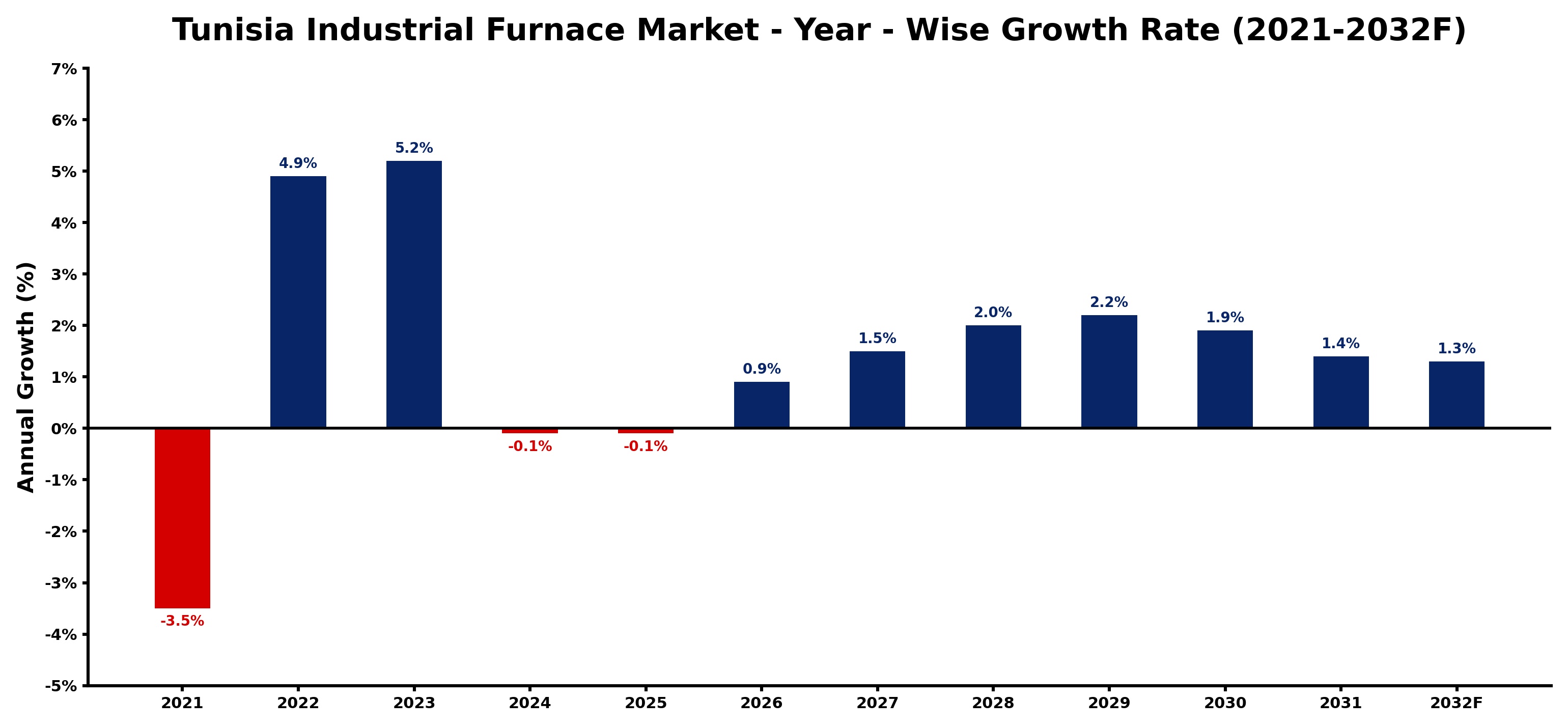
The table below presents the year‑wise growth rates along with the key drivers influencing the market
| Year | Growth Rate | Major Drivers |
| 2021 | -3.5% | High inflation curtailed investments in new industrial furnace technologies |
| 2022 | 4.9% | Increased manufacturing capacity drives demand for high efficiency furnaces |
| 2023 | 5.2% | Local manufacturing investments boost high efficiency furnace production capabilities |
| 2024 | -0.1% | Lower manufacturing output diminished furnace installation projects in Tunisia |
| 2025 | -0.1% | Inflation pressures curtailed investments in new manufacturing technologies |
| 2026 | 0.9% | Advanced furnace technologies drive local steel production efficiency |
| 2027 | 1.5% | Smart furnace technology adoption boosts energy efficiency in production |
| 2028 | 2.0% | Local manufacturing investments boost demand for advanced furnace technologies |
| 2029 | 2.2% | Furnace retrofitting projects enhance energy efficiency and production capacity |
| 2030 | 1.9% | Export driven automotive production ramped up furnace equipment purchases |
| 2031 | 1.4% | Foundry upgrades boost demand for advanced furnace technologies |
| 2032 | 1.3% | Local manufacturers upgrade equipment to enhance furnace efficiency |
Note - Market size estimations and growth projections presented in this report are based on 6Wresearch's advanced forecasting approach, validated with industry datasets as of June 2026.
Tunisia Industrial Furnace Market Synopsis
The strongest force shaping the Tunisia Industrial Furnace Market is the increasing focus on energy efficiency and environmental sustainability. With mounting pressures from regulatory bodies and consumers alike, manufacturers are investing in advanced furnace technologies that minimize emissions and enhance efficiency. This trend aligns with the broader industrial development goals within the country.
Additionally, the market is witnessing a notable shift towards customization and automation, with industries demanding tailored solutions that optimize productivity. This evolution is not only responding to immediate operational needs but also preparing businesses for the future of manufacturing, where smart technologies play a crucial role in operational excellence.
Tunisia Industrial Furnace Market Key Takeaways
- The market is driven by industrialization across various sectors, including manufacturing and construction.
- Technological advancements focused on energy efficiency and reduced environmental impact are reshaping the landscape.
- There is significant competition based on product quality, efficiency, and after-sales services.
- Stringent government regulations are promoting the adoption of cleaner technologies in industrial processes.
- Investment opportunities are emerging in customized and automated furnace solutions tailored for specific industrial needs.
Evaluation of Restraints in Tunisia Industrial Furnace Market
The Tunisia Industrial Furnace Market is hindered by several real constraints. Foremost among these is the increasing competition from foreign suppliers who offer lower-priced alternatives, challenging local manufacturers to innovate and reduce costs. Additionally, limited access to advanced technologies and high-quality materials restricts the capabilities of Tunisian firms. Fluctuating raw material prices add another layer of uncertainty, while regulatory frameworks necessitate compliance that can be costly and complicated. Together, these factors create a challenging environment for growth and profitability within the sector.
Tunisia Industrial Furnace Market Trends
One of the prominent trends in the Tunisia Industrial Furnace Market is the accelerated adoption of energy-efficient and environmentally friendly technologies. Companies are actively seeking to reduce emissions and comply with increasingly stringent environmental regulations. Additionally, a growing interest in automated and digitally connected furnace solutions is becoming prevalent, allowing for enhanced monitoring and control of operations. This shift towards sustainable practices is also reflected in the development of advanced refractory materials, which exhibit superior durability and insulation properties, further elevating the market's innovation landscape.
Tunisia Industrial Furnace Market Opportunities
Investors looking into the Tunisia Industrial Furnace Market will find promising opportunities, particularly in sectors that are experiencing significant growth, such as metalworking, glass manufacturing, and chemical processing. The rising demand for efficient and sustainable heating solutions presents a fertile ground for companies specializing in cutting-edge furnace technologies. Moreover, forming partnerships with local manufacturers can facilitate access to customized solutions that cater specifically to the Tunisian market's needs. With the government's commitment to modernizing industrial practices, strategic investments in this sector could yield substantial returns.
Government Initiatives in the Tunisia Industrial Furnace Market
The Tunisian government is actively promoting policies aimed at enhancing energy efficiency and reducing the environmental footprint of industrial operations. These initiatives include regulations that support the adoption of advanced furnace technologies designed to lower greenhouse gas emissions and improve energy consumption. Additionally, incentives and subsidies are available for industries that invest in cleaner and more efficient technologies, creating a supportive environment for market growth. The overarching goal of these policies is to foster sustainable practices in the industrial sector while driving economic advancement.
Future Insights of the Tunisia Industrial Furnace Market
Looking ahead to the period from 2026 to 2032, the Tunisia Industrial Furnace Market is expected to experience steady growth driven by ongoing industrialization and the increasing demand for efficient heating solutions. Technological innovations, particularly in the realm of energy-efficient and environmentally friendly furnace designs, are anticipated to reshape the market landscape. Coupled with government initiatives encouraging sustainable industrial practices, this sector is poised for expansion as businesses strive to enhance productivity while adhering to strict regulatory frameworks.
Tunisia Industrial Furnace Market Latest Developments (May 2025 - June 2026)
Recent developments in the Tunisia Industrial Furnace Market indicate a strong push towards sustainable technologies, as companies prioritize energy efficiency and compliance with environmental standards. There is a noticeable uptick in the introduction of advanced furnace solutions that incorporate automation and digital monitoring capabilities. Additionally, local manufacturers are increasingly collaborating with international technology providers to leverage expertise and expand their product offerings. This growing focus on innovation is setting the stage for a more competitive market landscape.
Tunisia Industrial Furnace Market - Key Attractiveness of the Report
- 10 Years of Market Numbers
- Historical Data Starting from 2022 to 2025
- Base Year: 2025
- Forecast Data until 2032
- Key Performance Indicators Impacting the Market
- Major Upcoming Developments and Projects
Key Highlights of the Report:
- Tunisia Industrial Furnace Market Outlook
- Market Size of Tunisia Industrial Furnace Market, 2025
- Forecast of Tunisia Industrial Furnace Market, 2032
- Historical Data and Forecast of Tunisia Industrial Furnace Revenues & Volume for the Period 2022-2032F
- Tunisia Industrial Furnace Market Trend Evolution
- Tunisia Industrial Furnace Market Drivers and Challenges
- Tunisia Industrial Furnace Price Trends
- Tunisia Industrial Furnace Porter's Five Forces
- Tunisia Industrial Furnace Industry Life Cycle
- Historical Data and Forecast of Tunisia Industrial Furnace Market Revenues & Volume By Furnace Type for the Period 2022-2032F
- Historical Data and Forecast of Tunisia Industrial Furnace Market Revenues & Volume By Gas/fuel Operated Industrial Furnace for the Period 2022-2032F
- Historical Data and Forecast of Tunisia Industrial Furnace Market Revenues & Volume By Electrically Operated Industrial Furnace for the Period 2022-2032F
- Historical Data and Forecast of Tunisia Industrial Furnace Market Revenues & Volume By Arrangement for the Period 2022-2032F
- Historical Data and Forecast of Tunisia Industrial Furnace Market Revenues & Volume By Tube or Clamshell Type for the Period 2022-2032F
- Historical Data and Forecast of Tunisia Industrial Furnace Market Revenues & Volume By Box Type for the Period 2022-2032F
- Historical Data and Forecast of Tunisia Industrial Furnace Market Revenues & Volume By Bottom Loading & Car Bottom Furnace for the Period 2022-2032F
- Historical Data and Forecast of Tunisia Industrial Furnace Market Revenues & Volume By Top Loading Furnace for the Period 2022-2032F
- Historical Data and Forecast of Tunisia Industrial Furnace Market Revenues & Volume By Others for the Period 2022-2032F
- Historical Data and Forecast of Tunisia Industrial Furnace Market Revenues & Volume By End-User for the Period 2022-2032F
- Historical Data and Forecast of Tunisia Industrial Furnace Market Revenues & Volume By Metals & Mining for the Period 2022-2032F
- Historical Data and Forecast of Tunisia Industrial Furnace Market Revenues & Volume By Transportation for the Period 2022-2032F
- Historical Data and Forecast of Tunisia Industrial Furnace Market Revenues & Volume By Oil & Gas for the Period 2022-2032F
- Historical Data and Forecast of Tunisia Industrial Furnace Market Revenues & Volume By Chemicals for the Period 2022-2032F
- Historical Data and Forecast of Tunisia Industrial Furnace Market Revenues & Volume By Others for the Period 2022-2032F
- Tunisia Industrial Furnace Import Export Trade Statistics
- Market Opportunity Assessment By Furnace Type
- Market Opportunity Assessment By Arrangement
- Market Opportunity Assessment By End-User
- Tunisia Industrial Furnace Top Companies Market Share
- Tunisia Industrial Furnace Competitive Benchmarking By Technical and Operational Parameters
- Tunisia Industrial Furnace Company Profiles
- Tunisia Industrial Furnace Key Strategic Recommendations






































