Tunisia Industrial Sugar Market Size, Share & Growth Rate
The Tunisia Industrial Sugar Market was estimated at USD 158 Million in 2025 and is projected to reach USD 173 Million by 2032, growing at a CAGR of 1.3% from 2026 to 2032. This growth trajectory is primarily driven by the robust expansion of the food processing and beverage sectors, where industrial sugar is integral for sweetening, flavor enhancement, and food preservation. Additionally, increasing consumer preferences for specialty sugar products are enhancing market dynamics and encouraging manufacturers to innovate their offerings.
Tunisia Industrial Sugar Market Year-wise Growth Rate and Key Drivers
This graph highlights how the Tunisia Industrial Sugar Market has steadily grown over the years, supported by major growth factors.
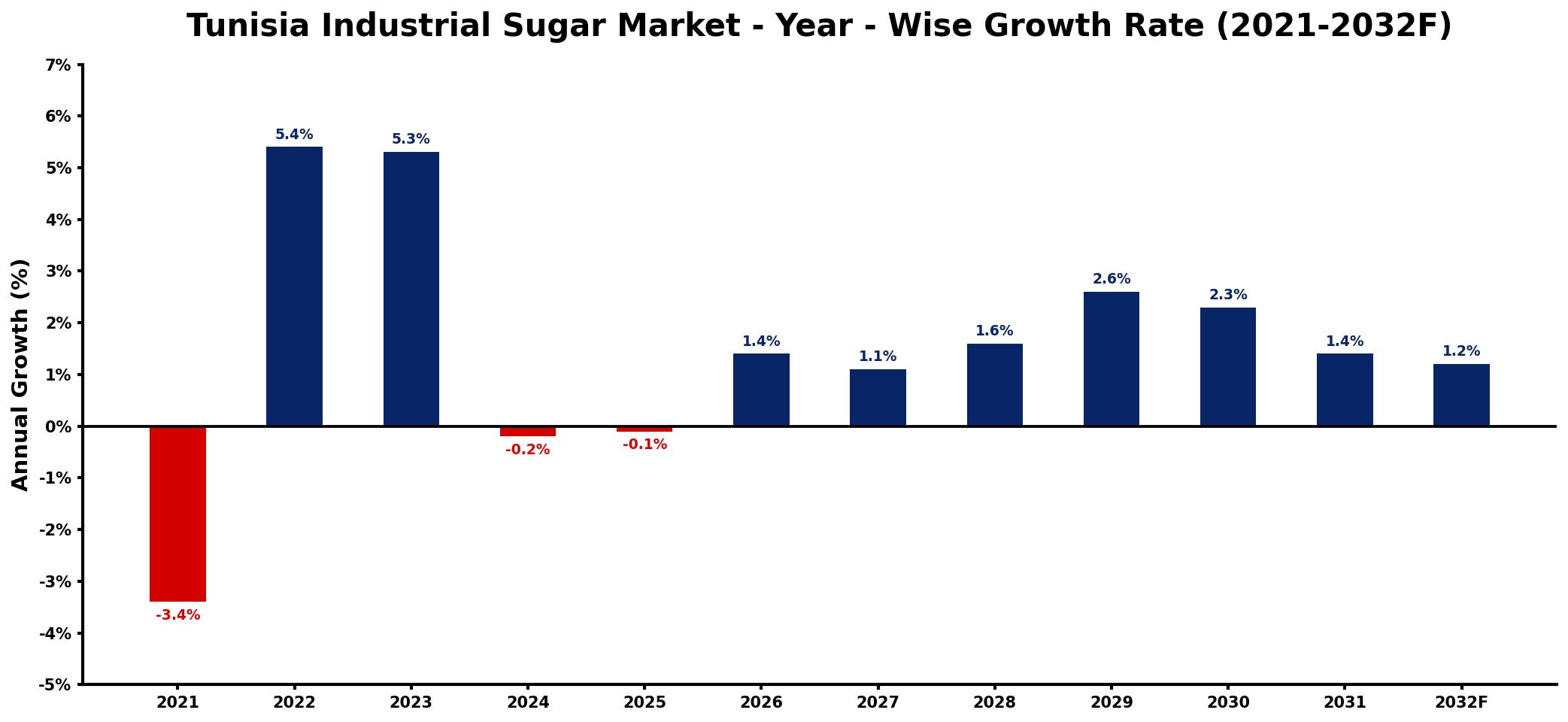
The table below presents the year‑wise growth rates along with the key drivers influencing the market
| Year | Growth Rate | Major Drivers |
| 2021 | -3.4% | decreased manufacturing activity levels |
| 2022 | 5.4% | increased consumer demand trends |
| 2023 | 5.3% | expansion of food processing sector |
| 2024 | -0.2% | reduction in agricultural outputs |
| 2025 | -0.1% | lower investment in infrastructure |
| 2026 | 1.4% | growth in export opportunities |
| 2027 | 1.1% | rising domestic consumption rates |
| 2028 | 1.6% | development of new facilities |
| 2029 | 2.6% | enhanced distribution networks established |
| 2030 | 2.3% | improvement in supply chain efficiency |
| 2031 | 1.4% | growing demand for alternatives |
| 2032 | 1.2% | strengthened partnerships and collaborations |
Note: Market size estimations and growth projections presented in this report are based on 6Wresearch's proprietary forecasting methodology, utilizing the latest available industry data, government publications, and primary research inputs.
Tunisia Industrial Sugar Market Synopsis
In recent years, the Tunisia industrial sugar market has demonstrated notable advancements, particularly in food and beverage processing. As consumers demand higher quality ingredients, manufacturers are under pressure to enhance their production techniques while ensuring sustainability. The focus on supply chain efficiency further highlights the market's evolution, as businesses strive to meet both regulatory standards and consumer expectations.
As Tunisia's industrial sugar landscape develops, challenges such as high production costs and the need for stable raw material supplies remain critical issues. Producers are increasingly exploring eco-friendly practices and modern technologies, aiming to not only optimize costs but also address growing environmental concerns. This evolving market offers a unique landscape for investment and innovation.
Tunisia Industrial Sugar Market Key Takeaways
- Rising demand from the food processing and beverage sectors is pivotal to market growth.
- Investments in R&D are crucial for developing high-quality, specialty sugar products.
- Government incentives promote sustainability and encourage modernization in production.
- Competition among producers necessitates efficient supply chains and cost management.
- The market is poised for gradual expansion, aligning with global trends in sweetener consumption.
Evaluation of Restraints in Tunisia Industrial Sugar Market
Despite the promising outlook, the Tunisia industrial sugar market contends with several significant constraints. Chief among these are elevated production costs, which often hamper profitability and limit investment in advanced production technologies. Additionally, sourcing raw materials at competitive prices remains a persistent challenge, impacting supply continuity. These factors necessitate a concerted effort from stakeholders to optimize production methods and enhance supply chain efficiencies in order to ensure sustainable market growth.
Tunisia Industrial Sugar Market Trends
Current trends shaping the Tunisia industrial sugar market include a shift towards healthier sweetener alternatives, as consumers become increasingly health-conscious. Furthermore, the emergence of liquid sugar and specialty sugar products is gaining traction among manufacturers who seek to cater to diverse consumer preferences. Technological advancements, particularly in production techniques, are also creating pathways for enhanced quality and efficiency, thereby positioning Tunisian producers competitively in global markets.
Tunisia Industrial Sugar Market Opportunities
The Tunisia industrial sugar market is ripe with opportunities for growth and investment. There is a significant potential in developing specialty sugars that align with modern consumer demands, such as organic and low-calorie options. Additionally, tapping into export markets could yield substantial benefits for local producers, especially with government backing for sustainability efforts. By embracing innovation and strategic partnerships, stakeholders can harness these opportunities to gain a competitive edge.
Government Initiatives in the Tunisia Industrial Sugar Market
Government policies in Tunisia focus on enhancing sustainability within the industrial sugar sector. Initiatives include providing financial incentives for producers who adopt eco-friendly practices and invest in modernizing their facilities. Regulatory frameworks have been implemented to ensure compliance with international quality standards, facilitating not only local market growth but also positioning Tunisian industrial sugar favorably for export opportunities.
Future Insights of the Tunisia Industrial Sugar Market
Looking ahead to 2026-2032, the Tunisia industrial sugar market is expected to evolve significantly. The continued expansion of the food and beverage industries will remain a key driver, while innovations in production and product offerings will likely reshape market dynamics. The emphasis on sustainability and efficiency is anticipated to lead to enhanced competitiveness among local producers, opening doors to new market segments and export avenues. Stakeholders who invest wisely in technology and consumer trends will be well-positioned to capitalize on this growth.
Tunisia Industrial Sugar Market Latest Developments (2025 - 2026)
In recent months, the Tunisia industrial sugar market has seen a heightened focus on sustainability, with various producers launching initiatives aimed at reducing their environmental footprints. Collaborations among industry players and research institutions have emerged, fostering innovations in sugar production processes. Additionally, as the domestic demand for specialty sugars rises, several companies are working to refine their product offerings to better meet consumer preferences and align with global market trends.
Tunisia Industrial Sugar Market - Key Attractiveness of the Report
- 10 Years of Market Numbers
- Historical Data Starting from 2022 to 2025
- Base Year: 2025
- Forecast Data until 2032
- Key Performance Indicators Impacting the Market
- Major Upcoming Developments and Projects
Key Highlights of the Report:
- Tunisia Industrial Sugar Market Outlook
- Market Size of Tunisia Industrial Sugar Market, 2025
- Forecast of Tunisia Industrial Sugar Market, 2032
- Historical Data and Forecast of Tunisia Industrial Sugar Revenues & Volume for the Period 2022-2032F
- Tunisia Industrial Sugar Market Trend Evolution
- Tunisia Industrial Sugar Market Drivers and Challenges
- Tunisia Industrial Sugar Price Trends
- Tunisia Industrial Sugar Porter's Five Forces
- Tunisia Industrial Sugar Industry Life Cycle
- Historical Data and Forecast of Tunisia Industrial Sugar Market Revenues & Volume By Type for the Period 2022-2032F
- Historical Data and Forecast of Tunisia Industrial Sugar Market Revenues & Volume By White sugar for the Period 2022-2032F
- Historical Data and Forecast of Tunisia Industrial Sugar Market Revenues & Volume By Brown sugar for the Period 2022-2032F
- Historical Data and Forecast of Tunisia Industrial Sugar Market Revenues & Volume By Liquid sugar for the Period 2022-2032F
- Historical Data and Forecast of Tunisia Industrial Sugar Market Revenues & Volume By Form for the Period 2022-2032F
- Historical Data and Forecast of Tunisia Industrial Sugar Market Revenues & Volume By Granulated for the Period 2022-2032F
- Historical Data and Forecast of Tunisia Industrial Sugar Market Revenues & Volume By Powdered for the Period 2022-2032F
- Historical Data and Forecast of Tunisia Industrial Sugar Market Revenues & Volume By Syrup for the Period 2022-2032F
- Historical Data and Forecast of Tunisia Industrial Sugar Market Revenues & Volume By Application for the Period 2022-2032F
- Historical Data and Forecast of Tunisia Industrial Sugar Market Revenues & Volume By Dairy for the Period 2022-2032F
- Historical Data and Forecast of Tunisia Industrial Sugar Market Revenues & Volume By Bakery for the Period 2022-2032F
- Historical Data and Forecast of Tunisia Industrial Sugar Market Revenues & Volume By Confectionery for the Period 2022-2032F
- Historical Data and Forecast of Tunisia Industrial Sugar Market Revenues & Volume By Beverage for the Period 2022-2032F
- Historical Data and Forecast of Tunisia Industrial Sugar Market Revenues & Volume By Canned & frozen foods for the Period 2022-2032F
- Historical Data and Forecast of Tunisia Industrial Sugar Market Revenues & Volume By Pharmaceuticals for the Period 2022-2032F
- Historical Data and Forecast of Tunisia Industrial Sugar Market Revenues & Volume By Other food items for the Period 2022-2032F
- Historical Data and Forecast of Tunisia Industrial Sugar Market Revenues & Volume By Source for the Period 2022-2032F
- Historical Data and Forecast of Tunisia Industrial Sugar Market Revenues & Volume By Cane sugar for the Period 2022-2032F
- Historical Data and Forecast of Tunisia Industrial Sugar Market Revenues & Volume By Beet sugar for the Period 2022-2032F
- Tunisia Industrial Sugar Import Export Trade Statistics
- Market Opportunity Assessment By Type
- Market Opportunity Assessment By Form
- Market Opportunity Assessment By Application
- Market Opportunity Assessment By Source
- Tunisia Industrial Sugar Top Companies Market Share
- Tunisia Industrial Sugar Competitive Benchmarking By Technical and Operational Parameters
- Tunisia Industrial Sugar Company Profiles
- Tunisia Industrial Sugar Key Strategic Recommendations






































