Tunisia Insulated Glass Market Size, Share & Growth Rate
The Tunisia Insulated Glass Market was estimated at USD 1411 Million in 2025 and is projected to reach USD 2013 Million by 2032, growing at a CAGR of 5.2% from 2026 to 2032. This robust growth trajectory is largely attributed to the increasing demand for energy-efficient building materials driven by government incentives and rising consumer awareness regarding sustainability in construction. As both residential and commercial sectors embrace these innovations, insulated glass solutions are becoming essential for modern building designs.
Tunisia Insulated Glass Market Year-wise Growth Rate and Key Drivers
This graph highlights how the Tunisia Insulated Glass Market has steadily grown over the years, supported by major growth factors.
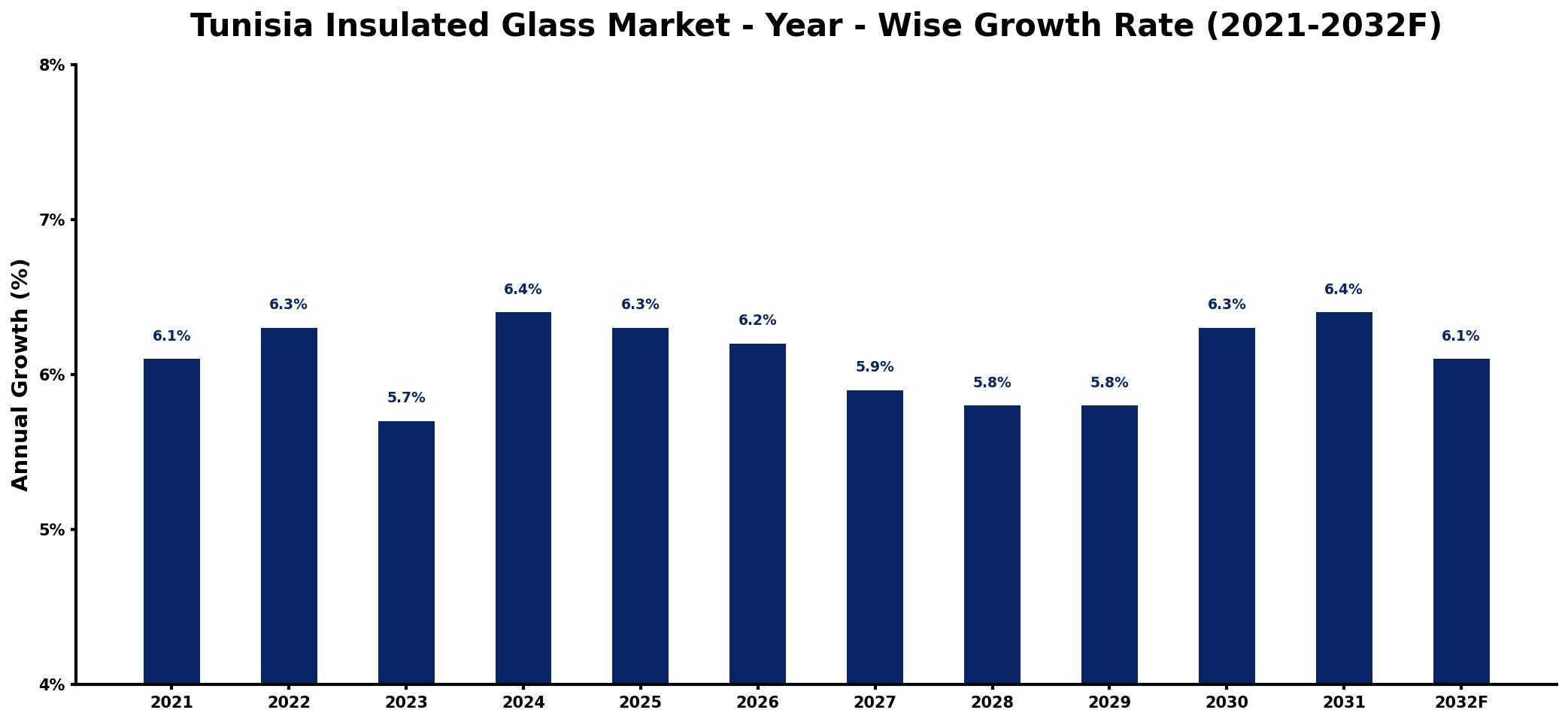
The table below presents the year‑wise growth rates along with the key drivers influencing the market
| Year | Growth Rate | Major Drivers |
| 2021 | 6.1% | Rising construction sector investments |
| 2022 | 6.3% | Increased energy efficiency regulations |
| 2023 | 5.7% | Growing demand for sustainable materials |
| 2024 | 6.4% | Expansion of commercial building projects |
| 2025 | 6.3% | Surge in residential renovation activities |
| 2026 | 6.2% | Strengthening of green building initiatives |
| 2027 | 5.9% | Technological advancements in applications |
| 2028 | 5.8% | Increase in urbanization trends |
| 2029 | 5.8% | Growth in energy conservation awareness |
| 2030 | 6.3% | Rising popularity of architectural design |
| 2031 | 6.4% | Boost in government infrastructure spending |
| 2032 | 6.1% | Heightened focus on environmental standards |
Note: Market size estimations and growth projections presented in this report are based on 6Wresearch's proprietary forecasting methodology, utilizing the latest available industry data, government publications, and primary research inputs.
Tunisia Insulated Glass Market Synopsis
The Tunisia Insulated Glass Market has recently gained momentum due to a heightened focus on energy efficiency and sustainable building practices. As construction activity surges, the market is anticipated to evolve further, driven by innovations in product offerings and technology.
This upward trend indicates a promising future as insulated glass gains traction across residential, commercial, and industrial sectors. Consumers are increasingly recognizing the benefits of thermal insulation and noise reduction, setting the stage for enhanced market adoption and penetration.
Tunisia Insulated Glass Market Key Takeaways
- The market is fueled by growing consumer demand for energy-efficient building materials.
- Government initiatives are promoting green construction practices, enhancing market appeal.
- Technological advancements, including smart glass innovations, are shaping product offerings.
- Customization in insulated glass solutions is becoming a priority for both consumers and builders.
- Investment opportunities exist in local manufacturing and product development to meet evolving demands.
Evaluation of Restraints in Tunisia Insulated Glass Market
Despite the positive outlook, the Tunisia Insulated Glass Market faces certain constraints that could impede growth. Rising raw material costs have increased the price of insulated glass products, making them less accessible for some builders and consumers. Fluctuating exchange rates can complicate imports, adding further pressure on pricing. Additionally, limited public awareness surrounding energy-efficient technologies may slow adoption rates, requiring more extensive education and outreach from industry stakeholders.
Tunisia Insulated Glass Market Trends
Several key trends are emerging within the Tunisia Insulated Glass Market. One notable trend is the increasing consumer preference for environmentally friendly glass products, largely fueled by rising awareness of sustainability issues. Advances in technology have also led to innovations such as low-emissivity coatings and smart glass, which adjust transparency in response to external conditions. Furthermore, a significant inclination toward customizable solutions is evident, as customers seek products that are both aesthetically pleasing and functionally efficient.
Tunisia Insulated Glass Market Opportunities
The Tunisia Insulated Glass Market presents substantial investment opportunities, particularly in the wake of ongoing construction growth and a shift toward green building practices. As the government prioritizes sustainable development, insulated glass products are increasingly recognized for their efficiency in reducing energy consumption and operational costs. Companies that invest in innovative technology and high-quality manufacturing processes will be well-positioned to meet the rising demand for customizable and eco-friendly solutions.
Government Initiatives in the Tunisia Insulated Glass Market
The Tunisian government has implemented various policies to encourage the adoption of insulated glass in building projects, aiming to promote energy efficiency and sustainability. Initiatives include regulatory frameworks advocating for high-performance insulated glass products, along with incentives such as tax breaks and subsidies for manufacturers investing in energy-efficient technologies. Such governmental support is pivotal in fostering a robust domestic insulated glass industry.
Future Insights of the Tunisia Insulated Glass Market
Looking ahead to 2026-2032, the Tunisia Insulated Glass Market is set for significant growth driven by continued construction activity and a deepening commitment to sustainable building practices. As awareness of energy-efficient solutions broadens, government regulations mandating the use of insulated glass in various construction projects are likely to become more prevalent. Advances in manufacturing technologies will further enhance the market, positioning insulated glass as a cornerstone of modern construction.
Tunisia Insulated Glass Market Latest Developments (2025 - 2026)
Recent developments in the Tunisia Insulated Glass Market reflect an industry shift toward enhanced sustainability and technological integration. Ongoing projects aim to bolster local production capabilities, reducing reliance on imports while addressing rising costs. Innovation continues to be at the forefront as manufacturers explore new material technologies and customization options, meeting the evolving demands of builders and consumers alike.
Tunisia Insulated Glass Market - Key Attractiveness of the Report
- 10 Years of Market Numbers
- Historical Data Starting from 2022 to 2025
- Base Year: 2025
- Forecast Data until 2032
- Key Performance Indicators Impacting the Market
- Major Upcoming Developments and Projects
Key Highlights of the Report:
- Tunisia Insulated Glass Market Outlook
- Market Size of Tunisia Insulated Glass Market, 2025
- Forecast of Tunisia Insulated Glass Market, 2032
- Historical Data and Forecast of Tunisia Insulated Glass Revenues & Volume for the Period 2022-2032F
- Tunisia Insulated Glass Market Trend Evolution
- Tunisia Insulated Glass Market Drivers and Challenges
- Tunisia Insulated Glass Price Trends
- Tunisia Insulated Glass Porter's Five Forces
- Tunisia Insulated Glass Industry Life Cycle
- Historical Data and Forecast of Tunisia Insulated Glass Market Revenues & Volume By Type for the Period 2022-2032F
- Historical Data and Forecast of Tunisia Insulated Glass Market Revenues & Volume By Heated Insulating Glass for the Period 2022-2032F
- Historical Data and Forecast of Tunisia Insulated Glass Market Revenues & Volume By Tempering Insulating Glass for the Period 2022-2032F
- Historical Data and Forecast of Tunisia Insulated Glass Market Revenues & Volume By Custom Insulated Glass for the Period 2022-2032F
- Historical Data and Forecast of Tunisia Insulated Glass Market Revenues & Volume By Other Glasses for the Period 2022-2032F
- Historical Data and Forecast of Tunisia Insulated Glass Market Revenues & Volume By Application for the Period 2022-2032F
- Historical Data and Forecast of Tunisia Insulated Glass Market Revenues & Volume By Doors & Partitions for the Period 2022-2032F
- Historical Data and Forecast of Tunisia Insulated Glass Market Revenues & Volume By Kitchen Appliances & Cabinets for the Period 2022-2032F
- Historical Data and Forecast of Tunisia Insulated Glass Market Revenues & Volume By Floors & Ceilings for the Period 2022-2032F
- Historical Data and Forecast of Tunisia Insulated Glass Market Revenues & Volume By Furniture & Curtain Walls for the Period 2022-2032F
- Historical Data and Forecast of Tunisia Insulated Glass Market Revenues & Volume By Railings & Bolted Structures for the Period 2022-2032F
- Historical Data and Forecast of Tunisia Insulated Glass Market Revenues & Volume By Automotive Glasses for the Period 2022-2032F
- Historical Data and Forecast of Tunisia Insulated Glass Market Revenues & Volume By End User for the Period 2022-2032F
- Historical Data and Forecast of Tunisia Insulated Glass Market Revenues & Volume By Residential Buildings for the Period 2022-2032F
- Historical Data and Forecast of Tunisia Insulated Glass Market Revenues & Volume By Commercial & Institutional Buildings for the Period 2022-2032F
- Historical Data and Forecast of Tunisia Insulated Glass Market Revenues & Volume By Industrial Users for the Period 2022-2032F
- Tunisia Insulated Glass Import Export Trade Statistics
- Market Opportunity Assessment By Type
- Market Opportunity Assessment By Application
- Market Opportunity Assessment By End User
- Tunisia Insulated Glass Top Companies Market Share
- Tunisia Insulated Glass Competitive Benchmarking By Technical and Operational Parameters
- Tunisia Insulated Glass Company Profiles
- Tunisia Insulated Glass Key Strategic Recommendations






































