Tunisia LED Professional Lighting Market Summary
The tunisia led professional lighting market was estimated at USD 262 Million in 2025 and is projected to reach USD 365 Million by 2032, growing at a CAGR of 5.6% from 2026 to 2032.
Tunisia LED Professional Lighting Market Year-wise Growth Rate and Key Drivers
This graph highlights how the Tunisia LED Professional Lighting Market has steadily grown over the past five years, supported by major growth factors.
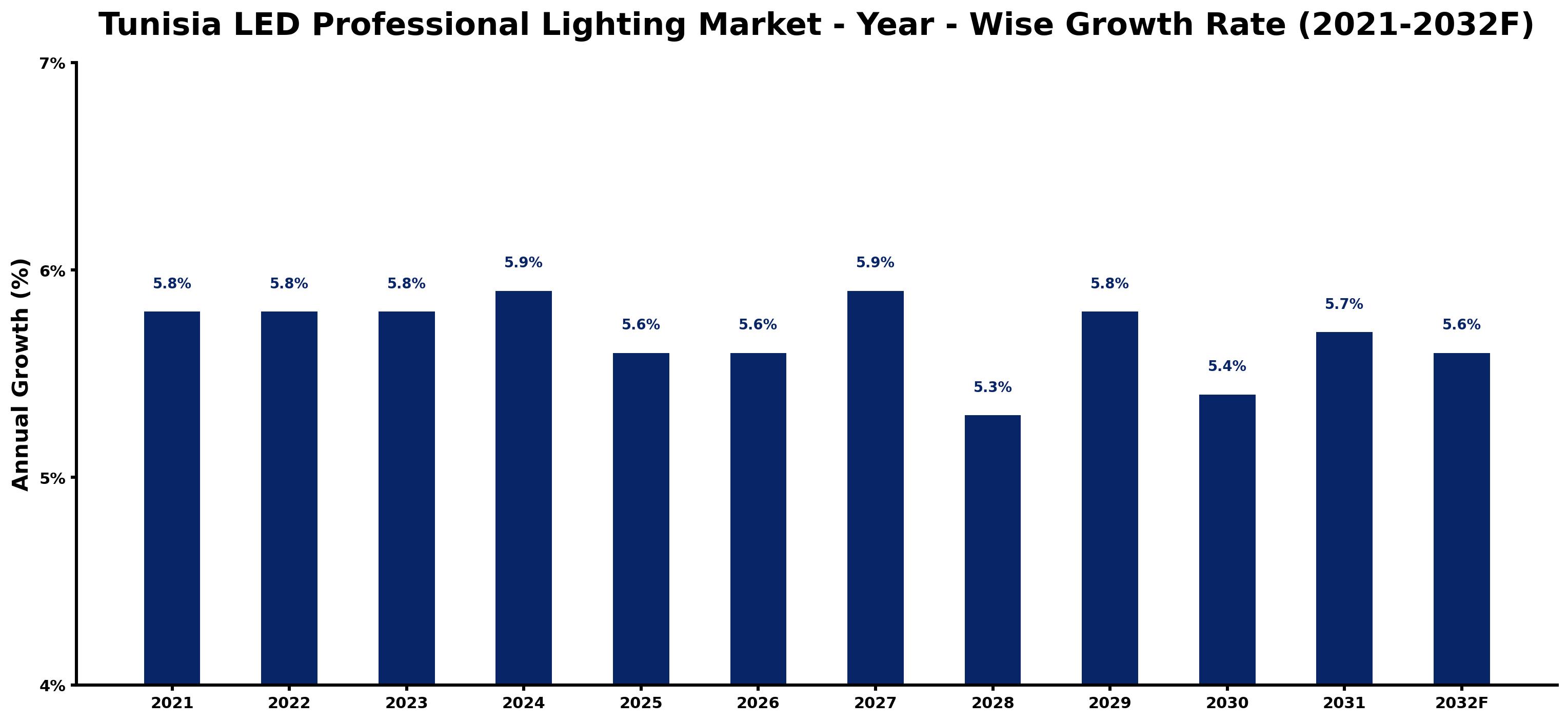
The table below presents the year wise growth rates along with the key drivers influencing the market
| Year | Growth Rate | Major Drivers |
| 2021 | 5.8% | Post-lockdown retail projects seek efficient lighting solutions to enhance customer experience. |
| 2022 | 5.8% | Infrastructural modernization efforts emphasize energy-efficient lighting to reduce operational costs. |
| 2023 | 5.8% | Awareness about energy savings increasingly influences choices among commercial property owners. |
| 2024 | 5.9% | Technological advancements in LED capabilities attract investments in smart lighting ecosystems. |
| 2025 | 5.6% | Local manufacturers begin to scale production, ensuring competitive pricing for key markets. |
| 2026 | 5.6% | Sustainability initiatives become integral to urban planning, boosting demand for LED lighting. |
| 2027 | 5.9% | Construction pipelines surge, leading to higher requirements for advanced lighting systems. |
| 2028 | 5.3% | Smart city projects integrate LED lighting, aligning with Tunisia's urban development goals. |
| 2029 | 5.8% | Projects focusing on hospitality and tourism increasingly seek customized lighting solutions. |
| 2030 | 5.4% | Emerging trends in healthy lighting drive interest in circadian rhythm-based products. |
| 2031 | 5.7% | Localized manufacturing reduces supply chain delays, promoting quicker market responsiveness. |
| 2032 | 5.6% | Collaboration between energy providers and lighting companies enhances product accessibility and adoption. |
Note - Market size estimations and growth projections presented in this report are based on 6Wresearch's advanced forecasting approach, validated with industry datasets as of June 2026.
Tunisia LED Professional Lighting Market Synopsis
The Tunisia LED Professional Lighting Market is projected to reach 5.6% and witness significant growth during the forecast period (2026-2032). This anticipated growth is fueled by various factors, including the increasing demand for energy-efficient lighting solutions, heightened environmental consciousness among consumers, and active government initiatives aimed at promoting sustainable energy practices. Furthermore, the integration of advanced technologies such as smart controls and Internet of Things (IoT) systems has facilitated the adoption of LED lighting in commercial environments, ultimately bolstering market expansion. As Tunisia embarks on upgrading its public infrastructure to stimulate economic development, the necessity for reliable and efficient lighting solutions will significantly influence the market landscape over the next six years.
Tunisia LED Professional Lighting Market Growth Drivers
The growth of the Tunisia LED Professional Lighting Market can be attributed to several key drivers:
- The shift towards energy-efficient lighting is one of the most significant factors. LED lighting consumes substantially less energy compared to traditional options, which leads to lower electricity bills and reduced carbon footprints.
- Environmental awareness among consumers continues to rise. As more individuals become conscious of their ecological impact, they are increasingly opting for sustainable lighting solutions such as LED fixtures.
- Government bodies are actively promoting green initiatives, including energy-saving programs and incentives for adopting LED technology, further stimulating market growth.
- Technological advancements, including smart lighting solutions and IoT-enabled systems, are increasing the appeal of LED lighting in various applications, ranging from residential to commercial use.
- The ongoing upgrade of public infrastructure in Tunisia necessitates reliable and advanced lighting systems, which drives the demand for innovative LED solutions across urban spaces.
Tunisia LED Professional Lighting Market Trends and Opportunities
Several trends are shaping the Tunisia LED Professional Lighting Market, offering new opportunities for growth:
- The implementation of smart city initiatives has led to an increased investment in modern lighting solutions, thereby expanding opportunities for LED technologies.
- Sustainable building practices are increasingly being adopted in new constructions, prompting the use of energy-efficient lighting systems including LED lights.
- There is a growing trend towards customization of lighting solutions, which allows businesses and consumers to create environments tailored to specific needs and preferences, utilizing LED technology.
- The emergence of remote lighting control systems is enhancing the functionality of LED installations, enabling users to optimize energy use while enhancing convenience.
- As the hospitality and retail sectors continue to evolve, the demand for aesthetically pleasing yet energy-efficient lighting solutions will drive more businesses to adopt LED technology.
Tunisia LED Professional Lighting Market Challenges and Restraints
Despite the promising growth trajectory, the Tunisia LED Professional Lighting Market faces several challenges:
- High initial costs associated with the installation of LED systems can deter potential adopters, particularly in budget-conscious sectors.
- There is a lack of awareness regarding the long-term benefits of LED lighting among some consumer segments, which can impede market penetration.
- The presence of counterfeit products in the market poses a risk to consumers, who may opt for cheaper alternatives with lower performance and durability.
- Technical challenges related to the integration of LED lighting with existing infrastructure and systems can complicate adoption.
- Competition from traditional lighting technologies, which may still be favored in certain applications, remains a hurdle for the LED market.
Tunisia LED Professional Lighting Market Government Investment and Initiatives
The Tunisian government has shown a strong commitment to promoting the adoption of LED lighting through various investment initiatives. These include:
- Significant investments in public infrastructure projects that prioritize energy-efficient lighting, reflecting the government's dedication to sustainability.
- Implementation of policies and incentives aimed at encouraging businesses and households to switch to LED lighting solutions, supporting both economic and environmental goals.
- Creation of partnerships with international organizations to foster the development of sustainable energy practices, including the adoption of LED technology.
- Educational campaigns designed to raise awareness about the benefits of energy-efficient lighting options, specifically targeting consumers and business owners.
- Support for research and innovation in lighting technologies to foster the development of new products and solutions that meet the evolving needs of the market.
Tunisia LED Professional Lighting Market Latest Developments (May 2025 - June 2026)
Recent developments in the Tunisia LED Professional Lighting Market indicate a proactive shift towards enhanced sustainability and smart solutions. Over the period from May 2025 to June 2026, notable trends include:
- A growing emphasis on the integration of IoT capabilities in LED lighting systems, facilitating improved control and management of lighting environments.
- Increased government support for projects aimed at retrofitting existing lighting systems with LED technology, reflecting a commitment to sustainability.
- The rise of public-private partnerships focusing on large-scale LED installations in urban areas, enhancing both aesthetic appeal and energy efficiency.
- Expansion of educational programs aimed at informing stakeholders about the advantages of LED lighting, thereby encouraging its adoption.
- Development of innovative financing models to offset the initial costs of LED installations, making it more accessible for various sectors.
Tunisia LED Professional Lighting Market - Key Attractiveness of the Report
- 10 Years of Market Numbers
- Historical Data Starting from 2022 to 2025
- Base Year: 2025
- Forecast Data until 2032
- Key Performance Indicators Impacting the Market
- Major Upcoming Developments and Projects
Key Highlights of the Report:
- Tunisia LED Professional Lighting Market Outlook
- Market Size of Tunisia LED Professional Lighting Market, 2025
- Forecast of Tunisia LED Professional Lighting Market, 2032
- Historical Data and Forecast of Tunisia LED Professional Lighting Revenues & Volume for the Period 2022-2032
- Tunisia LED Professional Lighting Market Trend Evolution
- Tunisia LED Professional Lighting Market Drivers and Challenges
- Tunisia LED Professional Lighting Price Trends
- Tunisia LED Professional Lighting Porter's Five Forces
- Tunisia LED Professional Lighting Industry Life Cycle
- Historical Data and Forecast of Tunisia LED Professional Lighting Market Revenues & Volume By Product Type for the Period 2022-2032
- Historical Data and Forecast of Tunisia LED Professional Lighting Market Revenues & Volume By LED Bulbs for the Period 2022-2032
- Historical Data and Forecast of Tunisia LED Professional Lighting Market Revenues & Volume By LED Fixtures for the Period 2022-2032
- Historical Data and Forecast of Tunisia LED Professional Lighting Market Revenues & Volume By Bare LED Tubes for the Period 2022-2032
- Historical Data and Forecast of Tunisia LED Professional Lighting Market Revenues & Volume By LED Down lights for the Period 2022-2032
- Historical Data and Forecast of Tunisia LED Professional Lighting Market Revenues & Volume By Applications for the Period 2022-2032
- Historical Data and Forecast of Tunisia LED Professional Lighting Market Revenues & Volume By Indoor for the Period 2022-2032
- Historical Data and Forecast of Tunisia LED Professional Lighting Market Revenues & Volume By Outdoor for the Period 2022-2032
- Historical Data and Forecast of Tunisia LED Professional Lighting Market Revenues & Volume By Automotive for the Period 2022-2032
- Historical Data and Forecast of Tunisia LED Professional Lighting Market Revenues & Volume By Backlighting for the Period 2022-2032
- Tunisia LED Professional Lighting Import Export Trade Statistics
- Market Opportunity Assessment By Product Type
- Market Opportunity Assessment By Applications
- Tunisia LED Professional Lighting Top Companies Market Share
- Tunisia LED Professional Lighting Competitive Benchmarking By Technical and Operational Parameters
- Tunisia LED Professional Lighting Company Profiles
- Tunisia LED Professional Lighting Key Strategic Recommendations
Market Covered
This report offers a comprehensive study of the subsequent market segments:
By Product Type
- LED Bulbs
- LED Fixtures
- Bare LED Tubes
- LED Down lights
By Applications
- Indoor, Outdoor
- Automotive
- Backlighting






































