Tunisia Life Science Reagents Market Size, Share & Growth Rate
The Tunisia Life Science Reagents Market was estimated at USD 1347 Million in 2025 and is projected to reach USD 1938 Million by 2032, growing at a CAGR of 5.3% from 2026 to 2032. This growth trajectory is primarily driven by increased investments in research and development across biotechnology and pharmaceutical sectors, as well as a burgeoning demand for personalized medicine. As Tunisias life sciences landscape continues to mature, the market is set to benefit from advancements in genomics, proteomics, and novel drug discovery processes.
Tunisia Life Science Reagents Market Year-wise Growth Rate and Key Drivers
This graph highlights how the Tunisia Life Science Reagents Market has steadily grown over the years, supported by major growth factors.
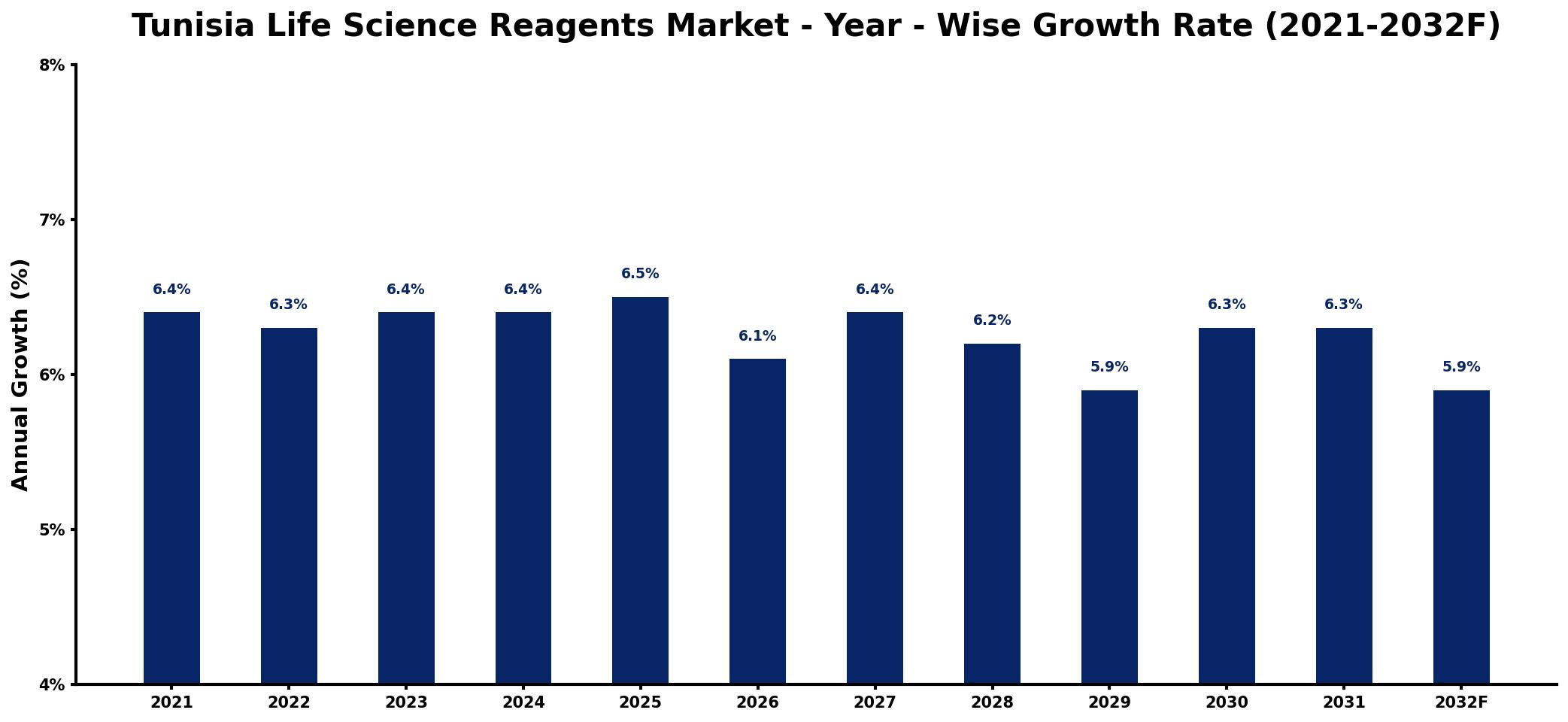
The table below presents the year‑wise growth rates along with the key drivers influencing the market
| Year | Growth Rate | Major Drivers |
| 2021 | 6.4% | Rising healthcare investments drive growth |
| 2022 | 6.3% | Increased research funding for projects |
| 2023 | 6.4% | Growing biotechnology sector demands supplies |
| 2024 | 6.4% | Expansion of pharmaceutical manufacturing facilities |
| 2025 | 6.5% | Emerging diagnostic technologies create opportunities |
| 2026 | 6.1% | Strengthened regulatory frameworks enhance confidence |
| 2027 | 6.4% | Surge in academic research initiatives |
| 2028 | 6.2% | increased pharmaceutical industry usage |
| 2029 | 5.9% | Increased collaboration among research institutions |
| 2030 | 6.3% | Technological advancements foster innovation pathways |
| 2031 | 6.3% | Focus on sustainable production methods |
| 2032 | 5.9% | Emerging markets present new prospects |
Note: Market size estimations and growth projections presented in this report are based on 6Wresearch's proprietary forecasting methodology, utilizing the latest available industry data, government publications, and primary research inputs.
Tunisia Life Science Reagents Market Synopsis
The Tunisia Life Science Reagents Market has recently gained momentum, fueled by expanding research initiatives and the rising need for high-quality laboratory materials. As the market evolves, it is increasingly poised for growth, driven by innovation and technology advancements that are reshaping the landscape of research in the region.
Despite past constraints, the market is now characterized by a vibrant mix of local and international suppliers, providing a diverse array of reagents tailored to meet the demands of a growing scientific community. The ongoing trend towards personalized medicine and advanced research methodologies signals a promising future for the Tunisia Life Science Reagents Market.
Tunisia Life Science Reagents Market Key Takeaways
- Steady growth is expected, with a market size projected to reach USD 1938 Million by 2032.
- Key drivers include rising research investments and increasing prevalence of chronic diseases.
- The market is seeing a shift towards innovative and specialized reagents supporting advanced applications.
- Sustainability and eco-friendly practices are becoming pivotal in reagent development.
- Strategic partnerships and collaborations are essential for capitalizing on emerging opportunities.
Evaluation of Restraints in Tunisia Life Science Reagents Market
While the Tunisia Life Science Reagents Market shows significant promise, several key restraints are impeding its potential. Limited access to advanced technology and a small market size hinder local manufacturers, while stringent regulations regarding the importation of certain reagents further complicate growth. Additionally, the political and economic landscape can introduce instability, which adversely affects investment in research and development. The shortage of skilled workforce and inadequate infrastructure in the life sciences sector are also challenges that must be addressed to unlock the market's full potential.
Tunisia Life Science Reagents Market Trends
Current trends in the Tunisia Life Science Reagents Market indicate a pronounced shift toward innovation, with increased demand for specialized reagents such as those used in CRISPR technology and next-generation sequencing. Researchers are seeking high-quality and reliable reagents to ensure accurate and reproducible results. Furthermore, there is a growing emphasis on developing sustainable reagents that align with global trends toward environmentally friendly research practices. These trends illustrate a broader move towards advanced methodologies, reflecting the increasing sophistication of scientific inquiry in Tunisia.
Tunisia Life Science Reagents Market Opportunities
The Tunisia Life Science Reagents Market presents robust investment opportunities, particularly in areas like personalized medicine and drug discovery. Investors can capitalize on the rising demand for high-quality reagents—such as antibodies, biochemicals, and assay kits—across research institutions and biotechnology companies. Establishing partnerships with local distributors or setting up direct distribution channels could facilitate market penetration and foster growth. As the life sciences sector continues to advance, recognizing the regulatory landscape and forging strong connections with key stakeholders will be vital for capitalizing on these opportunities.
Government Initiatives in the Tunisia Life Science Reagents Market
The Tunisian government actively promotes research and development in the life sciences sector through various initiatives designed to foster innovation. Incentives such as tax breaks and funding opportunities are offered to attract investment in new technologies and reagents. Additionally, stringent regulations ensure that life science reagents meet safety and quality standards, thus enhancing the market's overall credibility. The government also focuses on building partnerships with international organizations to facilitate knowledge exchange, contributing to the competitiveness and growth of the Tunisia Life Science Reagents Market.
Future Insights of the Tunisia Life Science Reagents Market
Looking ahead to the period from 2026 to 2032, the Tunisia Life Science Reagents Market is projected to continue its upward trajectory, driven by sustained investments in R&D and a growing preference for personalized medicine solutions. The expanding sectors of genomics, proteomics, and biotechnology will further influence market dynamics. As collaborations between academic institutions, research organizations, and biotech firms intensify, these partnerships are anticipated to bolster innovation, thereby enhancing the availability and diversity of reagents in the market.
Tunisia Life Science Reagents Market Latest Developments (2025 - 2026)
In the recent months, the Tunisia Life Science Reagents Market has witnessed strategic initiatives aimed at enhancing local capabilities and access to advanced reagents. Collaborative research projects between universities and private sectors are emerging, focusing on innovative reagent development. Additionally, there has been an increasing push towards sustainability, with suppliers exploring eco-friendly alternatives. This evolving landscape reflects a proactive response to both market demand and global sustainability trends.
Tunisia Life Science Reagents Market - Key Attractiveness of the Report
- 10 Years of Market Numbers
- Historical Data Starting from 2022 to 2025
- Base Year: 2025
- Forecast Data until 2032
- Key Performance Indicators Impacting the Market
- Major Upcoming Developments and Projects
Key Highlights of the Report:
- Tunisia Life Science Reagents Market Outlook
- Market Size of Tunisia Life Science Reagents Market, 2025
- Forecast of Tunisia Life Science Reagents Market, 2032
- Historical Data and Forecast of Tunisia Life Science Reagents Revenues & Volume for the Period 2022-2032F
- Tunisia Life Science Reagents Market Trend Evolution
- Tunisia Life Science Reagents Market Drivers and Challenges
- Tunisia Life Science Reagents Price Trends
- Tunisia Life Science Reagents Porter's Five Forces
- Tunisia Life Science Reagents Industry Life Cycle
- Historical Data and Forecast of Tunisia Life Science Reagents Market Revenues & Volume By Product for the Period 2022-2032F
- Historical Data and Forecast of Tunisia Life Science Reagents Market Revenues & Volume By Chromatography Reagents for the Period 2022-2032F
- Historical Data and Forecast of Tunisia Life Science Reagents Market Revenues & Volume By Molecular Diagnostics Reagents for the Period 2022-2032F
- Historical Data and Forecast of Tunisia Life Science Reagents Market Revenues & Volume By Immunoassay Reagents for the Period 2022-2032F
- Historical Data and Forecast of Tunisia Life Science Reagents Market Revenues & Volume By Clinical Chemistry Reagents for the Period 2022-2032F
- Historical Data and Forecast of Tunisia Life Science Reagents Market Revenues & Volume By Flow Cytometry Reagents for the Period 2022-2032F
- Historical Data and Forecast of Tunisia Life Science Reagents Market Revenues & Volume By Cell & Tissue Culture Reagents for the Period 2022-2032F
- Historical Data and Forecast of Tunisia Life Science Reagents Market Revenues & Volume By Hematology & Hemostasis Reagents for the Period 2022-2032F
- Historical Data and Forecast of Tunisia Chromatography Reagents Life Science Reagents Market Revenues & Volume By Microbiology Reagents for the Period 2022-2032F
- Historical Data and Forecast of Tunisia Life Science Reagents Market Revenues & Volume By End-user for the Period 2022-2032F
- Historical Data and Forecast of Tunisia Life Science Reagents Market Revenues & Volume By Hospitals & Diagnostics Laboratories for the Period 2022-2032F
- Historical Data and Forecast of Tunisia Life Science Reagents Market Revenues & Volume By Commercial & Contract Research Manufacturers for the Period 2022-2032F
- Historical Data and Forecast of Tunisia Life Science Reagents Market Revenues & Volume By Academic & Research Institutes for the Period 2022-2032F
- Historical Data and Forecast of Tunisia Life Science Reagents Market Revenues & Volume By Others for the Period 2022-2032F
- Tunisia Life Science Reagents Import Export Trade Statistics
- Market Opportunity Assessment By Product
- Market Opportunity Assessment By End-user
- Tunisia Life Science Reagents Top Companies Market Share
- Tunisia Life Science Reagents Competitive Benchmarking By Technical and Operational Parameters
- Tunisia Life Science Reagents Company Profiles
- Tunisia Life Science Reagents Key Strategic Recommendations






































