Tunisia Men Personal Care Market Summary
The tunisia men personal care market was estimated at USD 490 Million in 2025 and is projected to reach USD 669 Million by 2032, growing at a CAGR of 5.6% from 2026 to 2032.
Tunisia Men Personal Care Market Year-wise Growth Rate and Key Drivers
This graph highlights how the Tunisia Men Personal Care Market has steadily grown over the past five years, supported by major growth factors.
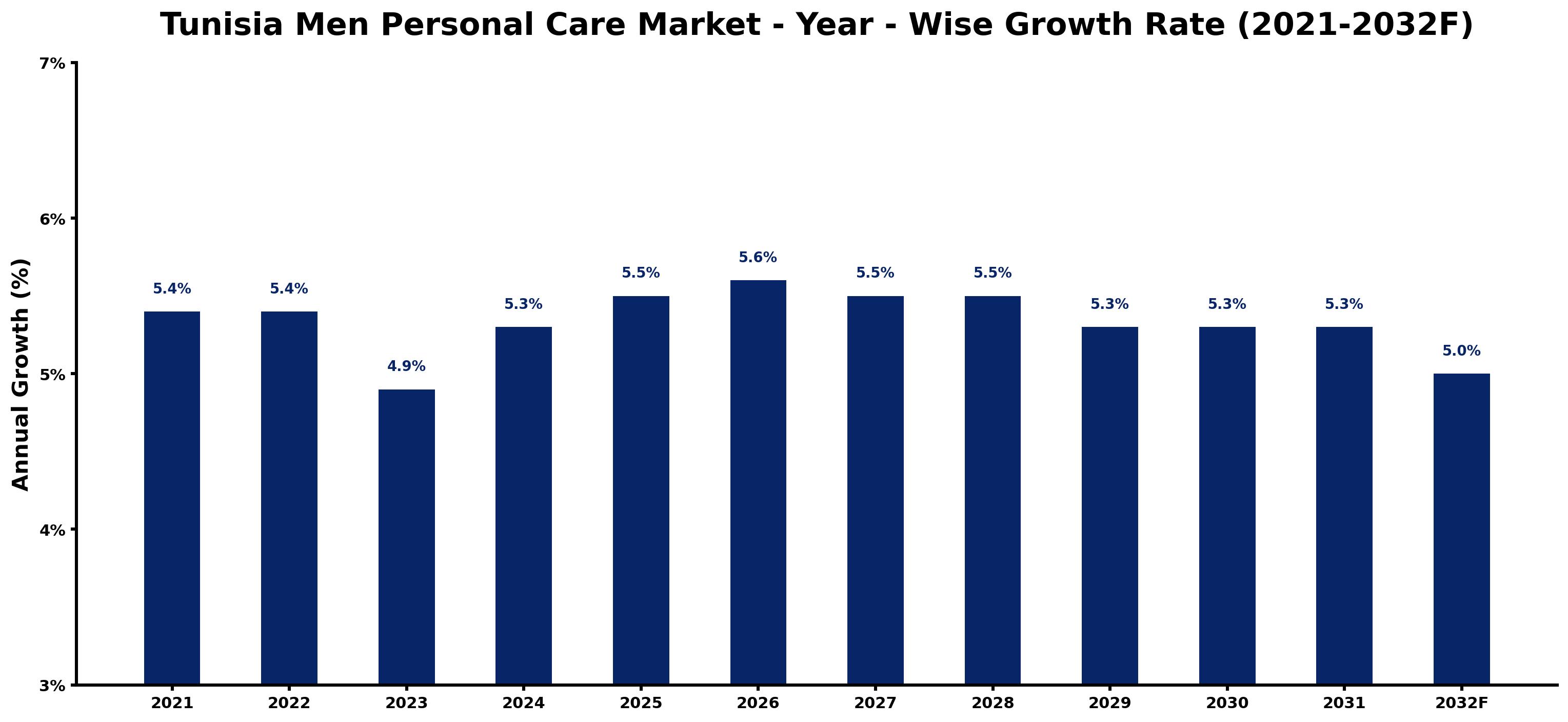
The table below presents the year wise growth rates along with the key drivers influencing the market
| Year | Growth Rate | Major Drivers |
| 2021 | 5.4% | Pandemic recovery shifted consumer focus toward personal hygiene and grooming products. |
| 2022 | 5.4% | Local brands gained traction, offering personalized services and tailored products for men. |
| 2023 | 4.9% | Increased digital marketing efforts enhanced engagement among younger male consumers. |
| 2024 | 5.3% | Expansion of local retailers improved accessibility to men's grooming essentials across regions. |
| 2025 | 5.5% | Urbanization accelerated preferences for convenience-oriented personal care solutions and services. |
| 2026 | 5.6% | Consumer awareness campaigns spotlighted the importance of skincare for men's health. |
| 2027 | 5.5% | International brands entered the market, increasing competition and diversifying product offerings. |
| 2028 | 5.5% | Sustainability trends pushed brands to adopt eco-friendly packaging and ethically sourced ingredients. |
| 2029 | 5.3% | Social media influencers began shaping grooming trends, impacting consumer purchasing decisions. |
| 2030 | 5.3% | Emerging e-commerce platforms streamlined purchasing, enhancing customer accessibility and convenience. |
| 2031 | 5.3% | Continued investment in men's wellness spas and grooming salons attracted male clientele. |
| 2032 | 5.0% | Cultural shifts embraced self-care, normalizing grooming routines among men of all ages. |
Note - Market size estimations and growth projections presented in this report are based on 6Wresearch's advanced forecasting approach, validated with industry datasets as of June 2026.
Tunisia Men Personal Care Market Synopsis
The Tunisia Men Personal Care Market is projected to reach 5.6% and witness significant growth during the forecast period (2026-2032). This upward trajectory can be attributed to a growing awareness among the male population regarding grooming and personal hygiene. Alongside this increasing awareness, a preference shift towards premium and high-quality personal care products, including skincare, hair care, and grooming tools, is evident.
Tunisia Men Personal Care Market Growth Drivers
Several factors are driving the growth of the Tunisia Men Personal Care Market. Urbanization and changing lifestyles are one of the primary influences, as they enhance the visibility and accessibility of grooming products. Increased disposable income among Tunisian men is allowing consumers to invest in more quality-oriented and premium products. Additionally, the rise in social media marketing is playing a vital role in shaping consumer preferences, as influencers promote grooming routines and products tailored for men.
- The growing trend of self-care is encouraging Tunisian men to adopt regular grooming practices, thereby increasing demand for personal care products.
- Enhanced marketing strategies from both international and local brands are successfully repositioning men's grooming items as essential rather than luxury goods.
- Emerging local brands are beginning to respond to the unique grooming needs of Tunisian men, thus catering to a previously underserved segment of the market.
- Health consciousness is on the rise; men are becoming more aware of the ingredients in their grooming products and gravitating towards those that are natural and organic.
- Multi-functional grooming products that offer convenience are becoming increasingly sought after, reflecting the busy lifestyles of modern consumers.
Tunisia Men Personal Care Market Trends and Opportunities
In the Tunisia Men Personal Care Market, noticeable trends indicate a strong inclination towards cleaner and multifunctional products. As Tunisian men become more conscious of their grooming choices, there is a growing demand for products free from harmful chemicals and that provide added benefits such as hydration or nourishment. The trend towards natural and organic products is reshaping the inventory of available products, opening up opportunities for new entrants into the market.
- The rise of personalized grooming solutions tailored to individual skin and hair types is becoming more common, allowing greater consumer satisfaction.
- Brands that emphasize eco-friendly practices and sustainability are gaining traction among environmentally conscious consumers.
- Digital marketing and e-commerce platforms are providing new channels for brands to reach a wider audience, especially the younger demographic.
- Collaborations with local influencers can amplify brand presence and drive sales by creating relatable marketing content.
- The increasing popularity of subscription services for grooming products provides a potential avenue for steady revenue while catering to customer convenience.
Tunisia Men Personal Care Market Challenges and Restraints
Despite its growth prospects, the Tunisia Men Personal Care Market faces challenges, notably stemming from traditional gender norms that discourage men from fully engaging in grooming practices. Such norms perpetuate a stigma that associates personal care products with femininity, which can hinder uptake among male consumers. Furthermore, limited awareness about the benefits of specialized grooming products designed for men can stifle market expansion.
- The perception of grooming as a luxury rather than a necessity can deter men from investing in personal care.
- Access to a diverse array of high-quality products, particularly those tailored for local preferences, remains limited compared to other markets.
- The need for educational initiatives to inform consumers about the benefits of specific products designed for men's grooming.
- Resistance to change in grooming habits may slow down the adoption of new trends and products.
- Brand loyalty may be difficult to establish as consumers might prioritize price over brand reputation.
Tunisia Men Personal Care Market Government Investment and Initiatives
The Tunisian government has taken proactive steps through various regulations and initiatives to promote the Men Personal Care Market. Such policies include the enforcement of stringent labeling requirements, ensuring transparency regarding product ingredients and usage instructions. The government has also established quality standards aimed at ensuring consumer safety and the efficacy of personal care products marketed specifically for men.
- In an effort to support local industries, the government offers incentives aimed at enhancing the production capabilities of domestic manufacturers.
- Investment in public awareness campaigns highlights the importance of personal grooming and hygiene among men.
- Regulatory frameworks are being refined to encourage innovation and the introduction of new products in the market.
- Partnerships between the government and educational institutions aim to increase awareness and knowledge about personal care products tailored for men.
- Strengthening the local supply chain for personal care products contributes to economic growth while meeting consumer demands more effectively.
Tunisia Men Personal Care Market Latest Developments (May 2025 - June 2026)
Recent industry developments within the Tunisia Men Personal Care Market indicate a marked shift towards embracing innovative product formulations. The period saw a significant rise in the introduction of natural and organic products, as brands respond to rising consumer consciousness regarding product ingredients. Additionally, there has been a surge in digital marketing initiatives, with local brands forging partnerships with influencers to effectively reach the millennial demographic.
- The emergence of direct-to-consumer sales through online platforms is reshaping distribution channels, providing immediate accessibility to consumers.
- Brands have launched campaigns focusing on self-care for men, aiming to dispel traditional gender norms associated with grooming.
- Collaborative efforts between local brands and international partners have enhanced product offerings and expanded market reach.
- The introduction of subscription models for grooming kits has gained popularity, catering to the need for convenience.
- Consumer feedback mechanisms are being prioritized, allowing companies to adapt their product lines according to user preferences and trends.
Tunisia Men Personal Care Market - Key Attractiveness of the Report
- 10 Years of Market Numbers
- Historical Data Starting from 2022 to 2025
- Base Year: 2025
- Forecast Data until 2032
- Key Performance Indicators Impacting the Market
- Major Upcoming Developments and Projects
Key Highlights of the Report:
- Tunisia Men Personal Care Market Outlook
- Market Size of Tunisia Men Personal Care Market, 2025
- Forecast of Tunisia Men Personal Care Market, 2032F
- Historical Data and Forecast of Tunisia Men Personal Care Revenues & Volume for the Period 2022-2032F
- Tunisia Men Personal Care Market Trend Evolution
- Tunisia Men Personal Care Market Drivers and Challenges
- Tunisia Men Personal Care Price Trends
- Tunisia Men Personal Care Porter's Five Forces
- Tunisia Men Personal Care Industry Life Cycle
- Historical Data and Forecast of Tunisia Men Personal Care Market Revenues & Volume By Types for the Period 2022-2032F
- Historical Data and Forecast of Tunisia Men Personal Care Market Revenues & Volume By Hair Care for the Period 2022-2032F
- Historical Data and Forecast of Tunisia Men Personal Care Market Revenues & Volume By Shaving for the Period 2022-2032F
- Historical Data and Forecast of Tunisia Men Personal Care Market Revenues & Volume By Oral Care for the Period 2022-2032F
- Historical Data and Forecast of Tunisia Men Personal Care Market Revenues & Volume By Personal Cleanliness for the Period 2022-2032F
- Historical Data and Forecast of Tunisia Men Personal Care Market Revenues & Volume By Skin Care for the Period 2022-2032F
- Historical Data and Forecast of Tunisia Men Personal Care Market Revenues & Volume By Others for the Period 2022-2032F
- Historical Data and Forecast of Tunisia Men Personal Care Market Revenues & Volume By Distribution Channel for the Period 2022-2032F
- Historical Data and Forecast of Tunisia Men Personal Care Market Revenues & Volume By Online for the Period 2022-2032F
- Historical Data and Forecast of Tunisia Men Personal Care Market Revenues & Volume By Offline for the Period 2022-2032F
- Tunisia Men Personal Care Import Export Trade Statistics
- Market Opportunity Assessment By Types
- Market Opportunity Assessment By Distribution Channel
- Tunisia Men Personal Care Top Companies Market Share
- Tunisia Men Personal Care Competitive Benchmarking By Technical and Operational Parameters
- Tunisia Men Personal Care Company Profiles
- Tunisia Men Personal Care Key Strategic Recommendations






































