Tunisia Metal Fabrication Market Size, Share & Growth Rate
The Tunisia Metal Fabrication Market was estimated at USD 289 Million in 2025 and is projected to reach USD 399 Million by 2032, growing at a CAGR of 4.7% from 2026 to 2032. This positive trajectory is primarily driven by an escalating demand from key sectors such as automotive, construction, and aerospace. Additionally, significant investments in infrastructure projects, along with technological advancements in fabrication processes, are poised to further support market growth.
Tunisia Metal Fabrication Market Year-wise Growth Rate and Key Drivers
This graph highlights how the Tunisia Metal Fabrication Market has steadily grown over the years, supported by major growth factors.
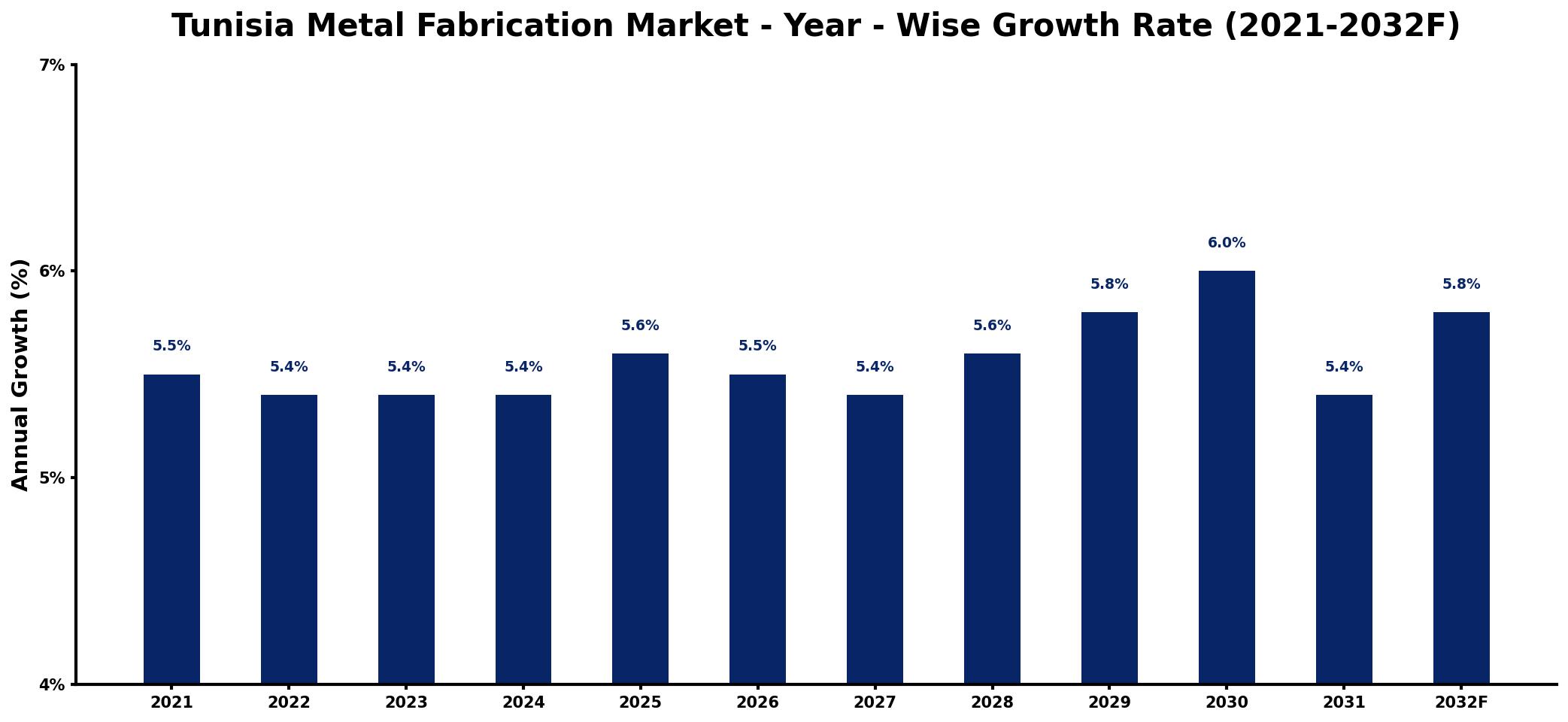
The table below presents the year‑wise growth rates along with the key drivers influencing the market
| Year | Growth Rate | Major Drivers |
| 2021 | 5.5% | Rising construction sector demand |
| 2022 | 5.4% | Increased investment in infrastructure |
| 2023 | 5.4% | Growing automotive industry needs |
| 2024 | 5.4% | Expansion of renewable energy projects |
| 2025 | 5.6% | Boost in consumer electronics production |
| 2026 | 5.5% | Surge in export opportunities |
| 2027 | 5.4% | Strengthening tourism industry growth |
| 2028 | 5.6% | Advancements in technology sectors |
| 2029 | 5.8% | Heightened demand for machinery parts |
| 2030 | 6.0% | Growing urbanization and housing projects |
| 2031 | 5.4% | Increased defense sector investments |
| 2032 | 5.8% | Rising demand for sustainable solutions |
Note: Market size estimations and growth projections presented in this report are based on 6Wresearch's proprietary forecasting methodology, utilizing the latest available industry data, government publications, and primary research inputs.
Tunisia Metal Fabrication Market Synopsis
The most significant force shaping the Tunisia Metal Fabrication Market is the rapid expansion of the construction and automotive sectors. These industries are not only consuming a large volume of fabricated metal products but are also pushing for innovation and efficiency in fabrication techniques.
Furthermore, the growing industrial infrastructure in Tunisia is fostering a more skilled workforce, which is essential for advancing fabrication capabilities. This is leading to increased competitiveness in the region and positioning Tunisia as an attractive hub for metal fabrication.
Tunisia Metal Fabrication Market Key Takeaways
- The market is expanding at a CAGR of 4.7% between 2026 and 2032.
- Key sectors driving demand include construction, automotive, and aerospace industries.
- Technological advancements are facilitating improvements in fabrication processes.
- Government incentives are boosting local manufacturing capabilities.
- Investment in skilled labor is enhancing the overall quality of fabricated products.
Evaluation of Restraints in Tunisia Metal Fabrication Market
Despite its promising growth, the Tunisia Metal Fabrication Market grapples with several restraints. Fluctuating raw material costs create uncertainty for manufacturers, making it challenging to maintain competitive pricing. Additionally, stringent environmental regulations impose limitations on production processes, necessitating significant adjustments in operational practices. The increasing competition from lower-cost manufacturing hubs further adds pressure on local players, requiring them to innovate and adapt to sustain their market positions.
Tunisia Metal Fabrication Market Trends
Several key trends are influencing the Tunisia Metal Fabrication Market. One notable trend is the adoption of eco-friendly practices and technologies aimed at minimizing environmental impact, as stakeholders increasingly prioritize sustainability. Furthermore, digitization and automation are beginning to permeate the sector, enhancing productivity and precision in fabrication processes. These technological shifts are critical as they align with global standards and consumer expectations.
The increasing focus on local sourcing is also shaping demand; industries are increasingly looking to work with local fabricators for efficiency and to reduce lead times. This shift not only supports local businesses but also stimulates further growth in the domestic market.
Tunisia Metal Fabrication Market Opportunities
The Tunisia Metal Fabrication Market presents a multitude of growth and investment opportunities. The ongoing infrastructure projects offer substantial potential for fabricators to engage in large-scale contracts. Moreover, the automotive sector's focus on electrification and advanced manufacturing technologies is creating new avenues for specialized fabrication services. Additionally, as local industries increasingly seek to modernize their production processes, investments in state-of-the-art equipment and capabilities will further drive market expansion.
Government Initiatives in the Tunisia Metal Fabrication Market
The Tunisian government has undertaken several initiatives to promote the local metal fabrication industry. Policies are being implemented to provide tax breaks and subsidies that encourage companies to modernize their equipment and adopt environmentally sustainable practices. These efforts are part of a broader strategy to enhance the manufacturing capabilities within the country and to attract foreign investment, thereby fostering a more competitive market landscape.
Future Insights of the Tunisia Metal Fabrication Market
Looking ahead to 2026-2032, the Tunisia Metal Fabrication Market is expected to continue its upward trajectory. The combination of increasing investment in infrastructure and technological advancements will likely yield new opportunities for growth. Furthermore, as the demand for fabricated metal products from sectors such as construction and automotive continues to escalate, manufacturers who embrace innovation and sustainability are poised to thrive in this evolving landscape.
Tunisia Metal Fabrication Market Latest Developments (2025 - 2026)
Recent developments in the Tunisia Metal Fabrication Market indicate a strong shift towards modernization and sustainability. Manufacturers are increasingly investing in advanced technologies to improve production efficiency and reduce waste. Furthermore, strategic partnerships between local firms and international entities are becoming more common, facilitating knowledge transfer and access to cutting-edge practices. The government's push for eco-friendly operations is also prompting businesses to adapt and align with new regulations and consumer preferences.
Tunisia Metal Fabrication Market - Key Attractiveness of the Report
- 10 Years of Market Numbers
- Historical Data Starting from 2022 to 2025
- Base Year: 2025
- Forecast Data until 2032
- Key Performance Indicators Impacting the Market
- Major Upcoming Developments and Projects
Key Highlights of the Report:
- Tunisia Metal Fabrication Market Outlook
- Market Size of Tunisia Metal Fabrication Market, 2025
- Forecast of Tunisia Metal Fabrication Market, 2032
- Historical Data and Forecast of Tunisia Metal Fabrication Revenues & Volume for the Period 2022-2032F
- Tunisia Metal Fabrication Market Trend Evolution
- Tunisia Metal Fabrication Market Drivers and Challenges
- Tunisia Metal Fabrication Price Trends
- Tunisia Metal Fabrication Porter's Five Forces
- Tunisia Metal Fabrication Industry Life Cycle
- Historical Data and Forecast of Tunisia Metal Fabrication Market Revenues & Volume By End-user Industry for the Period 2022-2032F
- Historical Data and Forecast of Tunisia Metal Fabrication Market Revenues & Volume By Manufacturing for the Period 2022-2032F
- Historical Data and Forecast of Tunisia Metal Fabrication Market Revenues & Volume By Power and Utilities for the Period 2022-2032F
- Historical Data and Forecast of Tunisia Metal Fabrication Market Revenues & Volume By Construction for the Period 2022-2032F
- Historical Data and Forecast of Tunisia Metal Fabrication Market Revenues & Volume By Oil and Gas for the Period 2022-2032F
- Historical Data and Forecast of Tunisia Metal Fabrication Market Revenues & Volume By Other End-user Industries for the Period 2022-2032F
- Historical Data and Forecast of Tunisia Metal Fabrication Market Revenues & Volume By Metal Folding for the Period 2022-2032F
- Historical Data and Forecast of Tunisia Metal Fabrication Market Revenues & Volume By Product category for the Period 2022-2032F
- Historical Data and Forecast of Tunisia Metal Fabrication Market Revenues & Volume By Structural steel fabrication for the Period 2022-2032F
- Historical Data and Forecast of Tunisia Metal Fabrication Market Revenues & Volume By Process Equipment Fabrication for the Period 2022-2032F
- Tunisia Metal Fabrication Import Export Trade Statistics
- Market Opportunity Assessment By End-user Industry
- Market Opportunity Assessment By Product category
- Tunisia Metal Fabrication Top Companies Market Share
- Tunisia Metal Fabrication Competitive Benchmarking By Technical and Operational Parameters
- Tunisia Metal Fabrication Company Profiles
- Tunisia Metal Fabrication Key Strategic Recommendations






































