Tunisia Nylon Filament Yarn Market Size, Share & Growth Rate
The Tunisia Nylon Filament Yarn Market was estimated at USD 226 Million in 2025 and is projected to reach USD 301 Million by 2032, growing at a CAGR of 4.2% from 2026 to 2032. This growth trajectory is propelled by the increasing demand across various sectors, including textiles and automotive, where the versatility of nylon yarn has become increasingly indispensable. Rising disposable incomes and changing consumer preferences are further catalyzing this upward trend, making it an opportune time for investments in the region.
Tunisia Nylon Filament Yarn Market Year-wise Growth Rate and Key Drivers
This graph highlights how the Tunisia Nylon Filament Yarn Market has steadily grown over the years, supported by major growth factors.
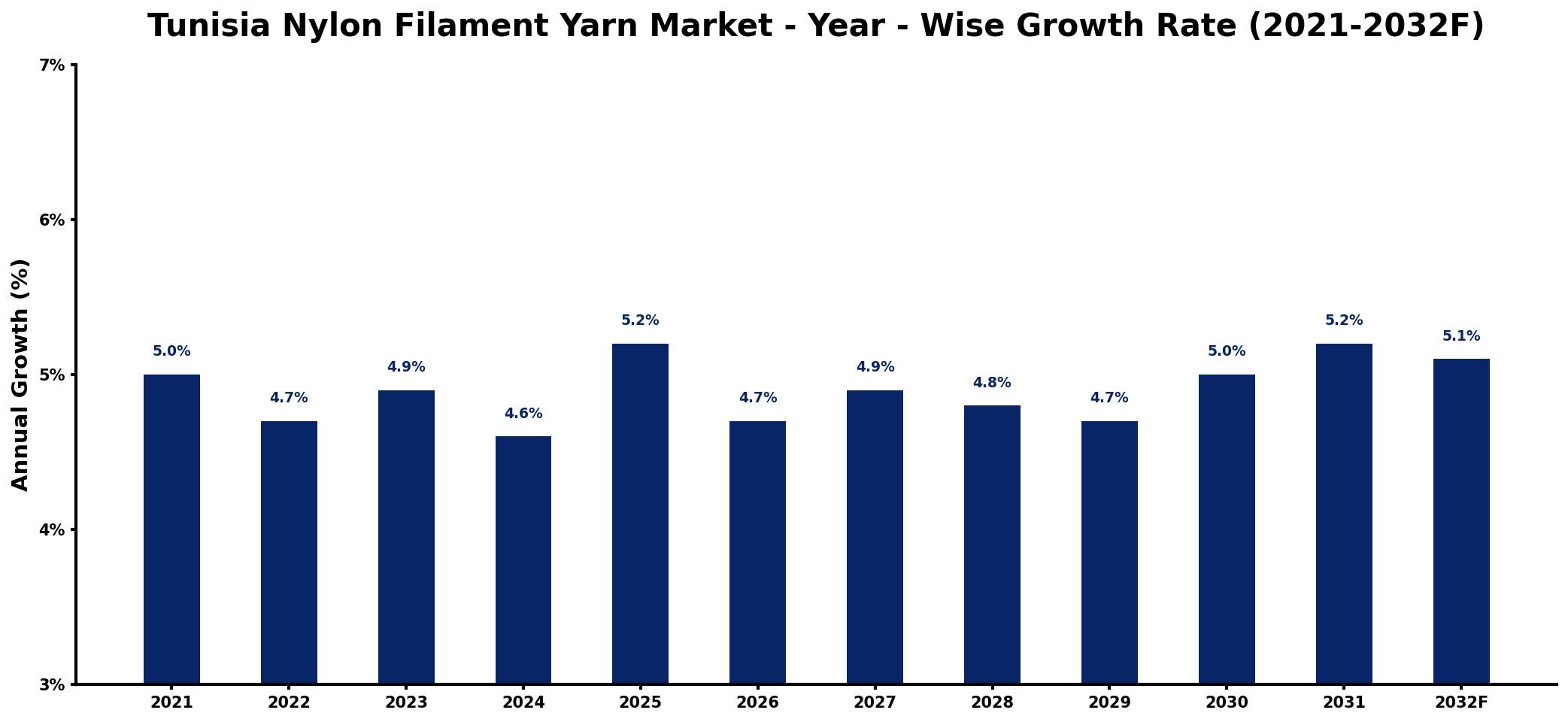
The table below presents the year‑wise growth rates along with the key drivers influencing the market
| Year | Growth Rate | Major Drivers |
| 2021 | 5.0% | Rising textile manufacturing capacity |
| 2022 | 4.7% | Growing consumer fashion preferences |
| 2023 | 4.9% | Increasing demand for sustainable materials |
| 2024 | 4.6% | Expansion of export markets |
| 2025 | 5.2% | Investment in production technologies |
| 2026 | 4.7% | Enhanced infrastructure for logistics |
| 2027 | 4.9% | Surge in sportswear production |
| 2028 | 4.8% | Development of innovative applications |
| 2029 | 4.7% | Strengthening local supply chains |
| 2030 | 5.0% | Boost in online retail channels |
| 2031 | 5.2% | Emergence of eco-friendly initiatives |
| 2032 | 5.1% | Growth in automotive textile usage |
Note: Market size estimations and growth projections presented in this report are based on 6Wresearch's proprietary forecasting methodology, utilizing the latest available industry data, government publications, and primary research inputs.
Tunisia Nylon Filament Yarn Market Synopsis
In recent years, the Tunisia Nylon Filament Yarn Market has gained significant momentum, fueled by diverse applications and a booming textile industry. However, the market is set to evolve further, with a pronounced shift towards sustainability and innovation expected to redefine operational strategies.
As manufacturers respond to growing consumer demands for eco-friendly products, the introduction of recycled nylon filament yarn is anticipated to reshape competitive dynamics. Coupled with advancements in production technologies, the market is well-positioned to cater to a wider array of applications while enhancing overall product quality.
Tunisia Nylon Filament Yarn Market Key Takeaways
- The market is growing steadily, with significant opportunities for investment in sustainable and innovative yarn solutions.
- Technological advancements are crucial for improving product performance and expanding applications.
- Consumer awareness regarding eco-friendly materials is driving the demand for recycled nylon filament yarn.
- Competition from low-cost imports poses a challenge, urging local manufacturers to enhance their value propositions.
- Government policies are fostering a supportive environment for domestic production and innovation.
Evaluation of Restraints in Tunisia Nylon Filament Yarn Market
While the Tunisia Nylon Filament Yarn Market shows promising growth potential, several restraints threaten its trajectory. High competition from inexpensive imports often pressures local manufacturers, challenging their ability to maintain profitability. Additionally, fluctuations in raw material prices can directly impact production costs, affecting market stability. The limited domestic production capacity further exacerbates the situation, compelling stakeholders to navigate these hurdles through strategic partnerships and operational enhancements.
Tunisia Nylon Filament Yarn Market Trends
A notable trend within the Tunisia Nylon Filament Yarn Market is the increasing shift towards sustainable and eco-friendly product offerings. The demand for recycled nylon filament yarn is rising as consumers become more environmentally conscious. Manufacturers are focusing on enhancing their technological capabilities to produce high-quality, durable yarns that meet various industry standards. Customization is also on the rise, with businesses providing a diverse range of colors, textures, and functionalities tailored to specific applications.
Tunisia Nylon Filament Yarn Market Opportunities
Investment opportunities abound in the Tunisia Nylon Filament Yarn Market, particularly in the textile and automotive sectors. The strategic location of Tunisia serves as a gateway to European and African markets, allowing for enhanced export prospects. Collaborating with local textile manufacturers can yield mutually beneficial outcomes, particularly in the area of raw material supply. Moreover, focusing on sustainable production methods aligns with global trends, catering to an increasingly eco-conscious consumer base and fostering long-term competitiveness.
Government Initiatives in the Tunisia Nylon Filament Yarn Market
The Tunisian government plays a vital role in supporting the Nylon Filament Yarn Market through various initiatives. Policies have been established to provide financial incentives for local manufacturers, thereby bolstering domestic production capabilities. In addition, promoting research and development aims to enhance product innovation and quality. Furthermore, trade agreements are in place to facilitate market access for Tunisian yarn producers, aiming to elevate their competitiveness on both regional and international fronts.
Future Insights of the Tunisia Nylon Filament Yarn Market
Looking ahead to the period from 2026 to 2032, the Tunisia Nylon Filament Yarn Market is anticipated to flourish, driven by robust demand in global textile and automotive sectors. Technological advancements in production processes will continue to enhance the quality and performance of nylon yarn, making it adaptable to a variety of applications. The prevailing trend toward sustainability is set to further influence market dynamics, compelling stakeholders to adopt greener practices and products to meet evolving consumer expectations.
Tunisia Nylon Filament Yarn Market Latest Developments (2025 - 2026)
Recent developments in the Tunisia Nylon Filament Yarn Market indicate a focus on innovation and sustainability. Key players are increasingly investing in advanced production technologies and exploring partnerships for sourcing recycled materials. Additionally, industry stakeholders are responding to evolving consumer preferences by launching a wider variety of eco-friendly products. This proactive approach is expected to fortify market presence and enhance competitive positioning in both local and international arenas.
Tunisia Nylon Filament Yarn Market - Key Attractiveness of the Report
- 10 Years of Market Numbers
- Historical Data Starting from 2022 to 2025
- Base Year: 2025
- Forecast Data until 2032
- Key Performance Indicators Impacting the Market
- Major Upcoming Developments and Projects
Key Highlights of the Report:
- Tunisia Nylon Filament Yarn Market Outlook
- Market Size of Tunisia Nylon Filament Yarn Market, 2025
- Forecast of Tunisia Nylon Filament Yarn Market, 2032
- Historical Data and Forecast of Tunisia Nylon Filament Yarn Revenues & Volume for the Period 2022-2032F
- Tunisia Nylon Filament Yarn Market Trend Evolution
- Tunisia Nylon Filament Yarn Market Drivers and Challenges
- Tunisia Nylon Filament Yarn Price Trends
- Tunisia Nylon Filament Yarn Porter's Five Forces
- Tunisia Nylon Filament Yarn Industry Life Cycle
- Historical Data and Forecast of Tunisia Nylon Filament Yarn Market Revenues & Volume By Grade for the Period 2022-2032F
- Historical Data and Forecast of Tunisia Nylon Filament Yarn Market Revenues & Volume By Flat Yarn for the Period 2022-2032F
- Historical Data and Forecast of Tunisia Nylon Filament Yarn Market Revenues & Volume By Textured Yarn for the Period 2022-2032F
- Historical Data and Forecast of Tunisia Nylon Filament Yarn Market Revenues & Volume By Partially Oriented Yarn for the Period 2022-2032F
- Historical Data and Forecast of Tunisia Nylon Filament Yarn Market Revenues & Volume By Fully Drawn Yarn for the Period 2022-2032F
- Historical Data and Forecast of Tunisia Nylon Filament Yarn Market Revenues & Volume By Dyed Yarns for the Period 2022-2032F
- Historical Data and Forecast of Tunisia Nylon Filament Yarn Market Revenues & Volume By Application for the Period 2022-2032F
- Historical Data and Forecast of Tunisia Nylon Filament Yarn Market Revenues & Volume By Textiles for the Period 2022-2032F
- Historical Data and Forecast of Tunisia Nylon Filament Yarn Market Revenues & Volume By Sports Apparels for the Period 2022-2032F
- Historical Data and Forecast of Tunisia Nylon Filament Yarn Market Revenues & Volume By Sports and Adventure Equipment for the Period 2022-2032F
- Historical Data and Forecast of Tunisia Nylon Filament Yarn Market Revenues & Volume By Travel Accessories for the Period 2022-2032F
- Historical Data and Forecast of Tunisia Nylon Filament Yarn Market Revenues & Volume By Fishing Nets for the Period 2022-2032F
- Historical Data and Forecast of Tunisia Nylon Filament Yarn Market Revenues & Volume By Fabric for the Period 2022-2032F
- Historical Data and Forecast of Tunisia Nylon Filament Yarn Market Revenues & Volume By Sales Channel for the Period 2022-2032F
- Historical Data and Forecast of Tunisia Nylon Filament Yarn Market Revenues & Volume By Direct Company Sale for the Period 2022-2032F
- Historical Data and Forecast of Tunisia Nylon Filament Yarn Market Revenues & Volume By Direct Import for the Period 2022-2032F
- Historical Data and Forecast of Tunisia Nylon Filament Yarn Market Revenues & Volume By Distributors & Traders for the Period 2022-2032F
- Historical Data and Forecast of Tunisia Nylon Filament Yarn Market Revenues & Volume By Retailers for the Period 2022-2032F
- Tunisia Nylon Filament Yarn Import Export Trade Statistics
- Market Opportunity Assessment By Grade
- Market Opportunity Assessment By Application
- Market Opportunity Assessment By Sales Channel
- Tunisia Nylon Filament Yarn Top Companies Market Share
- Tunisia Nylon Filament Yarn Competitive Benchmarking By Technical and Operational Parameters
- Tunisia Nylon Filament Yarn Company Profiles
- Tunisia Nylon Filament Yarn Key Strategic Recommendations






































