Tunisia Oats Market Size, Share & Growth Rate
The Tunisia Oats Market was estimated at USD 263 Million in 2025 and is projected to reach USD 349 Million by 2032, growing at a CAGR of 4.1% from 2026 to 2032. This growth is primarily driven by a rising consumer awareness about the nutritional benefits of oats, particularly in terms of health and wellness. As more Tunisian consumers gravitate towards fiber-rich diets and healthier breakfast options, the demand for oats and oats-based products continues to gain momentum.
Tunisia Oats Market Year-wise Growth Rate and Key Drivers
This graph highlights how the Tunisia Oats Market has steadily grown over the years, supported by major growth factors.
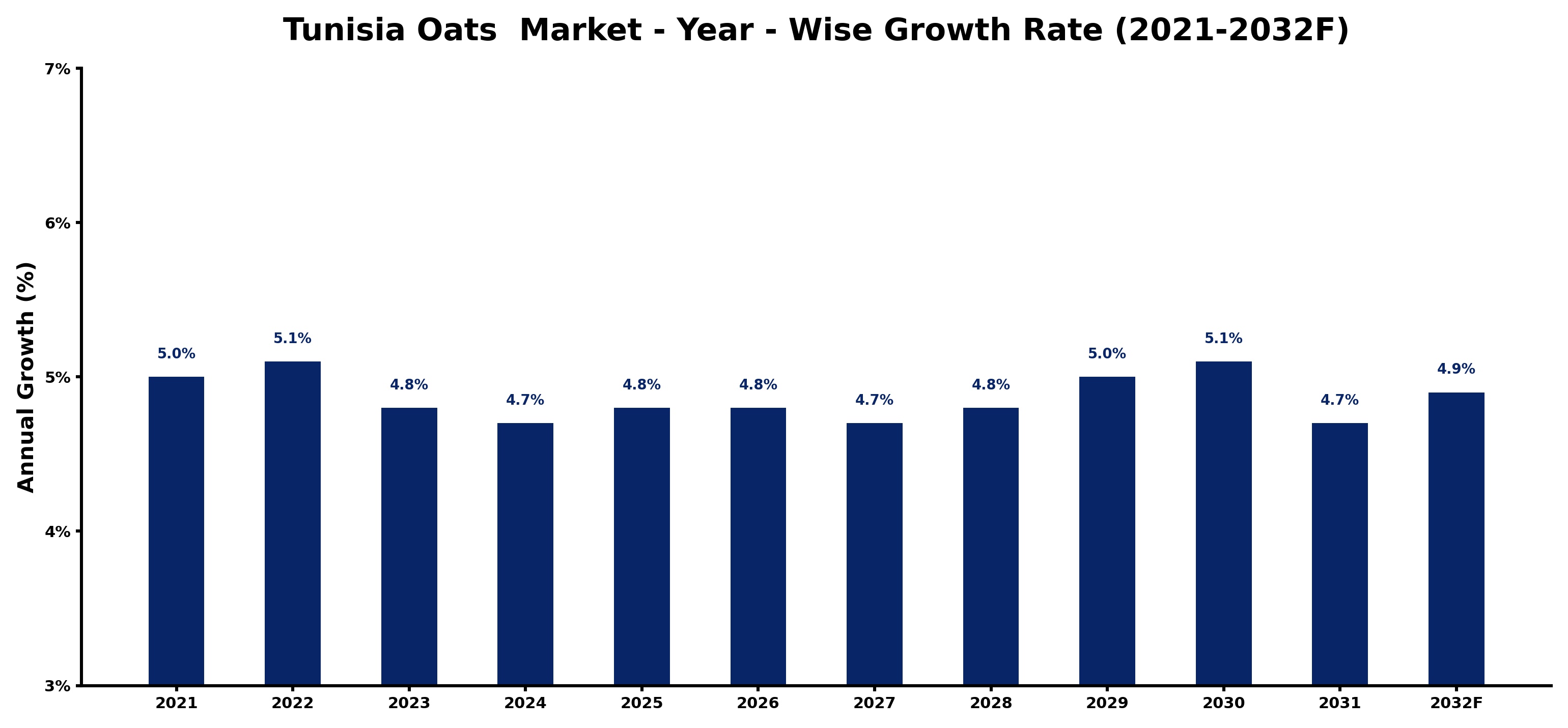
The table below presents the year‑wise growth rates along with the key drivers influencing the market
| Year | Growth Rate | Major Drivers |
| 2021 | 5.0% | Health consciousness drove consumption |
| 2022 | 5.1% | Increased demand for breakfast options |
| 2023 | 4.8% | Rising interest in gluten-free diets |
| 2024 | 4.7% | Oat-based products gained popularity |
| 2025 | 4.8% | Sustainable farming practices expanded |
| 2026 | 4.8% | Nutritional benefits promoted widely |
| 2027 | 4.7% | Consumer awareness of oats increased |
| 2028 | 4.8% | Innovative product launches attracted interest |
| 2029 | 5.0% | Export opportunities enhanced market reach |
| 2030 | 5.1% | Collaborations with health influencers grew |
| 2031 | 4.7% | Local sourcing initiatives gained traction |
| 2032 | 4.9% | E-commerce growth expanded market access |
Note - Market size estimations and growth projections presented in this report are based on 6Wresearch’s advanced forecasting approach, validated with industry datasets as of June 2026.
Tunisia Oats Market Synopsis
In recent years, the Tunisian oats market has become increasingly dynamic, reflecting a broader shift in consumer preferences towards nutritious food choices. With an emphasis on clean eating and health consciousness, oats are emerging as a staple in many households, particularly for breakfast.
Various oats-based products, such as oatmeal, granola bars, and oat milk, are gaining popularity, catering to a diverse range of dietary needs and preferences. As these products fill the market, they play a crucial role in promoting oats not just as a food item, but as part of a healthy lifestyle.
Tunisia Oats Market Key Takeaways
- The market is benefitting from increased health awareness among Tunisian consumers.
- Oats-based products are diversifying, addressing the demand for convenient and nutritious food options.
- Local producers are expanding their offerings to meet rising consumer needs.
- Investment in oat cultivation and processing technology is essential for boosting domestic production.
- Government support plays a significant role in enhancing market competitiveness and sustainability.
Evaluation of Restraints in Tunisia Oats Market
Despite its growth potential, the Tunisia oats market faces significant hurdles. A general lack of consumer awareness about the specific health benefits of oats remains a barrier to adoption. Furthermore, limited local production capacity means that the market is heavily reliant on imports, making it vulnerable to fluctuations in international supply chains. Competition from other staple grains, such as wheat and barley, also complicates market penetration for oats. Additionally, the higher price point of oats compared to traditional grains may deter budget-conscious consumers. Addressing these issues through consumer education and enhanced domestic production capabilities will be crucial for market growth.
Tunisia Oats Market Trends
The market is witnessing a notable shift towards healthier and more nutritious options, spurred by an increasing awareness of health and wellness. As consumers prioritize products with high fiber content and low cholesterol, oats have positioned themselves as a versatile superfood. Food manufacturers are capitalizing on this trend, creating innovative oat-based products that resonate with health-conscious consumers. Furthermore, the rising popularity of plant-based diets is propelling demand for alternatives like oat milk, highlighting oats' adaptability across various food categories.
Tunisia Oats Market Opportunities
The Tunisian oats market presents ample investment opportunities for both local and international stakeholders. The burgeoning interest in oats-based products, such as granola bars and oatmeal, provides avenues for launching new products or expanding existing lines. Moreover, the trend towards organic farming opens up possibilities for investors interested in sustainable agricultural practices. Collaborating with local farmers to improve cultivation methods and yield could enhance production efficiency, further driving market growth. Additionally, exploring export opportunities may help position Tunisian oats in international markets, tapping into a global demand for nutritious and sustainable food products.
Government Initiatives in the Tunisia Oats Market
Government policies and initiatives are pivotal in fostering the growth of the Tunisia oats market. Through subsidies and support programs, the government encourages local oat production to enhance self-sufficiency and reduce dependency on imports. Regulations surrounding quality standards ensure that Tunisian oats remain competitive both domestically and internationally. Additionally, the government is actively promoting research and development initiatives aimed at improving oat cultivation techniques, ultimately boosting yield and production efficiency.
Future Insights of the Tunisia Oats Market
Looking forward to the period from 2026 to 2032, the Tunisia oats market is expected to continue its trajectory of growth. Rising consumer focus on health and wellness, combined with the increasing popularity of oats as a versatile food source, positions the market favorably for expansion. Innovations in oat-based products are anticipated to attract a broader consumer base, while efforts in improving local production capabilities will help meet the growing demand. With both consumer habits and government support aligning towards healthier choices, the outlook remains positive for the Tunisia oats market.
Tunisia Oats Market Latest Developments (May 2025 - June 2026)
In the past year, the Tunisian oats market has seen a surge in innovative product launches, with brands focusing on diverse and health-oriented oat-based options. Additionally, there is a noticeable increase in local farming initiatives aimed at enhancing oat production and quality. Market players are also investing in consumer education campaigns to raise awareness about the health benefits of oats, further stimulating demand. The growing trend of oat-based dairy alternatives has captured significant consumer interest, aligning with the plant-based movement.
Tunisia Oats Market - Key Attractiveness of the Report
- 10 Years of Market Numbers
- Historical Data Starting from 2022 to 2025
- Base Year: 2025
- Forecast Data until 2032
- Key Performance Indicators Impacting the Market
- Major Upcoming Developments and Projects
Key Highlights of the Report:
- Tunisia Oats Market Outlook
- Market Size of Tunisia Oats Market, 2025
- Forecast of Tunisia Oats Market, 2032
- Historical Data and Forecast of Tunisia Oats Revenues & Volume for the Period 2022-2032F
- Tunisia Oats Market Trend Evolution
- Tunisia Oats Market Drivers and Challenges
- Tunisia Oats Price Trends
- Tunisia Oats Porter's Five Forces
- Tunisia Oats Industry Life Cycle
- Historical Data and Forecast of Tunisia Oats Market Revenues & Volume By Form for the Period 2022-2032F
- Historical Data and Forecast of Tunisia Oats Market Revenues & Volume By Flavoured Oats for the Period 2022-2032F
- Historical Data and Forecast of Tunisia Oats Market Revenues & Volume By Base Oats for the Period 2022-2032F
- Historical Data and Forecast of Tunisia Oats Market Revenues & Volume By Distribution Channel for the Period 2022-2032F
- Historical Data and Forecast of Tunisia Oats Market Revenues & Volume By Supermarket/Hypermarket for the Period 2022-2032F
- Historical Data and Forecast of Tunisia Oats Market Revenues & Volume By Convenience Stores for the Period 2022-2032F
- Historical Data and Forecast of Tunisia Oats Market Revenues & Volume By Online Channels for the Period 2022-2032F
- Historical Data and Forecast of Tunisia Oats Market Revenues & Volume By Others for the Period 2022-2032F
- Tunisia Oats Import Export Trade Statistics
- Market Opportunity Assessment By Form
- Market Opportunity Assessment By Distribution Channel
- Tunisia Oats Top Companies Market Share
- Tunisia Oats Competitive Benchmarking By Technical and Operational Parameters
- Tunisia Oats Company Profiles
- Tunisia Oats Key Strategic Recommendations






































