Tunisia Oil & Gas Pumps Market Size, Share & Growth Rate
The Tunisia Oil & Gas Pumps Market was estimated at USD 293 Million in 2025 and is projected to reach USD 387 Million by 2032, growing at a CAGR of 4.1% from 2026 to 2032. This growth trajectory is largely fueled by increasing investments in oil and gas exploration, coupled with a significant push from the government towards enhancing local production capabilities. As exploration activities intensify, the demand for various pump technologies is expected to rise, catering to drilling, well stimulation, and transportation needs.
Tunisia Oil & Gas Pumps Market Year-wise Growth Rate and Key Drivers
This graph highlights how the Tunisia Oil & Gas Pumps Market has steadily grown over the years, supported by major growth factors.
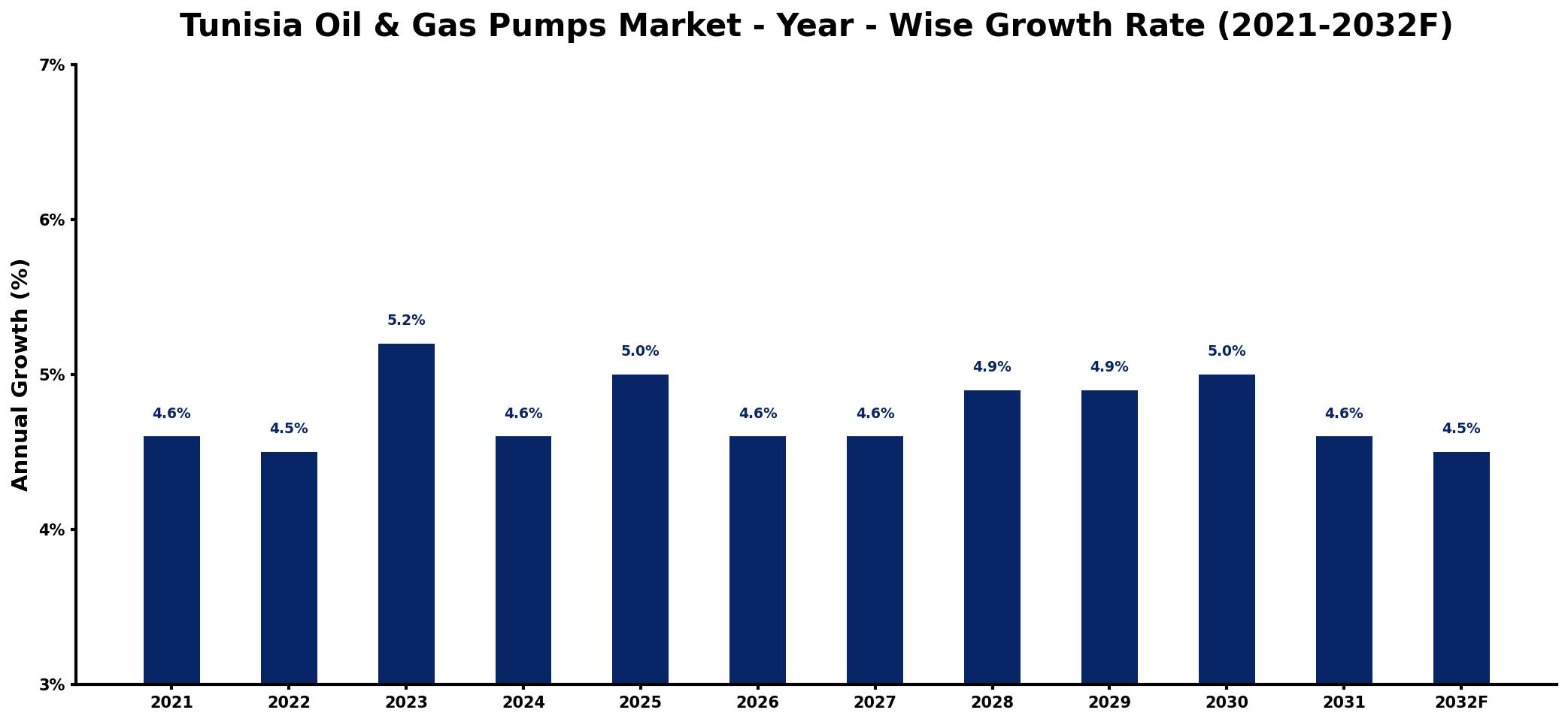
The table below presents the year‑wise growth rates along with the key drivers influencing the market
| Year | Growth Rate | Major Drivers |
| 2021 | 4.6% | Rising energy sector investments |
| 2022 | 4.5% | Growing infrastructure development projects |
| 2023 | 5.2% | Increased energy consumption rates |
| 2024 | 4.6% | Expansion in mining activities |
| 2025 | 5.0% | Higher industrial production levels |
| 2026 | 4.6% | Boost in renewable energy initiatives |
| 2027 | 4.6% | Strengthening regional trade agreements |
| 2028 | 4.9% | Surge in foreign direct investments |
| 2029 | 4.9% | Advancements in technology adoption |
| 2030 | 5.0% | Growing demand for efficiency |
| 2031 | 4.6% | Increased governmental support policies |
| 2032 | 4.5% | Expansion of local manufacturing capabilities |
Note: Market size estimations and growth projections presented in this report are based on 6Wresearch's proprietary forecasting methodology, utilizing the latest available industry data, government publications, and primary research inputs.
Tunisia Oil & Gas Pumps Market Synopsis
Currently, the Tunisia Oil & Gas Pumps Market is witnessing a robust expansion, reflecting the countrys growing commitment to strengthening its energy sector. The mixture of both local and international manufacturers is intensifying competition, leading to innovations and improvements in pump technologies tailored specifically for oil and gas applications.
The market environment is underpinned by a favorable policy landscape encouraging investment and technological advancements. With the government promoting initiatives aimed at sustainable practices and operational efficiency, theres a palpable shift towards modernized and eco-friendly pump solutions designed to meet the evolving demands of the industry.
- Steady growth trajectory propelled by significant investments in oil and gas exploration.
- A strong focus on sustainability and the adoption of advanced pump technologies is emerging.
- Government initiatives are fostering local manufacturing and reducing import reliance.
- Key players are innovating to enhance efficiency and minimize environmental impact.
- Digitalization and automation are gaining traction, optimizing pump performance in operations.
Despite the promising outlook, the Tunisia Oil & Gas Pumps Market faces several limitations. Fluctuating global oil prices are a significant concern, potentially leading to hesitance in investment decisions. Political uncertainties may disrupt the regulatory framework, further complicating project timelines. Moreover, aging infrastructure and inadequate maintenance can hinder operational efficiencies, while reliance on foreign technologies poses a challenge for local industry growth. To navigate these obstacles, stakeholders need to adapt swiftly and commit to innovation.
The market is currently experiencing a distinct shift towards efficiency and sustainability. With rising environmental consciousness, there is an increasing demand for pump technologies that enhance operational efficiency while minimizing energy consumption and carbon emissions. Additionally, the growing interest in digital solutions is prompting oil and gas companies to leverage automation technologies, ensuring reliable operations and improved pump performance.
Significant growth and investment opportunities abound in the Tunisia Oil & Gas Pumps Market. The escalating demand for efficient pumps across drilling, refining, and transportation processes offers lucrative prospects for manufacturers and suppliers. Moreover, firms that can provide innovative solutions geared towards energy efficiency and sustainability will likely secure a competitive advantage. It is crucial for investors to stay informed of market trends and technological advancements to maximize their potential in this evolving landscape.
The Tunisian government is actively implementing policies aimed at revitalizing the Oil & Gas Pumps Market. Focus areas include promoting local content, enhancing environmental sustainability, and bolstering energy security. The government encourages partnerships that foster local manufacturing capabilities, aiming to decrease dependency on imported pumps. Additionally, stringent regulations are being enforced to ensure that oil and gas operations adhere to environmental standards, facilitating a sustainable market environment.
Looking ahead to 2026-2032, the Tunisia Oil & Gas Pumps Market is poised for steady growth, driven by ongoing investments in the energy sector and an uptick in exploration activities. The government's commitment to attracting foreign investments and promoting domestic production will further amplify demand for pumps. The rise of advanced technologies such as digitalization and automation is expected to enhance market dynamics, providing additional avenues for growth as stakeholders seek to adopt smarter and more efficient operations.
Recent developments in the Tunisia Oil & Gas Pumps Market highlight a continuous evolution towards efficiency and innovation. Companies are increasingly focusing on integrating advanced technologies to optimize pump performance and enhance operational reliability. The market is also seeing a concerted effort from stakeholders to align with government policies that promote local production and sustainability, indicating a collaborative approach towards a more resilient oil and gas sector.
- 10 Years of Market Numbers
- Historical Data Starting from 2022 to 2025
- Base Year: 2025
- Forecast Data until 2032
- Key Performance Indicators Impacting the Market
- Major Upcoming Developments and Projects
Key Highlights of the Report:
- Tunisia Oil & Gas Pumps Market Outlook
- Market Size of Tunisia Oil & Gas Pumps Market, 2025
- Forecast of Tunisia Oil & Gas Pumps Market, 2032
- Historical Data and Forecast of Tunisia Oil & Gas Pumps Revenues & Volume for the Period 2022-2032F
- Tunisia Oil & Gas Pumps Market Trend Evolution
- Tunisia Oil & Gas Pumps Market Drivers and Challenges
- Tunisia Oil & Gas Pumps Price Trends
- Tunisia Oil & Gas Pumps Porter's Five Forces
- Tunisia Oil & Gas Pumps Industry Life Cycle
- Historical Data and Forecast of Tunisia Oil & Gas Pumps Market Revenues & Volume By Type for the Period 2022-2032F
- Historical Data and Forecast of Tunisia Oil & Gas Pumps Market Revenues & Volume By Submersible Pumps for the Period 2022-2032F
- Historical Data and Forecast of Tunisia Oil & Gas Pumps Market Revenues & Volume By Non-submersible Pumps for the Period 2022-2032F
- Historical Data and Forecast of Tunisia Oil & Gas Pumps Market Revenues & Volume By Pump Type for the Period 2022-2032F
- Historical Data and Forecast of Tunisia Oil & Gas Pumps Market Revenues & Volume By Centrifugal Pump for the Period 2022-2032F
- Historical Data and Forecast of Tunisia Oil & Gas Pumps Market Revenues & Volume By Positive Displacement Pump for the Period 2022-2032F
- Historical Data and Forecast of Tunisia Oil & Gas Pumps Market Revenues & Volume By Cryogenic Pump for the Period 2022-2032F
- Historical Data and Forecast of Tunisia Oil & Gas Pumps Market Revenues & Volume By Application for the Period 2022-2032F
- Historical Data and Forecast of Tunisia Oil & Gas Pumps Market Revenues & Volume By Upstream for the Period 2022-2032F
- Historical Data and Forecast of Tunisia Oil & Gas Pumps Market Revenues & Volume By Midstream for the Period 2022-2032F
- Historical Data and Forecast of Tunisia Oil & Gas Pumps Market Revenues & Volume By Downstream for the Period 2022-2032F
- Tunisia Oil & Gas Pumps Import Export Trade Statistics
- Market Opportunity Assessment By Type
- Market Opportunity Assessment By Pump Type
- Market Opportunity Assessment By Application
- Tunisia Oil & Gas Pumps Top Companies Market Share
- Tunisia Oil & Gas Pumps Competitive Benchmarking By Technical and Operational Parameters
- Tunisia Oil & Gas Pumps Company Profiles
- Tunisia Oil & Gas Pumps Key Strategic Recommendations






































