Tunisia Perchloroethylene Market Size, Share & Growth Rate
The Tunisia Perchloroethylene Market was estimated at USD 459 Million in 2025 and is projected to reach USD 600 Million by 2032, growing at a CAGR of 3.9% from 2026 to 2032. This growth trajectory is primarily driven by the increasing utilization of perchloroethylene in vital sectors such as dry cleaning and textile processing, where its solvent properties are essential. Moreover, evolving environmental regulations are prompting industries to seek out cleaner solutions, positioning perchloroethylene as a viable alternative to less eco-friendly solvents.
Tunisia Perchloroethylene Market Year-wise Growth Rate and Key Drivers
This graph highlights how the Tunisia Perchloroethylene Market has steadily grown over the years, supported by major growth factors.
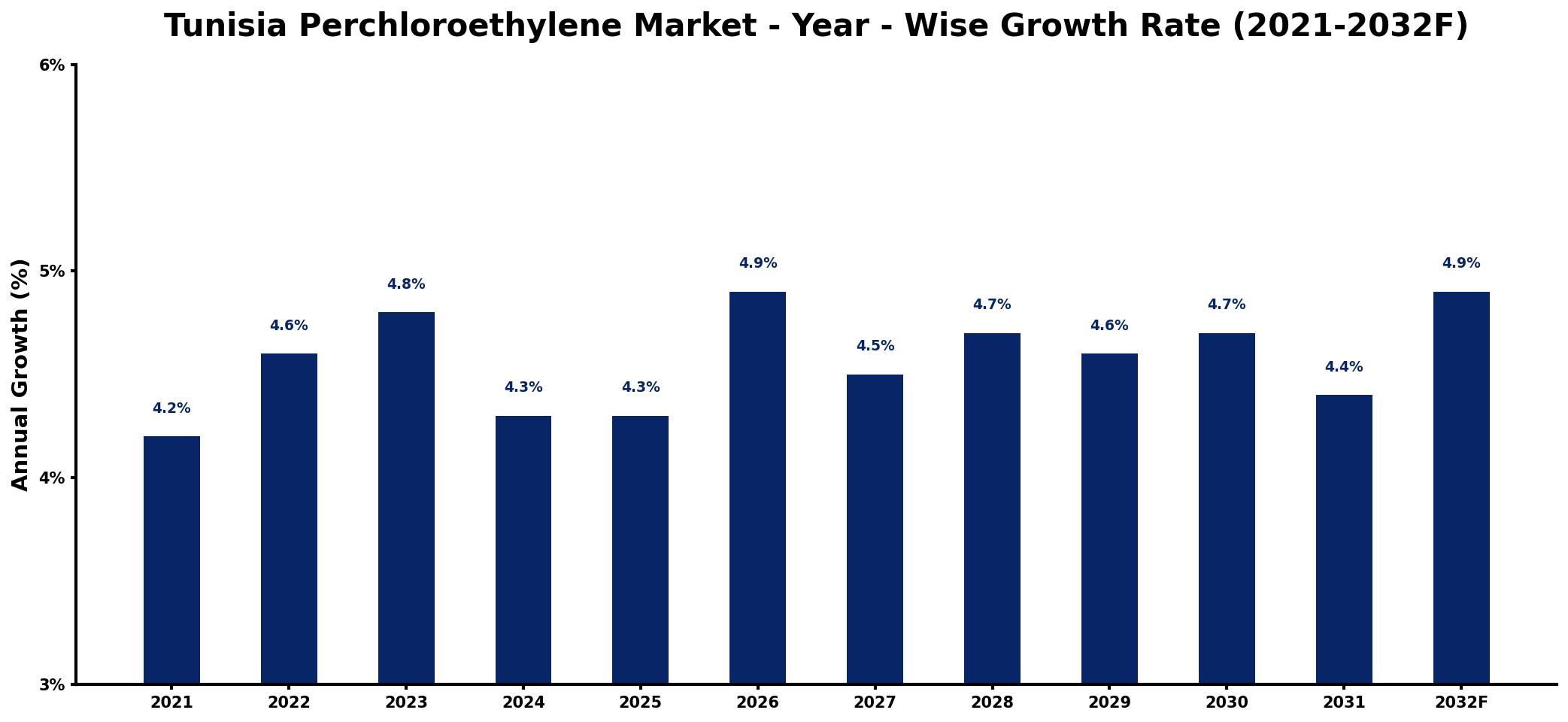
The table below presents the year‑wise growth rates along with the key drivers influencing the market
| Year | Growth Rate | Major Drivers |
| 2021 | 4.2% | Rising demand from dry cleaning |
| 2022 | 4.6% | Increased industrial cleaning applications |
| 2023 | 4.8% | Growth in automotive maintenance services |
| 2024 | 4.3% | Expansion of manufacturing sector investments |
| 2025 | 4.3% | Surge in healthcare cleaning requirements |
| 2026 | 4.9% | Emergence of new cleaning technologies |
| 2027 | 4.5% | Boost in consumer electronics production |
| 2028 | 4.7% | Growing popularity of eco-friendly alternatives |
| 2029 | 4.6% | Increased focus on safety regulations |
| 2030 | 4.7% | rising infrastructure development spending |
| 2031 | 4.4% | Strengthened regulatory compliance initiatives |
| 2032 | 4.9% | increased capital investment inflows |
Note: Market size estimations and growth projections presented in this report are based on 6Wresearch's proprietary forecasting methodology, utilizing the latest available industry data, government publications, and primary research inputs.
Tunisia Perchloroethylene Market Synopsis
The strongest force currently shaping the Tunisia Perchloroethylene Market is the mounting pressure for eco-friendly alternatives in response to environmental concerns. As regulations tighten and awareness grows regarding the hazards of more harmful solvents, industries are increasingly turning towards perchloroethylene, recognizing its efficacy and relatively lower environmental footprint.
Another crucial factor influencing the market is the push for innovation and sustainability among industry players. Companies are investing in research to enhance the efficiency of perchloroethylene applications while also exploring novel formulations that align with environmental standards, ensuring they remain competitive in this evolving landscape.
Tunisia Perchloroethylene Market Key Takeaways
- The market is witnessing a shift toward greener alternatives as environmental regulations tighten.
- Perchloroethylene remains a preferred choice for dry cleaning and textile processing due to its superior cleaning properties.
- Investment in product innovation is critical for players to adapt to sustainability demands.
- Rising industrialization and urbanization are boosting the demand for perchloroethylene in cleaning and degreasing applications.
- Government policies are shaping market dynamics by enforcing regulations on the handling and use of perchloroethylene.
Evaluation of Restraints in Tunisia Perchloroethylene Market
Despite the positive outlook, several constraints hold back the Tunisia Perchloroethylene Market. Key among these are the stringent environmental regulations targeting the chemical's usage, which can limit its application in certain sectors. Additionally, competition from alternative cleaning technologies, such as hydrocarbons and wet cleaning methods, poses a significant challenge. Economic factors, including raw material availability and fluctuating prices, further contribute to market volatility, necessitating strategic planning and adaptation from stakeholders.
Tunisia Perchloroethylene Market Trends
Current trends indicate a strong movement towards the adoption of automation and efficiency in dry cleaning processes. As operational costs rise, industry players are increasingly investing in state-of-the-art technology that enhances productivity while minimizing waste. Furthermore, there is a notable increase in consumer demand for eco-friendly dry cleaning solutions, leading to heightened interest in sustainable practices within the industry.
Tunisia Perchloroethylene Market Opportunities
The Tunisia Perchloroethylene Market holds considerable investment potential, particularly in the textile and dry cleaning sectors, as urbanization accelerates. With government initiatives aiming to attract foreign investments, opportunities for establishing production and distribution facilities are promising. Furthermore, Tunisia's strategic location serves as a gateway to European and African markets, enhancing export possibilities for businesses engaged in perchloroethylene manufacturing.
Government Initiatives in the Tunisia Perchloroethylene Market
The Tunisian government has implemented various regulations to govern the Perchloroethylene market effectively. These include comprehensive guidelines on the storage, handling, and disposal of perchloroethylene, aimed at promoting both environmental and public health safety. Moreover, monitoring and enforcement mechanisms are in place to ensure compliance, thereby fostering responsible practices in the industry.
Future Insights of the Tunisia Perchloroethylene Market
Looking ahead to 2026-2032, the Tunisia Perchloroethylene Market is poised for steady growth. The anticipated rise in demand from key sectors, along with an increasing emphasis on environmental compliance, will drive market expansion. The ongoing innovations towards greener solvent alternatives may initially present challenges, yet they also promise significant opportunities for businesses ready to adapt and innovate, ensuring relevance in a shifting landscape.
Tunisia Perchloroethylene Market Latest Developments (2025 - 2026)
Recent developments in the Tunisia Perchloroethylene Market indicate a shift towards greener initiatives within the industry. Companies are increasingly adopting advanced technologies to enhance operational efficiency and minimize environmental impact. Additionally, partnerships between local manufacturers and international firms are emerging, aimed at boosting production capabilities while meeting sustainability standards.
Tunisia Perchloroethylene Market - Key Attractiveness of the Report
- 10 Years of Market Numbers
- Historical Data Starting from 2022 to 2025
- Base Year: 2025
- Forecast Data until 2032
- Key Performance Indicators Impacting the Market
- Major Upcoming Developments and Projects
Key Highlights of the Report:
- Tunisia Perchloroethylene Market Outlook
- Market Size of Tunisia Perchloroethylene Market, 2025
- Forecast of Tunisia Perchloroethylene Market, 2032
- Historical Data and Forecast of Tunisia Perchloroethylene Revenues & Volume for the Period 2022-2032F
- Tunisia Perchloroethylene Market Trend Evolution
- Tunisia Perchloroethylene Market Drivers and Challenges
- Tunisia Perchloroethylene Price Trends
- Tunisia Perchloroethylene Porter's Five Forces
- Tunisia Perchloroethylene Industry Life Cycle
- Historical Data and Forecast of Tunisia Perchloroethylene Market Revenues & Volume By Type for the Period 2022-2032F
- Historical Data and Forecast of Tunisia Perchloroethylene Market Revenues & Volume By Ethylene Oxychlorination for the Period 2022-2032F
- Historical Data and Forecast of Tunisia Perchloroethylene Market Revenues & Volume By Acetylene Method for the Period 2022-2032F
- Historical Data and Forecast of Tunisia Perchloroethylene Market Revenues & Volume By Ethylene Direct Chlorination for the Period 2022-2032F
- Historical Data and Forecast of Tunisia Perchloroethylene Market Revenues & Volume By End-use for the Period 2022-2032F
- Historical Data and Forecast of Tunisia Perchloroethylene Market Revenues & Volume By Dry Cleaning Agent for the Period 2022-2032F
- Historical Data and Forecast of Tunisia Perchloroethylene Market Revenues & Volume By Solvent for the Period 2022-2032F
- Historical Data and Forecast of Tunisia Perchloroethylene Market Revenues & Volume By Others for the Period 2022-2032F
- Tunisia Perchloroethylene Import Export Trade Statistics
- Market Opportunity Assessment By Type
- Market Opportunity Assessment By End-use
- Tunisia Perchloroethylene Top Companies Market Share
- Tunisia Perchloroethylene Competitive Benchmarking By Technical and Operational Parameters
- Tunisia Perchloroethylene Company Profiles
- Tunisia Perchloroethylene Key Strategic Recommendations






































