Tunisia Plastic Processing Equipment Market Size, Share & Growth Rate
The Tunisia Plastic Processing Equipment Market was estimated at USD 1015 Million in 2025 and is projected to reach USD 1460 Million by 2032, growing at a CAGR of 5.3% from 2026 to 2032. This growth trajectory is primarily fueled by increasing industrialization and the rising demand for plastic across multiple sectors such as packaging, automotive, and construction. The market is further buoyed by government initiatives aimed at promoting the usage of advanced plastic processing technologies.
Tunisia Plastic Processing Equipment Market Year-wise Growth Rate and Key Drivers
This graph highlights how the Tunisia Plastic Processing Equipment Market has steadily grown over the years, supported by major growth factors.
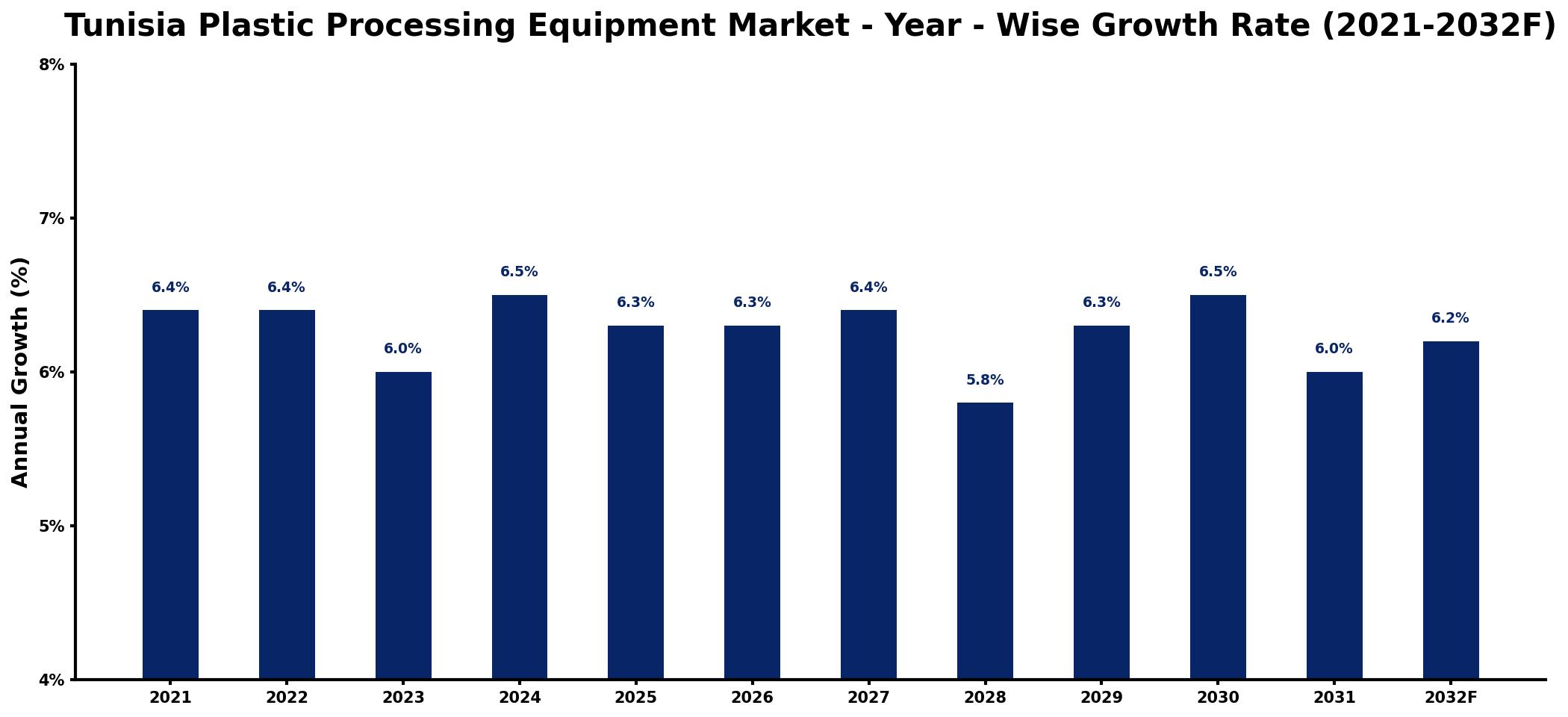
The table below presents the year‑wise growth rates along with the key drivers influencing the market
| Year | Growth Rate | Major Drivers |
| 2021 | 6.4% | Rising demand for sustainable materials |
| 2022 | 6.4% | Increased investments in manufacturing |
| 2023 | 6.0% | Expansion of consumer goods sector |
| 2024 | 6.5% | Growth in packaging industry applications |
| 2025 | 6.3% | Emergence of renewable energy initiatives |
| 2026 | 6.3% | Technological advancements in production |
| 2027 | 6.4% | Surge in construction sector projects |
| 2028 | 5.8% | Shift towards automation in factories |
| 2029 | 6.3% | Growing e-commerce logistics requirements |
| 2030 | 6.5% | Increased focus on recycling initiatives |
| 2031 | 6.0% | Demand for lightweight materials rises |
| 2032 | 6.2% | increased overall sector activity |
Note: Market size estimations and growth projections presented in this report are based on 6Wresearch's proprietary forecasting methodology, utilizing the latest available industry data, government publications, and primary research inputs.
Tunisia Plastic Processing Equipment Market Synopsis
While the Tunisia Plastic Processing Equipment Market has experienced stable growth in recent years, it is gearing up for a significant leap forward. The surge in various industries adopting plastic processing technologies indicates a robust future for market players, driven by innovations and sustainability initiatives.
Moreover, with the government actively supporting local manufacturing and technological upgrades, the market dynamics appear favorable. However, external challenges, including fluctuating raw material costs and environmental concerns, necessitate strategic adaptations among local producers to sustain this upward trajectory.
Tunisia Plastic Processing Equipment Market Key Takeaways
- Demand for eco-friendly plastic processing equipment is rising as industries focus on sustainability.
- Technological advancements, including automation and digitalization, are reshaping manufacturing efficiency.
- The market faces constraints from limited skilled labor, affecting productivity and operational costs.
- Investment opportunities abound in machinery manufacturing and technological upgrades.
- Government policies are actively promoting industrial development and environmentally conscious practices.
Evaluation of Restraints in Tunisia Plastic Processing Equipment Market
Despite the promising growth outlook, the Tunisia Plastic Processing Equipment Market encounters several significant constraints. The limited availability of skilled labor proficient in modern plastic processing machinery undermines production efficiency and increases operational costs. Additionally, inadequate infrastructure and unreliable power supply complicate manufacturing operations. The volatility of raw material prices further exacerbates the economic landscape, posing challenges to profitability. These factors necessitate urgent attention from stakeholders to enhance the workforce's capabilities and improve operational frameworks.
Tunisia Plastic Processing Equipment Market Trends
The market is witnessing transformative trends that are set to redefine its landscape. One of the most notable shifts is the escalating demand for sustainable and eco-friendly equipment, as environmental concerns continue to gain prominence. In line with this, manufacturers are increasingly innovating to develop solutions that minimize energy consumption and waste generation. Furthermore, the rise of automation and digital technologies is becoming prevalent, enhancing efficiency and productivity across the board. The adoption of advanced technologies, including 3D printing and robotics, is poised to further improve manufacturing processes, offering significant competitive advantages.
Tunisia Plastic Processing Equipment Market Opportunities
As Tunisia continues to industrialize, the Plastic Processing Equipment Market offers diverse investment opportunities. The burgeoning demand for plastic products in sectors like packaging, automotive, construction, and consumer goods signals a robust market for manufacturing and distributing plastic processing machinery. Investments in technology upgrades aimed at enhancing efficiency and sustainability are particularly promising. Additionally, Tunisia's strategic geographical position provides access to the broader African market, further amplifying the potential for growth and investment in this sector.
Government Initiatives in the Tunisia Plastic Processing Equipment Market
The Tunisian government is playing a pivotal role in fostering growth in the plastic processing equipment market through various initiatives. Policies aimed at regulating and promoting sustainable practices include the implementation of a ban on single-use plastics and initiatives encouraging recycling and waste management. Incentives such as tax breaks for companies adopting eco-friendly technologies further stimulate industry innovation. By establishing quality standards for plastic products, the government aims to enhance consumer safety and drive responsible production practices. Collectively, these initiatives are designed to mitigate plastic pollution and bolster the growth of the plastic processing equipment sector.
Future Insights of the Tunisia Plastic Processing Equipment Market
The future of the Tunisia Plastic Processing Equipment Market looks promising, with expectations of steady growth driven by several key factors. The rising demand for plastic products across various industries will continue to fuel market expansion. Furthermore, technological advancements in equipment and an increasing investment in the manufacturing sector are anticipated to enhance production capabilities. The ongoing trend towards sustainable and eco-friendly plastic materials is expected to shape the markets evolution, ensuring its relevance in an increasingly environmentally-conscious landscape. Despite potential obstacles like fluctuating raw material prices and competitive pressures from international players, the focus on innovation and efficiency positions the market favorably for the years ahead.
Tunisia Plastic Processing Equipment Market Latest Developments (2025 - 2026)
Recent developments in the Tunisia Plastic Processing Equipment Market indicate a shift towards greater technological integration and sustainability. Companies are prioritizing investment in advanced machinery that promotes energy efficiency and reduces waste. Additionally, several initiatives are underway to enhance training programs for skilled labor, addressing the talent shortage in this sector. Moreover, partnerships between local manufacturers and international technology firms are emerging to foster innovation and competitiveness, ensuring that Tunisian businesses can effectively meet evolving market demands.
Tunisia Plastic Processing Equipment Market - Key Attractiveness of the Report
- 10 Years of Market Numbers
- Historical Data Starting from 2022 to 2025
- Base Year: 2025
- Forecast Data until 2032
- Key Performance Indicators Impacting the Market
- Major Upcoming Developments and Projects
Key Highlights of the Report:
- Tunisia Plastic Processing Equipment Market Outlook
- Market Size of Tunisia Plastic Processing Equipment Market, 2025
- Forecast of Tunisia Plastic Processing Equipment Market, 2032
- Historical Data and Forecast of Tunisia Plastic Processing Equipment Revenues & Volume for the Period 2022-2032F
- Tunisia Plastic Processing Equipment Market Trend Evolution
- Tunisia Plastic Processing Equipment Market Drivers and Challenges
- Tunisia Plastic Processing Equipment Price Trends
- Tunisia Plastic Processing Equipment Porter's Five Forces
- Tunisia Plastic Processing Equipment Industry Life Cycle
- Historical Data and Forecast of Tunisia Plastic Processing Equipment Market Revenues & Volume By Product for the Period 2022-2032F
- Historical Data and Forecast of Tunisia Plastic Processing Equipment Market Revenues & Volume By Screw for the Period 2022-2032F
- Historical Data and Forecast of Tunisia Plastic Processing Equipment Market Revenues & Volume By Twin Screw for the Period 2022-2032F
- Historical Data and Forecast of Tunisia Plastic Processing Equipment Market Revenues & Volume By Barrel for the Period 2022-2032F
- Historical Data and Forecast of Tunisia Plastic Processing Equipment Market Revenues & Volume By Nozzle System for the Period 2022-2032F
- Historical Data and Forecast of Tunisia Plastic Processing Equipment Market Revenues & Volume By End Caps for the Period 2022-2032F
- Historical Data and Forecast of Tunisia Plastic Processing Equipment Market Revenues & Volume By Others for the Period 2022-2032F
- Historical Data and Forecast of Tunisia Plastic Processing Equipment Market Revenues & Volume By Material for the Period 2022-2032F
- Historical Data and Forecast of Tunisia Plastic Processing Equipment Market Revenues & Volume By Bimetallic for the Period 2022-2032F
- Historical Data and Forecast of Tunisia Plastic Processing Equipment Market Revenues & Volume By Nitride for the Period 2022-2032F
- Historical Data and Forecast of Tunisia Plastic Processing Equipment Market Revenues & Volume By Carbide for the Period 2022-2032F
- Historical Data and Forecast of Tunisia Plastic Processing Equipment Market Revenues & Volume By Steel for the Period 2022-2032F
- Historical Data and Forecast of Tunisia Plastic Processing Equipment Market Revenues & Volume By Chrome for the Period 2022-2032F
- Historical Data and Forecast of Tunisia Plastic Processing Equipment Market Revenues & Volume By Others for the Period 2022-2032F
- Historical Data and Forecast of Tunisia Plastic Processing Equipment Market Revenues & Volume By Industry for the Period 2022-2032F
- Historical Data and Forecast of Tunisia Plastic Processing Equipment Market Revenues & Volume By Automotive for the Period 2022-2032F
- Historical Data and Forecast of Tunisia Plastic Processing Equipment Market Revenues & Volume By Packaging for the Period 2022-2032F
- Historical Data and Forecast of Tunisia Plastic Processing Equipment Market Revenues & Volume By Electronics for the Period 2022-2032F
- Historical Data and Forecast of Tunisia Plastic Processing Equipment Market Revenues & Volume By Healthcare for the Period 2022-2032F
- Historical Data and Forecast of Tunisia Plastic Processing Equipment Market Revenues & Volume By Consumer Goods for the Period 2022-2032F
- Historical Data and Forecast of Tunisia Plastic Processing Equipment Market Revenues & Volume By Others for the Period 2022-2032F
- Historical Data and Forecast of Tunisia Plastic Processing Equipment Market Revenues & Volume By Application for the Period 2022-2032F
- Historical Data and Forecast of Tunisia Plastic Processing Equipment Market Revenues & Volume By Extrusion for the Period 2022-2032F
- Historical Data and Forecast of Tunisia Plastic Processing Equipment Market Revenues & Volume By Injection Molding for the Period 2022-2032F
- Historical Data and Forecast of Tunisia Plastic Processing Equipment Market Revenues & Volume By Sales Channel for the Period 2022-2032F
- Historical Data and Forecast of Tunisia Plastic Processing Equipment Market Revenues & Volume By OEM for the Period 2022-2032F
- Historical Data and Forecast of Tunisia Plastic Processing Equipment Market Revenues & Volume By After Market for the Period 2022-2032F
- Tunisia Plastic Processing Equipment Import Export Trade Statistics
- Market Opportunity Assessment By Product
- Market Opportunity Assessment By Material
- Market Opportunity Assessment By Industry
- Market Opportunity Assessment By Application
- Market Opportunity Assessment By Sales Channel
- Tunisia Plastic Processing Equipment Top Companies Market Share
- Tunisia Plastic Processing Equipment Competitive Benchmarking By Technical and Operational Parameters
- Tunisia Plastic Processing Equipment Company Profiles
- Tunisia Plastic Processing Equipment Key Strategic Recommendations






































