Tunisia Precious Metals Market Size, Share & Growth Rate
The Tunisia Precious Metals Market was estimated at USD 114 Million in 2025 and is projected to reach USD 124 Million by 2032, growing at a CAGR of 1.2% from 2026 to 2032. This growth trajectory is significantly influenced by the increasing industrial applications for precious metals, particularly in electronics and automotive sectors. Moreover, a rising interest among investors in gold and silver as safe-haven assets during economic fluctuations further fuels market demand.
Tunisia Precious Metals Market Year-wise Growth Rate and Key Drivers
This graph highlights how the Tunisia Precious Metals Market has steadily grown over the years, supported by major growth factors.
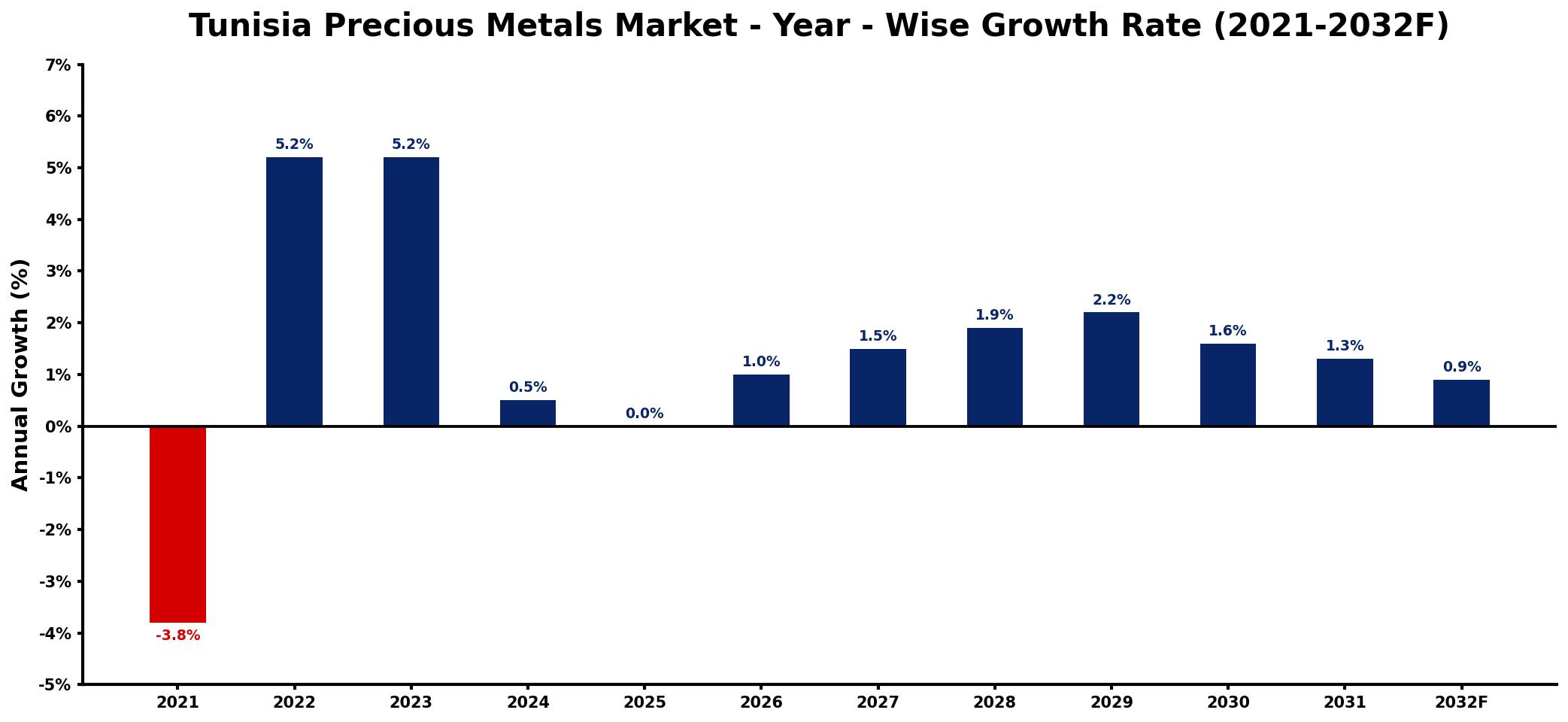
The table below presents the year‑wise growth rates along with the key drivers influencing the market
| Year | Growth Rate | Major Drivers |
| 2021 | -3.8% | decreased industrial manufacturing output |
| 2022 | 5.2% | increased jewelry market demand |
| 2023 | 5.2% | growing investment in technology |
| 2024 | 0.5% | expansion of mining operations |
| 2025 | 0.0% | stabilization of global markets |
| 2026 | 1.0% | rise in consumer purchasing power |
| 2027 | 1.5% | enhanced export opportunities emerging |
| 2028 | 1.9% | increased demand from electronics |
| 2029 | 2.2% | growing interest in sustainable investments |
| 2030 | 1.6% | rising demand from electronics |
| 2031 | 1.3% | rising popularity of alternative investments |
| 2032 | 0.9% | increased focus on recycling initiatives |
Note: Market size estimations and growth projections presented in this report are based on 6Wresearch's proprietary forecasting methodology, utilizing the latest available industry data, government publications, and primary research inputs.
Tunisia Precious Metals Market Synopsis
Tunisia's unique geological landscape offers a range of mineral resources, making it a pivotal player in the precious metals market. The country's mining operations are increasingly focused on enhancing extraction methods, aiming for sustainability while meeting the growing demand for gold, silver, and platinum.
In addition to industrial use, cultural factors also drive the demand for precious metals, particularly gold in jewelry. Tunisian traditions and gifting practices involving gold contribute to a sustained interest in gold purchases, blending investment with cultural significance.
Tunisia Precious Metals Market Key Takeaways
- The market is poised for steady growth, driven by increased industrial applications and investment interest.
- Tunisia's mining sector is evolving, with emphasis on sustainable practices and improved extraction efficiency.
- Cultural factors significantly influence demand, particularly for gold in jewelry, enhancing market resilience.
- Government regulations aim to foster transparency and sustainable development within the industry.
- Market volatility linked to global economic conditions poses challenges for operational costs and investor sentiment.
Evaluation of Restraints in Tunisia Precious Metals Market
The Tunisia Precious Metals Market encounters several restraints that could impact its growth. Notably, market volatility and unpredictable price fluctuations driven by global economic conditions create uncertainty for investors and producers alike. Additionally, regulatory changes related to environmental concerns can elevate operational costs for mining and refining, potentially hampering profitability. Infrastructure limitations also present a barrier, as the need for improved logistics and processing facilities is paramount for future growth. These factors necessitate the adoption of sustainable practices that align with regulatory frameworks, balancing economic interests with environmental stewardship.
Tunisia Precious Metals Market Trends
A noticeable trend in the Tunisia Precious Metals Market is the integration of technology into mining processes, enhancing efficiency and safety. Automation and data analytics are gaining traction, helping to optimize resource management and reduce environmental impact. Furthermore, the shift towards sustainable practices is leading companies to adopt greener technologies for extraction and processing. The interest in ethical sourcing is also on the rise, driven by consumer awareness and demand for responsibly sourced precious metals.
Tunisia Precious Metals Market Opportunities
There are significant growth opportunities in the Tunisia Precious Metals Market, particularly for companies that invest in sustainable practices and innovation. As global demand for ethically sourced precious metals increases, Tunisian producers can leverage their unique position to cater to international markets. Additionally, expanding industrial applications—such as in renewable energy technologies and advanced electronics—can open new avenues for growth. Strengthening partnerships with international stakeholders can also facilitate access to new technologies and investment, enhancing the overall competitiveness of the market.
Government Initiatives in the Tunisia Precious Metals Market
The Tunisian government has enacted a series of policies aimed at regulating the precious metals sector, ensuring sustainable practices in extraction and refining. Licensing requirements for mining operations are in place to promote transparency and accountability. Environmental regulations are also crucial, as they seek to minimize ecological impact while facilitating responsible mining activities. Furthermore, export controls are implemented to ensure that the economic benefits of precious metal trade are maximized for the country, promoting national interest.
Future Insights of the Tunisia Precious Metals Market
Looking ahead to the 2026-2032 period, the Tunisia Precious Metals Market is expected to evolve with increasing industrial demand and investor confidence. As more companies adopt sustainable practices and advanced technologies, the market could see a shift towards higher efficiency and lower costs. Additionally, the integration of ethical sourcing will likely enhance the markets attractiveness to global investors. With the governments supportive policies, the landscape is ripe for growth, positioning Tunisia as a competitive player in the global precious metals arena.
Tunisia Precious Metals Market Latest Developments (2025 - 2026)
Recent developments in the Tunisia Precious Metals Market indicate a shift towards increased investment in sustainable extraction technologies. Companies are exploring partnerships that leverage innovative solutions to enhance operational efficiencies. Additionally, regulatory adjustments are being made to streamline the licensing process for mining operations, encouraging more players to enter the market. This period also witnesses growing discussions around ethical sourcing, with stakeholders emphasizing the importance of responsible practices across the supply chain.
Tunisia Precious Metals Market - Key Attractiveness of the Report
- 10 Years of Market Numbers
- Historical Data Starting from 2022 to 2025
- Base Year: 2025
- Forecast Data until 2032
- Key Performance Indicators Impacting the Market
- Major Upcoming Developments and Projects
Key Highlights of the Report:
- Tunisia Precious Metals Market Outlook
- Market Size of Tunisia Precious Metals Market, 2025
- Forecast of Tunisia Precious Metals Market, 2032
- Historical Data and Forecast of Tunisia Precious Metals Revenues & Volume for the Period 2022-2032F
- Tunisia Precious Metals Market Trend Evolution
- Tunisia Precious Metals Market Drivers and Challenges
- Tunisia Precious Metals Price Trends
- Tunisia Precious Metals Porter's Five Forces
- Tunisia Precious Metals Industry Life Cycle
- Historical Data and Forecast of Tunisia Precious Metals Market Revenues & Volume By Product for the Period 2022-2032F
- Historical Data and Forecast of Tunisia Precious Metals Market Revenues & Volume By Gold for the Period 2022-2032F
- Historical Data and Forecast of Tunisia Precious Metals Market Revenues & Volume By Silver for the Period 2022-2032F
- Historical Data and Forecast of Tunisia Precious Metals Market Revenues & Volume By Platinum Group Metals (PGM) for the Period 2022-2032F
- Historical Data and Forecast of Tunisia Precious Metals Market Revenues & Volume By Application for the Period 2022-2032F
- Historical Data and Forecast of Tunisia Precious Metals Market Revenues & Volume By Jewelry for the Period 2022-2032F
- Historical Data and Forecast of Tunisia Precious Metals Market Revenues & Volume By Industrial for the Period 2022-2032F
- Historical Data and Forecast of Tunisia Precious Metals Market Revenues & Volume By Investment for the Period 2022-2032F
- Tunisia Precious Metals Import Export Trade Statistics
- Market Opportunity Assessment By Product
- Market Opportunity Assessment By Application
- Tunisia Precious Metals Top Companies Market Share
- Tunisia Precious Metals Competitive Benchmarking By Technical and Operational Parameters
- Tunisia Precious Metals Company Profiles
- Tunisia Precious Metals Key Strategic Recommendations






































