Tunisia Rubber Compound Market Size, Share & Growth Rate
The Tunisia Rubber Compound Market was estimated at USD 203 Million in 2025 and is projected to reach USD 283 Million by 2032, growing at a CAGR of 4.9% from 2026 to 2032. This growth trajectory is fueled primarily by the burgeoning automotive sector, where an increasing demand for high-performance components is driving investments in specialized rubber compounds. Additionally, infrastructure development projects are expected to elevate the demand for rubber materials across various construction applications.
Tunisia Rubber Compound Market Year-wise Growth Rate and Key Drivers
This graph highlights how the Tunisia Rubber Compound Market has steadily grown over the years, supported by major growth factors.
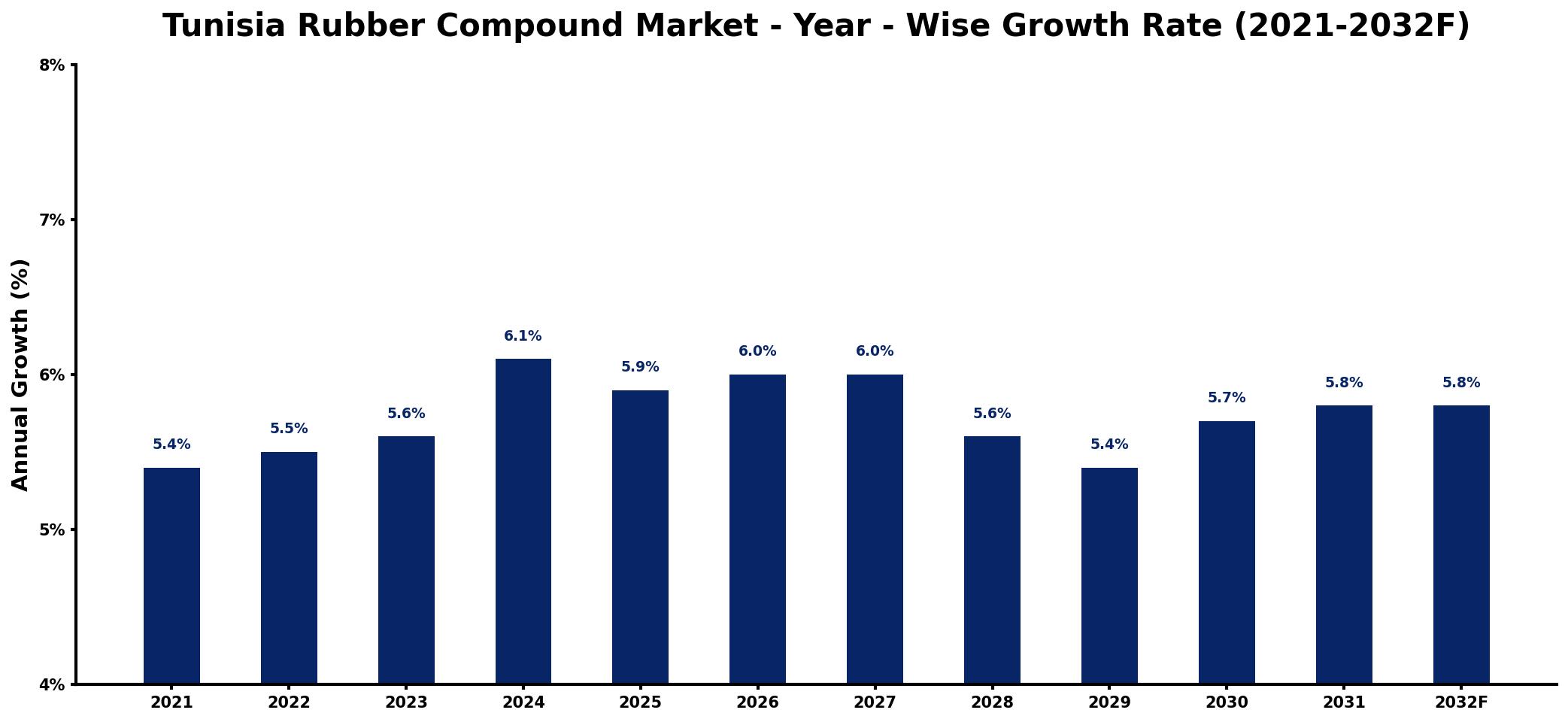
The table below presents the year‑wise growth rates along with the key drivers influencing the market
| Year | Growth Rate | Major Drivers |
| 2021 | 5.4% | Rising automotive sector demand |
| 2022 | 5.5% | Growth in construction projects |
| 2023 | 5.6% | Increased exports to Europe |
| 2024 | 6.1% | Technological advancements in production |
| 2025 | 5.9% | Expansion of local manufacturing facilities |
| 2026 | 6.0% | Surge in medical applications |
| 2027 | 6.0% | Growing consumer goods market |
| 2028 | 5.6% | Emerging renewable energy investments |
| 2029 | 5.4% | Strengthening regional trade agreements |
| 2030 | 5.7% | Demand from footwear industry |
| 2031 | 5.8% | Increase in infrastructure investments |
| 2032 | 5.8% | Rising eco-friendly product adoption |
Note: Market size estimations and growth projections presented in this report are based on 6Wresearch's proprietary forecasting methodology, utilizing the latest available industry data, government publications, and primary research inputs.
Tunisia Rubber Compound Market Synopsis
In Tunisia, the rubber compound market is witnessing a significant upswing owing to a robust expansion in the automotive and construction industries. As infrastructure development progresses, the necessity for reliable and durable rubber compounds has become increasingly apparent, marking a critical point in supply chain dynamics.
Furthermore, manufacturers are placing greater emphasis on sustainability. The shift towards eco-friendly compounds resonates well with global trends, addressing consumer concerns regarding the environmental impact of rubber products. As companies innovate, the market is adapting to meet these new demands.
Tunisia Rubber Compound Market Key Takeaways
- The market is driven by growth in the automotive, construction, and industrial sectors.
- There is a marked shift towards sustainable and eco-friendly rubber compounds.
- Technological advancements are enhancing production efficiency and product quality.
- Strategic partnerships and innovation are vital for companies looking to maintain a competitive edge.
- Regulatory compliance presents challenges but also opportunities for differentiation in product quality.
Evaluation of Restraints in Tunisia Rubber Compound Market
Despite the positive outlook, the Tunisia rubber compound market faces several formidable challenges. Fluctuating raw material prices can significantly affect manufacturing costs, thereby squeezing margins. Additionally, the local market contends with political and economic instability, which can deter potential investments. Stringent environmental regulations require manufacturers to not only comply with standards but often adapt processes, which can be resource-intensive. These factors create a landscape where only the most innovative and agile companies will thrive.
Tunisia Rubber Compound Market Trends
Current trends in the Tunisia rubber compound market reveal a strong pivot towards environmentally friendly products. Manufacturers are actively developing compounds that eliminate harmful chemicals, thereby addressing rising consumer and regulatory demands for sustainability. Another emerging trend is the increasing application of advanced technologies, including automation and digitalization, to enhance production processes and improve quality control measures.
Additionally, customization of rubber compounds is becoming increasingly prevalent, allowing producers to meet the specific needs of diverse industries. This trend reflects a broader industry shift towards tailored solutions that enhance performance across various applications, from automotive to healthcare.
Tunisia Rubber Compound Market Opportunities
The growth prospects in the Tunisia rubber compound market are promising, particularly for investors looking to tap into the burgeoning automotive and construction sectors. With infrastructure projects gaining momentum, companies that provide specialized rubber solutions are well-positioned to benefit. Furthermore, government initiatives aimed at bolstering industrialization and foreign investments create a fertile ground for profitable ventures in this market. The rising trend of technological innovation also opens doors for high returns on investment in rubber compounding technologies.
Government Initiatives in the Tunisia Rubber Compound Market
The Tunisian government has introduced various policies aimed at enhancing the rubber compound market's potential. Incentives for foreign investments are designed to attract international players while fostering local talent in research and development. Regulations concerning product quality and safety standards are strictly enforced, which helps local manufacturers meet global competitiveness. Additionally, public funding programs are available to support local businesses, encouraging innovation and strengthening partnerships within the industry.
Future Insights of the Tunisia Rubber Compound Market
Looking ahead to 2026-2032, the Tunisia rubber compound market is set for continued growth fueled by various end-use industries. The automotive sector, in particular, is likely to experience robust demand for specialized rubber compounds, particularly in tire manufacturing. Ongoing government support for industrial expansion, combined with rising manufacturing activities, is expected to significantly contribute to market development. However, staying attuned to raw material price fluctuations and competitive pressures will be crucial for stakeholders in the coming years.
Tunisia Rubber Compound Market Latest Developments (2025 - 2026)
Recent developments in the Tunisia rubber compound market indicate a growing inclination towards advanced production techniques. Manufacturers are increasingly investing in automation technologies to enhance operational efficiency. Additionally, there's a notable surge in collaborative initiatives aimed at research and development, which focus on creating more sustainable rubber compounds. These efforts are in alignment with global trends and underscore the industry's commitment to innovation and environmental responsibility.
Tunisia Rubber Compound Market - Key Attractiveness of the Report
- 10 Years of Market Numbers
- Historical Data Starting from 2022 to 2025
- Base Year: 2025
- Forecast Data until 2032
- Key Performance Indicators Impacting the Market
- Major Upcoming Developments and Projects
Key Highlights of the Report:
- Tunisia Rubber Compound Market Outlook
- Market Size of Tunisia Rubber Compound Market, 2025
- Forecast of Tunisia Rubber Compound Market, 2032
- Historical Data and Forecast of Tunisia Rubber Compound Revenues & Volume for the Period 2022-2032F
- Tunisia Rubber Compound Market Trend Evolution
- Tunisia Rubber Compound Market Drivers and Challenges
- Tunisia Rubber Compound Price Trends
- Tunisia Rubber Compound Porter's Five Forces
- Tunisia Rubber Compound Industry Life Cycle
- Historical Data and Forecast of Tunisia Rubber Compound Market Revenues & Volume By Rubber Type for the Period 2022-2032F
- Historical Data and Forecast of Tunisia Rubber Compound Market Revenues & Volume By Silicone Rubber for the Period 2022-2032F
- Historical Data and Forecast of Tunisia Rubber Compound Market Revenues & Volume By Fluoro Rubber for the Period 2022-2032F
- Historical Data and Forecast of Tunisia Rubber Compound Market Revenues & Volume By Butyronitrile Rubber for the Period 2022-2032F
- Historical Data and Forecast of Tunisia Rubber Compound Market Revenues & Volume By EPDM Rubber for the Period 2022-2032F
- Historical Data and Forecast of Tunisia Rubber Compound Market Revenues & Volume By Chloroprene Rubber for the Period 2022-2032F
- Historical Data and Forecast of Tunisia Rubber Compound Market Revenues & Volume By Others for the Period 2022-2032F
- Historical Data and Forecast of Tunisia Rubber Compound Market Revenues & Volume By End-User for the Period 2022-2032F
- Historical Data and Forecast of Tunisia Rubber Compound Market Revenues & Volume By Tires for the Period 2022-2032F
- Historical Data and Forecast of Tunisia Rubber Compound Market Revenues & Volume By Hose & Belting for the Period 2022-2032F
- Historical Data and Forecast of Tunisia Rubber Compound Market Revenues & Volume By Roofing & Geo Membranes for the Period 2022-2032F
- Historical Data and Forecast of Tunisia Rubber Compound Market Revenues & Volume By Footwear for the Period 2022-2032F
- Historical Data and Forecast of Tunisia Rubber Compound Market Revenues & Volume By Wire & Cable Insulation for the Period 2022-2032F
- Historical Data and Forecast of Tunisia Rubber Compound Market Revenues & Volume By Others for the Period 2022-2032F
- Tunisia Rubber Compound Import Export Trade Statistics
- Market Opportunity Assessment By Rubber Type
- Market Opportunity Assessment By End-User
- Tunisia Rubber Compound Top Companies Market Share
- Tunisia Rubber Compound Competitive Benchmarking By Technical and Operational Parameters
- Tunisia Rubber Compound Company Profiles
- Tunisia Rubber Compound Key Strategic Recommendations






































