Tunisia Sports Flooring Market Summary
The tunisia sports flooring market was estimated at USD 427 Million in 2025 and is projected to reach USD 585 Million by 2032, growing at a CAGR of 5.1% from 2026 to 2032.
Tunisia Sports Flooring Market Year-wise Growth Rate and Key Drivers
This graph highlights how the Tunisia Sports Flooring Market has steadily grown over the past five years, supported by major growth factors.
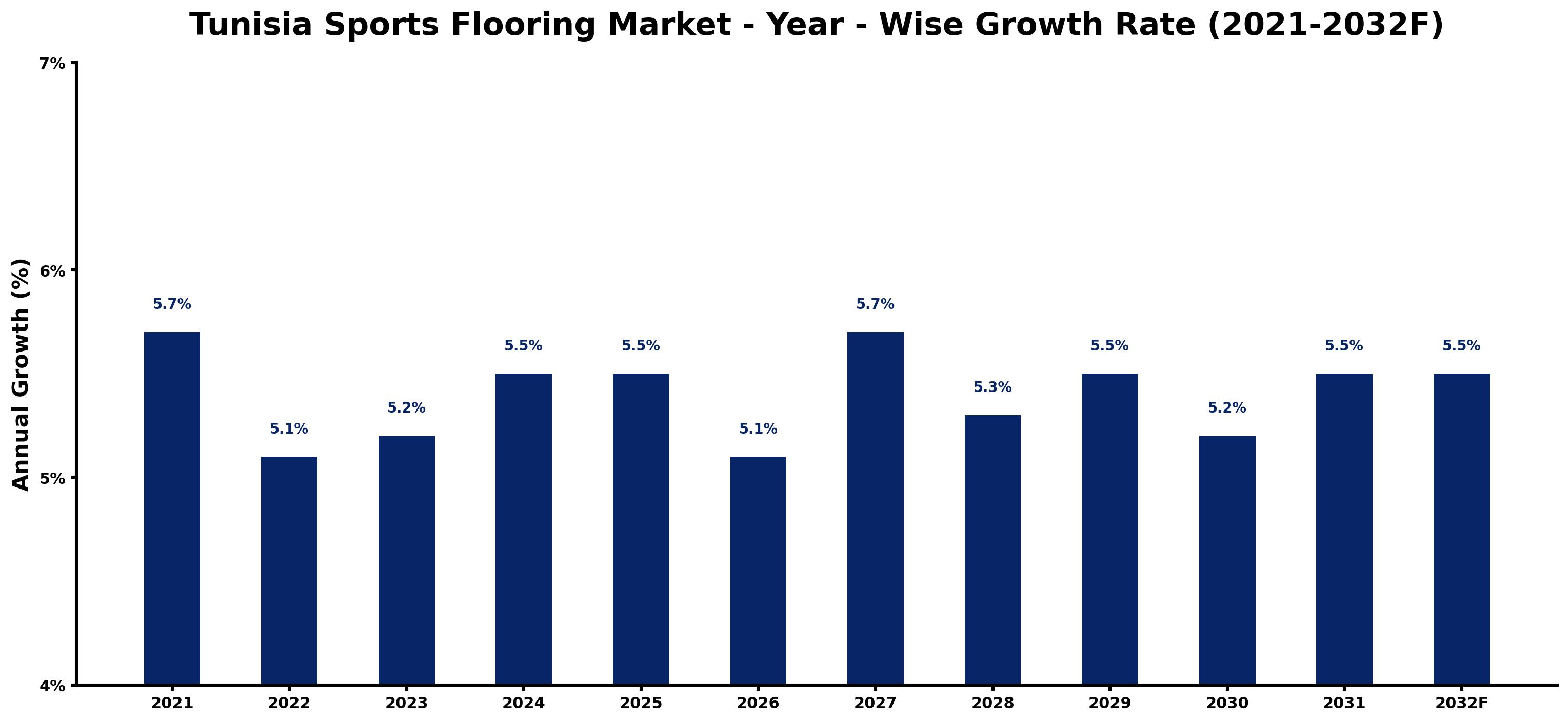
The table below presents the year wise growth rates along with the key drivers influencing the market
| Year | Growth Rate | Major Drivers |
| 2021 | 5.7% | The resurgence of sports activities fueled demand for quality flooring solutions. |
| 2022 | 5.1% | Local manufacturers began enhancing product offerings to align with international standards. |
| 2023 | 5.2% | Investment in sports infrastructure markedly increased, attracting further private sector interest. |
| 2024 | 5.5% | Emergence of eco-friendly materials transformed product options for environmentally conscious buyers. |
| 2025 | 5.5% | Community sports initiatives gained traction, pushing demand for accessible flooring solutions. |
| 2026 | 5.1% | Technological advancements in flooring materials improved durability and performance metrics significantly. |
| 2027 | 5.7% | Collaborations between local and international brands expanded the market landscape effectively. |
| 2028 | 5.3% | Urban population growth led to increased construction of sports facilities and complexes. |
| 2029 | 5.5% | Growing health awareness among youth spurred interest in sports participation and facilities. |
| 2030 | 5.2% | A surge in regional sports events significantly boosted demand for reliable flooring options. |
| 2031 | 5.5% | Emerging trends focused on multifunctional spaces encouraged versatile flooring product developments. |
| 2032 | 5.5% | Sustainability in construction practices became a focal point for new flooring project specifications. |
Note - Market size estimations and growth projections presented in this report are based on 6Wresearch's advanced forecasting approach, validated with industry datasets as of June 2026.
Tunisia Sports Flooring Market Synopsis
The Tunisia Sports Flooring Market is projected to reach 5.1% and witness significant growth during the forecast period (2026-2032). The growth trajectory of this market is primarily fueled by the increasing engagement in sports and fitness activities across the country. Various sports flooring solutions, including hardwood, synthetic, and rubber surfaces, are becoming popular, as they cater to a diverse range of sporting needs. This growth is further propelled by rising awareness regarding the role of sports in fostering a healthy lifestyle and the continuous expansion of sports facilities throughout Tunisia.
Tunisia Sports Flooring Market Growth Drivers
Several factors are driving the growth of the Tunisia Sports Flooring Market. The increasing investment in sports infrastructure and facilities is a principal driver, enhancing accessibility to quality sporting environments for all demographics. Furthermore, the demand for high-performance flooring materials is escalating, particularly among sports clubs and educational institutions that aim to offer superior experiences.
- There is a notable rise in fitness consciousness among the population, resulting in higher participation rates in recreational activities that require specialized flooring.
- Investments in sports infrastructure by both public and private entities are supporting the development of modern sports facilities, which necessitate advanced flooring solutions.
- The growing trend of eco-friendliness is prompting consumers to seek sustainable flooring solutions, which is reshaping product offerings in the market.
- Technological advancements in flooring materials are enhancing performance features such as durability, shock absorption, and ease of maintenance, thus attracting more consumers.
- Increased promotional activities and events are creating greater awareness and demand for sports facilities, further driving the growth of the market.
Tunisia Sports Flooring Market Trends and Opportunities
The Tunisia Sports Flooring Market is evolving to meet the demands of various sporting disciplines. There is a growing preference for multifunctional flooring solutions that provide versatility for different sports activities. Consumers are particularly interested in flooring that is both durable and easy to maintain, ensuring safety and facilitating high performance.
- The trend toward using eco-friendly materials is gaining momentum, with an increased focus on products that feature recycled content and lower VOC emissions.
- Customization options are becoming essential, allowing facilities to integrate branding, colors, and unique designs into their flooring, thereby enhancing the user experience.
- As more indoor sports facilities and fitness centers emerge, the demand for robust flooring that can endure heavy foot traffic and strenuous physical activities is surging.
- Enhanced safety features are a growing priority among customers, prompting manufacturers to innovate flooring solutions that mitigate injury risks for athletes.
- The anticipation of hosting national and international sports events is motivating investments in high-quality sports flooring, contributing to the market's expansion.
Tunisia Sports Flooring Market Challenges and Restraints
Despite the promising growth prospects, the Tunisia Sports Flooring Market faces several challenges. A significant hurdle is the limited awareness among potential customers regarding the advantages of premium sports flooring solutions, which may hinder market penetration.
- Price sensitivity in the sector often leads to budget constraints, making it difficult for sports facilities to invest in high-quality flooring options.
- Competition from low-cost alternatives can compromise product quality, leading to a perception that cheaper solutions are equally viable.
- Fluctuations in raw material prices affect cost stability, complicating pricing strategies for manufacturers and suppliers.
- The lack of standardized regulations and quality control measures can lead to inconsistencies in flooring product performance and safety standards.
- Addressing these challenges requires a collaborative effort among industry stakeholders to improve awareness, enhance cost efficiencies, and advocate for necessary regulations.
Tunisia Sports Flooring Market Investment Opportunities
The landscape of the Tunisia Sports Flooring Market presents myriad investment opportunities for both domestic and international entities. The burgeoning popularity of sports and fitness activities is driving demand for high-quality flooring options across various segments, including gyms, schools, and sports facilities.
- Investing in the production and distribution of specialized flooring materials, such as rubber, vinyl, and wood composites, has strong potential for returns.
- The shift toward sustainable flooring solutions presents fertile ground for companies willing to innovate and offer eco-friendly products.
- Collaborating with educational institutions and sports clubs for large-scale flooring projects can capitalize on the expanding infrastructure development in the sports sector.
- Market entrants can explore niche segments such as flooring for outdoor sports facilities, which are increasingly gaining traction.
- Establishing distribution networks that cater to regional demands can enhance market presence and drive sales growth across the country.
Tunisia Sports Flooring Market Government Investment and Initiatives
The Tunisian government has enacted several policies aimed at promoting and regulating the sports flooring market. These initiatives are designed to ensure the safety and quality of sports flooring materials utilized in public and private sports facilities.
- Government spending is focused on the development of sports infrastructure, which includes the establishment of specialized flooring in new sports complexes and renovation projects.
- Policies encouraging research and development in innovative flooring technologies aim to improve overall performance and sustainability in the industry.
- There are regulatory frameworks in place to monitor the installation and maintenance standards of sports flooring, prioritizing athlete safety.
- Incentives for manufacturers to adopt eco-friendly production methods are being promoted to align with broader environmental goals.
- Collaborative initiatives between the government and private sector aim to enhance public sports facilities, thereby facilitating wider access to high-quality sporting environments for the community.
Tunisia Sports Flooring Market Latest Developments (May 2025 - June 2026)
In the period from May 2025 to June 2026, the Tunisia Sports Flooring Market underwent several notable developments. Industry stakeholders have increasingly focused on integrating advanced technologies into flooring solutions to enhance performance and user experience.
- There has been a marked shift toward the adoption of sustainable materials, with new products being introduced that emphasize low environmental impact and high durability.
- Regulatory bodies have intensified efforts to ensure compliance with safety standards for sports flooring installations, resulting in improved consumer confidence.
- Investment in public sports infrastructure has seen a rise, with significant government projects aimed at improving community access to recreational facilities.
- Strategic partnerships between flooring manufacturers and sports organizations have emerged, facilitating customized solutions that cater to specific sports requirements.
- Market players have increased engagement in educational campaigns to raise awareness about the benefits of quality sports flooring, which is likely to drive future demand.
Tunisia Sports Flooring Market - Key Attractiveness of the Report
- 10 Years of Market Numbers
- Historical Data Starting from 2022 to 2025
- Base Year: 2025
- Forecast Data until 2032
- Key Performance Indicators Impacting the Market
- Major Upcoming Developments and Projects
Key Highlights of the Report:
- Tunisia Sports Flooring Market Outlook
- Market Size of Tunisia Sports Flooring Market, 2025
- Forecast of Tunisia Sports Flooring Market, 2032F
- Historical Data and Forecast of Tunisia Sports Flooring Revenues & Volume for the Period 2022-2032F
- Tunisia Sports Flooring Market Trend Evolution
- Tunisia Sports Flooring Market Drivers and Challenges
- Tunisia Sports Flooring Price Trends
- Tunisia Sports Flooring Porter's Five Forces
- Tunisia Sports Flooring Industry Life Cycle
- Historical Data and Forecast of Tunisia Sports Flooring Market Revenues & Volume By Product Type for the Period 2022-2032F
- Historical Data and Forecast of Tunisia Sports Flooring Market Revenues & Volume By Outdoor for the Period 2022-2032F
- Historical Data and Forecast of Tunisia Sports Flooring Market Revenues & Volume By Indoor for the Period 2022-2032F
- Historical Data and Forecast of Tunisia Sports Flooring Market Revenues & Volume By Material Type for the Period 2022-2032F
- Historical Data and Forecast of Tunisia Sports Flooring Market Revenues & Volume By Wood for the Period 2022-2032F
- Historical Data and Forecast of Tunisia Sports Flooring Market Revenues & Volume By Rubber for the Period 2022-2032F
- Historical Data and Forecast of Tunisia Sports Flooring Market Revenues & Volume By Polymeric for the Period 2022-2032F
- Historical Data and Forecast of Tunisia Sports Flooring Market Revenues & Volume By Sales Channel for the Period 2022-2032F
- Historical Data and Forecast of Tunisia Sports Flooring Market Revenues & Volume By Direct Sales for the Period 2022-2032F
- Historical Data and Forecast of Tunisia Sports Flooring Market Revenues & Volume By Independent Sports Outlet for the Period 2022-2032F
- Historical Data and Forecast of Tunisia Sports Flooring Market Revenues & Volume By Mass Merchandiser for the Period 2022-2032F
- Historical Data and Forecast of Tunisia Sports Flooring Market Revenues & Volume By Value Added Resellers for the Period 2022-2032F
- Historical Data and Forecast of Tunisia Sports Flooring Market Revenues & Volume By End-users for the Period 2022-2032F
- Historical Data and Forecast of Tunisia Sports Flooring Market Revenues & Volume By Commercial for the Period 2022-2032F
- Historical Data and Forecast of Tunisia Sports Flooring Market Revenues & Volume By Residential for the Period 2022-2032F
- Tunisia Sports Flooring Import Export Trade Statistics
- Market Opportunity Assessment By Product Type
- Market Opportunity Assessment By Material Type
- Market Opportunity Assessment By Sales Channel
- Market Opportunity Assessment By End-users
- Tunisia Sports Flooring Top Companies Market Share
- Tunisia Sports Flooring Competitive Benchmarking By Technical and Operational Parameters
- Tunisia Sports Flooring Company Profiles
- Tunisia Sports Flooring Key Strategic Recommendations






































