Tunisia Textile Market Summary
The tunisia textile market was estimated at USD 380 Million in 2025 and is projected to reach USD 509 Million by 2032, growing at a CAGR of 5.2% from 2026 to 2032.
Tunisia Textile Market Year-wise Growth Rate and Key Drivers
This graph highlights how the Tunisia Textile Market has steadily grown over the past five years, supported by major growth factors.
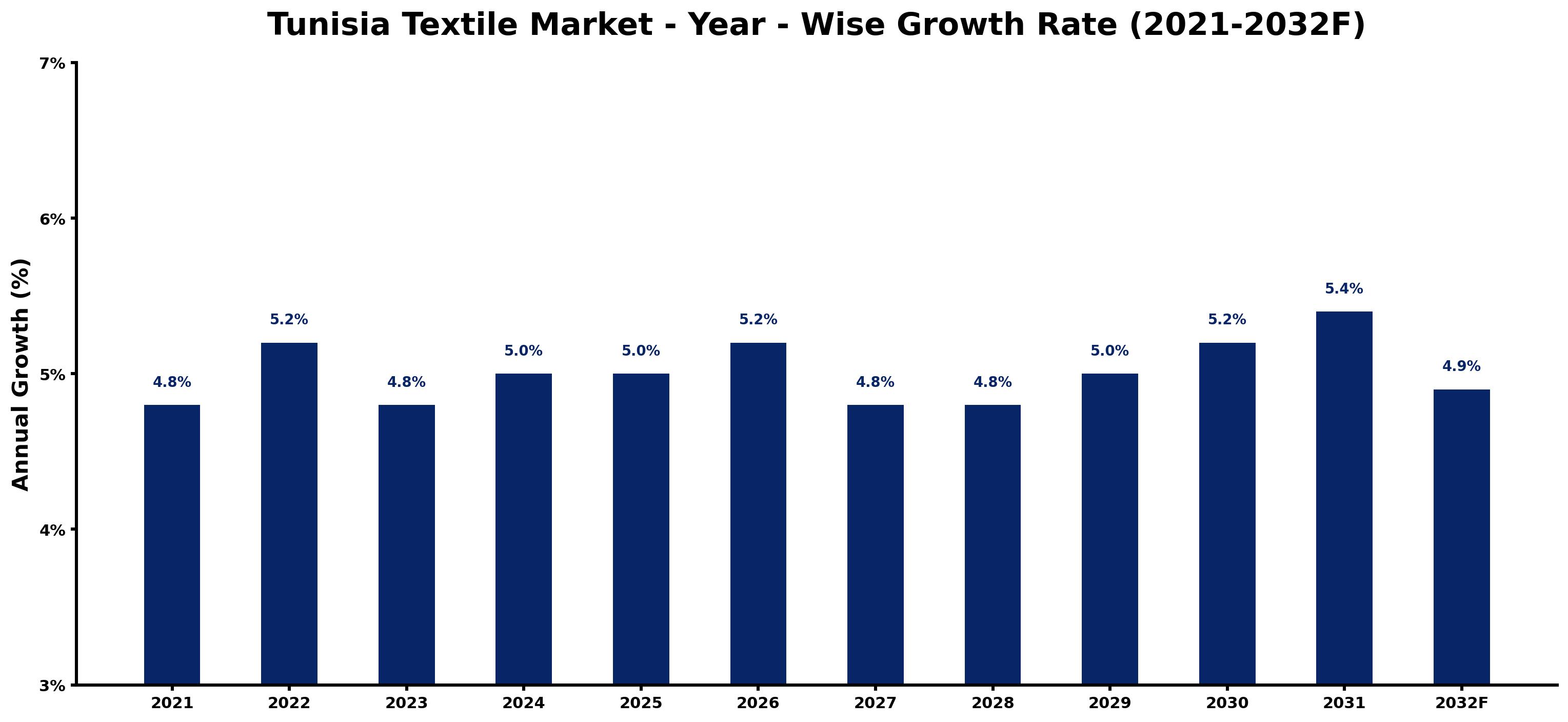
The table below presents the year wise growth rates along with the key drivers influencing the market
| Year | Growth Rate | Major Drivers |
| 2021 | 4.8% | Post-lockdown retail projects sparked renewed interest in local textile production capabilities. |
| 2022 | 5.2% | International brands explored Tunisian partnerships to leverage competitive labor costs and expertise. |
| 2023 | 4.8% | E-commerce platforms gained traction, reshaping consumer shopping habits in textile purchases. |
| 2024 | 5.0% | Sustainable practices gained momentum, prompting brands to adopt eco-friendly production methods. |
| 2025 | 5.0% | Technological advancements in textile manufacturing streamlined production processes, reducing lead times. |
| 2026 | 5.2% | Favorable trade agreements with Europe boosted Tunisian textile exports to key markets. |
| 2027 | 4.8% | Local artisans received support, fostering a revival of traditional Tunisian textile craftsmanship. |
| 2028 | 4.8% | Urbanization trends created demand for fashionable urban apparel, diversifying product lines. |
| 2029 | 5.0% | Consumer shift towards personalized products encouraged innovative designs in textile offerings. |
| 2030 | 5.2% | Textile education programs expanded, equipping the workforce with necessary skills for modern demands. |
| 2031 | 5.4% | Investment in renewable energy sources benefited textile manufacturers, lowering operational costs sustainably. |
| 2032 | 4.9% | Market consolidation among major players enhanced competitive strategies and consumer accessibility. |
Note - Market size estimations and growth projections presented in this report are based on 6Wresearch's advanced forecasting approach, validated with industry datasets as of June 2026.
Tunisia Textile Market Synopsis
The Tunisia Textile Market is projected to reach 5.2% and witness significant growth during the forecast period (2026-2032). This market is characterized by a diverse range of products that cater to both domestic and international consumers, including clothing, home textiles, and specialized technical textiles. The local textile industry thrives on the strengths of a skilled labor force and advantageous labor costs, bolstered by preferential trade agreements with crucial markets, notably the European Union. Moreover, ongoing investments aimed at modernizing production capabilities and embracing sustainable methodologies play a vital role in elevating the market's competitiveness.
Tunisia Textile Market Growth Drivers
Several factors are propelling the growth of the Tunisia Textile Market. Firstly, the increasing global demand for sustainable textiles is driving local manufacturers to adopt eco-friendly practices. Secondly, the strategic geographical positioning of Tunisia enhances its attractiveness as a textile manufacturing hub for European and African markets. Thirdly, the government's proactive approach in supporting the textile sector through incentives and infrastructure development fosters a conducive environment for investment. Additionally, advancements in technology facilitate improved production methods, while an expanding middle class within the country drives domestic consumption. Lastly, a trend towards innovative and high-quality textile offerings positions the Tunisian market favorably on the global stage.
Tunisia Textile Market Trends and Opportunities
The Tunisia Textile Market is currently witnessing significant trends that underline its potential for expansion. One of the most notable trends is the growing consumer preference for sustainable and ethically produced textiles. As environmental consciousness rises, consumers increasingly demand products fashioned from organic materials and manufactured through responsible processes. This shift has resulted in heightened interest in local textile production, as consumers aim to support domestic industries and minimize carbon footprints.
- Market players are beginning to prioritize transparency in their supply chains to cater to ethically-minded consumers.
- The demand for technical textiles is expected to rise as various sectors seek innovative solutions, creating new avenues for growth.
- Investments in eco-friendly textile manufacturing technologies are gaining traction, aligning with global sustainability goals.
- Overall design and innovation in textile products are becoming key differentiators in the increasingly competitive landscape.
- The emergence of e-commerce platforms is opening up new distribution channels, further enhancing market accessibility.
Tunisia Textile Market Challenges and Restraints
While the Tunisia Textile Market shows promise, it also faces multiple challenges that could hinder its growth trajectory. A primary concern is the intense competition from low-cost textile producers in countries such as China and Bangladesh, which puts pressure on Tunisian manufacturers to maintain competitive pricing. Furthermore, limited access to advanced technology and machinery restricts innovation and process efficiencies, impacting overall productivity.
- Political instability and economic uncertainties in the region can disrupt supply chains and overall business operations.
- The adherence to international labor and environmental standards poses an additional burden on manufacturers, potentially increasing production costs.
- The relatively slow pace of technological adoption in some segments of the industry presents a barrier to keeping up with global competitors.
- Market volatility and fluctuating material costs can affect pricing strategies and profitability for local textile firms.
- Inconsistent quality control standards may undermine Tunisian products' reputation in international markets.
Tunisia Textile Market Investment Opportunities
The investment landscape within the Tunisia Textile Market is becoming increasingly attractive for both local and foreign investors. Several factors contribute to this environment: the presence of a skilled workforce adept in traditional and modern textile production techniques, coupled with competitive labor costs, positions Tunisia as an appealing location for manufacturing. The government has also implemented policies designed to stimulate growth in the textile sector, including tax incentives and facilitation of foreign investment. Opportunities abound in various areas, including garment production, sustainable textiles, and technical fabric manufacturing.
- Investors are encouraged to explore the burgeoning sector of eco-friendly textile production, aligning with global sustainability trends.
- The government's focus on enhancing vocational training can lead to a more skilled workforce, thus improving productivity and innovation.
- Capitalizing on export opportunities to European markets can help diversify revenue streams for textile manufacturers.
- Growth in e-commerce can be leveraged to reach new customer bases, both domestically and internationally.
- Investments in technological upgrades can enhance operational efficiencies, positioning firms competitively in the global market.
Tunisia Textile Market Government Investment and Initiatives
The Tunisian government has taken significant strides to bolster the textile sector through various investment initiatives and policy frameworks. Implementation of investment incentives, such as tax breaks and subsidies for textile companies, is aimed at attracting both domestic and foreign investments. Efforts to enhance infrastructure and transportation networks are in the pipeline, which would facilitate the smooth movement of goods and materials critical to textile production.
In addition, the government is prioritizing the development of vocational training programs tailored to the textile industry, ensuring a skilled workforce equipped to meet modern production demands. Trade agreements signed with various nations further enhance market access for Tunisian textile products, providing avenues for growth. Overall, these policies, designed to stimulate market competitiveness and open up employment opportunities, reflect the government's commitment to the sustainability and expansion of the Tunisia Textile Market.
Tunisia Textile Market Latest Developments (May 2025 - June 2026)
Recent developments within the Tunisia Textile Market from May 2025 to June 2026 highlight significant shifts in industry dynamics. The push towards sustainability has gained momentum, with manufacturers increasingly incorporating eco-friendly practices and materials into their production processes. Additionally, there has been a notable increase in local collaborations aimed at innovating textile products, responding to evolving consumer preferences for quality and sustainability.
The government has also intensified its focus on policy reforms to create a more conducive environment for investments, indicating a clear commitment to enhancing the textile sector's prospects. Technological advancements are becoming more accessible, enabling local manufacturers to improve efficiency and competitiveness in the global marketplace. Furthermore, the rising prominence of e-commerce is reshaping distribution strategies, thereby expanding market reach and accessibility for Tunisian textile products.
Tunisia Textile Market - Key Attractiveness of the Report
- 10 Years of Market Numbers
- Historical Data Starting from 2022 to 2025
- Base Year: 2025
- Forecast Data until 2032
- Key Performance Indicators Impacting the Market
- Major Upcoming Developments and Projects
Key Highlights of the Report:
- Tunisia Textile Market Outlook
- Market Size of Tunisia Textile Market, 2025
- Forecast of Tunisia Textile Market, 2032F
- Historical Data and Forecast of Tunisia Textile Revenues & Volume for the Period 2022-2032F
- Tunisia Textile Market Trend Evolution
- Tunisia Textile Market Drivers and Challenges
- Tunisia Textile Price Trends
- Tunisia Textile Porter's Five Forces
- Tunisia Textile Industry Life Cycle
- Historical Data and Forecast of Tunisia Textile Market Revenues & Volume By Raw Material Types for the Period 2022-2032F
- Historical Data and Forecast of Tunisia Textile Market Revenues & Volume By Cotton for the Period 2022-2032F
- Historical Data and Forecast of Tunisia Textile Market Revenues & Volume By Chemical for the Period 2022-2032F
- Historical Data and Forecast of Tunisia Textile Market Revenues & Volume By Wool for the Period 2022-2032F
- Historical Data and Forecast of Tunisia Textile Market Revenues & Volume By Silk for the Period 2022-2032F
- Historical Data and Forecast of Tunisia Textile Market Revenues & Volume By Others for the Period 2022-2032F
- Historical Data and Forecast of Tunisia Textile Market Revenues & Volume By Product Types for the Period 2022-2032F
- Historical Data and Forecast of Tunisia Textile Market Revenues & Volume By Natural Fibers for the Period 2022-2032F
- Historical Data and Forecast of Tunisia Textile Market Revenues & Volume By Polyesters for the Period 2022-2032F
- Historical Data and Forecast of Tunisia Textile Market Revenues & Volume By Nylon for the Period 2022-2032F
- Historical Data and Forecast of Tunisia Textile Market Revenues & Volume By Others for the Period 2022-2032F
- Historical Data and Forecast of Tunisia Textile Market Revenues & Volume By Applications for the Period 2022-2032F
- Historical Data and Forecast of Tunisia Textile Market Revenues & Volume By Household for the Period 2022-2032F
- Historical Data and Forecast of Tunisia Textile Market Revenues & Volume By Technical for the Period 2022-2032F
- Historical Data and Forecast of Tunisia Textile Market Revenues & Volume By Fashion & Clothing for the Period 2022-2032F
- Historical Data and Forecast of Tunisia Textile Market Revenues & Volume By Others for the Period 2022-2032F
- Tunisia Textile Import Export Trade Statistics
- Market Opportunity Assessment By Raw Material Types
- Market Opportunity Assessment By Product Types
- Market Opportunity Assessment By Applications
- Tunisia Textile Top Companies Market Share
- Tunisia Textile Competitive Benchmarking By Technical and Operational Parameters
- Tunisia Textile Company Profiles
- Tunisia Textile Key Strategic Recommendations






































