Tunisia Tire Machinery Market Size, Share & Growth Rate
The Tunisia Tire Machinery Market was estimated at USD 528 Million in 2025 and is projected to reach USD 768 Million by 2032, growing at a CAGR of 5.5% from 2026 to 2032. This growth trajectory is being bolstered by the robust expansion of the automotive sector, which is witnessing a surge in vehicle production. Additionally, government incentives aimed at enhancing local manufacturing capabilities are playing a crucial role in attracting investments and fostering innovation within the tire machinery segment.
Tunisia Tire Machinery Market Year-wise Growth Rate and Key Drivers
This graph highlights how the Tunisia Tire Machinery Market has steadily grown over the years, supported by major growth factors.
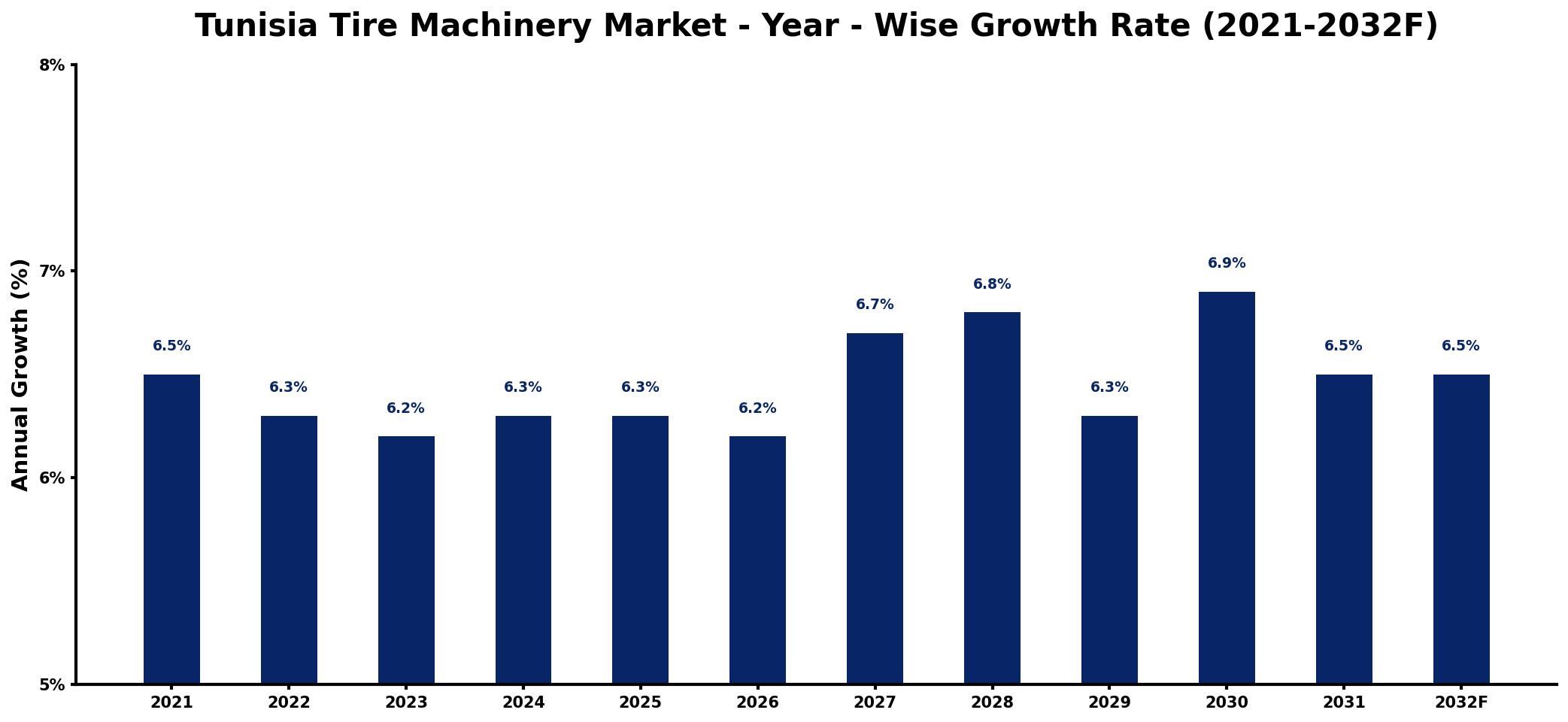
The table below presents the year‑wise growth rates along with the key drivers influencing the market
| Year | Growth Rate | Major Drivers |
| 2021 | 6.5% | Rising automotive production levels |
| 2022 | 6.3% | Increased infrastructure development projects |
| 2023 | 6.2% | Growing demand for exports |
| 2024 | 6.3% | Strengthened local manufacturing capabilities |
| 2025 | 6.3% | Expansion of logistics networks |
| 2026 | 6.2% | Boost in renewable energy investments |
| 2027 | 6.7% | Surge in automotive aftermarket services |
| 2028 | 6.8% | Diversification of industrial sectors |
| 2029 | 6.3% | Higher consumer spending trends |
| 2030 | 6.9% | Advancements in technology adoption |
| 2031 | 6.5% | Increased foreign direct investments |
| 2032 | 6.5% | Growth in e-commerce logistics |
Note: Market size estimations and growth projections presented in this report are based on 6Wresearch's proprietary forecasting methodology, utilizing the latest available industry data, government publications, and primary research inputs.
Tunisia Tire Machinery Market Synopsis
With the automotive industry continuing to flourish, the demand for efficient tire production machinery is on the rise in Tunisia. This demand is particularly evident as manufacturers seek to upgrade their machinery to improve production efficiency and meet evolving consumer preferences.
The market is characterized by a competitive landscape where innovation is key. Key players are increasingly focused on developing advanced tire machinery solutions that not only enhance production processes but also align with sustainability goals through reduced energy consumption and waste generation.
Tunisia Tire Machinery Market Key Takeaways
- The market is projected to grow steadily, driven by the automotive sector's expansion.
- Government policies are incentivizing domestic tire manufacturing.
- Innovation in automation and eco-friendly practices is reshaping production processes.
- The demand for advanced testing technologies is rising to meet quality standards.
- Investment opportunities abound for both local and foreign entities in machinery solutions.
Evaluation of Restraints in Tunisia Tire Machinery Market
The growth of the Tunisia Tire Machinery Market faces certain constraints, notably limited access to advanced technologies for small and medium enterprises. Financial limitations restrict their ability to invest in modern machinery that enhances efficiency. Inconsistent regulatory frameworks can create uncertainty, deterring potential investors and complicating operational plans. Moreover, the scarcity of a skilled workforce capable of operating sophisticated machinery poses a challenge for companies aiming to modernize their production lines. Addressing these issues through targeted investments and workforce development will be vital for unlocking the full growth potential of this market.
Tunisia Tire Machinery Market Trends
Current trends in the Tunisia Tire Machinery Market highlight a pronounced shift towards automation and digitalization, which are instrumental in elevating operational efficiency. Manufacturers are increasingly adopting smart technologies such as IoT and data analytics to facilitate predictive maintenance and optimize performance. Simultaneously, a growing emphasis on sustainability is leading to the development of machinery that adheres to eco-friendly standards, minimizing environmental impact.
Furthermore, the introduction of advanced tire testing and inspection technologies is becoming a priority, ensuring that products meet stringent quality standards and regulatory requirements. This trend reflects a broader commitment to enhancing consumer trust and product reliability.
Tunisia Tire Machinery Market Opportunities
The Tunisia tire machinery market is ripe with investment opportunities, particularly for those looking to capitalize on the booming automotive sector. There is substantial demand for advanced production machinery that enables local manufacturers to enhance efficiency and increase output. Investors could explore partnerships with local companies to introduce innovative technologies that improve tire quality and production capabilities. Additionally, offering maintenance and repair services for tire machinery presents a lucrative business avenue, fostering long-term relationships within the market.
Government Initiatives in the Tunisia Tire Machinery Market
The Tunisian government has implemented several initiatives designed to stimulate growth in the tire machinery market. These include providing incentives such as tax breaks and subsidies for companies establishing manufacturing facilities. Regulatory frameworks are being enhanced to ensure compliance with quality and environmental standards, fostering a competitive landscape. Additionally, public spending on research and development in the tire manufacturing sector is encouraging technological advancements, positioning Tunisia as a favorable destination for both local and international investments.
Future Insights of the Tunisia Tire Machinery Market
Looking ahead, the Tunisia Tire Machinery Market is poised for sustained growth through 2032. Continuous investments in the automotive industry, combined with advancements in manufacturing technologies, are expected to drive demand for efficient tire production machinery. Government support for local manufacturing and initiatives aimed at enhancing export capabilities will further contribute to market expansion. However, companies must remain vigilant regarding potential challenges, such as volatile raw material prices and competition from established international players. By adopting forward-thinking strategies, stakeholders can navigate these dynamics effectively.
Tunisia Tire Machinery Market Latest Developments (2025 - 2026)
Recent developments in the Tunisia Tire Machinery Market indicate a growing inclination towards the integration of smart technologies. Manufacturers are increasingly focusing on digital solutions that enhance operational efficiency and reduce costs. Additionally, there has been a marked rise in collaborative efforts among industry stakeholders aimed at advancing sustainability practices. Companies are exploring partnerships to harness technological innovations that align with environmental goals while meeting the burgeoning demand for high-quality tires.
Tunisia Tire Machinery Market - Key Attractiveness of the Report
- 10 Years of Market Numbers
- Historical Data Starting from 2022 to 2025
- Base Year: 2025
- Forecast Data until 2032
- Key Performance Indicators Impacting the Market
- Major Upcoming Developments and Projects
Key Highlights of the Report:
- Tunisia Tire Machinery Market Outlook
- Market Size of Tunisia Tire Machinery Market, 2025
- Forecast of Tunisia Tire Machinery Market, 2032
- Historical Data and Forecast of Tunisia Tire Machinery Revenues & Volume for the Period 2022-2032F
- Tunisia Tire Machinery Market Trend Evolution
- Tunisia Tire Machinery Market Drivers and Challenges
- Tunisia Tire Machinery Price Trends
- Tunisia Tire Machinery Porter's Five Forces
- Tunisia Tire Machinery Industry Life Cycle
- Historical Data and Forecast of Tunisia Tire Machinery Market Revenues & Volume By Type for the Period 2022-2032F
- Historical Data and Forecast of Tunisia Tire Machinery Market Revenues & Volume By Mixing Machine/ Rubber Mixers for the Period 2022-2032F
- Historical Data and Forecast of Tunisia Tire Machinery Market Revenues & Volume By Calendaring Machine for the Period 2022-2032F
- Historical Data and Forecast of Tunisia Tire Machinery Market Revenues & Volume By Extrusion Machines for the Period 2022-2032F
- Historical Data and Forecast of Tunisia Tire Machinery Market Revenues & Volume By Multi Extrusion Lines for the Period 2022-2032F
- Historical Data and Forecast of Tunisia Tire Machinery Market Revenues & Volume By Inner Liner Lines for the Period 2022-2032F
- Historical Data and Forecast of Tunisia Tire Machinery Market Revenues & Volume By Extruders for the Period 2022-2032F
- Historical Data and Forecast of Tunisia Tire Machinery Market Revenues & Volume By Cooling Units for the Period 2022-2032F
- Historical Data and Forecast of Tunisia Mixing Machine/ Rubber Mixers Tire Machinery Market Revenues & Volume By Cutting Machines for the Period 2022-2032F
- Historical Data and Forecast of Tunisia Tire Machinery Market Revenues & Volume By Tire Type for the Period 2022-2032F
- Historical Data and Forecast of Tunisia Tire Machinery Market Revenues & Volume By Radial Tire for the Period 2022-2032F
- Historical Data and Forecast of Tunisia Tire Machinery Market Revenues & Volume By Bias Tire for the Period 2022-2032F
- Historical Data and Forecast of Tunisia Tire Machinery Market Revenues & Volume By Application for the Period 2022-2032F
- Historical Data and Forecast of Tunisia Tire Machinery Market Revenues & Volume By Two-wheeler tires for the Period 2022-2032F
- Historical Data and Forecast of Tunisia Tire Machinery Market Revenues & Volume By Passenger Vehicle Tires for the Period 2022-2032F
- Historical Data and Forecast of Tunisia Tire Machinery Market Revenues & Volume By Hatchback for the Period 2022-2032F
- Historical Data and Forecast of Tunisia Tire Machinery Market Revenues & Volume By Sedan for the Period 2022-2032F
- Historical Data and Forecast of Tunisia Tire Machinery Market Revenues & Volume By Utility Vehicles for the Period 2022-2032F
- Historical Data and Forecast of Tunisia Tire Machinery Market Revenues & Volume By Light Commercial Vehicle Tires for the Period 2022-2032F
- Historical Data and Forecast of Tunisia Tire Machinery Market Revenues & Volume By Medium & Heavy Commercial Vehicle Tires for the Period 2022-2032F
- Historical Data and Forecast of Tunisia Tire Machinery Market Revenues & Volume By Off-road Vehicle Tires for the Period 2022-2032F
- Tunisia Tire Machinery Import Export Trade Statistics
- Market Opportunity Assessment By Type
- Market Opportunity Assessment By Tire Type
- Market Opportunity Assessment By Application
- Tunisia Tire Machinery Top Companies Market Share
- Tunisia Tire Machinery Competitive Benchmarking By Technical and Operational Parameters
- Tunisia Tire Machinery Company Profiles
- Tunisia Tire Machinery Key Strategic Recommendations






































