Tunisia Urea Market Size, Share & Growth Rate
The Tunisia Urea Market was estimated at USD 243 Million in 2025 and is projected to reach USD 318 Million by 2032, growing at a CAGR of 3.9% from 2026 to 2032. This growth trajectory is primarily attributed to the increasing demand for nitrogen fertilizers in the agricultural sector, vital for enhancing crop yields and ensuring food security. Moreover, government support and subsidies aimed at bolstering agricultural productivity further encourage the adoption of urea in various applications.
Tunisia Urea Market Growth Rate Analysis (2021-2032)
The Tunisia urea market has shown a stable growth pattern, with notable yearly increases in demand. Starting with 4.5% in 2021, growth peaked at 4.9% in 2022, driven by rising agricultural activities and an increasing need for fertilizers to enhance crop yields. The market maintained a commendable 4.5% growth in 2023 and is projected to capture 4.8% in 2024, facilitated by investments in agricultural technology and infrastructure. Despite a slight dip to 4.3% in 2025, the market is expected to rebound with consistent investments and a growing focus on sustainable farming practices, averaging about 4.7% through 2027. By 2032, demand will likely sustain around 4.6% as consumer preferences shift towards eco-friendly solutions in agriculture.
Tunisia Urea Market Year-wise Growth Rate and Key Drivers
This graph highlights how the Tunisia Urea Market has steadily grown over the past five years, supported by major growth factors.
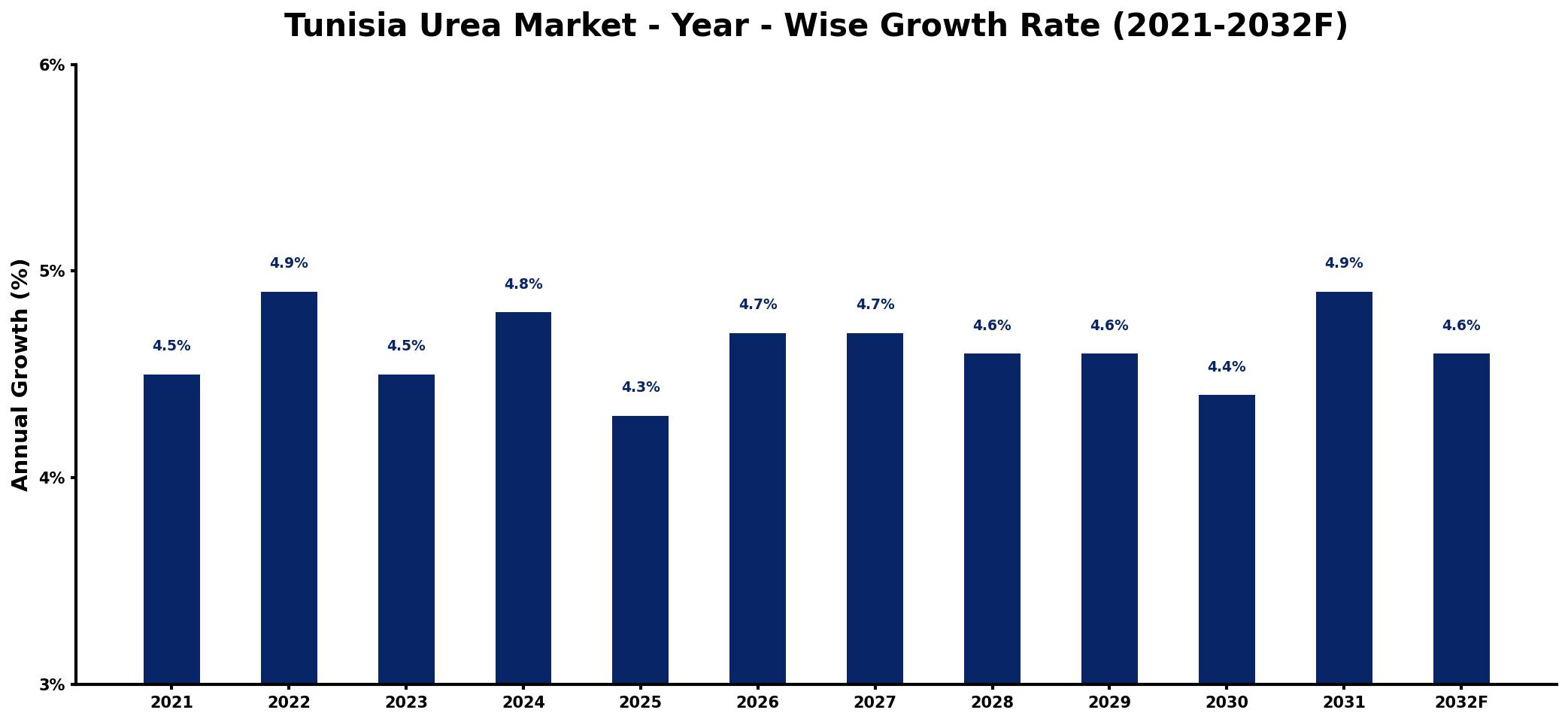
The table below presents the year‑wise growth rates along with the key drivers influencing the market
| Year | Growth Rate | Major Drivers |
| 2021 | 4.5% | Rising agricultural production demands |
| 2022 | 4.9% | Increased fertilizer application rates |
| 2023 | 4.5% | Expansion of irrigation projects |
| 2024 | 4.8% | Growing export market opportunities |
| 2025 | 4.3% | Investment in agricultural technology |
| 2026 | 4.7% | Enhanced crop yield expectations |
| 2027 | 4.7% | Strengthened agricultural policy support |
| 2028 | 4.6% | Rising global food security concerns |
| 2029 | 4.6% | Advancements in sustainable farming |
| 2030 | 4.4% | Diverse crop rotation practices emerging |
| 2031 | 4.9% | Boosted domestic consumption trends |
| 2032 | 4.6% | Innovations in nutrient management strategies |
Note: Market size estimations and growth projections presented in this report are based on 6Wresearch's proprietary forecasting methodology, utilizing the latest available industry data, government publications, and primary research inputs.
Tunisia Urea Market Synopsis
The Tunisian agricultural landscape is undergoing a transformation, with urea emerging as a crucial input to improve soil fertility and support the cultivation of high-yield crops. The reliance on urea reflects the broader trend of intensifying agricultural practices to meet the food demands of a growing population.
Despite its benefits, the urea market in Tunisia is not without challenges. The countrys heavy dependency on imported natural gas, a key raw material for urea production, exposes the market to global supply chain vulnerabilities. Additionally, concerns regarding the environmental impacts of nitrogen fertilizer usage have sparked discussions on sustainable agricultural practices.
Tunisia Urea Market Key Takeaways
- The urea market is integral to Tunisia's agricultural productivity and food security.
- Government policies and subsidies are pivotal in driving urea consumption among local farmers.
- Environmental concerns around nitrogen fertilizers are prompting a push for more sustainable practices.
- Global price volatility and import dependencies pose significant risks to market stability.
- The industrial use of urea is emerging as a supplementary growth driver, expanding its application beyond agriculture.
Evaluation of Restraints in Tunisia Urea Market
The Tunisia urea market grapples with several constraints that impede its potential growth. A primary concern is the reliance on imported natural gas, which serves as a critical input for urea production. This dependency makes the market susceptible to fluctuations in global energy prices and geopolitical tensions. Additionally, the volatility of urea prices on the international market creates uncertainty for local producers and consumers alike. Furthermore, the increasing environmental scrutiny surrounding nitrogen fertilizers poses regulatory risks that could limit their usage in the agricultural sector.
Tunisia Urea Market Trends
Several trends are shaping the Tunisia urea market. The integration of precision agriculture techniques is gaining traction among farmers, allowing for optimized fertilizer application and improved yield outcomes. Additionally, the increasing focus on sustainable agricultural practices is driving research into alternative nitrogen sources and formulations that mitigate environmental impacts. The adoption of urea in industrial applications, including plastics production, is also creating a diversification of demand beyond traditional agricultural use.
Tunisia Urea Market Opportunities
Opportunities for growth in the Tunisia urea market are robust, particularly with the increasing emphasis on high-yield crop varieties driven by both domestic and export demand. Investments in urea production facilities and efficient distribution channels could enhance local supply security, reducing reliance on imports. Furthermore, fostering innovation in sustainable urea products could capture a growing segment of environmentally-conscious consumers and farmers, aligning with global trends in sustainable agriculture.
Government Initiatives in the Tunisia Urea Market
The Tunisian government actively supports the urea market through various initiatives aimed at ensuring stable fertilizer supplies for the agricultural sector. Policies include providing financial subsidies to farmers for urea purchases and promoting educational programs focused on efficient fertilization techniques. These efforts aim to enhance agricultural productivity while simultaneously addressing environmental concerns related to nitrogen fertilizer use.
Future Insights of the Tunisia Urea Market
Looking ahead to 2026-2032, the Tunisia urea market is poised for gradual expansion fueled by ongoing agricultural development and supportive government policies. The potential for technological advancements in fertilizer application methods and the push for sustainability will likely reshape the landscape, offering new pathways for growth. However, addressing supply chain vulnerabilities and environmental challenges will be crucial for long-term stability and market confidence.
Tunisia Urea Market Latest Developments (2025 - 2026)
Recent developments within the Tunisia urea market have focused on enhancing local production capabilities to mitigate dependency on imports. Innovations in fertilizer formulation aimed at reducing environmental impacts have emerged, alongside efforts to educate farmers on sustainable practices. Additionally, discussions around new regulatory frameworks are gaining momentum, targeting the balance between agricultural needs and environmental stewardship.
Tunisia Urea Market - Key Attractiveness of the Report
- 10 Years of Market Numbers
- Historical Data Starting from 2022 to 2025
- Base Year: 2025
- Forecast Data until 2032
- Key Performance Indicators Impacting the Market
- Major Upcoming Developments and Projects
Key Highlights of the Report:
- Tunisia Urea Market Outlook
- Market Size of Tunisia Urea Market, 2025
- Forecast of Tunisia Urea Market, 2032
- Historical Data and Forecast of Tunisia Urea Revenues & Volume for the Period 2022-2032F
- Tunisia Urea Market Trend Evolution
- Tunisia Urea Market Drivers and Challenges
- Tunisia Urea Price Trends
- Tunisia Urea Porter's Five Forces
- Tunisia Urea Industry Life Cycle
- Historical Data and Forecast of Tunisia Urea Market Revenues & Volume By Grade for the Period 2022-2032F
- Historical Data and Forecast of Tunisia Urea Market Revenues & Volume By Fertilizer for the Period 2022-2032F
- Historical Data and Forecast of Tunisia Urea Market Revenues & Volume By Feed for the Period 2022-2032F
- Historical Data and Forecast of Tunisia Urea Market Revenues & Volume By Technical for the Period 2022-2032F
- Historical Data and Forecast of Tunisia Urea Market Revenues & Volume By End-user Industry for the Period 2022-2032F
- Historical Data and Forecast of Tunisia Urea Market Revenues & Volume By Agriculture for the Period 2022-2032F
- Historical Data and Forecast of Tunisia Urea Market Revenues & Volume By Chemical for the Period 2022-2032F
- Historical Data and Forecast of Tunisia Urea Market Revenues & Volume By Automotive for the Period 2022-2032F
- Historical Data and Forecast of Tunisia Urea Market Revenues & Volume By Medical for the Period 2022-2032F
- Historical Data and Forecast of Tunisia Urea Market Revenues & Volume By Others for the Period 2022-2032F
- Tunisia Urea Import Export Trade Statistics
- Market Opportunity Assessment By Grade
- Market Opportunity Assessment By End-user Industry
- Tunisia Urea Top Companies Market Share
- Tunisia Urea Competitive Benchmarking By Technical and Operational Parameters
- Tunisia Urea Company Profiles
- Tunisia Urea Key Strategic Recommendations






































