Tunisia Whiskey Market Size, Share & Growth Rate
The Tunisia Whiskey Market was estimated at USD 1419 Million in 2025 and is projected to reach USD 2050 Million by 2032, growing at a CAGR of 5.4% from 2026 to 2032. This growth is largely propelled by an evolving consumer base that is increasingly drawn to premium imported whiskey options. Additionally, rising disposable incomes and a burgeoning hospitality sector are creating favorable conditions for whiskey consumption across various establishments in Tunisia.
Tunisia Whiskey Market Growth Rate Analysis (2021-2032)
The Tunisia whiskey market has exhibited steady growth over recent years, with rates of 6.2% in 2021 and consistently increasing to 6.5% in 2023. This growth can largely be attributed to rising consumer demand driven by a younger demographic increasingly embracing whiskey culture. While growth slightly stabilized at 6.4% in 2024, it rebounded to 6.7% in 2030, likely bolstered by innovative marketing strategies and an influx of investments from both domestic and international distillers. However, modest declines in subsequent years, such as 6.1% in 2032, reflect shifting preferences towards other spirits and the need for improved distribution infrastructure. Overall, the market remains stable and poised for future opportunities, particularly with advancements in technology and digital engagement enhancing consumer experiences.
Tunisia Whiskey Market Year-wise Growth Rate and Key Drivers
This graph highlights how the Tunisia Whiskey Market has steadily grown over the past five years, supported by major growth factors.
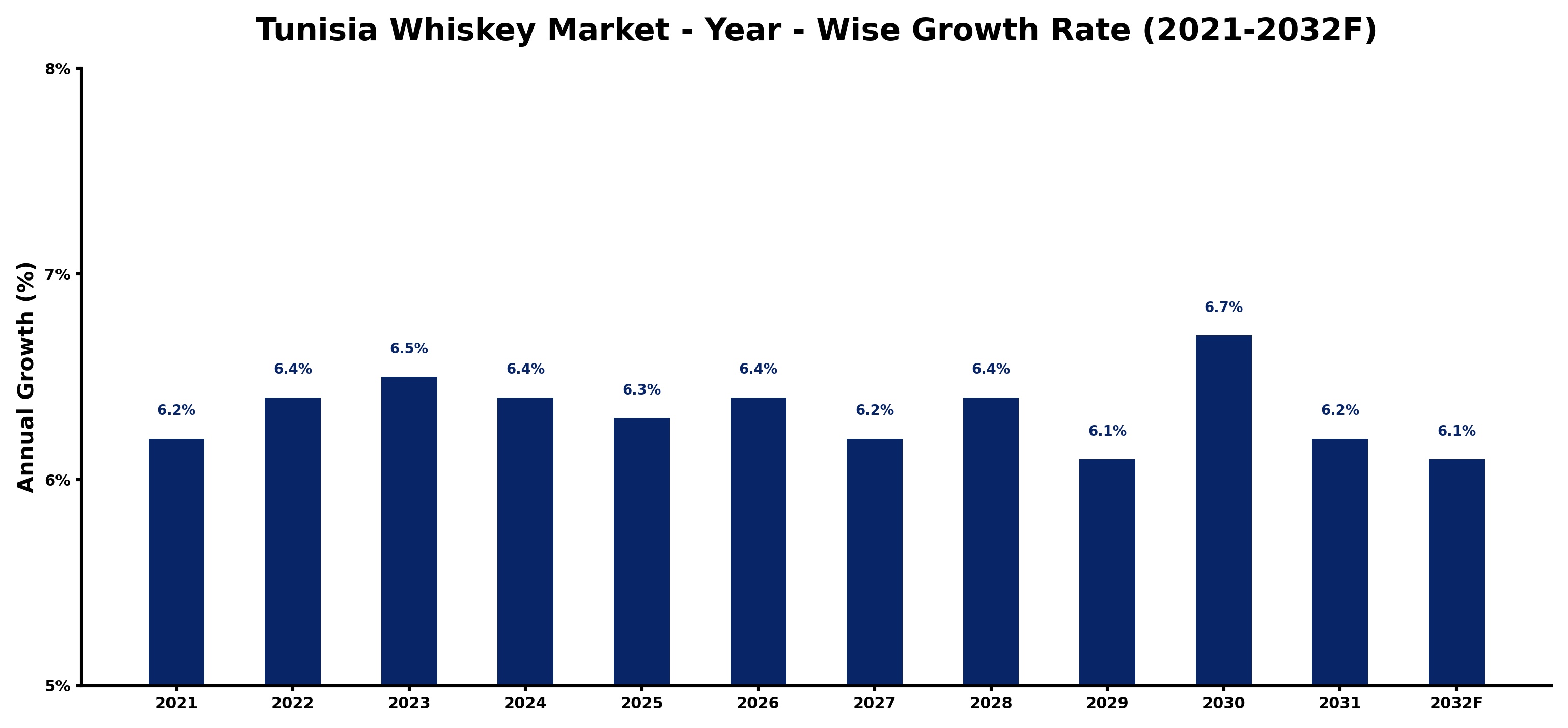
The table below presents the year‑wise growth rates along with the key drivers influencing the market
| Year | Growth Rate | Major Drivers |
| 2021 | 6.2% | Increased consumer interest in whiskey |
| 2022 | 6.4% | Growing tourism boosted whiskey sales |
| 2023 | 6.5% | New brands entered the market |
| 2024 | 6.4% | Whiskey festivals attracted enthusiasts |
| 2025 | 6.3% | Social media marketing expanded reach |
| 2026 | 6.4% | Craft distilleries gained popularity |
| 2027 | 6.2% | Whiskey tasting events increased demand |
| 2028 | 6.4% | Collaborations with local businesses emerged |
| 2029 | 6.1% | Innovative packaging attracted consumers |
| 2030 | 6.7% | Export opportunities expanded significantly |
| 2031 | 6.2% | Whiskey education programs flourished |
| 2032 | 6.1% | Sustainable practices enhanced brand loyalty |
Note - Market size estimations and growth projections presented in this report are based on 6Wresearch’s advanced forecasting approach, validated with industry datasets as of June 2026.
Tunisia Whiskey Market Synopsis
The market for whiskey in Tunisia is primarily characterized by the dominance of imported brands, reflecting a strong consumer inclination towards high-quality spirits. With more tourists visiting Tunisia, bars and hotels are now prioritizing premium whiskey offerings to cater to the changing preferences of both local and international consumers.
Despite the overall growth trajectory, the whiskey market faces unique challenges tied to cultural perceptions and regulatory hurdles. The traditional preferences for local alcoholic beverages present a significant barrier, necessitating tailored marketing strategies to convert this audience to whiskey consumption.
Tunisia Whiskey Market Key Takeaways
- The market is shifting towards premium and imported whiskey products, reflecting changing consumer preferences.
- Rising disposable incomes and evolving lifestyles are critical drivers of market expansion.
- Tourism and the hospitality industry are becoming significant contributors to whiskey consumption.
- Regulatory hurdles and cultural preferences pose challenges that whiskey brands must navigate to thrive.
- Innovative marketing strategies are essential for attracting diverse consumer segments in Tunisia.
Evaluation of Restraints in Tunisia Whiskey Market
The growth of the Tunisia whiskey market is hindered by several key factors. Stringent import regulations and high taxation on alcoholic beverages restrict product availability and make pricing less competitive. Additionally, cultural preferences lean heavily toward traditional local drinks, making it challenging for whiskey brands to penetrate the market effectively. Economic fluctuations further complicate the landscape, impacting disposable incomes and consumer spending on premium products.
Tunisia Whiskey Market Trends
The whiskey market in Tunisia is experiencing a notable trend towards the introduction of unique flavors and artisanal production methods. This trend is capturing the attention of consumers who seek novel tasting experiences. Furthermore, digital marketing strategies are becoming increasingly vital in reaching younger demographics, who are more open to experimenting with premium spirits compared to traditional consumers.
Tunisia Whiskey Market Opportunities
Growth opportunities are abundant in the Tunisia whiskey market, particularly in the realm of tourism-driven sales. Expanding distribution channels through bars and high-end retail could enhance visibility and accessibility for premium brands. Additionally, the introduction of local whiskey production could tap into national pride while catering to domestic and tourist markets seeking unique offerings.
Government Initiatives in the Tunisia Whiskey Market
Government policies surrounding the whiskey market are centered on import regulations and taxation structures aimed at regulating the alcohol industry. Local authorities, under the auspices of the Ministry of Commerce, enforce licensing requirements that can complicate market entry for international brands. Understanding these regulations is crucial for brands looking to navigate the complexities of the Tunisian market effectively.
Future Insights of the Tunisia Whiskey Market
As we look toward 2026-2032, the Tunisia whiskey market is poised for significant growth driven by changing consumer preferences and an expanding middle class. The rise of the hospitality sector, coupled with increasing tourism, will likely foster an environment conducive to whiskey consumption. Brands that adapt their offerings to align with local tastes while providing premium quality will likely capitalize on the growing demand.
Tunisia Whiskey Market Latest Developments (May 2025 - June 2026)
Recent developments in the Tunisia whiskey market indicate a surge in new product launches, particularly those emphasizing unique flavors and local heritage. Innovative marketing campaigns are being employed to educate consumers about whiskey varieties, thereby enhancing brand loyalty. Furthermore, the regulatory environment is being monitored closely for potential reforms that could improve market accessibility for foreign brands.
Tunisia Whiskey Market - Key Attractiveness of the Report
- 10 Years of Market Numbers
- Historical Data Starting from 2022 to 2025
- Base Year: 2025
- Forecast Data until 2032
- Key Performance Indicators Impacting the Market
- Major Upcoming Developments and Projects
Key Highlights of the Report:
- Tunisia Whiskey Market Outlook
- Market Size of Tunisia Whiskey Market, 2025
- Forecast of Tunisia Whiskey Market, 2032
- Historical Data and Forecast of Tunisia Whiskey Revenues & Volume for the Period 2022-2032F
- Tunisia Whiskey Market Trend Evolution
- Tunisia Whiskey Market Drivers and Challenges
- Tunisia Whiskey Price Trends
- Tunisia Whiskey Porter's Five Forces
- Tunisia Whiskey Industry Life Cycle
- Historical Data and Forecast of Tunisia Whiskey Market Revenues & Volume By Product Type for the Period 2022-2032F
- Historical Data and Forecast of Tunisia Whiskey Market Revenues & Volume By American Whisky for the Period 2022-2032F
- Historical Data and Forecast of Tunisia Whiskey Market Revenues & Volume By Irish Whisky for the Period 2022-2032F
- Historical Data and Forecast of Tunisia Whiskey Market Revenues & Volume By Scotch Whisky for the Period 2022-2032F
- Historical Data and Forecast of Tunisia Whiskey Market Revenues & Volume By Canadian Whisky for the Period 2022-2032F
- Historical Data and Forecast of Tunisia Whiskey Market Revenues & Volume By Others for the Period 2022-2032F
- Historical Data and Forecast of Tunisia Whiskey Market Revenues & Volume By Distribution Channel for the Period 2022-2032F
- Historical Data and Forecast of Tunisia Whiskey Market Revenues & Volume By On-trade for the Period 2022-2032F
- Historical Data and Forecast of Tunisia Whiskey Market Revenues & Volume By Off-trade for the Period 2022-2032F
- Tunisia Whiskey Import Export Trade Statistics
- Market Opportunity Assessment By Product Type
- Market Opportunity Assessment By Distribution Channel
- Tunisia Whiskey Top Companies Market Share
- Tunisia Whiskey Competitive Benchmarking By Technical and Operational Parameters
- Tunisia Whiskey Company Profiles
- Tunisia Whiskey Key Strategic Recommendations






































