Tunisia Winding Wire Market Size, Share & Growth Rate
The Tunisia Winding Wire Market was estimated at USD 1467 Million in 2025 and is projected to reach USD 2099 Million by 2032, growing at a CAGR of 5.3% from 2026 to 2032. This anticipated growth trajectory is primarily driven by robust demand from key sectors such as automotive, electronics, and telecommunications, all of which are integral to Tunisia's expanding industrial landscape. Furthermore, initiatives focused on renewable energy are further enhancing the need for high-quality winding wires, positioning the market for sustained growth.
Tunisia Winding Wire Market Growth Rate Analysis (2021-2032)
The Tunisia winding wire market has been experiencing steady growth, with annual increases hovering around 6% from 2021 through to 2023. Initially, a growth rate of 6.3% in 2021 was primarily driven by rising demand from the renewable energy sector, particularly in solar energy applications. This was followed by growth rates of 6.2% in both 2022 and 2023, indicative of stable consumer demand and ongoing investments in infrastructure. However, projections suggest slight fluctuations moving forward, with a dip to 6.0% in 2024. This moderation reflects a temporary easing as manufacturers adjust to evolving technology and increased competition. Additionally, growth is expected to rebound to 6.4% in 2026, fueled by advancements in digitalization and a robust industrial framework.
Tunisia Winding Wire Market Year-wise Growth Rate and Key Drivers
This graph highlights how the Tunisia Winding Wire Market has steadily grown over the past five years, supported by major growth factors.
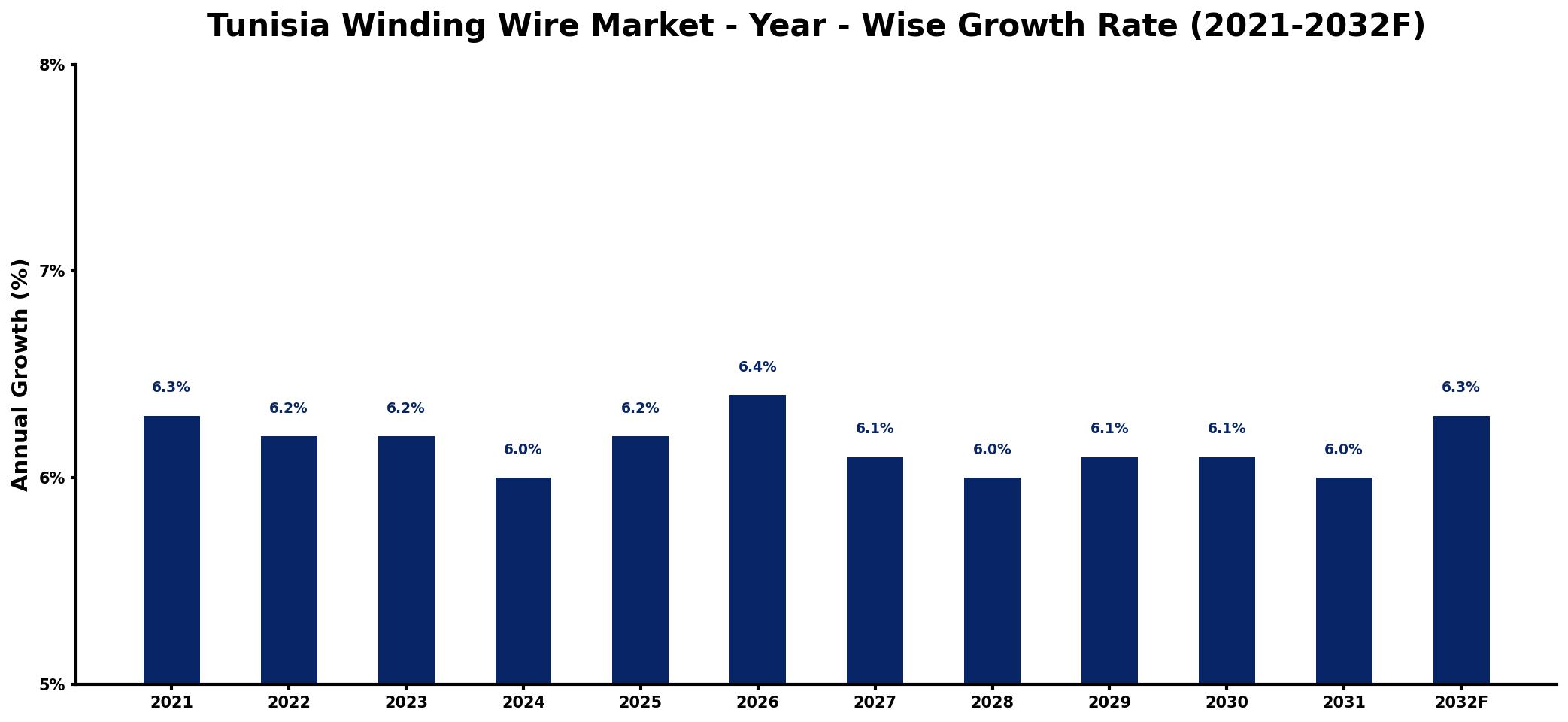
The table below presents the year‑wise growth rates along with the key drivers influencing the market
| Year | Growth Rate | Major Drivers |
| 2021 | 6.3% | Rising demand from construction sector |
| 2022 | 6.2% | Increased investments in renewable energy |
| 2023 | 6.2% | Growth in automotive manufacturing sector |
| 2024 | 6.0% | Expansion of electronics production facilities |
| 2025 | 6.2% | Uptrend in telecommunications infrastructure |
| 2026 | 6.4% | Boost in local manufacturing capabilities |
| 2027 | 6.1% | Surge in residential construction projects |
| 2028 | 6.0% | enhanced product quality standards |
| 2029 | 6.1% | Increased government infrastructure spending |
| 2030 | 6.1% | stronger distribution network expansion |
| 2031 | 6.0% | growing downstream application demand |
| 2032 | 6.3% | expanding manufacturing base activity |
Note: Market size estimations and growth projections presented in this report are based on 6Wresearch's proprietary forecasting methodology, utilizing the latest available industry data, government publications, and primary research inputs.
Tunisia Winding Wire Market Synopsis
Currently, the Tunisia winding wire market is characterized by a blend of local manufacturers and international players, creating a dynamic competitive landscape. This market is crucial for applications in electrical motors, transformers, and generators, which are essential components across various industries.
Moreover, the shift towards energy-efficient and sustainable materials is shaping the future of winding wire production. As businesses strive to meet regulatory standards and consumer demand for eco-friendly products, manufacturers are increasingly investing in innovative technologies and high-quality materials.
Tunisia Winding Wire Market Key Takeaways
- Increasing industrialization and infrastructure development drive demand for winding wires.
- Technological advancements are enhancing the performance and efficiency of winding wire products.
- Government initiatives to promote renewable energy are creating new market opportunities.
- Both domestic and international players are vying for market share, fostering competitive innovation.
- Sustainability and environmental considerations are becoming central to product development.
Evaluation of Restraints in Tunisia Winding Wire Market
Despite the positive outlook for the Tunisia winding wire market, several real restraints impede its growth. Intense competition from both domestic and international manufacturers creates pricing pressures that challenge profitability. Additionally, fluctuations in raw material prices complicate production cost management, potentially affecting supply chain stability. Compliance with rigorous regulatory standards adds another layer of complexity for manufacturers, who must ensure their products meet quality and safety benchmarks. The economic environment, marked by currency fluctuations, further contributes to market unpredictability, necessitating agile business strategies to navigate these challenges.
Tunisia Winding Wire Market Trends
A notable trend in the Tunisia winding wire market is the increasing preference for high-quality, energy-efficient products. Manufacturers are focusing on developing specialty wires that offer enhanced thermal and electrical properties to better serve industries reliant on advanced electrical components. Additionally, there is a growing emphasis on sustainable production practices, with eco-friendly materials gaining traction among consumers and businesses alike. Research and development investments are critical as they pave the way for innovative solutions that cater to evolving market needs.
Tunisia Winding Wire Market Opportunities
The Tunisia winding wire market presents numerous investment opportunities for stakeholders aiming to tap into the growing demand for electrical products. Opportunities lie in manufacturing high-quality winding wires tailored to specific industrial applications, particularly in automotive and energy sectors. Investors can also benefit from collaborating with local businesses to expand distribution networks, enhancing market access. Furthermore, initiatives centered around research and development will be pivotal, allowing companies to introduce cutting-edge technologies and materials, thereby carving a competitive edge in this burgeoning market.
Government Initiatives in the Tunisia Winding Wire Market
The Tunisian government actively supports the winding wire market through various policies aimed at fostering industry growth and sustainability. These include stringent quality control standards to ensure the reliability of products used in critical electrical applications. Import and export regulations are in place to manage market dynamics, while incentives such as tax breaks and subsidies are designed to bolster local manufacturing efforts. Additionally, environmental regulations promote responsible production practices, ensuring that the winding wire sector aligns with broader sustainability goals.
Future Insights of the Tunisia Winding Wire Market
Looking ahead to 2026-2032, the Tunisia winding wire market is poised for significant expansion, driven by the countrys advancing industrialization and infrastructure projects. The automotive and electronics sectors are expected to remain at the forefront of demand, with the renewable energy sector further propelling the need for efficient winding wire solutions. Technological advancements and innovations in sustainable practices will be key differentiators for manufacturers, allowing them to respond effectively to market demands while contributing to overall energy efficiency and environmental stewardship.
Tunisia Winding Wire Market Latest Developments (2025 - 2026)
Recent developments in the Tunisia winding wire market highlight a growing trend towards innovation, with companies increasingly adopting advanced manufacturing technologies. The focus on developing eco-friendly materials is becoming more pronounced, aligning with global sustainability movements. Collaborations between manufacturers and research institutions are gaining momentum, facilitating the introduction of novel winding wire products designed to meet stringent industry standards. Overall, the market landscape is evolving rapidly, with players keen on capitalizing on emerging opportunities and adapting to shifting consumer preferences.
Tunisia Winding Wire Market - Key Attractiveness of the Report
- 10 Years of Market Numbers
- Historical Data Starting from 2022 to 2025
- Base Year: 2025
- Forecast Data until 2032
- Key Performance Indicators Impacting the Market
- Major Upcoming Developments and Projects
Key Highlights of the Report:
- Tunisia Winding Wire Market Outlook
- Market Size of Tunisia Winding Wire Market, 2025
- Forecast of Tunisia Winding Wire Market, 2032
- Historical Data and Forecast of Tunisia Winding Wire Revenues & Volume for the Period 2022-2032F
- Tunisia Winding Wire Market Trend Evolution
- Tunisia Winding Wire Market Drivers and Challenges
- Tunisia Winding Wire Price Trends
- Tunisia Winding Wire Porter's Five Forces
- Tunisia Winding Wire Industry Life Cycle
- Historical Data and Forecast of Tunisia Winding Wire Market Revenues & Volume By Product for the Period 2022-2032F
- Historical Data and Forecast of Tunisia Winding Wire Market Revenues & Volume By Copper Winding Wire for the Period 2022-2032F
- Historical Data and Forecast of Tunisia Winding Wire Market Revenues & Volume By Aluminum Winding Wire for the Period 2022-2032F
- Tunisia Winding Wire Import Export Trade Statistics
- Market Opportunity Assessment By Product
- Tunisia Winding Wire Top Companies Market Share
- Tunisia Winding Wire Competitive Benchmarking By Technical and Operational Parameters
- Tunisia Winding Wire Company Profiles
- Tunisia Winding Wire Key Strategic Recommendations






































