Tunisia Workplace Safety Market Size & Growth Rate (2026-2032)
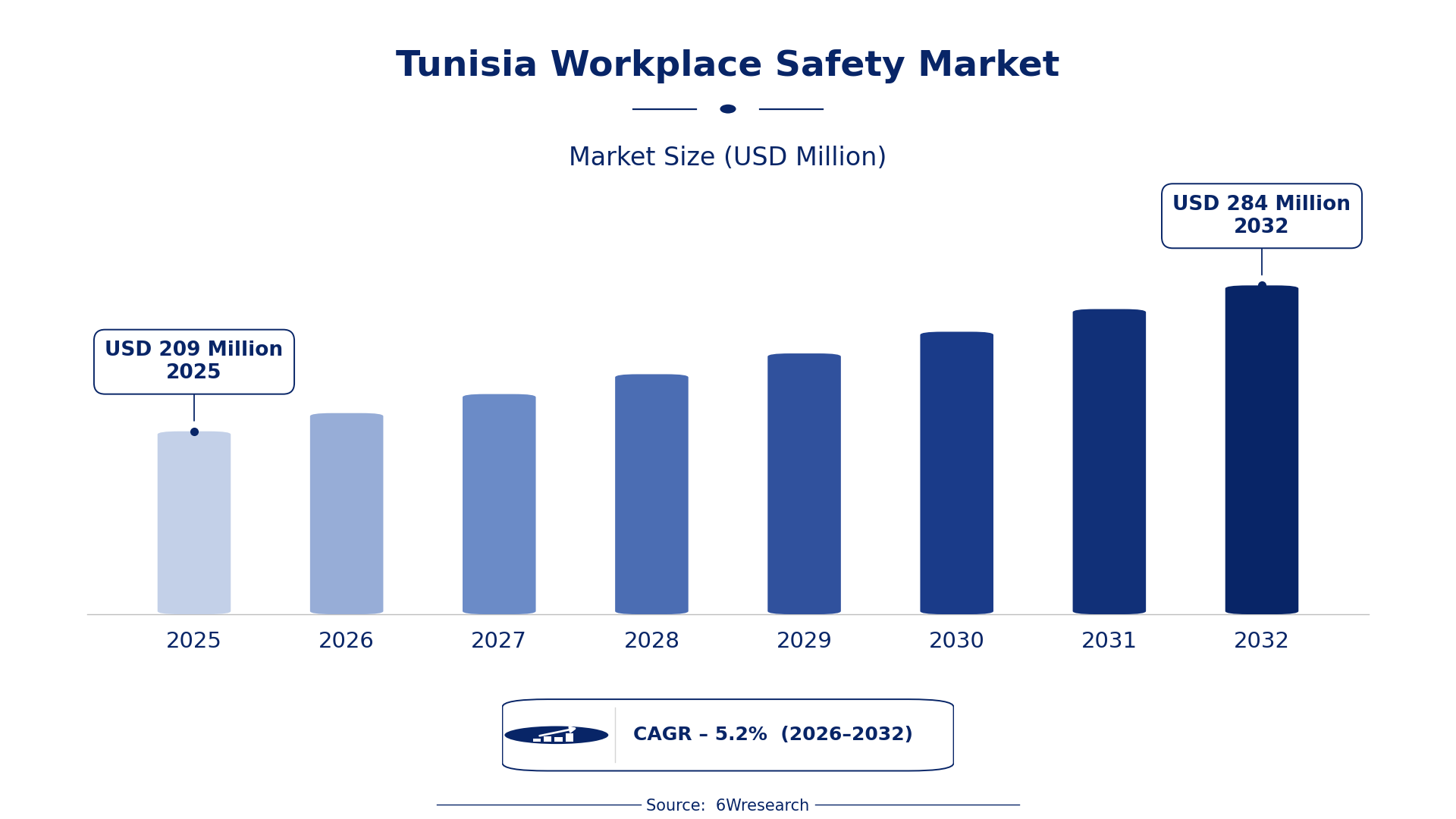
The Tunisia Workplace Safety Market was estimated at USD 209 Million in 2025 and is projected to reach USD 284 Million by 2032, growing at a CAGR of 5.2% from 2026 to 2032.
Tunisia Workplace Safety Market Synopsis
In Tunisia, workplace safety is gaining traction as a vital concern for both employers and employees. Organizations across various industries are recognizing the necessity of fostering safe working environments, driven by an increase in regulatory scrutiny and public awareness around occupational health. This dynamic is shaping the Tunisia Workplace Safety Market into a vital sector that contributes to employee well-being and overall productivity.
The market comprises an extensive array of solutions, from personal protective equipment (PPE) to comprehensive safety training programs. Industries such as construction, manufacturing, and healthcare are at the forefront of this shift, actively seeking advanced safety measures to mitigate risks and enhance compliance with regulatory frameworks. As a result, the competitive environment is stimulating innovations that align with evolving safety needs.
Tunisia Workplace Safety Market Year-wise Growth Rate and Key Drivers
This graph illustrates the annual growth rates of the Tunisia Workplace Safety Market from 2021 to 2032, highlighting a steady upward trajectory and projected expansion over the forecast period.
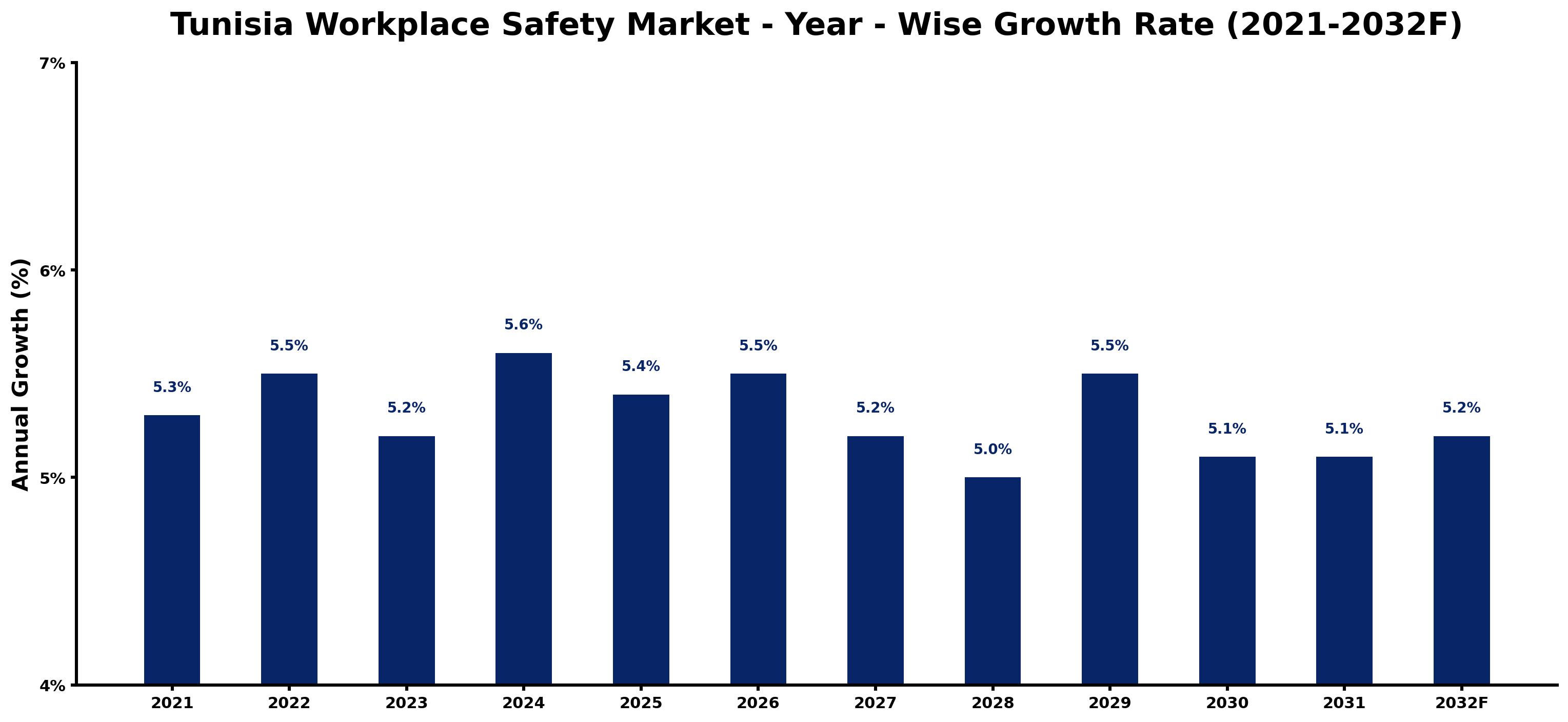
The table below presents the year‑wise growth rates along with the key drivers influencing the market
| Year | Growth Rate | Major Drivers |
| 2021 | 5.3% | Government's focus on enhancing occupational health regulations. |
| 2022 | 5.5% | Increased awareness of workplace hazards among employees. |
| 2023 | 5.2% | New labor laws mandating improved safety protocols. |
| 2024 | 5.6% | Growing foreign investments in manufacturing creating safety needs. |
| 2025 | 5.4% | Rising construction activity boosting demand for safety equipment. |
| 2026 | 5.5% | Enhanced training programs for safety management implemented. |
| 2027 | 5.2% | Local NGOs promoting workplace safety awareness campaigns. |
| 2028 | 5.0% | Regulatory pressure for compliance with international safety standards. |
| 2029 | 5.5% | Strengthened enforcement of safety regulations by authorities. |
| 2030 | 5.1% | Emerging tech solutions for workplace hazard identification adopted. |
| 2031 | 5.1% | Corporate social responsibility initiatives focusing on employee safety. |
| 2032 | 5.2% | Increased usage of digital safety management systems. |
Note: Market size estimations and growth projections presented in this report are based on 6Wresearch's proprietary forecasting methodology, utilizing the latest available industry data, government publications, and primary research inputs.
Tunisia Workplace Safety Market Key Takeaways
Below are some of the specific key takeaways from the market, including:
- Growing awareness among organizations is driving investment in workplace safety solutions.
- Technological advancements are enabling the adoption of IoT-enabled devices and safety wearables.
- Regulatory compliance is becoming a major impetus for organizations to enhance safety measures.
- Industries like healthcare and oil & gas are significantly contributing to market demand.
- Investment opportunities are expanding in safety training programs and risk assessment services.
Evaluation of Restraints in Tunisia Workplace Safety Market
Despite the market’s potential, several challenges hinder its growth. A lack of rigorous enforcement of existing safety regulations leads to insufficient adherence among smaller enterprises, often prioritizing productivity over safety measures. Additionally, the informal economy in Tunisia poses risks as many workers in unregulated sectors may not have access to necessary safety equipment or training. Raising awareness and enhancing the training capabilities of both employers and employees are critical to overcoming these hurdles.
Tunisia Workplace Safety Market Trends
Technological integration is transforming the Tunisia Workplace Safety Market. The shift towards smart safety solutions, including IoT-enabled monitoring systems, illustrates how technology can enhance safety protocols and provide real-time data for decision-making. Furthermore, there is an increasing focus on mental health and ergonomic solutions, recognizing that comprehensive safety extends beyond physical protection to encompass the overall well-being of employees.
Tunisia Workplace Safety Market Opportunities
Investors can find promising opportunities within the Tunisia Workplace Safety Market by providing innovative safety equipment and comprehensive training programs. The rising demand for compliance-driven safety solutions paves the way for advanced technologies, such as risk assessment software and emergency response systems. Additionally, consulting services focused on regulatory compliance offer significant avenues for growth, as companies strive to align with government mandates and industry standards.
Government Initiatives in the Tunisia Workplace Safety Market
The Tunisian government is actively shaping the workplace safety environment through various regulatory frameworks and initiatives. The Ministry of Social Affairs plays a central role in enforcing the Labor Code and ensuring compliance with occupational health and safety laws. This focus on regulation is critical in creating a culture of safety across industries, highlighting the government's commitment to improving safety standards in the workplace.
- A comprehensive review of the Occupational Health and Safety Law, completed in late 2023, has strengthened enforcement mechanisms.
- Currently ongoing safety audits across high-risk industries aim to evaluate compliance and provide feedback for improvement.
- A new training program for small businesses, scheduled for launch in early 2026, will provide resources and guidance on meeting safety standards.
- Future plans include a national awareness campaign focusing on workplace safety best practices set to begin in late 2025.
- Regulatory enhancements are being discussed to address informal sectors and ensure broader compliance with safety protocols.
Future Insights of the Tunisia Workplace Safety Market
Looking ahead to 2026-2032, the Tunisia Workplace Safety Market is set for steady growth, driven by technological adoption and a strong focus on employee welfare. As organizations recognize the link between safety and productivity, investments in advanced safety equipment and training will become increasingly common. Government initiatives are expected to further solidify compliance, ultimately fostering a more proactive safety culture across various sectors.
Tunisia Workplace Safety Market Latest Developments
Over the past year, the Tunisia Workplace Safety Market has seen significant activity, reflecting an increasing prioritization of safety initiatives across various sectors. Organizations are stepping up their efforts to comply with heightened safety regulations, often embracing innovative solutions to enhance workplace safety.
- A major technology vendor launched an IoT-enabled safety monitoring system in Q2 2024, aimed at improving safety compliance in manufacturing facilities.
- A leading regional operator initiated a safety training partnership with local experts in early 2024, focusing on construction and industrial sectors.
- Plans for a new safety consulting firm targeting small businesses are expected to be unveiled in late 2024, aiming to bridge the compliance gap.
- A comprehensive safety audit program, currently underway, is being conducted in healthcare facilities to assess and improve safety protocols.
- An upcoming legislative proposal is anticipated to introduce stricter penalties for safety violations in hazardous industries, expected to be reviewed by mid-2025.
Tunisia Workplace Safety Market - Key Attractiveness of the Report
- 10 Years of Market Numbers
- Historical Data Starting from 2022 to 2025
- Base Year: 2025
- Forecast Data until 2032
- Key Performance Indicators Impacting the Market
- Major Upcoming Developments and Projects
The construction, manufacturing, healthcare, and oil & gas sectors are major players driving demand for safety solutions, each facing unique challenges and regulatory requirements that necessitate heightened safety measures.
Key Highlights of the Report:
- Tunisia Workplace Safety Market Outlook
- Market Size of Tunisia Workplace Safety Market, 2025
- Forecast of Tunisia Workplace Safety Market, 2032
- Historical Data and Forecast of Tunisia Workplace Safety Revenues & Volume for the Period 2022-2032F
- Tunisia Workplace Safety Market Trend Evolution
- Tunisia Workplace Safety Market Drivers and Challenges
- Tunisia Workplace Safety Price Trends
- Tunisia Workplace Safety Porter's Five Forces
- Tunisia Workplace Safety Industry Life Cycle
- Historical Data and Forecast of Tunisia Workplace Safety Market Revenues & Volume By Component for the Period 2022-2032F
- Historical Data and Forecast of Tunisia Workplace Safety Market Revenues & Volume By Hardware for the Period 2022-2032F
- Historical Data and Forecast of Tunisia Workplace Safety Market Revenues & Volume By Software for the Period 2022-2032F
- Historical Data and Forecast of Tunisia Workplace Safety Market Revenues & Volume By Services for the Period 2022-2032F
- Historical Data and Forecast of Tunisia Workplace Safety Market Revenues & Volume By Application for the Period 2022-2032F
- Historical Data and Forecast of Tunisia Workplace Safety Market Revenues & Volume By Incident for the Period 2022-2032F
- Historical Data and Forecast of Tunisia Workplace Safety Market Revenues & Volume By Emergency Management for the Period 2022-2032F
- Historical Data and Forecast of Tunisia Workplace Safety Market Revenues & Volume By Asset Tracking for the Period 2022-2032F
- Historical Data and Forecast of Tunisia Workplace Safety Market Revenues & Volume By PPE Detection for the Period 2022-2032F
- Historical Data and Forecast of Tunisia Workplace Safety Market Revenues & Volume By System for the Period 2022-2032F
- Historical Data and Forecast of Tunisia Workplace Safety Market Revenues & Volume By Environmental Health and Safety for the Period 2022-2032F
- Historical Data and Forecast of Tunisia Workplace Safety Market Revenues & Volume By Access Control and Surveillance System for the Period 2022-2032F
- Historical Data and Forecast of Tunisia Workplace Safety Market Revenues & Volume By Real Time Location Monitoring for the Period 2022-2032F
- Historical Data and Forecast of Tunisia Workplace Safety Market Revenues & Volume By Others for the Period 2022-2032F
- Historical Data and Forecast of Tunisia Workplace Safety Market Revenues & Volume By Deployment Mode for the Period 2022-2032F
- Historical Data and Forecast of Tunisia Workplace Safety Market Revenues & Volume By On-premise for the Period 2022-2032F
- Historical Data and Forecast of Tunisia Workplace Safety Market Revenues & Volume By Cloud for the Period 2022-2032F
- Historical Data and Forecast of Tunisia Workplace Safety Market Revenues & Volume By End User for the Period 2022-2032F
- Historical Data and Forecast of Tunisia Workplace Safety Market Revenues & Volume By Energy and Utilities for the Period 2022-2032F
- Historical Data and Forecast of Tunisia Workplace Safety Market Revenues & Volume By Construction and Engineering for the Period 2022-2032F
- Historical Data and Forecast of Tunisia Workplace Safety Market Revenues & Volume By Chemical and Materials for the Period 2022-2032F
- Historical Data and Forecast of Tunisia Workplace Safety Market Revenues & Volume By Government and Defense for the Period 2022-2032F
- Historical Data and Forecast of Tunisia Workplace Safety Market Revenues & Volume By Healthcare for the Period 2022-2032F
- Historical Data and Forecast of Tunisia Workplace Safety Market Revenues & Volume By Food and Beverages for the Period 2022-2032F
- Historical Data and Forecast of Tunisia Workplace Safety Market Revenues & Volume By Others for the Period 2022-2032F
- Tunisia Workplace Safety Import Export Trade Statistics
- Market Opportunity Assessment By Component
- Market Opportunity Assessment By Application
- Market Opportunity Assessment By System
- Market Opportunity Assessment By Deployment Mode
- Market Opportunity Assessment By End User
- Tunisia Workplace Safety Top Companies Market Share
- Tunisia Workplace Safety Competitive Benchmarking By Technical and Operational Parameters
- Tunisia Workplace Safety Company Profiles
- Tunisia Workplace Safety Key Strategic Recommendations






































