Turkey Aircraft Seat Upholstery Market Size, Share & Growth Rate
The Turkey Aircraft Seat Upholstery Market was estimated at USD 382 Million in 2025 and is projected to reach USD 706 Million by 2032, growing at a CAGR of 9.2% from 2026 to 2032. This impressive growth trajectory is underpinned by an increase in air travel demand and evolving consumer preferences that prioritize comfort and sustainability in aviation. Airlines are increasingly focusing on enhancing passenger experience through the use of innovative materials and customized upholstery solutions, further driving market expansion.
Turkey Aircraft Seat Upholstery Market Year-wise Growth Rate and Key Drivers
This graph highlights how the Turkey Aircraft Seat Upholstery Market has steadily grown over the years, supported by major growth factors.
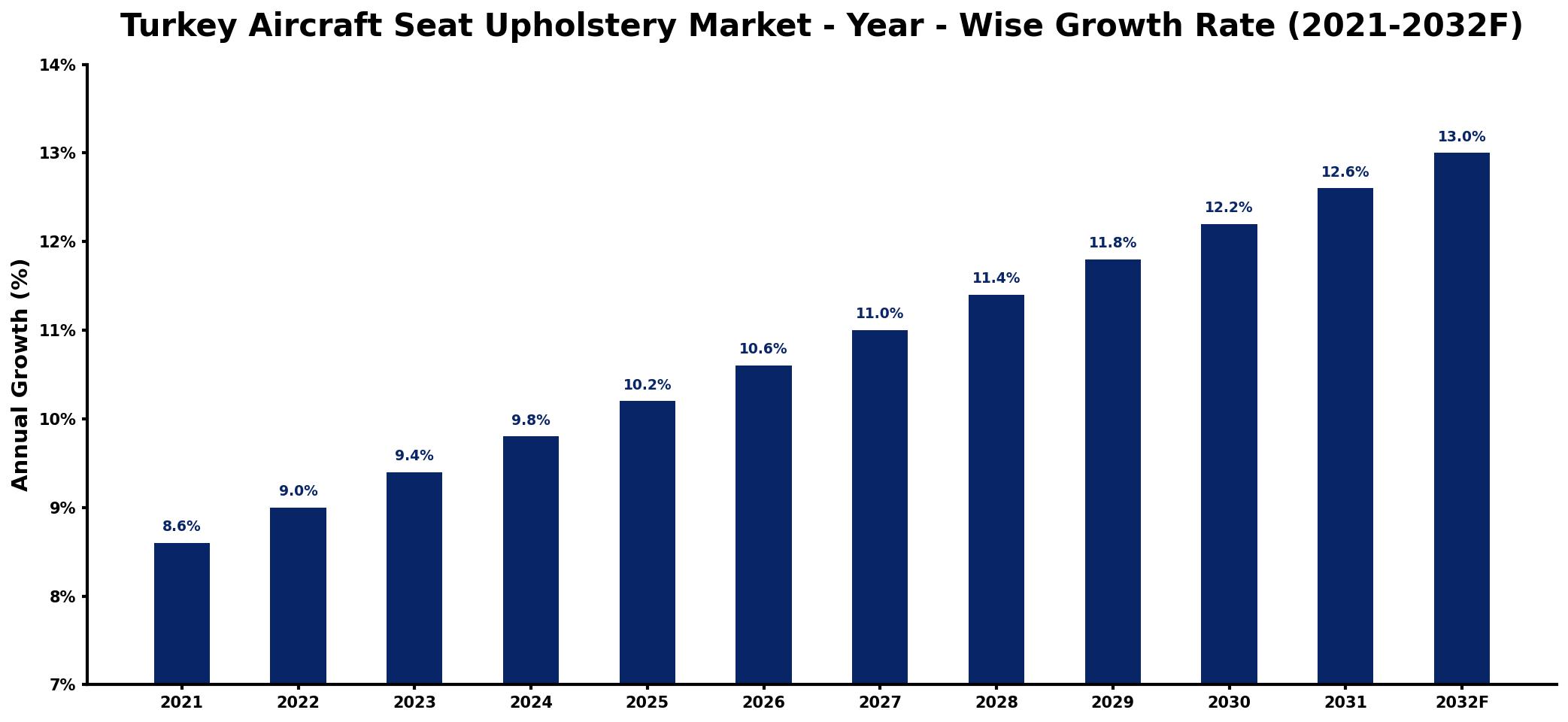
The table below presents the year‑wise growth rates along with the key drivers influencing the market
| Year | Growth Rate | Major Drivers |
| 2021 | 8.6% | Rising demand for luxury travel |
| 2022 | 9.0% | Expansion of regional airlines fleet |
| 2023 | 9.4% | Technological advancements in materials |
| 2024 | 9.8% | Increased passenger comfort expectations |
| 2025 | 10.2% | Growth in tourism and travel |
| 2026 | 10.6% | Investment in aviation infrastructure projects |
| 2027 | 11.0% | Emergence of eco-friendly materials |
| 2028 | 11.4% | Global airline industry recovery trends |
| 2029 | 11.8% | Innovative design trends in aviation |
| 2030 | 12.2% | Enhanced safety regulations and standards |
| 2031 | 12.6% | Partnerships with luxury brands |
| 2032 | 13.0% | Increase in long-haul flight services |
Note: Market size estimations and growth projections presented in this report are based on 6Wresearch's proprietary forecasting methodology, utilizing the latest available industry data, government publications, and primary research inputs.
Turkey Aircraft Seat Upholstery Market Synopsis
Recent momentum in the Turkey Aircraft Seat Upholstery Market indicates a shift towards more personalized and environmentally friendly solutions. The competitive landscape is becoming more dynamic as manufacturers adapt to the rapidly changing demands of airlines and travelers alike.
Looking ahead, the market is expected to harness technological advancements and sustainability initiatives, ensuring a stronger alignment with global aviation trends. The emphasis on lightweight materials and customization is likely to dominate strategies among upholstery providers.
Turkey Aircraft Seat Upholstery Market Key Takeaways
- The market is witnessing a strong demand for eco-friendly and durable upholstery materials as sustainability takes center stage.
- Technological innovations are leading to smart upholstery solutions that monitor passenger comfort and safety.
- Customization is increasingly favored by airlines to enhance brand identity and provide unique passenger experiences.
- Investment in research and development is vital for overcoming challenges related to material costs and regulatory compliance.
- The industry's growth is supported by favorable government policies aimed at enhancing safety and promoting local production.
Evaluation of Restraints in Turkey Aircraft Seat Upholstery Market
Despite its promising growth, the Turkey Aircraft Seat Upholstery Market faces notable restraints. Fluctuations in raw material prices can impact the overall manufacturing costs, posing challenges for profitability. Additionally, stringent regulations and certifications required for aircraft interiors can hinder swift market entry and innovation. The long-term impact of the COVID-19 pandemic continues to linger, influencing demand patterns while increasing operational complexities. Furthermore, geopolitical tensions in the region create an uncertain economic environment that could slow down industry advancements.
Turkey Aircraft Seat Upholstery Market Trends
The current trends within the Turkey Aircraft Seat Upholstery Market highlight a strong preference for lightweight and durable materials that enhance passenger comfort while optimizing fuel efficiency for airlines. The rise of sustainability is evident with a growing demand for eco-friendly, recyclable upholstery options. Technological advancements are also paving the way for innovative designs and functionalities, including smart upholstery that integrates sensors to enhance the travel experience. Customization, both in aesthetics and material choice, is increasingly popular, allowing airlines to differentiate themselves in a competitive market.
Turkey Aircraft Seat Upholstery Market Opportunities
The Turkey Aircraft Seat Upholstery Market is rife with investment opportunities. As airlines continue to expand their fleets in response to increasing air travel demand, there is significant potential for manufacturers to develop and supply innovative, comfortable, and durable upholstery solutions. Collaborations with airlines to provide bespoke upholstery services can also prove advantageous. Moreover, as environmental considerations gain traction, focusing on sustainable materials presents a strategic growth avenue for companies aiming to align with the market's evolving values.
Government Initiatives in the Turkey Aircraft Seat Upholstery Market
Government policies in Turkey are instrumental in shaping the Aircraft Seat Upholstery Market. Stringent safety standards and quality regulations are enforced by the General Directorate of Civil Aviation (SHGM), ensuring that all aircraft components, including upholstery, meet high safety benchmarks. Initiatives promoting the use of eco-friendly materials reflect a commitment to reducing environmental impact, while various incentives support local production and innovation. The government's regulatory framework aims to foster growth while maintaining safety and sustainability in the aviation sector.
Future Insights of the Turkey Aircraft Seat Upholstery Market
The future of the Turkey Aircraft Seat Upholstery Market looks promising as the aviation sector rebounds from pandemic-induced challenges. Increasing air travel demand, coupled with airlines' expansion plans, will likely amplify the need for innovative and comfortable seat upholstery solutions. Advancements in materials technology will continue to drive market growth, particularly concerning fire-retardant and lightweight fabrics. Furthermore, customization will remain essential as airlines seek to provide distinctive passenger experiences, positioning the market for robust development through 2032.
Turkey Aircraft Seat Upholstery Market Latest Developments (2025 - 2026)
Recent developments in the Turkey Aircraft Seat Upholstery Market reveal an increasing focus on sustainability and innovation. Manufacturers are exploring new eco-friendly materials to meet regulatory demands and consumer preferences, which are shifting towards greener solutions. Additionally, collaborations between upholstery providers and airlines are becoming more common, aimed at developing customized products that enhance passenger comfort and align with brand identity. The market is witnessing a broader trend of incorporating smart technologies into upholstery, reflecting the industry's responsiveness to evolving passenger needs.
Turkey Aircraft Seat Upholstery Market - Key Attractiveness of the Report
- 10 Years of Market Numbers
- Historical Data Starting from 2022 to 2025
- Base Year: 2025
- Forecast Data until 2032
- Key Performance Indicators Impacting the Market
- Major Upcoming Developments and Projects
Key Highlights of the Report:
- Turkey Aircraft Seat Upholstery Market Outlook
- Market Size of Turkey Aircraft Seat Upholstery Market, 2025
- Forecast of Turkey Aircraft Seat Upholstery Market, 2032
- Historical Data and Forecast of Turkey Aircraft Seat Upholstery Revenues & Volume for the Period 2022-2032F
- Turkey Aircraft Seat Upholstery Market Trend Evolution
- Turkey Aircraft Seat Upholstery Market Drivers and Challenges
- Turkey Aircraft Seat Upholstery Price Trends
- Turkey Aircraft Seat Upholstery Porter's Five Forces
- Turkey Aircraft Seat Upholstery Industry Life Cycle
- Historical Data and Forecast of Turkey Aircraft Seat Upholstery Market Revenues & Volume By Material Type for the Period 2022-2032F
- Historical Data and Forecast of Turkey Aircraft Seat Upholstery Market Revenues & Volume By Fabric for the Period 2022-2032F
- Historical Data and Forecast of Turkey Aircraft Seat Upholstery Market Revenues & Volume By Leather for the Period 2022-2032F
- Historical Data and Forecast of Turkey Aircraft Seat Upholstery Market Revenues & Volume By Vinyl for the Period 2022-2032F
- Historical Data and Forecast of Turkey Aircraft Seat Upholstery Market Revenues & Volume By Seat Cover Type for the Period 2022-2032F
- Historical Data and Forecast of Turkey Aircraft Seat Upholstery Market Revenues & Volume By Bottom Covers for the Period 2022-2032F
- Historical Data and Forecast of Turkey Aircraft Seat Upholstery Market Revenues & Volume By Back Rest for the Period 2022-2032F
- Historical Data and Forecast of Turkey Aircraft Seat Upholstery Market Revenues & Volume By Armrests for the Period 2022-2032F
- Historical Data and Forecast of Turkey Aircraft Seat Upholstery Market Revenues & Volume By Headrests for the Period 2022-2032F
- Historical Data and Forecast of Turkey Aircraft Seat Upholstery Market Revenues & Volume By Seat Rear Pockets for the Period 2022-2032F
- Historical Data and Forecast of Turkey Aircraft Seat Upholstery Market Revenues & Volume By Seat Type for the Period 2022-2032F
- Historical Data and Forecast of Turkey Aircraft Seat Upholstery Market Revenues & Volume By First Class for the Period 2022-2032F
- Historical Data and Forecast of Turkey Aircraft Seat Upholstery Market Revenues & Volume By Business Class for the Period 2022-2032F
- Historical Data and Forecast of Turkey Aircraft Seat Upholstery Market Revenues & Volume By Premium Economy Class for the Period 2022-2032F
- Historical Data and Forecast of Turkey Aircraft Seat Upholstery Market Revenues & Volume By Economy Class for the Period 2022-2032F
- Historical Data and Forecast of Turkey Aircraft Seat Upholstery Market Revenues & Volume By Aircraft Type for the Period 2022-2032F
- Historical Data and Forecast of Turkey Aircraft Seat Upholstery Market Revenues & Volume By Narrow-body Aircraft for the Period 2022-2032F
- Historical Data and Forecast of Turkey Aircraft Seat Upholstery Market Revenues & Volume By Wide-body Aircraft for the Period 2022-2032F
- Historical Data and Forecast of Turkey Aircraft Seat Upholstery Market Revenues & Volume By Very Large Aircraft for the Period 2022-2032F
- Historical Data and Forecast of Turkey Aircraft Seat Upholstery Market Revenues & Volume By Regional Transport Aircraft for the Period 2022-2032F
- Historical Data and Forecast of Turkey Aircraft Seat Upholstery Market Revenues & Volume By Business Jets for the Period 2022-2032F
- Historical Data and Forecast of Turkey Aircraft Seat Upholstery Market Revenues & Volume By General Aviation Aircraft for the Period 2022-2032F
- Historical Data and Forecast of Turkey Aircraft Seat Upholstery Market Revenues & Volume By Helicopters for the Period 2022-2032F
- Turkey Aircraft Seat Upholstery Import Export Trade Statistics
- Market Opportunity Assessment By Material Type
- Market Opportunity Assessment By Seat Cover Type
- Market Opportunity Assessment By Seat Type
- Market Opportunity Assessment By Aircraft Type
- Turkey Aircraft Seat Upholstery Top Companies Market Share
- Turkey Aircraft Seat Upholstery Competitive Benchmarking By Technical and Operational Parameters
- Turkey Aircraft Seat Upholstery Company Profiles
- Turkey Aircraft Seat Upholstery Key Strategic Recommendations






































