Turkey Aquarium Fish Market Size, Share & Growth Rate
The Turkey Aquarium Fish Market was estimated at USD 1024 Million in 2025 and is projected to reach USD 1471 Million by 2032, growing at a CAGR of 5.3% from 2026 to 2032. This growth trajectory is significantly influenced by an expanding consumer base driven by rising disposable incomes and urbanization, alongside a growing passion for ornamental fish keeping. The increasing popularity of aquascaping and ethical sourcing of fish further propels this market forward.
Turkey Aquarium Fish Market Year-wise Growth Rate and Key Drivers
This graph highlights how the Turkey Aquarium Fish Market has steadily grown over the years, supported by major growth factors.
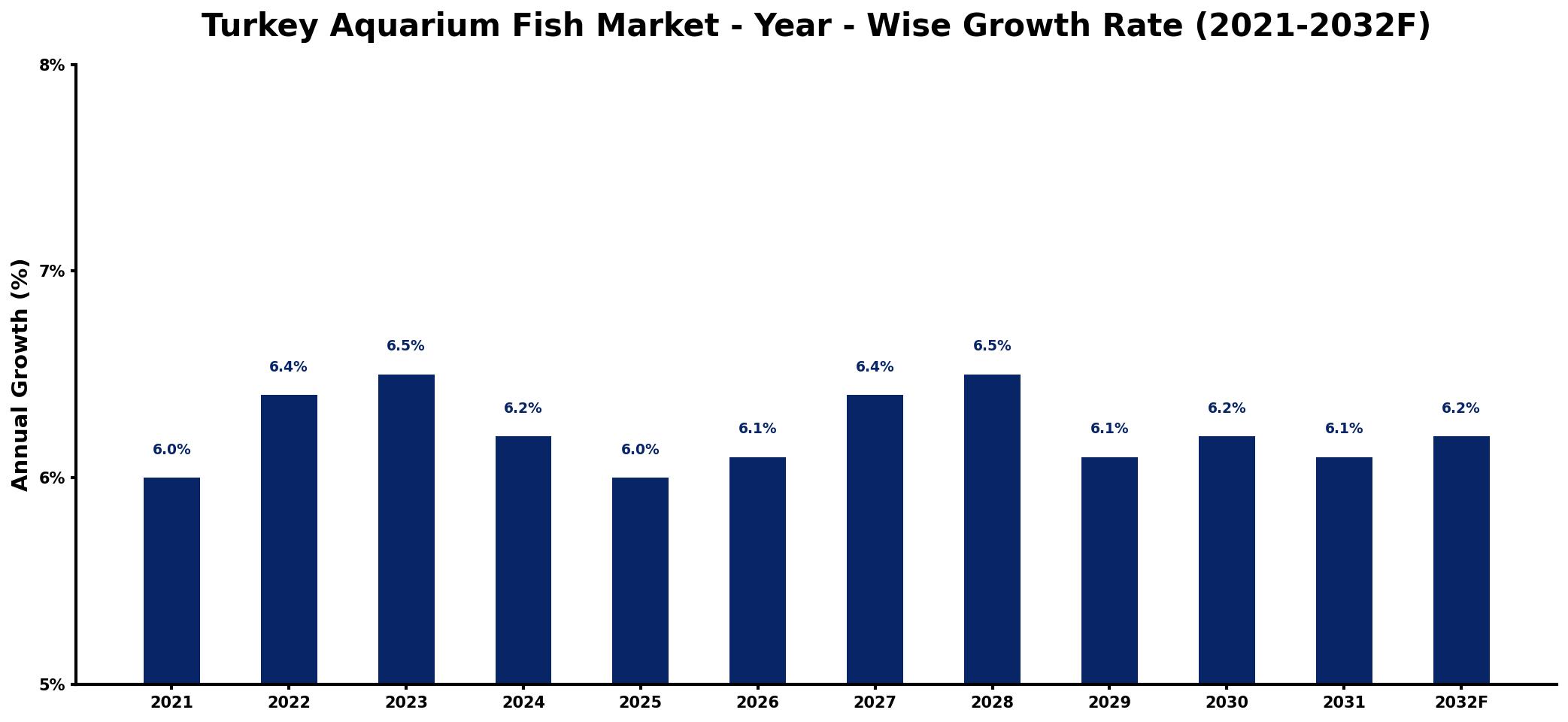
The table below presents the year‑wise growth rates along with the key drivers influencing the market
| Year | Growth Rate | Major Drivers |
| 2021 | 6.0% | Rise in pet ownership trends |
| 2022 | 6.4% | Expansion of online retail platforms |
| 2023 | 6.5% | Increased consumer disposable income |
| 2024 | 6.2% | Growth in eco-friendly products |
| 2025 | 6.0% | Surge in home decoration trends |
| 2026 | 6.1% | Emergence of urban gardening initiatives |
| 2027 | 6.4% | Higher demand for leisure activities |
| 2028 | 6.5% | Popularity of educational workshops |
| 2029 | 6.1% | Investment in sustainable practices |
| 2030 | 6.2% | strengthening international trade flows |
| 2031 | 6.1% | Rising interest in biodiversity conservation |
| 2032 | 6.2% | Increase in indoor hobbyists |
Note: Market size estimations and growth projections presented in this report are based on 6Wresearch's proprietary forecasting methodology, utilizing the latest available industry data, government publications, and primary research inputs.
Turkey Aquarium Fish Market Synopsis
The Turkey Aquarium Fish Market is marked by a vibrant ecosystem of both freshwater and marine species, appealing to both hobbyists and professional aquarists. Local breeders and retailers offer a wide assortment of unique and diverse aquarium fish, reflecting the country's growing aquarium culture.
Moreover, consumer preferences are shifting towards sustainable practices, resulting in increased demand for captive-bred fish. This trend not only supports ethical consumption but also enhances the market's resilience against environmental concerns associated with wild-caught species.
Turkey Aquarium Fish Market Key Takeaways
- The market is benefiting from a growing interest in aquascaping and exotic fish species.
- Urbanization and rising disposable incomes are driving demand for aquarium fish.
- Sustainable and ethical sourcing of fish is becoming a priority for consumers.
- Technological advancements simplify aquarium maintenance, attracting new enthusiasts.
- Investment opportunities exist in the breeding of rare species and eco-friendly practices.
Evaluation of Restraints in Turkey Aquarium Fish Market
Despite its promising growth, the Turkey Aquarium Fish Market faces significant challenges. Economic instability can lead to fluctuating consumer spending, impacting overall market demand. Additionally, stringent regulations surrounding the import and export of specific fish species can limit market variety and consumer choices. The burgeoning e-commerce sector further intensifies competition for traditional retailers, requiring them to innovate and adapt their business models to survive in a rapidly changing landscape.
Turkey Aquarium Fish Market Trends
Current trends indicate an increasing consumer inclination towards rare and exotic fish, often fueled by the rise of aquascaping as a creative outlet. Additionally, there's a heightened emphasis on sustainable practices, where consumers are opting for captive-bred species to minimize environmental impacts. Technological innovations in aquarium care, such as automated filtration systems and smart monitoring tools, are also enhancing the hobbyist experience, thus expanding the markets reach.
Turkey Aquarium Fish Market Investment Opportunities
The Turkey Aquarium Fish Market is ripe with investment opportunities, particularly in niche areas such as the breeding of rare fish species that cater to dedicated collectors. Another promising avenue lies in developing advanced equipment and accessories tailored for aquarium enthusiasts, enhancing their hobby experience. Furthermore, as sustainability becomes a focal point for consumers, investments in aquaculture and conservation initiatives are increasingly viable, allowing businesses to align profit with environmental responsibility.
Government Initiatives in the Turkey Aquarium Fish Market
The Turkish government is actively regulating the aquarium fish market to promote sustainable practices. This includes strict licensing requirements for breeding and collecting fish, aimed at protecting biodiversity. Additionally, there are regulations concerning the transport and trade of aquarium species, intended to mitigate disease risks and prevent the introduction of invasive species into local ecosystems. Efforts are also underway to raise awareness among stakeholders about responsible practices that ensure the long-term viability of the aquarium fish market.
Future Insights of the Turkey Aquarium Fish Market
Looking ahead, the Turkey Aquarium Fish Market is expected to thrive, supported by ongoing urbanization, increased disposable incomes, and a cultural shift towards home-based hobbies for stress relief and aesthetic enjoyment. The introduction of innovative breeding techniques and expanded species availability will continue to attract new consumers, while sustainability concerns will drive businesses to adopt more eco-friendly practices. Overall, the markets future appears bright, with opportunities for growth in both domestic and international segments.
Turkey Aquarium Fish Market Latest Developments (2025 - 2026)
Recent developments in the Turkey Aquarium Fish Market indicate a continued focus on sustainability and innovation. Industry stakeholders are increasingly adopting eco-friendly practices, and many are enhancing their digital presence to compete with online retailers. There is also a noticeable increase in collaborations between breeders and local retailers, aimed at ensuring a steady supply of quality fish while educating consumers about ethical sourcing.
Turkey Aquarium Fish Market - Key Attractiveness of the Report
- 10 Years of Market Numbers
- Historical Data Starting from 2022 to 2025
- Base Year: 2025
- Forecast Data until 2032
- Key Performance Indicators Impacting the Market
- Major Upcoming Developments and Projects
Key Highlights of the Report:
- Turkey Aquarium Fish Market Outlook
- Market Size of Turkey Aquarium Fish Market, 2025
- Forecast of Turkey Aquarium Fish Market, 2032
- Historical Data and Forecast of Turkey Aquarium Fish Revenues & Volume for the Period 2022-2032F
- Turkey Aquarium Fish Market Trend Evolution
- Turkey Aquarium Fish Market Drivers and Challenges
- Turkey Aquarium Fish Price Trends
- Turkey Aquarium Fish Porter's Five Forces
- Turkey Aquarium Fish Industry Life Cycle
- Historical Data and Forecast of Turkey Aquarium Fish Market Revenues & Volume By Type for the Period 2022-2032F
- Historical Data and Forecast of Turkey Aquarium Fish Market Revenues & Volume By Freshwater Fish for the Period 2022-2032F
- Historical Data and Forecast of Turkey Aquarium Fish Market Revenues & Volume By Saltwater Fish for the Period 2022-2032F
- Historical Data and Forecast of Turkey Aquarium Fish Market Revenues & Volume By Application for the Period 2022-2032F
- Historical Data and Forecast of Turkey Aquarium Fish Market Revenues & Volume By Commercial Aquarium for the Period 2022-2032F
- Historical Data and Forecast of Turkey Aquarium Fish Market Revenues & Volume By Home Aquarium for the Period 2022-2032F
- Turkey Aquarium Fish Import Export Trade Statistics
- Market Opportunity Assessment By Type
- Market Opportunity Assessment By Application
- Turkey Aquarium Fish Top Companies Market Share
- Turkey Aquarium Fish Competitive Benchmarking By Technical and Operational Parameters
- Turkey Aquarium Fish Company Profiles
- Turkey Aquarium Fish Key Strategic Recommendations






































