Turkey Base Metals Market Size, Share & Growth Rate
The Turkey Base Metals Market was estimated at USD 368 Million in 2025 and is projected to reach USD 520 Million by 2032, growing at a CAGR of 5.1% from 2026 to 2032. This growth trajectory is primarily driven by increasing industrialization, particularly in the construction and manufacturing sectors, which are both fundamental to the Turkish economy. Additionally, technological advancements and a rising emphasis on sustainable practices are further enhancing demand for key base metals like copper, zinc, and lead.
Turkey Base Metals Market Year-wise Growth Rate and Key Drivers
This graph highlights how the Turkey Base Metals Market has steadily grown over the years, supported by major growth factors.
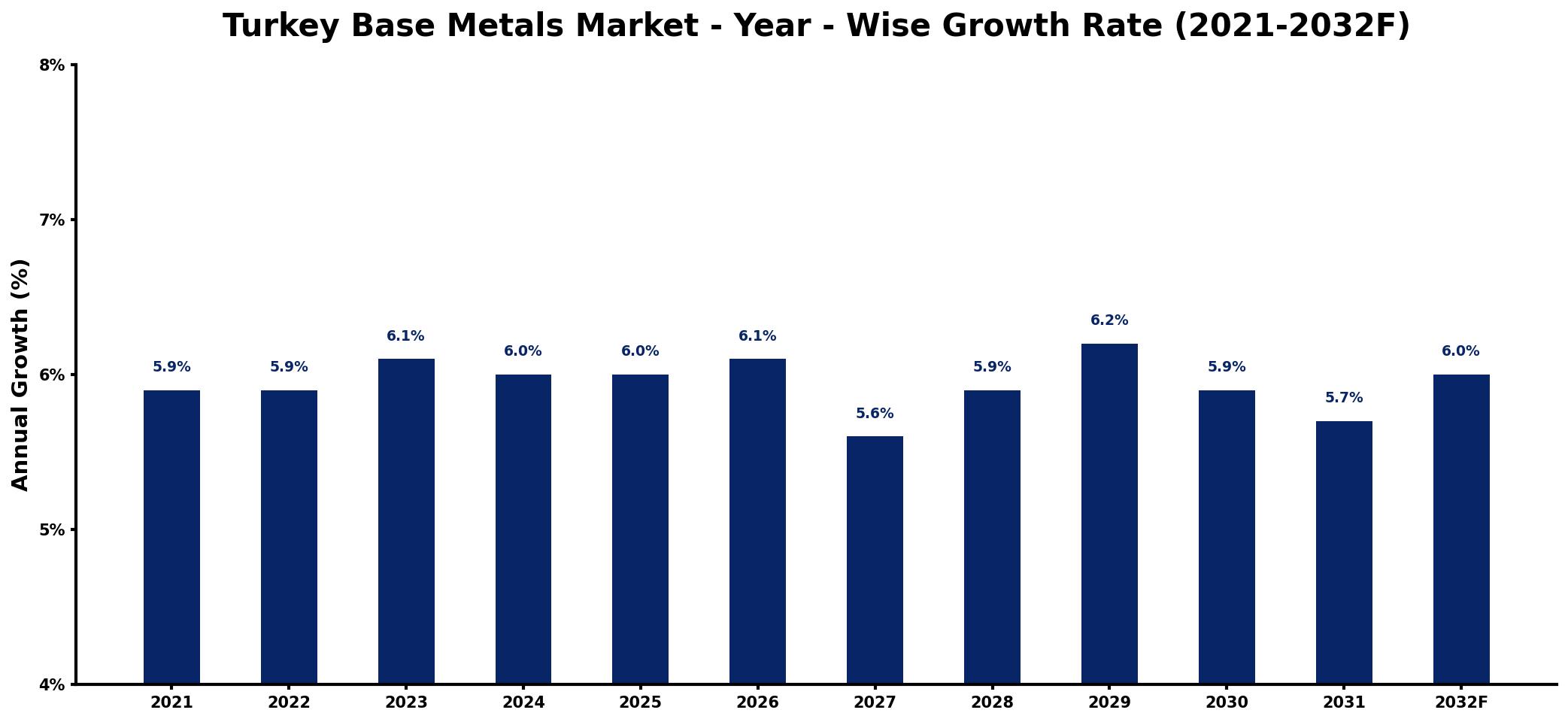
The table below presents the year‑wise growth rates along with the key drivers influencing the market
| Year | Growth Rate | Major Drivers |
| 2021 | 5.9% | Construction sector recovery drives demand |
| 2022 | 5.9% | Increased automotive production boosts consumption |
| 2023 | 6.1% | Renewable energy investments rise sharply |
| 2024 | 6.0% | Infrastructure projects expand rapidly |
| 2025 | 6.0% | Electronics manufacturing sees growth |
| 2026 | 6.1% | Telecommunications infrastructure upgrades increase |
| 2027 | 5.6% | Mining operations optimize efficiency |
| 2028 | 5.9% | Sustainable practices gain traction |
| 2029 | 6.2% | Global trade agreements enhance exports |
| 2030 | 5.9% | Urbanization trends fuel demand |
| 2031 | 5.7% | Technological advancements drive innovation |
| 2032 | 6.0% | Circular economy initiatives promote recycling |
Note: Market size estimations and growth projections presented in this report are based on 6Wresearch's proprietary forecasting methodology, utilizing the latest available industry data, government publications, and primary research inputs.
Turkey Base Metals Market Synopsis
The current force shaping the Turkey Base Metals Market is the robust demand for copper, attributed to its critical role in industries such as construction and automotive. Coupled with an increasing emphasis on recycling and sustainability, this trend is influencing both production and consumption patterns within the market.
Turkey's rich mineral resources and its historical prowess in mining provide a strong foundation for the base metals sector. Despite this potential, the market faces numerous challenges such as fluctuating metal prices and evolving regulatory landscapes that impact operational dynamics.
Turkey Base Metals Market Key Takeaways
- The Turkey Base Metals Market is poised for growth, driven by industrial demand, particularly in construction and manufacturing.
- Sustainability initiatives are fostering a shift towards recycled base metals, influencing market dynamics.
- Technological advancements in mining operations are improving efficiency and cost-effectiveness.
- Geopolitical factors significantly impact supply chains and trade patterns, contributing to market volatility.
- Investment opportunities abound in mining and related industries due to urbanization and infrastructure development.
Evaluation of Restraints in Turkey Base Metals Market
While the Turkey Base Metals Market showcases immense potential, several restraints pose challenges to growth. Volatile metal prices can hinder investment planning and profitability for companies involved in mining and production. Furthermore, regulatory pressures focusing on environmental sustainability add complexity to operational frameworks, compelling companies to adopt more costly practices. Geopolitical tensions often disrupt supply chains, contributing to market instability. Together, these factors necessitate strategic adaptation from market players to maintain competitiveness.
Turkey Base Metals Market Trends
Currently, the Turkey Base Metals Market is witnessing a marked increase in the demand for copper, essential for a variety of applications from electronics to construction. A growing inclination towards environmental responsibility is leading to heightened production of recycled metals, reshaping industry standards. Moreover, the sector is experiencing a technological renaissance, with digitalization and automation taking center stage to enhance operational efficiencies. These trends collectively create a dynamic landscape where sustainability and innovation drive progress.
Turkey Base Metals Market Opportunities
Investment opportunities within the Turkey Base Metals Market are particularly promising. With the country being a significant producer of key base metals, stakeholders can explore investments in local mining operations. The growth in construction and infrastructure projects presents a strong demand for base metals, creating a favorable environment for companies involved in manufacturing and distribution. As Turkey further urbanizes and focuses on renewable energy initiatives, long-term investments in this sector may yield substantial returns.
Government Initiatives in the Turkey Base Metals Market
The Turkish government has introduced a suite of policies aimed at bolstering the base metals market. These include regulations focused on sustainable mining practices, environmental protection initiatives, and incentives designed to enhance domestic production. The Mining Law provides a regulatory framework for mining operations, encompassing licensing and environmental assessments to ensure responsible resource utilization. Through these initiatives, the government aims to foster growth within the sector while promoting sustainability and reducing import reliance.
Future Insights of the Turkey Base Metals Market
Looking ahead, the Turkey Base Metals Market is expected to flourish, bolstered by ongoing industrialization and infrastructure advancements. An uptick in demand for base metals will likely accompany Turkeys investments in renewable energy and automotive sectors, especially as electric vehicles gain traction. While geopolitical tensions and fluctuating global market conditions may introduce uncertainties, the overall outlook remains positive, promising significant growth in the coming years.
Turkey Base Metals Market Latest Developments (2025 - 2026)
In recent months, the Turkey Base Metals Market has seen an acceleration in sustainable practices among mining companies, with several initiatives aimed at reducing environmental impact. Additionally, advancements in technology have led to more efficient mining processes, thus lowering operational costs. The ongoing urbanization in Turkey is stimulating further demand in the construction sector, consequently pushing the need for base metals. Strategic collaborations and partnerships are emerging within the industry to address supply chain challenges and enhance competitiveness.
Turkey Base Metals Market - Key Attractiveness of the Report
- 10 Years of Market Numbers
- Historical Data Starting from 2022 to 2025
- Base Year: 2025
- Forecast Data until 2032
- Key Performance Indicators Impacting the Market
- Major Upcoming Developments and Projects
Key Highlights of the Report:
- Turkey Base Metals Market Outlook
- Market Size of Turkey Base Metals Market, 2025
- Forecast of Turkey Base Metals Market, 2032
- Historical Data and Forecast of Turkey Base Metals Revenues & Volume for the Period 2022-2032F
- Turkey Base Metals Market Trend Evolution
- Turkey Base Metals Market Drivers and Challenges
- Turkey Base Metals Price Trends
- Turkey Base Metals Porter's Five Forces
- Turkey Base Metals Industry Life Cycle
- Historical Data and Forecast of Turkey Base Metals Market Revenues & Volume By Type for the Period 2022-2032F
- Historical Data and Forecast of Turkey Base Metals Market Revenues & Volume By Copper for the Period 2022-2032F
- Historical Data and Forecast of Turkey Base Metals Market Revenues & Volume By Zinc for the Period 2022-2032F
- Historical Data and Forecast of Turkey Base Metals Market Revenues & Volume By Lead for the Period 2022-2032F
- Historical Data and Forecast of Turkey Base Metals Market Revenues & Volume By Nickel for the Period 2022-2032F
- Historical Data and Forecast of Turkey Base Metals Market Revenues & Volume By Aluminum for the Period 2022-2032F
- Historical Data and Forecast of Turkey Base Metals Market Revenues & Volume By Tin for the Period 2022-2032F
- Historical Data and Forecast of Turkey Base Metals Market Revenues & Volume By End-user Industry for the Period 2022-2032F
- Historical Data and Forecast of Turkey Base Metals Market Revenues & Volume By Construction for the Period 2022-2032F
- Historical Data and Forecast of Turkey Base Metals Market Revenues & Volume By Automotive and Transportation for the Period 2022-2032F
- Historical Data and Forecast of Turkey Base Metals Market Revenues & Volume By Electrical and Electronics for the Period 2022-2032F
- Historical Data and Forecast of Turkey Base Metals Market Revenues & Volume By Consumer Products for the Period 2022-2032F
- Historical Data and Forecast of Turkey Base Metals Market Revenues & Volume By Medical Devices for the Period 2022-2032F
- Historical Data and Forecast of Turkey Base Metals Market Revenues & Volume By Others for the Period 2022-2032F
- Turkey Base Metals Import Export Trade Statistics
- Market Opportunity Assessment By Type
- Market Opportunity Assessment By End-user Industry
- Turkey Base Metals Top Companies Market Share
- Turkey Base Metals Competitive Benchmarking By Technical and Operational Parameters
- Turkey Base Metals Company Profiles
- Turkey Base Metals Key Strategic Recommendations






































