Turkey Canned Fruits Market Summary
The turkey canned fruits market was estimated at USD 204 Million in 2025 and is projected to reach USD 278 Million by 2032, growing at a CAGR of 5.1% from 2026 to 2032.
Turkey Canned Fruits Market Year-wise Growth Rate and Key Drivers
This graph highlights how the Turkey Canned Fruits Market has steadily grown over the past five years, supported by major growth factors.
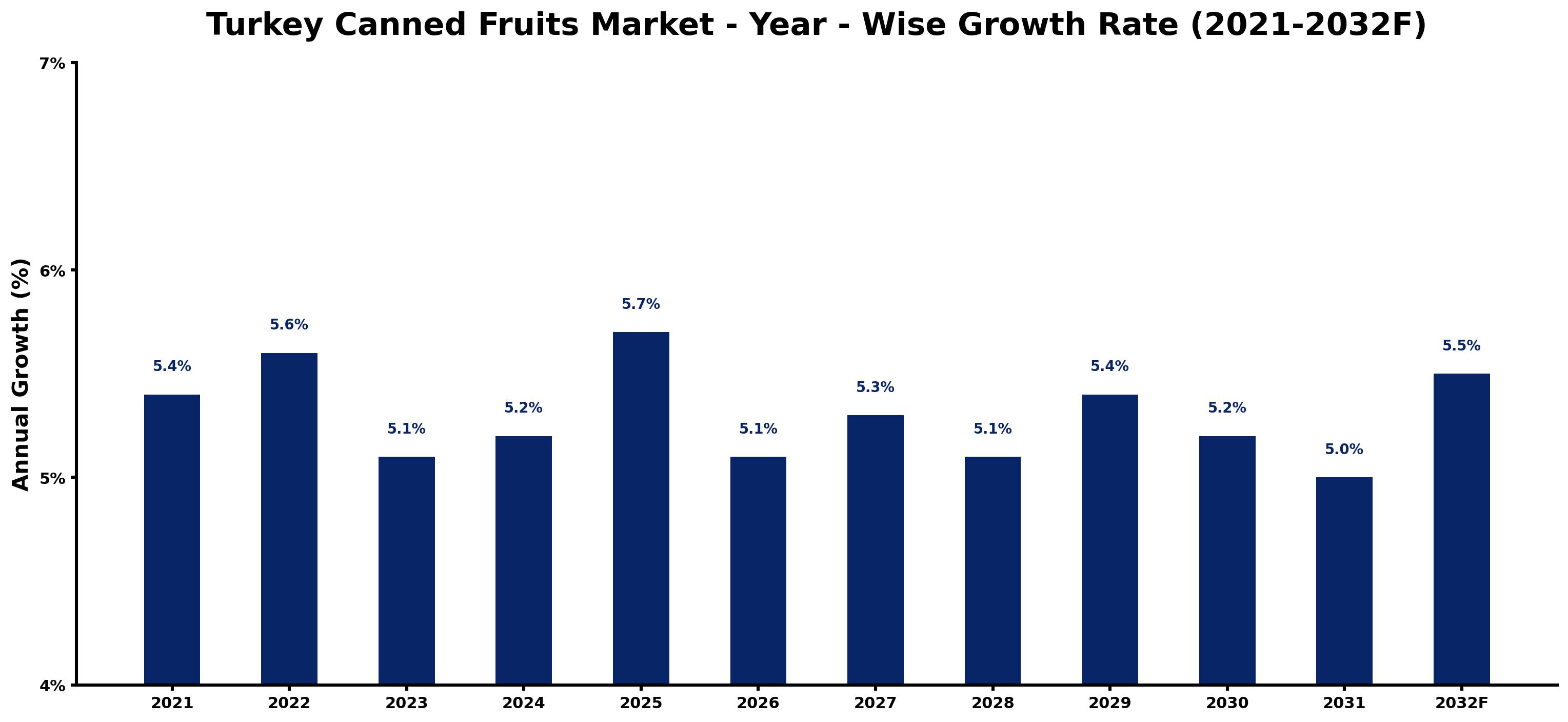
The table below presents the year wise growth rates along with the key drivers influencing the market
| Year | Growth Rate | Major Drivers |
| 2021 | 5.4% | Consumer preferences gravitate towards convenient and shelf-stable food options. |
| 2022 | 5.6% | Local producers enhance quality to compete with imported canned fruit varieties. |
| 2023 | 5.1% | E-commerce platforms witness a spike in canned fruit sales amid changing shopping habits. |
| 2024 | 5.2% | Health-conscious consumers increasingly favor preservative-free and organic canned fruit products. |
| 2025 | 5.7% | Innovative packaging solutions capture attention, emphasizing freshness and sustainability. |
| 2026 | 5.1% | International trade agreements expand export opportunities for Turkish canned fruit manufacturers. |
| 2027 | 5.3% | Culinary trends promote exotic fruit blends, driving new product development in the sector. |
| 2028 | 5.1% | Rural farming initiatives support local fruit supply chains for canned goods production. |
| 2029 | 5.4% | Automation in processing facilities leads to improved efficiency and lower production costs. |
| 2030 | 5.2% | Tourism rebounds, increasing demand for local delicacies like Turkish canned fruits. |
| 2031 | 5.0% | Collaborations between brands and health influencers enhance market visibility and appeal. |
| 2032 | 5.5% | Sustainability practices influence consumer choices, prompting innovation in eco-friendly packaging. |
Note - Market size estimations and growth projections presented in this report are based on 6Wresearch's advanced forecasting approach, validated with industry datasets as of June 2026.
Turkey Canned Fruits Market Synopsis
The Turkey Canned Fruits Market is projected to reach 5.1% and witness significant growth during the forecast period (2026-2032). This growth is primarily driven by an increasing consumer inclination towards convenient food solutions with prolonged shelf life. As urbanization accelerates and lifestyles become more fast-paced, the demand for readily available food products continues to rise. Additionally, the trend of healthy eating is pushing consumers to seek options that offer both convenience and nutritional value, thus elevating the appeal of canned fruits.
Turkey Canned Fruits Market Growth Drivers
Several factors contribute to the robust growth trajectory of the Turkey Canned Fruits Market. Key growth drivers include:
- The growing consumer preference for ready-to-eat and easy-to-prepare meals is propelling the demand for canned fruits.
- Heightened awareness regarding the nutritional benefits of canned fruits is fostering consumer trust and interest in these products.
- The variety of flavors and types of canned fruits available is catering to diverse consumer tastes, enhancing market appeal.
- Rising health consciousness has led to an increased demand for canned fruits made with natural ingredients and without preservatives.
- Improvements in packaging technology are helping to maintain the quality and taste of canned fruits, making them more attractive to health-conscious consumers.
Turkey Canned Fruits Market Trends and Opportunities
The Turkey Canned Fruits Market is currently witnessing significant trends that create numerous opportunities for growth. Notably, there is a palpable shift towards healthier product offerings. Here are some current trends:
- Consumers are increasingly seeking canned fruits that are free from artificial additives, indicating a strong preference for natural and organic options.
- Exotic varieties of canned fruits are gaining traction among consumers looking for unique flavors, thus expanding market offerings.
- The rise of online shopping is reshaping distribution channels, allowing manufacturers to reach a broader audience more effectively.
- There is a growing popularity for gourmet canned fruit products, appealing to food enthusiasts looking for premium options.
- Companies are investing in innovative packaging solutions to enhance the preservation and presentation of canned fruits, catering to aesthetic preferences in addition to functionality.
Turkey Canned Fruits Market Challenges and Restraints
Despite the positive growth outlook for the Turkey Canned Fruits Market, there are several challenges that industry participants must navigate:
- Intense competition from fresh fruits poses a significant challenge, as consumers continue to express a strong preference for fresh produce.
- Fluctuating raw material prices can impact production costs, thereby affecting profit margins for canned fruit manufacturers.
- The perception of canned fruits as less fresh compared to their fresh counterparts can impede market growth.
- Limited shelf space in retail outlets can restrict the visibility and availability of canned fruit products, challenging market penetration.
- Regulatory compliance related to food safety standards and labeling can create additional operational hurdles for manufacturers.
Turkey Canned Fruits Market Investment Opportunities
The evolving landscape of the Turkey Canned Fruits Market provides several lucrative investment opportunities:
- Investing in the development of innovative and sustainable packaging solutions can significantly enhance product appeal and shelf life.
- Leveraging e-commerce platforms can increase market reach, connecting manufacturers with a broader, tech-savvy consumer base.
- Collaboration with local farmers ensures a steady supply chain of high-quality raw materials, aligning with the trend of supporting local agriculture.
- Adopting transparent sourcing practices and clean labels can resonate with the growing number of health-conscious consumers.
- Exploring export opportunities to neighboring regions can further diversify market reach and revenue sources for manufacturers.
Turkey Canned Fruits Market Government Investment and Initiatives
Government policies play a crucial role in shaping the landscape of the Turkey Canned Fruits Market. Several initiatives are in place to support the sector:
- The government has implemented strict food safety standards to ensure product quality and consumer health, enhancing overall market credibility.
- Incentives for local fruit producers are designed to boost domestic production and reduce reliance on imports.
- Financial support programs for exporters aim to enhance the competitiveness of Turkish canned fruit products on a global scale.
- Educational initiatives are being promoted to raise awareness about the nutritional benefits of canned fruits, driving consumer interest.
- Regulatory frameworks are being adjusted to facilitate smoother operations for manufacturers, particularly in adherence to packaging and labeling standards.
Turkey Canned Fruits Market Latest Developments (May 2025 - June 2026)
In the period from May 2025 to June 2026, the Turkey Canned Fruits Market has seen notable developments. There has been a continued push towards healthier product offerings, with manufacturers focusing on clean label initiatives. Additionally, online retail channels have gained prominence as more consumers turn to e-commerce for their grocery needs. Innovations in packaging technology have allowed for better preservation of product quality, catering to the health-conscious demographic. Furthermore, there is an increasing trend towards collaboration between manufacturers and local farmers, ensuring a steady supply of high-quality fruits. The market is also responding to consumer demand for unique product flavors, with exotic varieties being introduced to attract gourmet enthusiasts.
Turkey Canned Fruits Market - Key Attractiveness of the Report
- 10 Years of Market Numbers
- Historical Data Starting from 2022 to 2025
- Base Year: 2025
- Forecast Data until 2032
- Key Performance Indicators Impacting the Market
- Major Upcoming Developments and Projects
Key Highlights of the Report:
- Turkey Canned Fruits Market Outlook
- Market Size of Turkey Canned Fruits Market, 2025
- Forecast of Turkey Canned Fruits Market, 2032F
- Historical Data and Forecast of Turkey Canned Fruits Revenues & Volume for the Period 2022-2032F
- Turkey Canned Fruits Market Trend Evolution
- Turkey Canned Fruits Market Drivers and Challenges
- Turkey Canned Fruits Price Trends
- Turkey Canned Fruits Porter's Five Forces
- Turkey Canned Fruits Industry Life Cycle
- Historical Data and Forecast of Turkey Canned Fruits Market Revenues & Volume By Fruit Type for the Period 2022-2032F
- Historical Data and Forecast of Turkey Canned Fruits Market Revenues & Volume By Peaches for the Period 2022-2032F
- Historical Data and Forecast of Turkey Canned Fruits Market Revenues & Volume By Pineapple for the Period 2022-2032F
- Historical Data and Forecast of Turkey Canned Fruits Market Revenues & Volume By Mandarin oranges for the Period 2022-2032F
- Historical Data and Forecast of Turkey Canned Fruits Market Revenues & Volume By Pears for the Period 2022-2032F
- Historical Data and Forecast of Turkey Canned Fruits Market Revenues & Volume By Others for the Period 2022-2032F
- Historical Data and Forecast of Turkey Canned Fruits Market Revenues & Volume By Form for the Period 2022-2032F
- Historical Data and Forecast of Turkey Canned Fruits Market Revenues & Volume By Whole fruits for the Period 2022-2032F
- Historical Data and Forecast of Turkey Canned Fruits Market Revenues & Volume By Cut fruits for the Period 2022-2032F
- Historical Data and Forecast of Turkey Canned Fruits Market Revenues & Volume By Distribution Channel for the Period 2022-2032F
- Historical Data and Forecast of Turkey Canned Fruits Market Revenues & Volume By Supermarkets/Hypermarkets for the Period 2022-2032F
- Historical Data and Forecast of Turkey Canned Fruits Market Revenues & Volume By Convenience Stores for the Period 2022-2032F
- Historical Data and Forecast of Turkey Canned Fruits Market Revenues & Volume By Online Retail for the Period 2022-2032F
- Historical Data and Forecast of Turkey Canned Fruits Market Revenues & Volume By Other for the Period 2022-2032F
- Turkey Canned Fruits Import Export Trade Statistics
- Market Opportunity Assessment By Fruit Type
- Market Opportunity Assessment By Form
- Market Opportunity Assessment By Distribution Channel
- Turkey Canned Fruits Top Companies Market Share
- Turkey Canned Fruits Competitive Benchmarking By Technical and Operational Parameters
- Turkey Canned Fruits Company Profiles
- Turkey Canned Fruits Key Strategic Recommendations






































