Turkey Consent Management Market Size & Growth Rate (2026-2032)
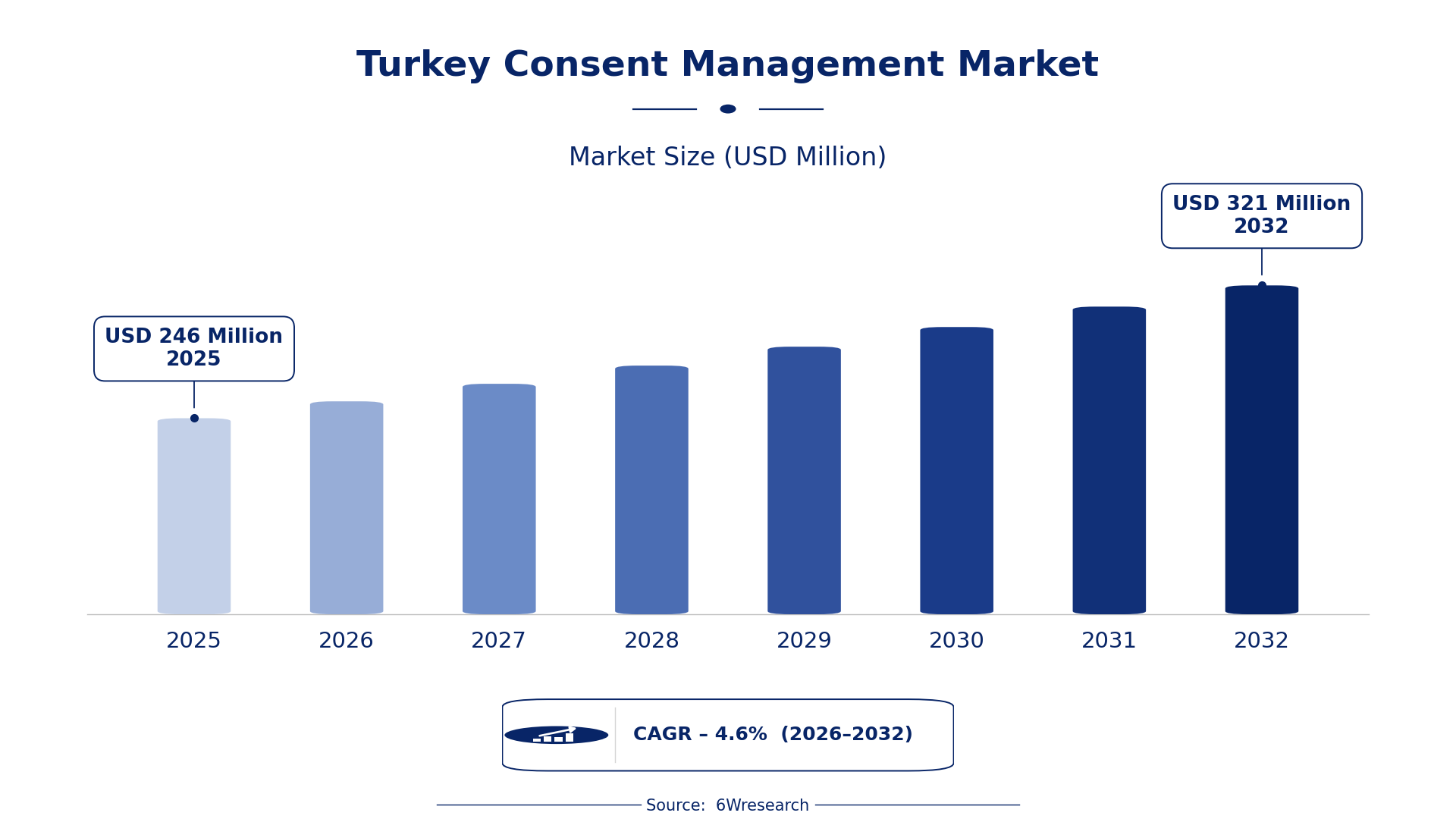
The Turkey Consent Management Market was estimated at USD 246 Million in 2025 and is projected to reach USD 321 Million by 2032, growing at a CAGR of 4.6% from 2026 to 2032.
Turkey Consent Management Market Synopsis
The increasing focus on compliance with data privacy regulations is the strongest force shaping the Turkey Consent Management Market today. As businesses grapple with the implications of the Turkish Data Protection Law and the European GDPR, they are investing heavily in consent management solutions to secure user trust and meet regulatory demands.
Consumer awareness regarding data privacy rights has also skyrocketed, driving demand for transparent consent mechanisms. Organizations across sectors, particularly e-commerce, financial services, and healthcare, are recognizing that effective consent management is not just a regulatory obligation but also a competitive differentiator.
Turkey Consent Management Market Year-wise Growth Rate and Key Drivers
This graph illustrates the annual growth rates of the Turkey Consent Management Market from 2021 to 2032, highlighting a steady upward trajectory and projected expansion over the forecast period.
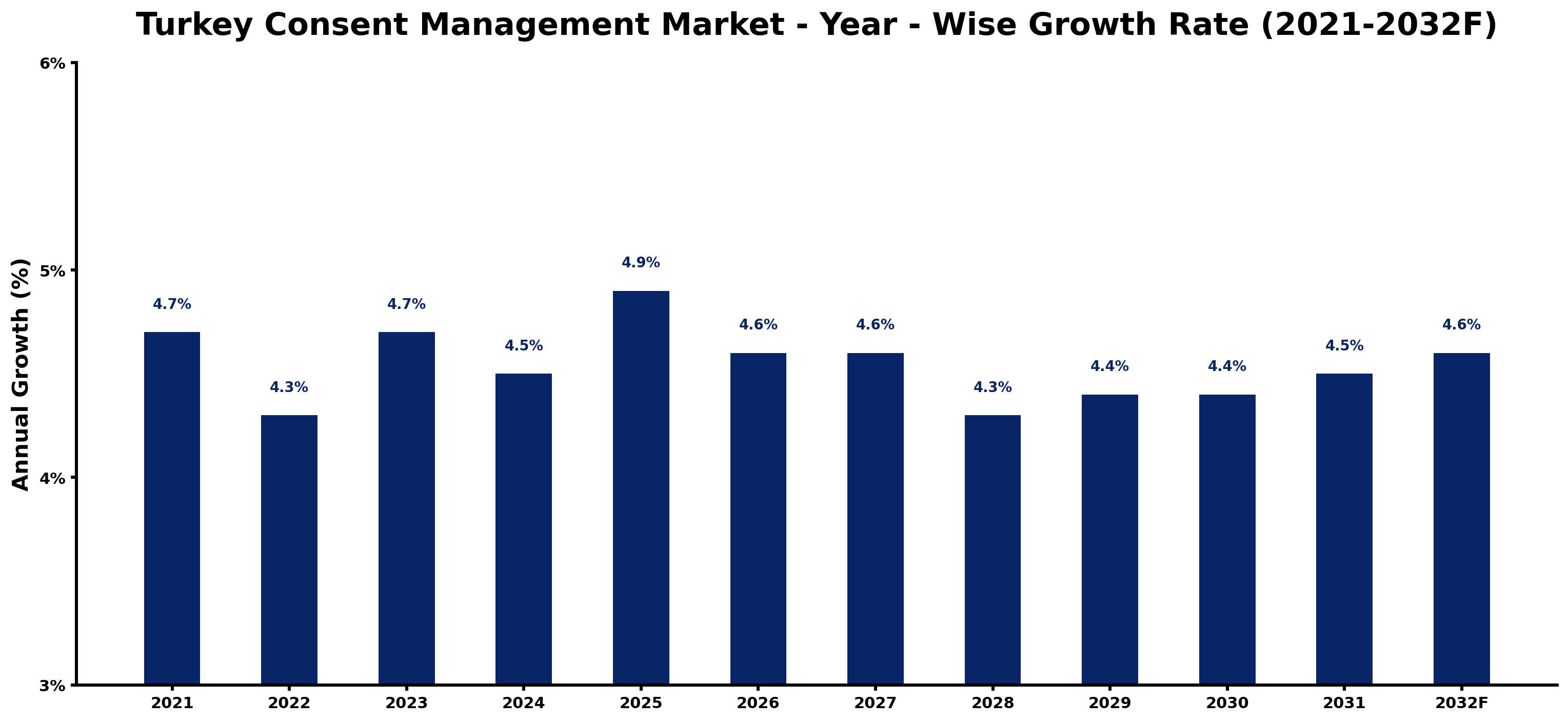
The table below presents the year‑wise growth rates along with the key drivers influencing the market
| Year | Growth Rate | Major Drivers |
| 2021 | 4.7% | Implementation of KVKK enhancing data protection regulations |
| 2022 | 4.3% | Rise in e-commerce necessitating stringent user consent measures |
| 2023 | 4.7% | Increased consumer awareness of data privacy rights |
| 2024 | 4.5% | Supportive initiatives for local startups in data management |
| 2025 | 4.9% | Growing internet penetration fueling consent management needs |
| 2026 | 4.6% | Adoption of online banking requiring clearer consent frameworks |
| 2027 | 4.6% | Emergence of mobile wallets increasing consent transaction demands |
| 2028 | 4.3% | Development of fintech solutions focusing on user consent |
| 2029 | 4.4% | Regulatory updates enhancing transparency in data use policies |
| 2030 | 4.4% | Increased cross-border data flows requiring compliant consent practices |
| 2031 | 4.5% | Corporate responsibility initiatives prioritizing user data protection |
| 2032 | 4.6% | Advancements in AI technologies influencing consent strategies |
Note: Market size estimations and growth projections presented in this report are based on 6Wresearch's proprietary forecasting methodology, utilizing the latest available industry data, government publications, and primary research inputs.
Turkey Consent Management Market Key Takeaways
Below are some of the specific key takeaways from the market, including:
- The market is experiencing a surge in demand due to heightened awareness of data privacy rights.
- Integration of AI and machine learning in consent management platforms is on the rise, enhancing user experiences.
- Compliance with the Turkish Data Protection Law is a critical driver for businesses adopting consent management solutions.
- Investment opportunities are emerging in innovative consent management technologies and consulting services.
- Companies are increasingly seeking to integrate consent management with digital marketing tools for better user engagement.
Evaluation of Restraints in Turkey Consent Management Market
The Turkey Consent Management Market is confronted with several restraints that could hinder its growth trajectory. The primary challenge lies in navigating the complex regulatory environment surrounding data privacy. Compliance with the Turkish Data Protection Law requires organizations to implement rigorous consent management systems, which can be resource-intensive and technically demanding. Additionally, the rapid evolution of consumer expectations for data control necessitates constant innovation, placing further pressure on businesses to adapt quickly. Balancing compliance with user experience remains a delicate task for many organizations.
Turkey Consent Management Market Trends
Several trends are currently shaping the Turkey Consent Management Market. A notable trend is the integration of advanced technologies like artificial intelligence and machine learning, which are being employed to enhance personalization in consent management solutions. This technological shift allows for more tailored user experiences and efficient data handling processes.
Additionally, businesses are increasingly focused on creating user-friendly consent mechanisms that prioritize transparency. The convergence of consent management with digital marketing strategies is also gaining traction, enabling organizations to align their data practices with broader marketing objectives while adhering to regulatory standards.
Turkey Consent Management Market Opportunities
The Turkey Consent Management Market is ripe with investment opportunities as companies increasingly prioritize data privacy and compliance. There is a growing need for innovative consent management platforms that facilitate seamless user interactions and maintain regulatory adherence. Consulting services that guide businesses through compliance implementation are in demand, as organizations seek to enhance their data protection practices. on top of that, investing in user-friendly tools that allow for transparency and customization could yield substantial returns as the market evolves.
Government Initiatives in the Turkey Consent Management Market
The Turkish government's approach to data protection is significantly shaping the Consent Management Market. The introduction of the Personal Data Protection Law (KVKK) aligns closely with the European GDPR, establishing clear requirements for data processing and consent. This regulatory framework is crucial as it mandates that businesses adopt comprehensive consent management practices to protect individual privacy rights, promoting transparency and accountability in data handling.
- A regulatory framework introduced in 2020 mandating explicit user consent for personal data processing, which has intensified compliance efforts across industries.
- A national initiative launched in late 2022 aimed at increasing public awareness about data privacy rights and the importance of consent.
- Currently ongoing government audits of data protection compliance among businesses to ensure adherence to the KVKK.
- Upcoming plans for a comprehensive review of data protection regulations expected in 2025 to further align Turkey's laws with European standards.
Future Insights of the Turkey Consent Management Market
Looking ahead to 2026-2032, the Turkey Consent Management Market is set for substantial growth. The increasing emphasis on data privacy regulations will drive organizations to invest heavily in robust consent management platforms. As consumer awareness continues to rise, companies will prioritize transparent practices to build trust and enhance customer relationships. The integration of cutting-edge technologies into consent management solutions will also play a crucial role in shaping the market, leading to more personalized user experiences and improved compliance strategies.
Turkey Consent Management Market Latest Developments
Recent developments within the Turkey Consent Management Market indicate a dynamic shift towards enhanced compliance and user engagement. Over the last year, businesses have accelerated their investment in consent management solutions, driven by regulatory pressures and the need for improved customer trust. This trend is expected to continue as organizations refine their strategies to meet evolving consumer expectations.
- A major technology vendor launched an innovative consent management platform in Q2 2025, incorporating machine learning for improved data handling.
- An initiative that began in early 2025 is currently underway, focusing on training programs for businesses to enhance their understanding of data privacy laws.
- A planned public-private partnership is expected to kick off in late 2026, aimed at developing standards for consent management across various sectors.
- In mid-2025, a leading regional operator announced a collaboration with compliance consultants to streamline their consent management processes.
Turkey Consent Management Market - Key Attractiveness of the Report
- 10 Years of Market Numbers
- Historical Data Starting from 2022 to 2025
- Base Year: 2025
- Forecast Data until 2032
- Key Performance Indicators Impacting the Market
- Major Upcoming Developments and Projects
Key Highlights of the Report:
- Turkey Consent Management Market Outlook
- Market Size of Turkey Consent Management Market, 2025
- Forecast of Turkey Consent Management Market, 2032
- Historical Data and Forecast of Turkey Consent Management Revenues & Volume for the Period 2022-2032F
- Turkey Consent Management Market Trend Evolution
- Turkey Consent Management Market Drivers and Challenges
- Turkey Consent Management Price Trends
- Turkey Consent Management Porter's Five Forces
- Turkey Consent Management Industry Life Cycle
- Historical Data and Forecast of Turkey Consent Management Market Revenues & Volume By Component for the Period 2022-2032F
- Historical Data and Forecast of Turkey Consent Management Market Revenues & Volume By Software for the Period 2022-2032F
- Historical Data and Forecast of Turkey Consent Management Market Revenues & Volume By Services for the Period 2022-2032F
- Historical Data and Forecast of Turkey Consent Management Market Revenues & Volume By Deployment Type for the Period 2022-2032F
- Historical Data and Forecast of Turkey Consent Management Market Revenues & Volume By Cloud for the Period 2022-2032F
- Historical Data and Forecast of Turkey Consent Management Market Revenues & Volume By On-premises for the Period 2022-2032F
- Historical Data and Forecast of Turkey Consent Management Market Revenues & Volume By Touchpoint for the Period 2022-2032F
- Historical Data and Forecast of Turkey Consent Management Market Revenues & Volume By Mobile App for the Period 2022-2032F
- Historical Data and Forecast of Turkey Consent Management Market Revenues & Volume By Web App for the Period 2022-2032F
- Historical Data and Forecast of Turkey Consent Management Market Revenues & Volume By Organization Size for the Period 2022-2032F
- Historical Data and Forecast of Turkey Consent Management Market Revenues & Volume By Large Enterprises for the Period 2022-2032F
- Historical Data and Forecast of Turkey Consent Management Market Revenues & Volume By Small and Medium-sized Enterprises (SMEs) for the Period 2022-2032F
- Turkey Consent Management Import Export Trade Statistics
- Market Opportunity Assessment By Component
- Market Opportunity Assessment By Deployment Type
- Market Opportunity Assessment By Touchpoint
- Market Opportunity Assessment By Organization Size
- Turkey Consent Management Top Companies Market Share
- Turkey Consent Management Competitive Benchmarking By Technical and Operational Parameters
- Turkey Consent Management Company Profiles
- Turkey Consent Management Key Strategic Recommendations






































