Turkey Enterprise AI Market Size & Growth Rate (2026-2032)
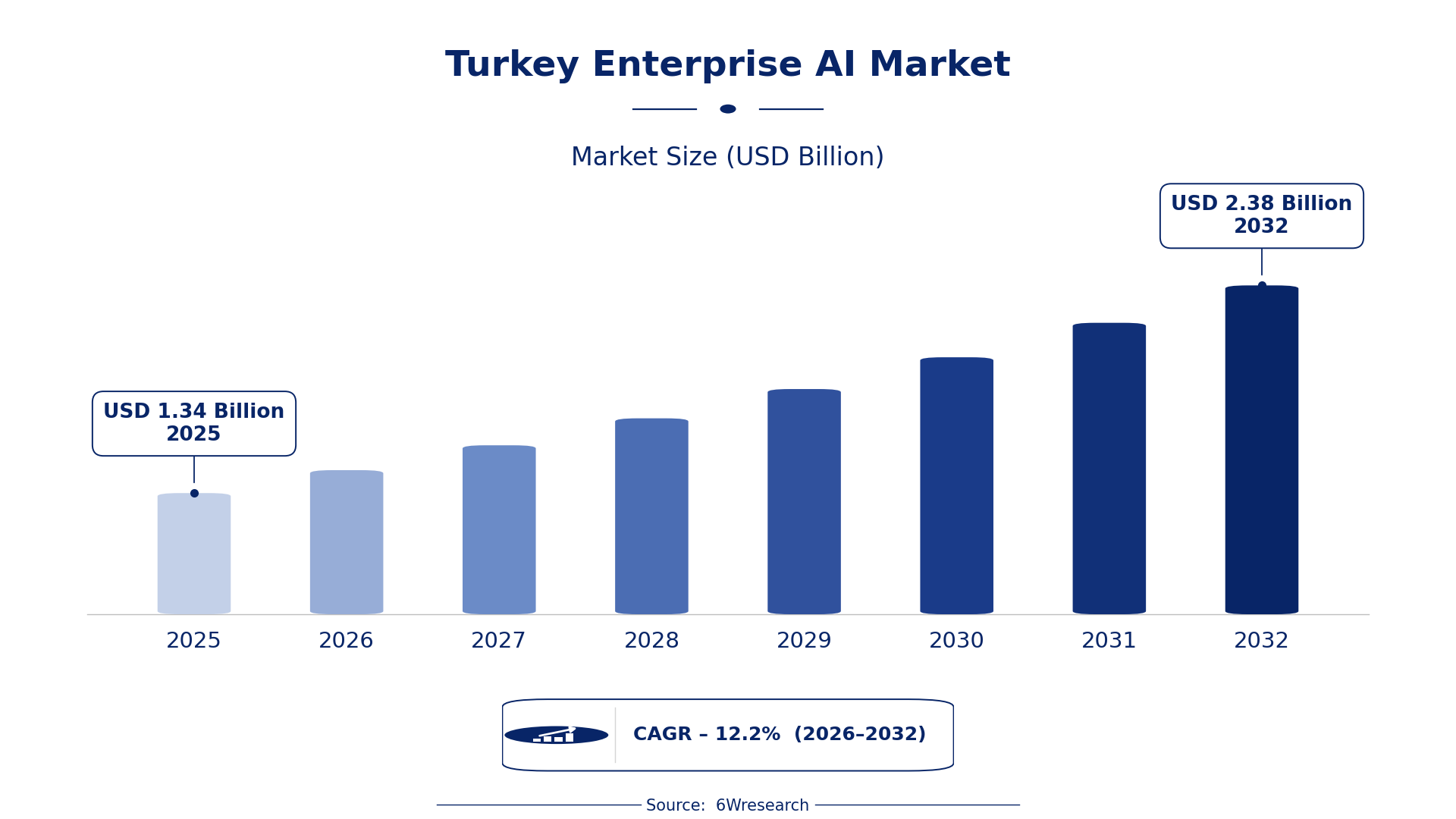
The Turkey Enterprise AI Market was estimated at USD 1342 Million in 2025 and is projected to reach USD 2377 Million by 2032, growing at a CAGR of 12.2% from 2026 to 2032.
Turkey Enterprise AI Market Synopsis
The Turkey Enterprise AI Market is rapidly expanding, reflecting a growing recognition among businesses of the transformative potential of artificial intelligence. Companies across sectors such as healthcare, finance, and retail are increasingly integrating AI solutions to boost efficiency and enhance customer experiences.
This market is fueled not only by technological advancements but also by favorable government policies aimed at promoting AI adoption. As Turkish enterprises look to gain a competitive edge, the demand for sophisticated AI applications is expected to escalate, paving the way for new innovations.
Turkey Enterprise AI Market Year-wise Growth Rate and Key Drivers
This graph illustrates the annual growth rates of the Turkey Enterprise AI Market from 2021 to 2032, highlighting a steady upward trajectory and projected expansion over the forecast period.
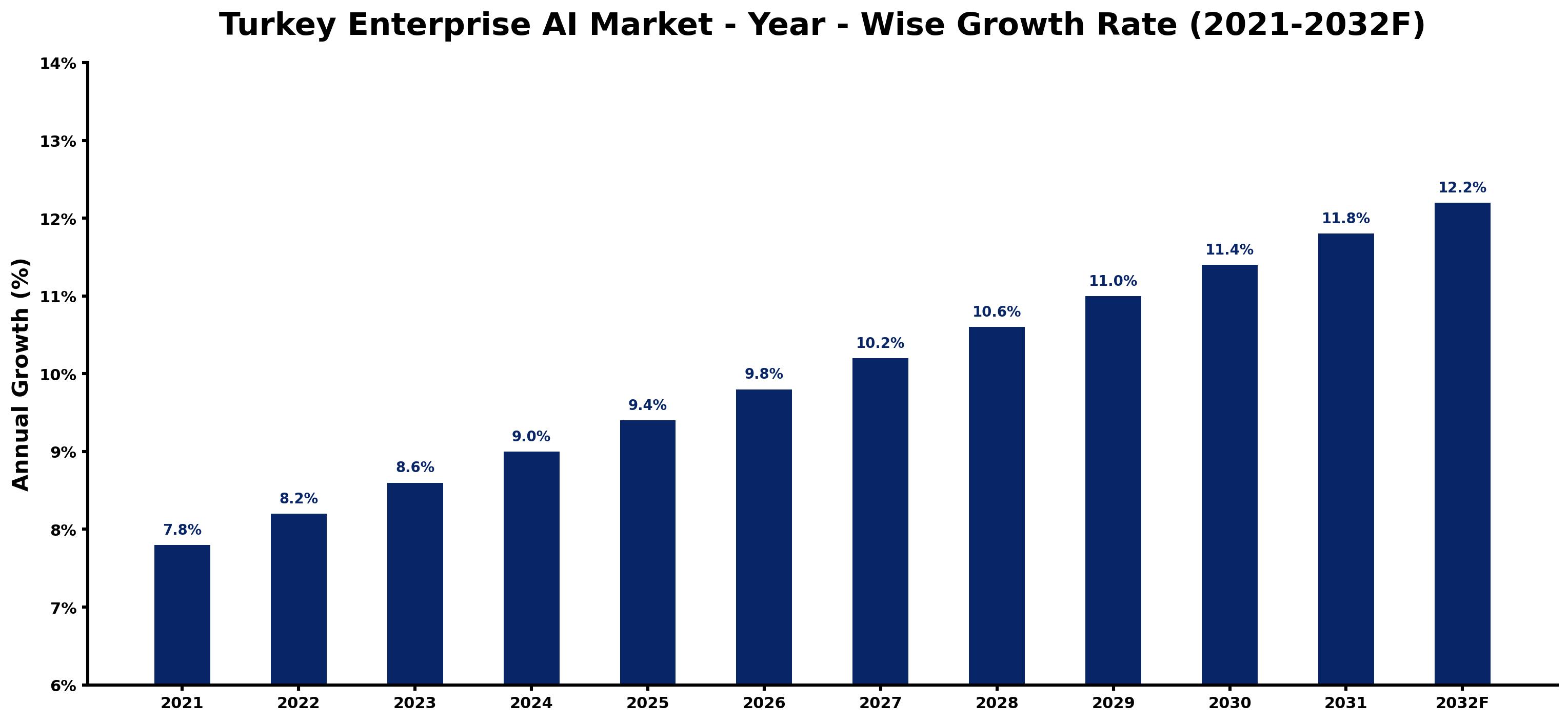
The table below presents the year‑wise growth rates along with the key drivers influencing the market
| Year | Growth Rate | Major Drivers |
| 2021 | 7.8% | Rise in digital transformation initiatives by Turkish companies. |
| 2022 | 8.2% | Regulatory support from BTK for AI development and standards. |
| 2023 | 8.6% | Growing local talent pool from tech-focused universities. |
| 2024 | 9.0% | Increased adoption of AI in Turkish healthcare services. |
| 2025 | 9.4% | Government endorsement of AI in public sector efficiency. |
| 2026 | 9.8% | Emergence of local startups specializing in AI solutions. |
| 2027 | 10.2% | Integration of AI solutions in Turkey's retail sector. |
| 2028 | 10.6% | Increasing mobile app development driven by AI capabilities. |
| 2029 | 11.0% | Increased investments in AI-driven financial technologies. |
| 2030 | 11.4% | Expanding AI use in agricultural optimization in Turkey. |
| 2031 | 11.8% | Growing awareness of data privacy regulations boosting AI demand. |
| 2032 | 12.2% | Focus on AI ethics led by Turkish tech organizations. |
Note: Market size estimations and growth projections presented in this report are based on 6Wresearch's proprietary forecasting methodology, utilizing the latest available industry data, government publications, and primary research inputs.
Turkey Enterprise AI Market Key Takeaways
Below are some of the specific key takeaways from the market, including:
- The market is witnessing significant investments in AI technologies across diverse sectors.
- Government initiatives are actively supporting AI development and implementation.
- AI solutions are increasingly tailored to address specific business challenges.
- Ethical AI practices are gaining traction among companies striving for transparency.
- There is a growing emphasis on AI-powered analytics to improve decision-making processes.
Evaluation of Restraints in Turkey Enterprise AI Market
Despite the promising growth trajectory, several factors hinder the full potential of the Turkey Enterprise AI Market. A notable restraint is the shortage of skilled AI professionals, which hampers organizations' ability to implement advanced solutions effectively. Concerns regarding data privacy and regulatory compliance also create hesitancy among businesses. on top of that, the complexity of integrating AI systems with existing infrastructure poses challenges, as companies navigate the need for significant investments in technology and talent development. These obstacles underscore the importance of strategic planning and a willingness to adapt within Turkey's evolving market environment.
Turkey Enterprise AI Market Trends
Several key trends are shaping the Turkey Enterprise AI Market. One prominent trend is the increasing reliance on AI-driven analytics to enhance operational efficiency and customer satisfaction. Organizations are integrating AI with IoT devices to harness improved data insights, facilitating better decision-making.
Additionally, there is a notable emphasis on ethical AI practices, ensuring transparency and accountability in AI deployment. As businesses in Turkey seek to innovate, demand for AI solutions that address specific challenges continues to rise, further driving market growth.
Turkey Enterprise AI Market Opportunities
The Turkey Enterprise AI Market presents substantial investment opportunities across various sectors. Healthcare, finance, and retail stand out as areas ripe for AI integration, with businesses seeking to enhance efficiency and customer experience through advanced solutions. Investors can capitalize on the demand for AI software development and analytics platforms tailored for Turkish enterprises. on top of that, backing AI-driven startups and research initiatives focused on innovation holds promise for significant returns in this thriving market.
Government Initiatives in the Turkey Enterprise AI Market
The Turkish government is proactively shaping the Enterprise AI Market through various initiatives aimed at fostering innovation and adoption. By focusing on developing a skilled workforce and supporting research, the government plays a critical role in positioning Turkey as a regional AI hub.
- A National Artificial Intelligence Strategy was launched in 2019, emphasizing talent development and R&D support.
- The Istanbul Artificial Intelligence Center, established in 2021, is currently working to accelerate AI market growth.
- Tax breaks and grants for businesses investing in AI technologies were introduced in early 2023.
- A national digital infrastructure upgrade program, aimed at enhancing data processing capabilities, is currently underway.
- Future plans include the establishment of partnerships with private sectors to bolster AI research and development by 2026.
Future Insights of the Turkey Enterprise AI Market
Looking ahead, the Turkey Enterprise AI Market is expected to thrive, driven by a commitment to digital transformation across sectors. As businesses increasingly recognize the necessity of AI in enhancing competitiveness, the demand for innovative applications will only intensify. on top of that, ongoing advancements in machine learning, natural language processing, and computer vision will create new opportunities for AI deployment, solidifying Turkey's position in the global AI arena.
Turkey Enterprise AI Market Latest Developments
Recent activity in the Turkey Enterprise AI Market reflects a dynamic environment characterized by innovation and investment. Companies are actively pursuing advancements in AI technologies, with a focus on enhancing their service offerings and operational capabilities.
- A major technology vendor launched an AI-powered analytics platform in Q2 2023, aimed at improving decision-making processes for enterprises.
- An initiative to develop AI training programs for professionals began in early 2023 and is currently ongoing.
- A partnership between local universities and industry leaders to foster AI research was established in late 2022, with initial projects underway.
- An upcoming AI conference, scheduled for late 2024, aims to showcase breakthroughs in AI technologies and promote collaboration among stakeholders.
Turkey Enterprise AI Market - Key Attractiveness of the Report
- 10 Years of Market Numbers
- Historical Data Starting from 2022 to 2025
- Base Year: 2025
- Forecast Data until 2032
- Key Performance Indicators Impacting the Market
- Major Upcoming Developments and Projects
Key Highlights of the Report:
- Turkey Enterprise AI Market Outlook
- Market Size of Turkey Enterprise AI Market, 2025
- Forecast of Turkey Enterprise AI Market, 2032
- Historical Data and Forecast of Turkey Enterprise AI Revenues & Volume for the Period 2022-2032F
- Turkey Enterprise AI Market Trend Evolution
- Turkey Enterprise AI Market Drivers and Challenges
- Turkey Enterprise AI Price Trends
- Turkey Enterprise AI Porter's Five Forces
- Turkey Enterprise AI Industry Life Cycle
- Historical Data and Forecast of Turkey Enterprise AI Market Revenues & Volume By Component for the Period 2022-2032F
- Historical Data and Forecast of Turkey Enterprise AI Market Revenues & Volume By Solution for the Period 2022-2032F
- Historical Data and Forecast of Turkey Enterprise AI Market Revenues & Volume By Services for the Period 2022-2032F
- Historical Data and Forecast of Turkey Enterprise AI Market Revenues & Volume By Technology for the Period 2022-2032F
- Historical Data and Forecast of Turkey Enterprise AI Market Revenues & Volume By Machine learning and deep learning for the Period 2022-2032F
- Historical Data and Forecast of Turkey Enterprise AI Market Revenues & Volume By Natural Language Processing (NLP) for the Period 2022-2032F
- Historical Data and Forecast of Turkey Enterprise AI Market Revenues & Volume By Application Area for the Period 2022-2032F
- Historical Data and Forecast of Turkey Enterprise AI Market Revenues & Volume By Security and risk management for the Period 2022-2032F
- Historical Data and Forecast of Turkey Enterprise AI Market Revenues & Volume By Marketing management for the Period 2022-2032F
- Historical Data and Forecast of Turkey Enterprise AI Market Revenues & Volume By Customer support and experience for the Period 2022-2032F
- Historical Data and Forecast of Turkey Enterprise AI Market Revenues & Volume By Human resource and recruitment management for the Period 2022-2032F
- Historical Data and Forecast of Turkey Enterprise AI Market Revenues & Volume By Analytics application for the Period 2022-2032F
- Historical Data and Forecast of Turkey Enterprise AI Market Revenues & Volume By Process automation for the Period 2022-2032F
- Historical Data and Forecast of Turkey Enterprise AI Market Revenues & Volume By Deployment Type for the Period 2022-2032F
- Historical Data and Forecast of Turkey Enterprise AI Market Revenues & Volume By Cloud for the Period 2022-2032F
- Historical Data and Forecast of Turkey Enterprise AI Market Revenues & Volume By On-premises for the Period 2022-2032F
- Historical Data and Forecast of Turkey Enterprise AI Market Revenues & Volume By Organization Size for the Period 2022-2032F
- Historical Data and Forecast of Turkey Enterprise AI Market Revenues & Volume By Small and Medium-sized Businesses (SMBs) for the Period 2022-2032F
- Historical Data and Forecast of Turkey Enterprise AI Market Revenues & Volume By Large enterprises for the Period 2022-2032F
- Turkey Enterprise AI Import Export Trade Statistics
- Market Opportunity Assessment By Component
- Market Opportunity Assessment By Technology
- Market Opportunity Assessment By Application Area
- Market Opportunity Assessment By Deployment Type
- Market Opportunity Assessment By Organization Size
- Turkey Enterprise AI Top Companies Market Share
- Turkey Enterprise AI Competitive Benchmarking By Technical and Operational Parameters
- Turkey Enterprise AI Company Profiles
- Turkey Enterprise AI Key Strategic Recommendations






































